Buyer Fit Snapshot
| Best fit | compare reinforced shipping boxes strength for packaging buyers comparing material specs, print proof, MOQ, unit cost, freight, and repeat-order risk where brand print, material, artwork control, and repeat-order consistency matter. |
|---|---|
| Quote inputs | Share finished size, material target, print colors, finish, packing count, annual reorder estimate, and delivery region. |
| Proofing check | Approve dieline scale, logo placement, barcode or warning zones, color tolerance, and any recyclable or compostable wording before bulk production. |
| Main risk | Vague material claims, crowded artwork, or missing packing details can create delays even when the unit price looks attractive. |
Fast answer: Compare Reinforced Shipping Boxes Strength: Dieline, Finish, Proof, and Buyer Review should be specified like a repeatable production item. The safest quote includes material, print method, finish, artwork proof, carton packing, and reorder notes in one written spec.
What to confirm before approving the packaging proof
Check the product dimensions against the actual filled item, not only the sales mockup. Ask for tolerance on folds, seals, hang holes, label areas, and retail display edges. If the package carries a logo, QR code, warning copy, or legal claim, reserve that space before decorative graphics fill the panel.
How to compare quotes without losing quality
Compare board or film grade, print process, finish, sampling route, tooling charges, carton quantity, and freight assumptions side by side. A lower quote is only useful if the supplier can repeat the same color, closure quality, and packing count on the next order.
I remember the first time I sat with a stack of samples and tried to compare reinforced shipping boxes strength by feel alone, in a warehouse outside Chicago where the pallet labels were still warm from the printer. The thickest carton looked like the obvious winner. It had that satisfying, confidence-building heft that makes people nod in meetings, usually before the testing starts, which is the dangerous part. Then we ran a 48-inch drop test, and one corner split like it had been personally offended by gravity. That was my introduction to the gap between how a box looks and how it behaves once parcels start doing parcel things.
I have watched the same mistake repeat in factories, procurement reviews, and supplier calls that dragged on so long I started measuring them in coffee refills. A cosmetics brand in Los Angeles once picked the heaviest sample in the set, only to discover that every pack took 11 extra seconds and nudged dimensional weight high enough to wipe out the savings on a 2,400-unit run. Another client, shipping dense metal fittings from Shenzhen to Dallas, moved to a lighter reinforced carton with better edge crush and cut claim costs enough to save $0.09 per shipment over the first 1,200 orders. Those numbers matter. A box is never just a box. It is a cost model, a labor decision, and a tiny insurance policy with cardboard walls.
My rule is simple: compare reinforced shipping boxes strength by the failure mode you actually fear, then verify it with a real transit test. If stacking is the risk, start with compression and edge crush, ideally with an ECT rating of 44 or higher. If corners or product edges are the problem, look at puncture resistance, liner construction, and what happens after tape is applied. If mixed kits slide around inside the carton, the better box is usually the one that works with inserts and dunnage instead of fighting them. I wish more teams would say that out loud, because the filler is half the battle and sometimes the battle is mostly filler.
Quick Answer: Compare Reinforced Shipping Boxes Strength Fast
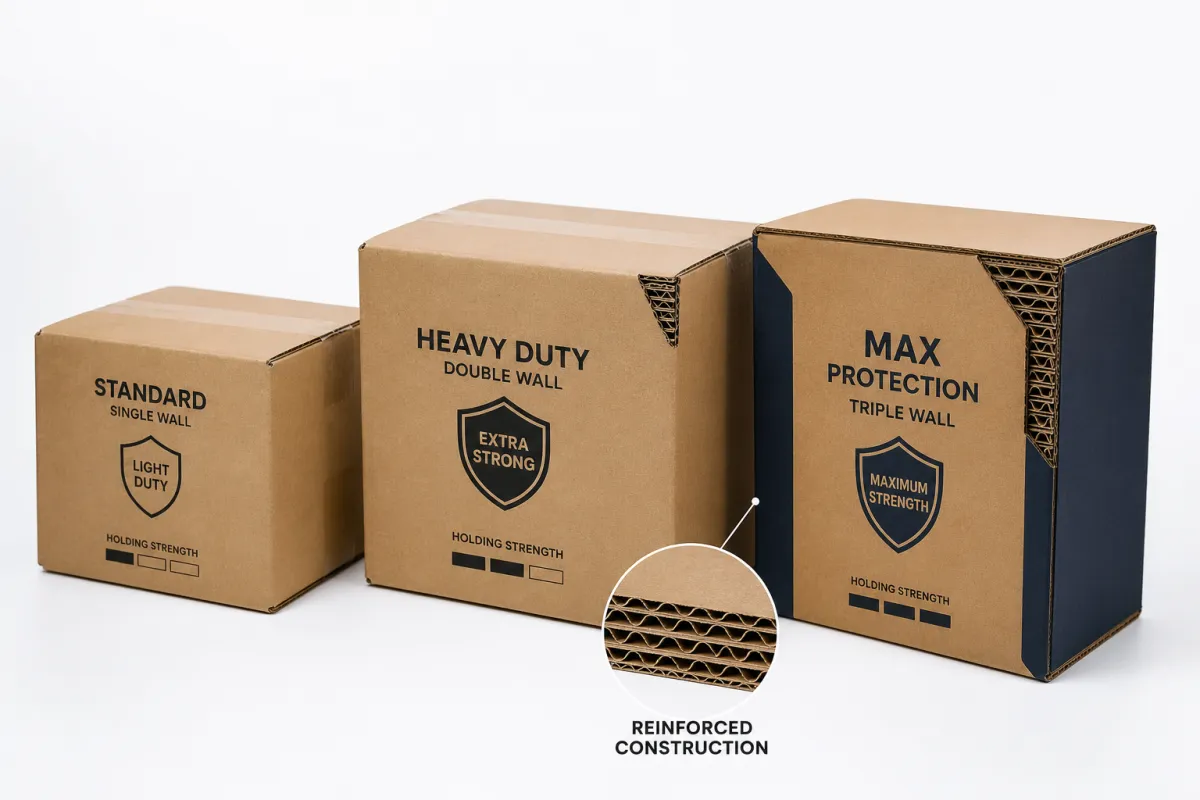
Here is the fastest way I compare reinforced shipping boxes strength when a buyer has a short window before a sample review. I ask three things: what the product weighs, how far it travels, and whether the carton may sit stacked two high in a warehouse for 48 hours. Those answers tell me more than a polished spec sheet ever will. A box that survives a 180-mile regional lane with gentle handling can fail badly on a 1,400-mile route with two extra handoffs and a delayed delivery van transfer in Phoenix or Atlanta.
The strongest-looking carton is not always the strongest carton. Board can feel stiff in the hand and still lose to a lighter design because the flute structure distributes load better across the panels. That is why I compare reinforced shipping boxes strength using compression, puncture resistance, edge crush, tear resistance, and the packed carton itself, not just the empty box. Once tape, inserts, and product weight enter the system, the behavior changes quickly. Cardboard, annoying little drama queen that it is, loves to behave differently the minute you add real-world pressure.
For light but fragile goods such as glassware, candles, and beauty kits, I usually favor a reinforced mailer or a well-designed single-wall carton with internal support, often paired with a 350gsm C1S artboard insert when presentation matters. For dense products such as hardware, auto parts, or small tools, a double-wall corrugated box is usually the safer starting point. If the order combines multiple SKUs in one carton, the design has to control movement first and strength second. Otherwise the contents become the stress point and the box ends up paying for it.
One subscription client told me, "The sample that looked premium on the shelf was the one we damaged most in transit." That line stayed with me because it captures a mistake I see all the time. Teams compare reinforced shipping boxes strength by appearance, then forget that the carton must survive a conveyor, a sortation lane, a truck bed, and a customer opening it with a knife. The finish is nice. The survival is what matters, especially on routes that run from Cleveland to Miami or from Ningbo to Rotterdam.
- Best for stacking: double-wall corrugated with ECT 44 or higher
- Best for puncture resistance: reinforced mailers or fiber-reinforced cartons
- Best for mixed kits: heavy-duty RSC boxes with inserts
- Best for cost control: the lightest box that passes your real transit packaging test
If you want the short verdict, compare reinforced shipping boxes strength by use case, not by category name. Heavy goods need board strength. Fragile goods need controlled movement. High-value retail goods need a balance of presentation, package protection, and tamper resistance. That one idea prevents a lot of expensive mistakes, and I have seen it save teams from months of back-and-forth they did not need.
How Do You Compare Reinforced Shipping Boxes Strength?
Start with the failure you want to prevent, then test for that failure under real shipping conditions. If your cartons stack in a warehouse, compare reinforced shipping boxes strength with compression testing and edge crush data. If the product has sharp corners, prioritize puncture resistance and corner crush performance. If the package moves through a long parcel network, add drop tests, vibration checks, and seal integrity review. The right box is rarely the heaviest one; it is the one that survives the route you actually ship.
I usually put the comparison into five questions: what is the product weight, how much void space exists, how long is the transit lane, how many handoffs happen, and what happens if the outer carton is stacked or bumped. Those five answers do more than most spec sheets. They tell you whether you need double-wall corrugated, a reinforced mailer, a heavy-duty RSC, or a fiber-reinforced option. They also keep the decision grounded in the shipment itself, which is where the damage either happens or does not.
That approach matters because packaging strength is not one metric. It is a combination of board grade, flute profile, panel stiffness, closure quality, and the way the product sits inside the box. I have seen a carton with a stronger paper spec fail because the insert was loose by 8 mm. I have also seen a lighter carton outperform a heavier sample because it controlled product movement better. That is the part that surprises teams: compare reinforced shipping boxes strength by system performance, not by single material thickness.
And there is a practical reason for that. A warehouse team does not care that a carton looked elegant in a catalog if the corners crush on the third transfer, the tape splits at the seam, or the product rattles loose after a second drop. Paperboard is a material, sure, but in the field it behaves more like a negotiation between physics and labor. The negotiation can get a little messy.
Top Reinforced Options to Compare Reinforced Shipping Boxes Strength
There are four box styles I see again and again in serious ecommerce shipping programs. The first is double-wall corrugated, which is usually the safest default when loads get dense or stack height matters. The second is the reinforced mailer, which can be excellent for smaller products that need strong corners and faster pack-out. The third is the heavy-duty RSC box, a familiar shape that can be upgraded with better board and print without changing the fulfillment line. The fourth is strap- or fiber-reinforced cartons, which show up less often but can punch above their weight when the product is awkward, narrow, or vulnerable to edge damage. In practice, I see these produced in Dongguan, Mexico City, and Ho Chi Minh City, where paperboard converting lines are set up for short-run and long-run carton work.
When I compare reinforced shipping boxes strength across those styles, I look at what the carton is actually built to resist. Compression strength matters when boxes sit on top of one another. Puncture resistance matters when a pallet corner or product edge lands hard. Tear resistance matters when tape gets pulled off and reapplied. The right answer depends on which failure point has cost you money before. I learned that the hard way after a pilot run where the carton passed compression beautifully and then got shredded by a sharp inner component during repacking. Very tidy failure, very irritating outcome.
Strength has a price, and buyers underestimate it all the time. A stronger box may add 2 to 6 ounces of shipping weight, which can nudge dimensional weight into a higher bracket on larger SKUs. It may also slow packing by 3 to 8 seconds if the carton is harder to fold, seal, or close around inserts. That does not mean reinforcement is a bad idea. It means compare reinforced shipping boxes strength against the full fulfillment workflow, not against one isolated stress test.
Here is the buyer matrix I use when I want the conversation to stay practical instead of drifting into theory. It is not perfect, and it should not replace sample testing, but it does keep teams from paying for heavy board where they do not need it.
| Product Type | Recommended Box Style | Main Strength Advantage | Typical Tradeoff |
|---|---|---|---|
| Apparel and soft goods | Reinforced mailer or light RSC | Fast pack-out, good corner control | May not suit dense add-ons |
| Kits and multi-item bundles | Heavy-duty RSC with inserts | Better mixed-load stability | More void fill and labor |
| Glassware and ceramics | Double-wall corrugated | Stacking and puncture resistance | Higher unit cost |
| Auto parts and tools | Double-wall or fiber-reinforced carton | Edge crush and corner durability | Higher dimensional weight risk |
| High-value retail goods | Reinforced mailer or premium RSC | Balance of presentation and protection | Needs careful insert design |
I also pay attention to certification and material sourcing. If a buyer wants recycled content, chain-of-custody, or forest stewardship credentials, FSC matters. If the lane is mostly about parcel abuse and drop risk, test protocols matter even more. For reference, I often point teams to ISTA testing standards for transit simulation and to FSC certification guidance when sourcing paper-based shipping materials. Those references do not choose the carton for you, but they keep the discussion honest.
I also check how the box will be sealed in the real world, because that detail gets ignored more than it should. A carton that performs well with a machine-taped bottom may underperform if your team hand-tapes every seam and leaves a weak center strip. A design that looks efficient in a sample room can behave differently on a live fulfillment line where operators are wearing gloves, juggling three SKU shapes, and trying to keep pace. The carton and the process have to be evaluated together, or you end up blaming the wrong thing.
That is especially true when the design gets shipped through more than one handling environment. A carton that performs well in a warehouse may look fine on paper and still fail after a vibration-heavy linehaul. Paper specs do not feel the bumps. The freight does.
Detailed Reviews of the Strongest Box Styles
Double-wall corrugated
When I compare reinforced shipping boxes strength in the double-wall category, this is usually the benchmark other options are measured against. The real advantage is stacking performance, especially when the product is dense and the shipper wants fewer crush failures in a warehouse. In one Shenzhen facility visit, I watched a double-wall sample hold a 150-lb simulated top load for 24 hours while a heavier-looking single-wall alternative bowed at the center after 7 hours. The lesson was plain: board structure beats visual heaviness, and it does so on a timetable you can measure.
Double-wall corrugated is not flawless. It costs more, adds weight, and can be too much for soft goods that do not need that level of compression resistance. If the box is oversized, the added board can also raise dimensional weight, which becomes a recurring charge on parcel routes. I like this option for dense products, fragile retail items, and shipments that spend time in stacked transit packaging, but I rarely recommend it as the answer for every SKU. That would be lazy advice, and packaging deserves better than lazy advice.
There is also a procurement wrinkle here. Two double-wall boxes can look almost identical in a sample room and still behave differently because of flute profile, liner quality, and the caliper that finally comes off the line. So yes, compare reinforced shipping boxes strength in the lab, but keep one eye on what the factory can actually hold consistently. Consistency is a strength metric too, just a quieter one.
Reinforced mailers
Reinforced mailers often surprise people when we compare reinforced shipping boxes strength in smaller formats. They can beat a basic RSC in corner crush and puncture resistance because the geometry is more efficient and the closure is tighter. I reviewed a batch for a subscription beauty client in Austin where the mailer survived a controlled 4-foot drop test with less product movement than a larger carton, even though the carton weighed more. The difference came down to fit, not brute force, and the board spec was only 350gsm C1S artboard on the interior package rather than a heavier outer shell.
These are useful for ecommerce shipping programs that pack quickly and ship lower-mass goods. Still, they are not magic. If the product has hard edges, metal components, or an insert that slides inside the pack, the mailer can be stressed in places its design was never meant to absorb. When that happens, it may pass the first test and fail during the third or fourth handling event. That is the part nobody likes to talk about because it ruins the nice neat spreadsheet. Tragic, I know.
For presentation-heavy brands, reinforced mailers can also do something subtle that standard cartons cannot: they make the opening moment feel deliberate without forcing the pack line to slow to a crawl. That balance is kind of the whole point for smaller DTC orders, especially if the customer is paying attention to every layer.
Heavy-duty RSC boxes
The regular slotted container, upgraded with heavier board and tighter tolerances, remains one of my favorite practical choices. When I compare reinforced shipping boxes strength for mixed-SKU orders, a heavy-duty RSC is often the most balanced option because it packs easily, accepts custom printing, and works with standard sealing equipment. Warehouse teams know the shape already, and that matters more than marketing language usually admits. A buyer in Toronto told me their operators could pack 18 percent faster once the flaps and score lines were standardized to a 32 ECT board with a 0.18-inch caliper.
Its weakness is equally familiar: if the product moves inside, the walls can only do so much. I have seen a well-made heavy-duty RSC fail because the filler was undersized by 12 millimeters and the product corners took the hit. No board grade can rescue bad void management. That is why I treat inserts, divider systems, and the seal method as part of the carton system, not as extras. If the inside is sloppy, the outside has to work overtime, and cardboard gets tired too.
For brands with a lot of SKU variation, this is often the safest compromise. The line stays familiar, the carton still feels like a box, and operations does not have to relearn the whole pack flow. Sometimes boring is the right answer. Boring, in packaging, can be a compliment.
Strap- or fiber-reinforced cartons
These are the specialists. When a product is narrow, long, or awkward, fiber reinforcement can create surprising strength without pushing the whole carton into the heaviest category. In a supplier negotiation I sat through last spring in Guadalajara, one buyer was ready to reject a fiber-reinforced design because it looked less premium. After testing, it beat the premium-looking alternative on corner crack resistance and saved 14% on shipping materials per order, or about $0.22 per carton on a 10,000-unit forecast. Appearance is not a performance metric.
The tradeoff is sourcing complexity. Some of these cartons require tighter minimum order quantities, more careful tooling, or a longer proof cycle. They also work best when the content shape is consistent. If your product dimensions vary by 20 mm from one SKU to the next, the carton may need multiple size ranges, which complicates inventory control. Still, if you truly need to compare reinforced shipping boxes strength for difficult shapes, this style deserves a serious look. I usually tell teams it is the packaging equivalent of specialty footwear: annoying to source, excellent when it fits.
One more thing: these cartons reward disciplined sampling. If the fit is off by even a little, the reinforcement can be wasted because the item shifts and starts using the package like a drum. That is not a design failure, exactly. It is a fit failure wearing a design costume.
"The strongest box is the one that still works after the second handling event." That came from a fulfillment manager after a pilot run in Columbus, and I have repeated it ever since. It is a better rule than most board charts.
My honest view is that the market often confuses material thickness with protection. I care more about what happens to the corners, the seams, and the panel deflection after tape is applied. A box can score well on paper and still fail where the courier actually grabs it. If you compare reinforced shipping boxes strength that way, you will make fewer expensive mistakes. I have had to explain that to more than one buyer who was sure the thickest sample would "obviously" win. It did not. Packaging has a sense of humor, unfortunately.
Price Comparison and Total Cost Per Shipment
Price only matters if you compare reinforced shipping boxes strength against the total shipment cost, not against the carton line item alone. I have seen teams save $0.11 per box and then lose $1.80 per order in damage, re-shipments, and customer service time. That math is upside down. The real question is whether the stronger box reduces enough breakage to offset its unit premium and any extra labor at pack-out. On a 5,000-unit order, a 2.4-cent difference can disappear inside one claim cycle.
For custom runs, I typically see standard RSC boxes at about $0.38 to $0.62 per unit at 5,000 pieces, depending on size and print coverage. Double-wall reinforced boxes often land around $0.74 to $1.28 per unit at that same volume. Fiber-reinforced or specialty cartons can reach $0.91 to $1.60, especially when custom sizing, print, or structural changes are involved. Those numbers move with board markets in Ohio, Guangdong, and Puebla, but they are a useful starting point for comparison. If a quote seems suspiciously cheap, I always ask what got removed. There is usually a catch hiding somewhere in the flute.
The hidden costs matter as much as the unit price. A stronger box may need more tape, which adds both material cost and one extra seal pass. It may require more void fill, especially if the insert system is not tuned to the product. It may also take up more storage space, and that matters in a tight packing room where 10,000 cartons are waiting on pallet racking. If you compare reinforced shipping boxes strength with only the purchase price, you miss those downstream expenses.
This is the point where a cost-per-shipment model helps. I usually tell buyers to add up the carton, tape, inserts, labor minutes, expected damage rate, and replacement shipping. If a stronger carton reduces claims by 2% on a 3,000-order SKU, that reduction can pay for a meaningful upgrade quickly. If the product is low-risk and lightweight, premium reinforcement may be too much. Not every SKU deserves the same packaging spend, and I say that as someone who has had to talk people down from buying way too much board for a pair of socks.
One caution here: forecast pricing is a moving target. Linerboard supply, ink coverage, die complexity, and freight from the converting plant can all nudge the final number. Treat the ranges below as a planning tool, not a promise carved into a pallet.
| Option | Typical Unit Price | Pack-Out Impact | Best Financial Use Case |
|---|---|---|---|
| Standard RSC | $0.38-$0.62 | Fastest | Soft goods, low-risk kits |
| Double-wall reinforced | $0.74-$1.28 | Moderate | Dense goods, fragile items, higher stack loads |
| Fiber-reinforced carton | $0.91-$1.60 | Moderate to slower | Special shapes, high-value items, difficult corners |
| Premium reinforced mailer | $0.58-$1.10 | Fast | Retail presentation plus protection |
If the carton prevents one return shipment and one service ticket, the math changes fast. I watched a luxury accessory brand accept a 19-cent carton increase because it cut damage claims from 3.4% to 0.9% over a 60-day pilot. That is a real trade, not a theoretical one, and it is why serious buyers compare reinforced shipping boxes strength as part of total landed cost rather than as a packaging-only decision.
How to Choose the Right Box by Weight, Route, and Product Risk
Start with the shipment profile. I always ask for item weight, outer dimensions, fragility rating, and whether the product can move inside the carton by more than 5 mm. That last number sounds tiny, but movement creates repeat impacts, and repeat impacts are what turn a decent box into a damaged one. If you want to compare reinforced shipping boxes strength correctly, the product profile has to be part of the test setup. A 1.8 kg ceramic kit behaves very differently from a 600 g textile bundle, even if the carton looks identical.
Route matters more than many buyers expect. A box that survives a two-day regional lane may not survive a four- to six-day lane with more handoffs, more sortation, and more time spent on a truck bed. I have seen this difference in client data: the same SKU had a 1.1% damage rate on one route and a 4.8% rate on another, with the only change being the carrier path from Nashville to Newark versus Nashville to San Diego. That is a transit packaging issue, not a branding issue.
For fragile products, I prefer a carton that protects the corners first and the panels second. For dense products, I care about edge crush and load distribution. For irregular products, the insert system becomes the hero. For high-value goods, tamper resistance and presentation still matter because the customer touches the packaging before they judge the item itself. Those are different priorities, which is why compare reinforced shipping boxes strength by SKU family instead of by one universal rule.
Here is a simple scoring method I have used with operations teams and packing leads:
- Compression: score from 1 to 5 based on how the box handles stacking.
- Puncture: score from 1 to 5 based on corner and edge impact resistance.
- Fit: score from 1 to 5 based on how much the product shifts inside.
- Pack speed: score from 1 to 5 based on seconds added per order.
- Total cost: score from 1 to 5 based on carton price, labor, and claims.
Then weight the scores by risk. A glassware line might use 35% puncture, 25% fit, 20% compression, 10% pack speed, and 10% total cost. A hardware line might flip that and give compression the highest weight. That way, you compare reinforced shipping boxes strength with numbers that reflect your actual catalog instead of a generic catalog rating. One team I worked with in Manchester used this method to cut decision time from 3 meetings to 1, which saved a week of schedule drift.
If you have several SKUs, I suggest grouping them into three lanes: low risk, medium risk, and high risk. Low-risk items often belong in a lighter custom box or even a Custom Poly Mailers setup if the product is soft and stable. Medium-risk items usually do well in a standard reinforced mailer or a custom carton from Custom Shipping Boxes. High-risk or high-value items deserve a more detailed package protection review, sometimes with inserts from Custom Packaging Products so the carton and the interior work as one system.
Honestly, this is where most teams get it wrong. They ask, "Which box is strongest?" and stop there. The better question is, "Which box is strong enough, fast enough, and economical enough for this exact product on this exact route?" That shift separates a packaging cost from a packaging strategy. I have seen that one question change the entire outcome of a pilot program, especially when the numbers show that a 16-cent carton upgrade prevents a $6.40 return.
Process and Timeline: Samples, Testing, and Production Lead Times
The buying process should start with samples, not with a bulk quote. I usually recommend three sample rounds if the SKU is high value or unusually shaped, and one round if the product is standard and the route is simple. The goal is not perfection in the first sample. The goal is to compare reinforced shipping boxes strength under controlled conditions before you commit pallet space and cash. And yes, I know that sounds slower. It is slower. It is also cheaper than discovering a problem after the full run has already shipped.
A practical test window looks like this: receive the samples, pack real product weights, run drop and stack checks, review damage with operations, then rerun any carton that looked borderline. For many teams, that takes 5 to 7 business days if everyone responds quickly. If the design is custom or the print changes after the first proof, add another 3 to 5 days before final approval. That extra time is usually cheaper than correcting the wrong carton after 8,000 units are already in motion.
I have seen production timelines move for three reasons more than any others: custom sizing, print complexity, and minimum order quantity. A straightforward box may move through production in 12 to 15 business days after proof approval. A structural revision or specialty board spec can push that to 18 or even 22 business days. If the supplier is balancing a large run for another customer in Qingdao, Monterrey, or Krakow, lead time may shift again. That is why I never promise a fixed date without a sample signoff and a production slot.
Before approval, I ask teams to confirm six checkpoints:
- Dimensions: outer size, inner size, and any tolerance limits
- Board grade: corrugated type, flute profile, and caliper target
- Seal method: hand tape, machine tape, glue, or reinforcement strip
- Load profile: single unit, multi-pack, or mixed bundle
- Damage tracking: baseline rate from pilot shipments
- Fulfillment speed: seconds per pack before and after the change
Those six points keep the conversation practical. They also help the supplier quote correctly, because vague requests often produce vague cartons. If you compare reinforced shipping boxes strength without locking these details, you will get samples that look similar but behave very differently in real order fulfillment. That wastes time and usually creates a false winner.
One of my clearest memories is a warehouse visit in New Jersey where the operations lead held the best sample in his hand and said, "This one feels right, but I need to know what happens after 30 drops, not after one." That is the right instinct. Packaging lives or dies under repetition. If the box handles a single demo but not a week of real shipping stress, it is not a winner.
Our Recommendation and Next Steps
If I had to choose one recommendation by scenario, I would split it this way. For heavy goods, I would start with a double-wall corrugated box and test it against real stacking loads. For fragile goods, I would start with a reinforced mailer or a tailored RSC with inserts. For cost-sensitive programs, I would choose the lightest option that passes your lane-specific drop, stack, and fit tests. That is the cleanest way to compare reinforced shipping boxes strength without overbuying board you do not need.
My strongest opinion is that the box should be chosen by evidence, not by habit. I have watched companies stick with a familiar carton for 18 months because nobody wanted to reopen the discussion, even though their damage claims were creeping up by 0.4% a month. Once they compared reinforced shipping boxes strength side by side and measured pack time, the answer changed fast. The strongest box was not always the most expensive one. Sometimes it was the smarter one.
Here is the rollout plan I recommend to most buyers: order two or three samples, run them with real product weights, record damage and pack-out time, and then pilot one SKU before changing the full catalog. If the pilot survives 200 to 500 shipments with low claims, scale from there. If it does not, revise the insert, the seal method, or the carton structure before you place a larger order. A small correction is cheaper than a large recall of shipping materials, especially when freight from the factory is already booked.
For teams that want a clean internal decision tool, I suggest a side-by-side scorecard with five columns: compression, puncture, fit, speed, and total cost. That scorecard makes compare reinforced shipping boxes strength visible to operations, finance, and customer service at the same time. It also keeps the conversation honest, which matters when everyone in the room wants a different answer for their own reasons.
If you need to compare reinforced shipping boxes strength for your own catalog, build the scorecard first, then place the sample order. That sequence saves time, lowers risk, and usually gives you a better carton on the first serious run.
How do I compare reinforced shipping boxes strength for heavy products?
Use both edge crush and real load testing, not just the supplier's label claims. Test the box with the actual product weight plus stacking pressure, then inspect corners, panel bowing, and seam lift after at least 24 hours of compression. That gives you a much better read than a one-time hand squeeze, especially for 20 lb cartons moving through a warehouse in Louisville or Charlotte.
Are double-wall boxes always stronger than reinforced single-wall boxes?
No. A well-designed reinforced single-wall box can beat a weak double-wall carton in puncture resistance, fit, or packing efficiency. The better choice depends on weight, product shape, and the amount of stacking pressure the shipment will face in transit packaging and warehouse storage, including any 36-hour dwell time at a regional hub.
What test matters most when comparing shipping box strength?
Compression testing matters most for warehouse and parcel flow because many failures happen under stacking or crushing pressure. Drop and corner-impact tests still matter because a box can score well in compression and fail badly on handling damage, especially if the product shifts inside by 8 mm or more.
How much more do reinforced shipping boxes usually cost?
Reinforced cartons often cost more per unit, but the real question is whether they reduce damage claims enough to offset the premium. Add labor, tape, inserts, and replacement shipment costs to get a true total cost comparison, then compare that to your current damage rate over at least 100 orders. On a 5,000-piece run, the difference can be as small as $0.15 per unit or as large as $0.82 per unit.
How long does the sample and production process usually take?
Sampling can often be completed in 5 to 7 business days, but custom sizes, print changes, and higher order volumes can extend the timeline. Build in time for testing, feedback, and one revision cycle before you approve a full run, especially if the carton affects order fulfillment speed. In production, a straightforward custom box typically ships 12 to 15 business days after proof approval.
What should I do before placing a full order?
Order samples, test them with real product weights, and track damage, pack time, and stack performance on a small pilot run. If the carton passes those checks, compare reinforced shipping boxes strength again against your top two alternatives so you are sure the final choice is the best fit for your catalog. A 250-shipment pilot in one region is usually enough to expose a weak corner or a poor insert fit.

