Buyer Fit Snapshot
| Best fit | Compare Kraft vs Molded Pulp Lids projects where brand print, material claims, artwork control, MOQ, and repeat-order consistency need to be specified before quoting. |
|---|---|
| Quote inputs | Share finished size, material target, print colors, finish, packing count, annual reorder estimate, ship-to region, and any compliance wording. |
| Proofing check | Approve dieline scale, logo placement, barcode or warning zones, color tolerance, closure strength, and carton packing before bulk production. |
| Main risk | Vague material claims, crowded artwork, missing packing details, or unclear freight terms can make a low unit price expensive after revisions. |
Fast answer: Compare Kraft vs Molded Pulp Lids: Artwork Proof, Packing Count, and Landed Cost should be specified like a repeatable production item. The safest quote records material, print method, finish, artwork proof, packing count, and reorder notes in one written spec.
Production checks before approval
Compare the actual filled-product size with the drawing, then confirm tolerance on folds, seals, hang holes, label areas, and retail display edges. Reserve space for logos, QR codes, warning copy, and material claims before decorative graphics fill the panel.
Quote comparison points
Review material grade, print process, finish, sampling route, tooling charges, carton quantity, and freight assumptions side by side. A quote is only useful when the supplier can repeat the same color, closure quality, and packing count on the next order.
Compare Kraft vs Molded Pulp Lids: Which Is Better? I first compared kraft vs molded pulp lids in a sample room in Shenzhen on a wet Tuesday in March, with steam curling out of a ramen bowl and a kraft prototype starting to ripple after only 8 minutes. The molded pulp version was rougher to the touch, almost plain, but it held its rim through a 1.2 kg stack test and survived a courier run from Futian to Nanshan without the corners getting crushed. That contrast is the whole story in miniature. Kraft usually wins on print clarity and a polished retail look; molded pulp usually wins on structure, fiber-forward appeal, and the sort of handling that foodservice teams in Guangzhou, Dongguan, and Shenzhen deal with every day. This is not a beauty contest. It is a decision shaped by heat, moisture, grease, cost, and lead time. The lid that photographs best can still be the one that fails first, and packaging has a nasty habit of proving that right when nobody wants it to.
For Custom Logo Things buyers, I treat compare kraft vs Molded Pulp lids as a sourcing decision first and a design question second. One brand in Suzhou paid about $0.04 more per unit for a cleaner-looking kraft lid on a 10,000-piece run, then lost more than that in rejects because the rim softened after 14 minutes in a delivery tote. I remember the procurement call because the room went quiet for a few seconds after the operations manager read out the reject rate: 6.8% on the first shipment. Another buyer in Shanghai chose molded pulp for a lunch program and got a reorder after the lid stayed intact through 18 minutes in a stacked bag, two handoffs, and a rider who said he “did not baby the order.” That is usually how these decisions settle. The lid that survives the route from kitchen to customer is the one that matters, not the one that looks prettiest in a rendering.
My yardstick is simple: fit, heat response, grease control, stackability, handoff appearance, landed cost, and lead time. I compare kraft vs molded pulp lids the way a buyer should compare them on a live job sheet, with exact dimensions, temperature numbers, and no glossy promises. I have been burned by pretty samples before, so I trust the ugly spreadsheet more than the shiny mockup, especially when the spec sheet says 350gsm C1S artboard but the factory quietly suggests 300gsm because board prices moved in Foshan that week. Numbers make the conversation less romantic and more accurate, which is exactly what foodservice packaging needs.
Compare Kraft vs Molded Pulp Lids: Quick Answer
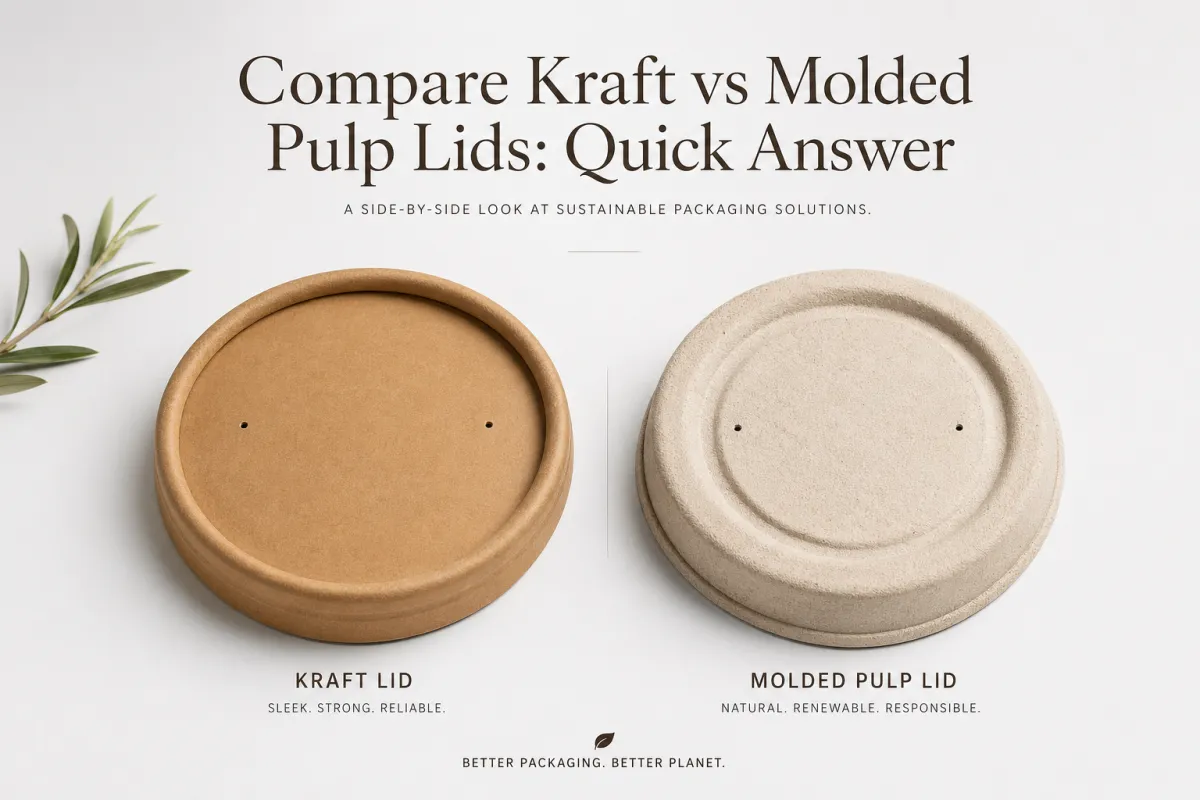
Compare kraft vs molded pulp lids on actual daily use, and kraft usually comes out ahead when the customer sees the package first and judges the brand by a crisp edge, a clean logo, or a natural paper look that feels deliberate. Molded pulp tends to do better when the package is stacked, carried, tossed into a delivery tote, or exposed to heat and condensation for 15 to 25 minutes. That is the short answer, and it is the one I wish more procurement teams heard before ordering 50,000 units from a factory in Dongguan and hoping the result would sort itself out later.
Many buyers overrate appearance and underrate physics. A lid is a closure, not a brochure. On a coffee program I reviewed in Hangzhou, a bakery chain chose kraft because the matte surface photographed beautifully under warm 3200K lighting. The first complaints arrived after the morning rush: lids were lifting on cups that sat in a car for 12 to 15 minutes during a cross-town commute. The molded pulp option was less glamorous in the studio, but it stayed seated better because the geometry gripped the rim more firmly. That is why I keep telling teams to compare kraft vs molded pulp lids on the route from the shop to the customer, not only on the sample table. A product can look perfect under ring lights and still fail in a glove compartment, which is where a lot of real service actually happens.
“The prettier lid was the one we had to replace first.” A regional beverage buyer in Shenzhen said that after a pilot exposed weak rim retention on kraft and better compression resistance on molded pulp across a 3-day test.
The clean answer: choose kraft if the brand story depends on presentation, print, and a smoother visual handoff; choose molded pulp if the service model depends on heat tolerance, stacking strength, and a more rugged fiber feel. When you compare kraft vs molded pulp lids, the winner is usually the one that matches the messiest part of the operation, not the most photogenic one. That sounds unromantic, but packaging rarely cares about romance. It cares about steam, bags, elbows, and gravity, and those are all brutally specific. Compare kraft vs molded pulp lids this way, and the debate becomes much less abstract.
To keep the rest of this article honest, I am using the same criteria I would bring to a buyer review: material build, lid-to-container fit, steam behavior, grease resistance, transport durability, unit price, and production timing. If a supplier cannot speak clearly about those points, I would keep looking. If they can, ask for sample packs from Shenzhen or Foshan and test them on your actual container line before you commit. A supplier who can answer with specifics usually saves you from learning the hard way, and the hard way has a nasty habit of arriving on Friday afternoon.
How Do You Compare Kraft vs Molded Pulp Lids in a Real Test?
Compare kraft vs molded pulp lids in a real test by using the same container, the same fill temperature, the same wait time, and the same delivery bag. Judge fit, steam response, grease contact, stack pressure, and final presentation after transit, not just on a dry sample table. Kraft usually wins on print and front-of-house polish; molded pulp usually wins on structure, compression resistance, and stability under heat and condensation. If you want a simple featured-snippet answer, that is it: use the same test conditions, then keep the material that survives your actual service route with the fewest failures.
The tricky part is that “real test” means your real conditions, not the supplier’s happiest version of them. Compare kraft vs molded pulp lids with a hot-fill temperature of 85C to 95C if that is your service range. Compare them with the same rider bag, the same cup carrier, and the same route length if deliveries matter. Compare them after 10, 15, and 20 minutes of dwell time if customers do not open immediately. The material that stays seated, resists softening, and still looks sellable after transit is the one you want.
One more thing: make the test boring on purpose. That sounds odd, but it keeps the result honest. Use the same staff member if you can, the same packing sequence, and the same order of operations. Small differences matter more than people expect. A lid loaded into a lukewarm bag can look fine for a minute and then go soft later, which is not useful if your real service is a 20-minute bike run. I have seen teams blame the material when the real issue was a different bag liner or a tighter stack in one test and not the other. That kind of mistake is avoidable, but only if you compare kraft vs molded pulp lids under repeatable conditions.
Compare Kraft vs Molded Pulp Lids by Core Performance
Compare kraft vs molded pulp lids by core performance, and rigidity comes first. Kraft lids often use paperboard structures in the 250gsm to 400gsm range, sometimes paired with aqueous coating, PE lamination, or a thin barrier layer. That gives a flatter visual profile and a smoother print surface for one-color logos, foil accents, or simple line art. Molded pulp lids, by contrast, are built from formed fiber, often hot-pressed in molds in Xiamen or Dongguan, with wall thickness closer to 1.0 mm to 1.8 mm depending on the cavity depth. They usually feel thicker in the hand even when the scale says the difference is modest. The hand is a funny instrument; it notices “sturdy” before it notices “technically 0.2 mm thicker.”
Steam resistance is where the split becomes visible. Kraft lids can hold up on short dwell times, especially with low-moisture items or cups that get consumed in under 10 minutes. Place them over a hot soup or a takeout bowl sitting under a heat lamp at 70C, and the behavior changes quickly. Condensation can soften the paper structure, curl an edge, or weaken the seal area. Molded pulp is not immune to moisture, but it often handles steam and incidental condensation more gracefully because the structure is a formed fiber mass rather than layered board. I have watched a kraft sample develop that unhappy little edge wave that says, “I was fine until humidity got involved.”
Grease handling is messier to judge. A kraft lid with the right barrier can resist light oil contact reasonably well, yet performance depends on the coating chemistry and the length of contact. A dry bakery item is one thing; a curry bowl with chili oil sitting for 20 minutes is another. Molded pulp can look plain, but it can be surprisingly stable under grease if the formulation and compression are right. I have also seen molded pulp absorb odor and staining faster than a coated kraft lid on certain menu items, so I never treat either option as automatically superior for oily foods. If your team has ever opened a carton in Guangzhou and thought, “That smell got ambitious,” then you already know why this matters.
Here is the practical scorecard I use when I compare kraft vs molded pulp lids for buyers:
- Presentation: kraft usually leads because it looks cleaner in photos and on a counter.
- Compression strength: molded pulp usually leads because it handles stack pressure and bag crush better.
- Steam tolerance: molded pulp often performs more consistently, especially on hot bowls at 85C to 95C.
- Grease resistance: kraft can lead if the coating is specified well; otherwise the gap closes quickly.
- Fit consistency: both can be excellent, but the container tooling matters more than the material name.
- Brand feel: kraft reads polished; molded pulp reads honest, sturdy, and more fiber-first.
There is also a handoff factor that gets ignored too often. In one client meeting with a sandwich chain in Nanjing, the marketing team loved the kraft look because it matched the rest of the printed sleeve system. The operations manager cared about a 200-unit lunch rush where lids were being grabbed with one hand, stacked, and passed out under time pressure. He asked a blunt question I still remember: “Which one forgives human error?” That is a better compare kraft vs molded pulp lids question than any mood board. The answer usually sits in the packing line, not the deck.
For buyers who want a simple mental model, use this: kraft is often the more polished choice, molded pulp is often the more forgiving choice. Neither material rescues a poor spec. Neither material repairs a bad container fit. Neither material should be judged without a real heat test, a real bag-drop test, and a real wait-time test. If a lid survives the kitchen but dies in the delivery bag, the kitchen never had the real problem to begin with.
Detailed Reviews: Compare Kraft vs Molded Pulp Lids in Real Use
I prefer to compare kraft vs molded pulp lids by menu type because that is where the failures show up. A lid can look excellent on a dry counter and still fail in service. The same lid might be ideal for a bakery clamshell, acceptable for a hot drink, and wrong for a soup bowl that travels 20 minutes in an insulated bag from a kitchen in Hangzhou to a customer in another district. Here is how I break it down after sampling hundreds of closures across beverage, soup, bakery, and chilled applications. Not because I enjoy being fussy, although I do, but because the menu always tells the truth if you let it. Compare kraft vs molded pulp lids against the menu first, and the packaging arguments get much more useful very quickly.
Hot Drinks
Hot drinks reward appearance first. Kraft usually earns points on presentation and sip comfort. A printed lid with a tight rim can look upscale in a cafe, especially when the cup wrap, sleeve, and lid all share the same texture family. Compare kraft vs molded pulp lids on a 90C beverage line, though, and the practical issues show up fast: softening, slight flex at the drink opening, and a seal that weakens if the cup sits too long before pickup. I saw this in a client test in Shanghai where a craft coffee buyer ran a 15-minute standing-time simulation; the molded pulp lid stayed stable, while the kraft version began to show edge memory around the opening. “Edge memory” is a polite phrase. What it really looked like was the lid getting grumpy.
Molded pulp is not the default choice for coffee aesthetics, yet it can outperform in rough handling. If the route includes courier pickup, bike delivery, or a long car ride from a store in Shenzhen to a suburb outside the city center, the extra rigidity matters. My rule is simple: compare kraft vs molded pulp lids for hot drinks by asking one question. Does the drink leave the barista and go straight to the guest, or does it travel for 10 to 20 minutes? If it travels, molded pulp deserves serious attention. If it sits in a tray, waits, gets lifted, set down, and lifted again, I trust the sturdier option more than the prettier one.
Soups and Broths
Soups are less forgiving than almost any other category. Steam, splash, and condensation attack the lid together. Compare kraft vs molded pulp lids here, and molded pulp often shows better structural tolerance because it is less likely to wrinkle under repeated heat cycles. The caveat is grease. If the soup is oily, I want a supplier to prove the coating or fiber treatment is stable under prolonged contact. One supplier in Zhejiang showed a molded fiber sample that passed a dry soak test, then failed after 22 minutes with tomato oil and stacked containers. The issue was not the category. It was the formulation, and the lid behaved like it had a personal grievance.
Soup lids need to do three things well: stay seated, avoid collapse, and keep the package looking intact when the customer opens the bag at home. Compare kraft vs molded pulp lids for soup, and my honest view is that molded pulp usually has the edge on strength, while kraft can still work if the barrier layer is right and the dwell time is short. Short delivery, short dwell, moderate fill temperature around 80C? Kraft can be fine. Long travel, high steam, stacked containers in a rider bag? Molded pulp starts to look safer. The more the soup behaves like a tiny weather system, the more I want the tougher lid.
Bakery and Dry Goods
Bakery packaging changes the math. Croissants, cookies, rolls, and dry snacks give visual story more weight than steam resistance. Compare kraft vs molded pulp lids in that setting, and kraft often wins because the customer sees the product, the brand message, and the closure together. A bakery can use print, embossing, or a subtle logo panel to turn the lid into part of the experience. Molded pulp can still be attractive, but it usually reads as more utilitarian. That is not a flaw if your brand leans natural and grounded; it is a flaw only if you want the closure to do part of the selling in a 15-second counter interaction.
I remember a supplier negotiation with a boutique bakery in Guangzhou that wanted a “premium but not fussy” lid for a seasonal pastry line. They tested both materials at 30-piece counter trays and 100-piece dispatch cartons. The kraft sample photographed better and matched the printed box. The molded pulp sample, though, survived transit better when stacked under heavier items. The final choice was split: kraft for front-of-house display, molded pulp for wholesale dispatch. That hybrid decision is more common than many buyers expect. It also saved the client from an argument that was heading toward the sort of meeting where everyone speaks in adjectives for 40 minutes.
Cold Foods and Chilled Items
Cold foods bring a different risk: condensation. A chilled salad cup, fruit bowl, or yogurt container can create moisture on the underside of the lid before the customer opens it. Compare kraft vs molded pulp lids here, and the result depends heavily on coating and humidity exposure. Kraft may keep a cleaner visual edge for short service windows, while molded pulp can tolerate some handling abuse if the package is stacked in refrigeration or moved between prep stations in a 4C cold room.
The real question is not just material but environment. Is the lid going into a cold case for 90 minutes, or is it going into a delivery tote with ice packs and then a customer fridge after a 25-minute ride? That difference changes everything. I have seen kraft lids look perfect in a refrigerated display and then bow at the rim after condensation builds. I have also seen molded pulp lids pick up surface dampness more quickly, yet remain functional and secure. So yes, compare kraft vs molded pulp lids for chilled foods, but compare them against your actual storage and service rhythm, not against a brochure claim. Brochures, charmingly, never have to mop up condensation.
If you want one clean rule from all these use cases, use this: the hotter, wetter, and rougher the journey, the more molded pulp deserves attention. The more visual the job, the more kraft pulls ahead. That rule holds surprisingly well, though it is not absolute. A smart buyer still tests both. A cautious buyer tests both twice, then bothers the supplier with questions that are extremely specific and slightly annoying. I say that affectionately, because specificity saves money in Shenzhen, Dongguan, and every other manufacturing center that survives on details.
Price Comparison: What You Actually Pay
Price is where compare kraft vs molded pulp lids gets interesting, because the unit price on a quote sheet can hide more than it reveals. I have reviewed supply bids where kraft looked cheaper by 15% on paper, only for the landed cost to rise once custom printing, barrier coating, and carton packing were added. I have also seen molded pulp start a little higher on unit price, then win the overall budget because the pieces nested more efficiently in freight and caused fewer transit losses on a route from Foshan to Los Angeles. Quote sheets are fond of optimism; landed-cost sheets are usually less charming and far more useful. Compare kraft vs molded pulp lids on landed cost, and the math gets more honest.
On recent RFQs I handled for foodservice buyers, a stock kraft lid in a 5,000-piece run came in around $0.13 to $0.16 per unit, while a molded pulp equivalent sat around $0.10 to $0.14 per unit depending on cavity count and finish. Once custom printing entered the picture, the kraft version moved closer to $0.18 to $0.22 per unit, and molded pulp landed around $0.14 to $0.19 per unit if the shape stayed standard. Those numbers are not universal. They are the kind of numbers I have actually seen on desk quotes and factory calls from Shenzhen, Jiangmen, and Ningbo, and they move with board grade, order size, and freight lanes. Still, they are close enough to keep people honest.
What matters more than sticker price are the hidden cost drivers. Compare kraft vs molded pulp lids, and look at the full chain:
- Tooling: molded pulp can require mold investment or setup if the shape is custom, while kraft may rely more on die-cut tooling and print plates.
- Setup fees: color matching, coating selection, and press setup can make kraft more expensive on smaller runs.
- Minimum order quantities: I have seen kraft start at 3,000 to 5,000 units for simple work, while molded pulp custom work often wants 10,000 to 20,000 units before pricing becomes efficient.
- Freight efficiency: molded pulp often nests well, but the bulk density can still surprise people if cartons are oversized.
- Damage rate: if a lid deforms in transit, the replacement cost is part of the real price.
- Warehouse space: a pallet count that saves 18% on space can matter more than a 2-cent unit difference.
The cleanest comparison happens when both suppliers quote the same assumptions: same quantity, same print coverage, same container fit, same freight term, and same carton pack. Otherwise, compare kraft vs molded pulp lids becomes a comparison of two different quotes, not two different products. I always ask for a landed-cost sheet that includes unit price, inner pack count, carton count, pallet count, and expected transit damage allowance. That extra hour saves a week of argument later. It also keeps the “but the quote said” conversation from getting out of hand, which is a tiny blessing but a real one.
| Cost Factor | Kraft Lids | Molded Pulp Lids | What It Means for Buyers |
|---|---|---|---|
| Small run unit price | $0.13 to $0.16 | $0.10 to $0.14 | Standard molded pulp can look cheaper before customization is added. |
| Custom print or branding | $0.18 to $0.22 | $0.14 to $0.19 | Kraft often pays more for print setup and coating. |
| Tooling and setup | Moderate | Moderate to high for new molds | Custom shapes can move molded pulp into a higher setup bucket. |
| Shipping density | Good | Very good if nested properly | Freight can erase a unit-price advantage if cartons are inefficient. |
| Damage risk in transit | Moderate | Lower when formed well | Lower damage rates can reduce true landed cost. |
If your program is small and you need a clean launch, kraft can feel easier because setup is often lighter. If your program is steady, high volume, and built around a single container family, molded pulp can become the more economical line item after freight and shrink are included. That is why I tell buyers to compare kraft vs molded pulp lids on landed cost, not only on quote price. The gap is often larger than it appears at first glance, and that gap has a way of growing legs when nobody is watching freight.
Process, Lead Times, and Customization
Lead time is where a lot of packaging plans start to wobble. A supplier can have the right material and the right price, then still miss the launch window because the sample cycle was underplanned. Compare kraft vs molded pulp lids on speed alone, and stock kraft usually wins because it can move through sampling, print proofing, and production with less tooling dependency. Molded pulp often needs a bit more patience if the project requires a custom cavity, surface treatment, or compression tuning in a factory outside Dongguan. Patience is a nice word; procurement tends to call it panic if the calendar is already tight.
Here is the timeline I usually map for buyers: sample request, dimensional check, fit test, hot or cold performance test, artwork approval, production scheduling, and final shipment. For a simple stock kraft lid, I have seen a 12 to 15 business day path from proof approval to finished goods when the supplier already has inventory or an open press slot. For custom molded pulp, I have seen 18 to 30 business days, and longer if mold adjustments are needed after the first test run. Those numbers vary by plant in Shenzhen, Huizhou, or Ningbo, but they are realistic enough to plan around. I once had a project slip because someone forgot to factor in a public holiday on the supplier side. A tiny omission, a giant headache. Compare kraft vs molded pulp lids early, and you reduce the odds of that kind of delay.
One supplier negotiation still stands out. The buyer wanted a branded lid for a launch tied to a store opening in Shanghai, and the marketing team had fixed the date before procurement checked the lid path. The kraft option could ship faster, but the molded pulp option had the better fit for the heavy ceramic-style bowls they were using. We split the order: a smaller kraft run for the opening event, then a molded pulp production run once the fit spec was finalized. That compromise saved the launch without forcing a weak long-term choice. I liked that solution because it was practical, not theatrical. Packaging teams should get more credit for choosing the boring answer that works.
Customization is where compare kraft vs molded pulp lids gets more specific. Kraft offers better opportunities for print finish, spot color, texture control, and logo placement. If you want a clean black-on-natural look, a 350gsm C1S artboard feel, or a subtle logo emboss, kraft is usually the easier canvas. Molded pulp can still be branded, but the branding language tends to be more restrained: deboss, emboss, natural tint, or a fiber-pure look. Some brands prefer that restraint because it signals low embellishment and material honesty. Personally, I think that honesty can be pretty attractive, especially when the alternative is a lid trying too hard to look premium. This is also where fiber-based packaging positioning becomes part of the decision, not just the appearance.
There is also paperwork. If you are selling into foodservice chains or regulated markets, ask for food-contact documentation, migration data where relevant, and the material disclosure your compliance team needs. If a supplier claims compostability, ask for the exact standard basis instead of a vague promise. The name on the spec sheet is not enough. I have seen teams assume a lid was compostable because it “looked fiber-based,” then discover the barrier layer changed the disposal story completely. For transit durability, ask whether the packaging has been run through ISTA distribution testing or a similar protocol; the ISTA standards site is a useful place to start if you need a common language for drop, vibration, and compression testing.
If your brand also cares about fiber sourcing, ask whether the board or pulp is tied to FSC chain-of-custody or another traceable forestry program. That is not a decorative question; it matters for audits, retailer questionnaires, and brand claims. For disposal and recycling assumptions, the EPA recycling guidance is a better reality check than a vague sustainability badge. I would rather have a frank answer than a marketing line that cannot survive a customer complaint in New York, Berlin, or Singapore. You know the kind: the one that sounds lovely in a deck and falls apart the second a buyer asks one follow-up question.
My checklist for a fast launch is short and practical:
- Send the exact container sample, not a similar one.
- Confirm fill temperature, dwell time, and whether grease is present.
- Request a quote with carton count, pallet count, and freight terms.
- Ask for a written timeline with sample, approval, and production dates.
- Test the lid with the actual bag, carrier, or cup carrier you will use.
If you compare kraft vs molded pulp lids with that process discipline, delays become much easier to predict. The material choice stops feeling mysterious, and the project starts behaving like a normal procurement job again. That alone can feel like a minor miracle, especially on a schedule tied to a store launch in the Pearl River Delta.
How to Choose the Right Lid for Your Product
The simplest way to compare kraft vs molded pulp lids is to answer five questions before you buy: What does the lid touch? How hot is the product? How long does it sit before consumption? What image should the brand project? And what disposal route is actually available where the customer lives? Once you know those answers, the decision usually becomes clearer than the sales pitch would suggest. A cafe in Seoul, a bowl shop in Shenzhen, and a deli in Chicago can all reach different conclusions from the same lid if the route and dwell time differ by 10 minutes. Compare kraft vs molded pulp lids against the route, not just the SKU description.
My rule of thumb after years of packaging reviews is plain: choose kraft when presentation, print, and a polished front-of-house impression carry the most weight; choose molded pulp when resilience, stacking, and fiber-first positioning matter more. That is not a rigid formula. It bends with your menu, route, and price target. Still, it is a useful starting point for teams trying to compare kraft vs molded pulp lids quickly. I use it myself when I want to cut through the noise before the meeting turns into a materials philosophy seminar.
A few red flags deserve attention. First, never accept a compostability claim without checking the coating, additive package, and local infrastructure. Second, never approve a lid before fit testing it on your actual container rim diameter, because a 1 mm mismatch can cause closure trouble across the whole run. Third, never assume a supplier’s “food-safe” language covers every use case; ask for the specific compliance paperwork. Fourth, never decide on appearance alone if the product is hot or greasy. That mistake is expensive, and I have watched it happen more than once in a project out of Guangzhou. A matte finish can look beautiful in a sample pack and then look tired after 11 minutes of steam.
I also recommend a simple internal matrix before sampling. It keeps the decision grounded and cuts through sales language.
- Premium beverage service: kraft first, molded pulp second.
- Heavy delivery traffic: molded pulp first, kraft second.
- Short-turn bakery pickup: kraft first if the visual story matters.
- Hot soup or brothy menu: molded pulp first if steam is constant.
- Budget-focused launch: compare landed cost before deciding; either category can surprise you.
One more practical note: if you are split between aesthetics and durability, ask for a 50/50 pilot. I have seen that approach work well for cafes, quick-service chains, and regional catering programs in Shenzhen and Shanghai. You can compare kraft vs molded pulp lids in real service, then decide with complaint data instead of hunches. That is much better than arguing about material names in a conference room for three weeks while a launch date inches closer like a bad joke.
My candid opinion? Too many buyers assume the “greener” look is automatically the better operating choice. It is not. Better is the lid that survives the product, the route, and the staff handling it. That could be kraft. It could be molded pulp. The right answer is the one your actual operation proves in a 100-piece test, not the one that sounds best in a pitch deck. The rest is packaging folklore. Compare kraft vs molded pulp lids with real evidence, and the folklore fades fast.
Our Recommendation and Next Steps
If you force me to choose a winner without more context, I would not. I would split the recommendation by scenario. For premium beverage service with strong branding, kraft usually deserves the first sample slot. For delivery-heavy soup, grain bowls, or any menu that sees heat, moisture, and rough handling, molded pulp usually deserves the first sample slot. For budget takeout with simple print needs, compare kraft vs molded pulp lids on landed cost and transit survival before you lock anything in. There is no prize for guessing. There is only the invoice, and the invoice arrives with more memory than a mood board.
Here is how I would rank the scenarios after testing both materials on real jobs. Premium cafe chain with a photogenic counter in Shanghai? Kraft leads. Institutional foodservice with stacked trays and variable handling in Chengdu? Molded pulp leads. Catering program with a mixed menu and long dwell time in Shenzhen or Hangzhou? Molded pulp often has the edge, but only after the exact bowl fit is confirmed. New brand launch with a lean timeline and light product load? Kraft can move faster, and speed sometimes matters more than a theoretical perfect spec. “Sometimes” does a lot of heavy lifting in packaging, but it is usually honest.
For Custom Logo Things buyers, the next steps are straightforward:
- Order both samples in the exact container size you use.
- Run a hot-fill test at your normal serving temperature.
- Run a grease test with your messiest menu item.
- Shake the packed order in a delivery bag for 10 minutes.
- Check whether the lid still fits, seals, and looks sellable.
- Compare landed quotes with freight, cartons, and any print charges included.
I would also ask each supplier for a simple written note on disposal claims, minimum order quantity, and production timing. If they cannot tell you whether the first usable ship date is 12 business days, 18 business days, or 30 business days, they are not helping you plan. Good suppliers are specific. Weak suppliers hide behind generalities. And if a rep starts answering every question with “it depends,” I usually assume we are about to do all the real work ourselves.
My final buyer checklist is short enough to keep on one screen:
- Fit: does it lock onto your real container rim without forcing it?
- Heat: does it stay stable after 10 to 20 minutes of steam exposure?
- Grease: does it stay clean and firm with oily food contact?
- Timing: can the supplier hit your launch date with a sample-approved schedule?
- Claims: can the supplier document recyclability, compostability, or fiber sourcing clearly?
- Cost: is the quote based on true landed cost, not just unit price?
If you compare kraft vs molded pulp lids through that lens, the answer stops being abstract. You are no longer choosing between two packaging categories. You are choosing which failure mode you can tolerate less. For some businesses, that means a crisp kraft lid that elevates the brand story. For others, it means a molded pulp lid that takes abuse and keeps the pack intact. My recommendation is simple: compare kraft vs molded pulp lids on your own containers, on your own route, with your own menu, then buy the one that behaves well under pressure.
When should I compare kraft vs molded pulp lids for hot drinks?
Compare kraft vs molded pulp lids before you finalize a cup system, because steam, rim tension, and sip comfort can change the result more than the material name. If the drink stays hot for 15 to 20 minutes or rides in delivery for a route across Shenzhen, test both lids under real heat and movement, not just on a dry sample. I have seen a lid pass in the sample room and fail in a car-seat test within the same afternoon. That sort of thing makes you trust your car less and your samples even less.
Which is cheaper when you compare kraft vs molded pulp lids for small orders?
Small orders often favor the option with simpler setup and lower tooling burden, but freight, print setup, and damage rates can erase that advantage. A $0.02 difference in unit price can disappear fast if one option needs stronger cartons or more replacement stock. Ask for a landed-cost quote that includes packaging, shipping, and any customization so you are not comparing misleading unit prices. I would rather see a boring quote that tells the truth than a flashy one that needs a translator in Guangzhou or Los Angeles.
Do molded pulp lids handle grease better than kraft lids?
Not automatically; grease performance depends on coating, density, and how long the lid stays in contact with oily food. Compare kraft vs molded pulp lids against the exact menu item, because a lid that passes on a dry bowl can soften, stain, or deform once steam and oil combine. I would never sign off on either material without a live test using the messiest dish on the menu. The messier the better, honestly. A packaging sample that only behaves in ideal conditions is not useful; it is decorative.
How long does it take to source custom kraft or molded pulp lids?
Stock options are usually faster, while custom work adds time for sampling, approval, and production scheduling. In the projects I have handled, a stock kraft lid can sometimes move from proof approval to shipment in 12 to 15 business days, while custom molded pulp may need 18 to 30 business days or more if tooling changes are involved. If you need a launch date, ask suppliers for a timeline that separates sample lead time, tooling, and finished-goods delivery. Vague timing is how deadlines get creative, and nobody likes creative deadlines.
Are kraft and molded pulp lids recyclable or compostable?
It depends on the exact construction, coatings, and local waste infrastructure, so never assume the whole category behaves the same way. Compare kraft vs molded pulp lids by requesting documentation for the specific lid, then confirm what disposal route your customer base can actually access. A lid can look fiber-based and still fail a local disposal rule if the barrier layer or treatment changes the recovery path. I have seen more than one “friendly” material make a nuisance of itself in the real world, which is a very human thing for packaging to do.