Buyer Fit Snapshot
| Best fit | Corrugated Pallet Sleeves Wholesale for Bulk Shipping Options projects where brand print, material claims, artwork control, MOQ, and repeat-order consistency need to be specified before quoting. |
|---|---|
| Quote inputs | Share finished size, material target, print colors, finish, packing count, annual reorder estimate, ship-to region, and any compliance wording. |
| Proofing check | Approve dieline scale, logo placement, barcode or warning zones, color tolerance, closure strength, and carton packing before bulk production. |
| Main risk | Vague material claims, crowded artwork, missing packing details, or unclear freight terms can make a low unit price expensive after revisions. |
Fast answer: Corrugated Pallet Sleeves Wholesale for Bulk Shipping Options should be specified like a repeatable production item. The safest quote records material, print method, finish, artwork proof, packing count, and reorder notes in one written spec.
Production checks before approval
Compare the actual filled-product size with the drawing, then confirm tolerance on folds, seals, hang holes, label areas, and retail display edges. Reserve space for logos, QR codes, warning copy, and material claims before decorative graphics fill the panel.
Quote comparison points
Review material grade, print process, finish, sampling route, tooling charges, carton quantity, and freight assumptions side by side. A quote is only useful when the supplier can repeat the same color, closure quality, and packing count on the next order.
Corrugated pallet sleeves wholesale sounds like a line item that belongs in a procurement sheet until a 1,200-piece pallet lot folds at the corner of a dock in Shenzhen and the damage report lands at $7,400 before lunch. I still remember a failure like that because the cause was not some dramatic one-off event; it was a sleeve that measured 6 mm too loose, a board grade that lost its shape after two transfers, and a stack that had already started leaning before it even reached the outbound trailer. That is the practical value of corrugated pallet sleeves wholesale: fewer crushed cartons, straighter stacks, less rework on the receiving side, and a shipping unit that keeps its shape after a forklift pass instead of sagging at the corners like it missed a night of sleep.
Custom Logo Things works with buyers who want numbers more than brochure language, and honestly, that is the only sane way to buy packaging at scale from factories in the Pearl River Delta, Ningbo, and Suzhou. If you are comparing corrugated pallet sleeves wholesale options for bulk shipping, the same questions show up every time: what size, what board, what price, how fast, and what fails first when the load gets bounced by a transfer truck or stacked in a three-high lane. I like those conversations because they drag the real details into the open, including pallet footprint, route, moisture exposure, and the exact receiving bay where the shipment will be handled. Nobody needs a polished pitch when the sleeve has to survive a forklift, a cross-dock move, and a warehouse team working a 10-hour shift on 40 x 48 pallets.
Short version: the cheapest load protection is usually the one that prevents a $9,000 damage claim, not the one that looks cheapest on a quote sheet.
Corrugated Pallet Sleeves Wholesale: Why They Cut Damage
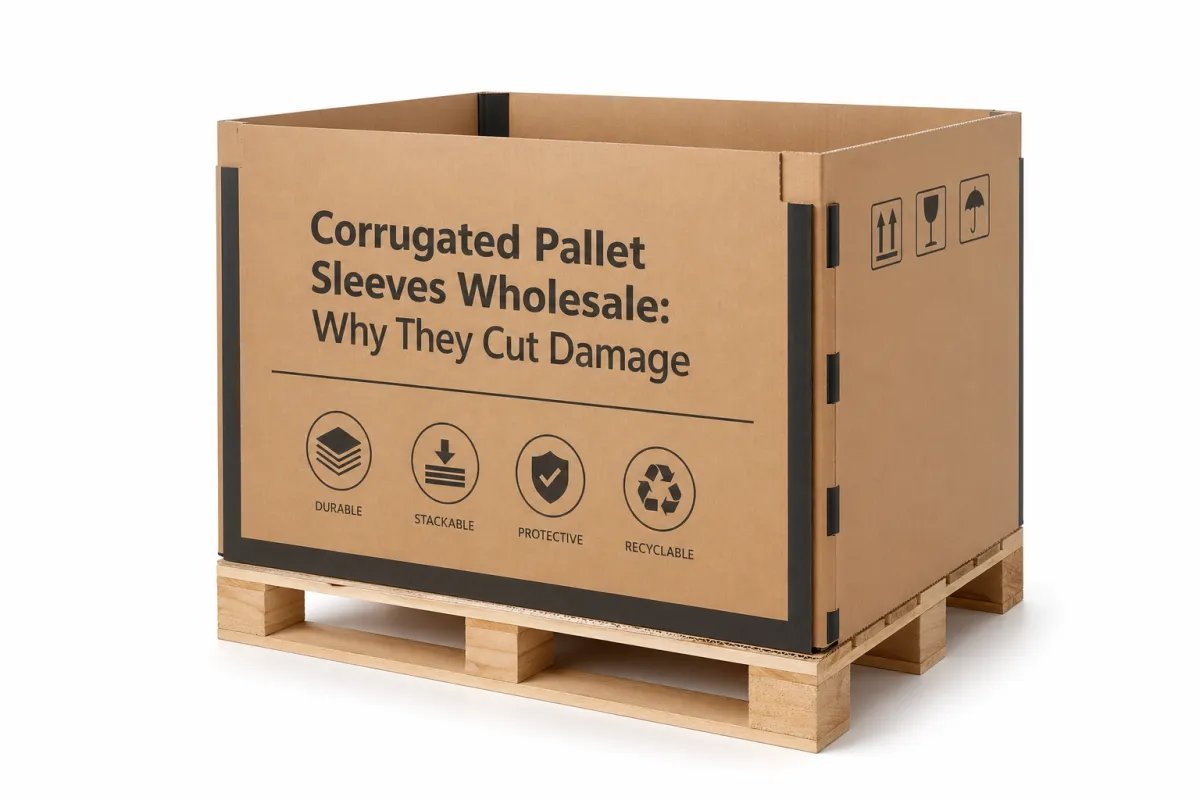
I learned that lesson beside a pallet of boxed electronics in a receiving bay outside Shenzhen, where two corner rows had shifted just enough to crush the outer cartons and bend the retail packs inside. The client had already paid for stretch film, corner boards, and a top sheet, but the load still racked during transit because the sides offered almost no structural help. Once we switched to corrugated pallet sleeves wholesale, the stack stayed square, the edge crush stopped spreading, and the customer’s warehouse team quit sending photos that made everyone upstream look careless. I still remember the relief on the shipping supervisor’s face when the first 600-unit run came back clean from the Qingdao route, because the failure had been costing him both time and credibility.
The value is straightforward. A corrugated sleeve turns a standard pallet into a more stable shipping unit by adding sidewall support, better compression resistance, and a cleaner profile for handling across conveyor drops, truck transfers, and manual staging. That matters because stretch wrap is not a structural member, shrink film only contains what is already there, and fully rigid crates are often more packaging than a lot of palletized shipments actually need. With corrugated pallet sleeves wholesale, you get a middle path that protects the product without paying for wood crates, extra labor, or dead space that never gets used. That middle path is where most purchasing decisions land when the product is leaving factories in Foshan, Xiamen, or Guangzhou by the thousand.
Here is where sleeves beat the usual suspects on real freight lanes:
- Stretch wrap: inexpensive on paper, weak on structure, and not much help when vibration starts walking a load across a trailer floor.
- Shrink film: useful for containment, but it does not provide the same sidewall stiffness as a corrugated build that can be specified to the right ECT and BCT targets.
- Rigid crates: excellent for severe environments, yet often heavier by 8 to 14 kg per unit and slower to pack in a two-shift operation.
- Loose carton stacking: works until the warehouse gets busy and the stack loses shape by the third move or the second handoff.
For bulk shipping, that structural difference matters more than most people expect. I have seen food-service buyers use corrugated pallet sleeves wholesale to keep boxed sauces and dry ingredients square on 42 x 42 pallets moving through Texas and New Jersey distribution hubs. I have seen automotive parts teams rely on them to protect packaged filters, hoses, and fasteners from edge crush on multi-stop freight moving out of Suzhou. I have also had retail distribution managers request them because a sleeve makes a pallet look deliberate instead of improvised, which sounds cosmetic until a shift lead is trying to keep one lane from turning into chaos at 5:30 p.m. And yes, chaos is the polite word I use in mixed company; the less polite version usually appears after a forklift bumper taps a corner and somebody says the load was “barely touched.”
Small, repeated handling events do more damage than most buyers want to admit. One bump is not the issue. Three handoffs, a turn, and a slightly overstacked trailer are the issue. That is why corrugated pallet sleeves wholesale is not just a packaging purchase; it is a freight-control decision with a cleaner presentation attached to it, especially for shipments leaving factory floors in Ningbo, Taicang, and the Greater Bay Area.
There is a direct business case too. Better load containment means fewer claims, fewer repacks, less time reworking pallets, and less waste from damaged product. If your outbound freight moves through distribution centers, regional carriers, or retail replenishment routes, one failed shipment can wipe out the savings from a cheaper spec in a single week. I have seen clients save $0.22 per unit on packaging and lose $18,000 in a damaged lot because the shipment was hand-fed through three facilities and then stacked too high in a humid trailer outside Houston. That math gets ugly fast, and it gets uglier when the damage lands on the busiest shipping day of the month.
For buyers comparing suppliers, this section is really about discipline. Choose the construction that fits the load. Choose the order volume that earns useful pricing. Choose the sleeve that protects the shipment without pushing you into a crate just because the quote looked more official on a spreadsheet from a factory in Dongguan or Jiaxing.
Product Details: What Corrugated Pallet Sleeves Are Built To Do
At the simplest level, a corrugated sleeve wraps around palletized goods to create a protected sidewall and a more stable shipping structure. The sleeve can be paired with a base tray and a top lid, or it can stand alone around a palletized stack depending on the product and the handling route. In corrugated pallet sleeves wholesale programs, the goal is not decoration; the goal is containment, strength, and a fit that repeats every time the line runs. I have sat in too many production meetings in Shenzhen and Dongguan where a “close enough” fit became a full-day headache later, and the headache was never for the person who approved the spec.
The construction details matter. A single-wall sleeve may be enough for lighter loads or short regional moves, especially on 25 kg to 40 kg pallet stacks. A double-wall build, often with BC flute or a similar combination, gives more compression resistance and a better chance of surviving stacking pressure in a warehouse holding 2,000 to 5,000 cartons. For heavier items, I want board grade, flute orientation, seam layout, and corner behavior on the table before anyone signs off. That is not fussiness; that is experience shaped by watching a pallet bow outward at exactly the wrong moment, right after everyone decided the trial run looked fine during a Friday afternoon check in Shenzhen. It is amazing how quickly a “fine” pallet can become everybody’s problem.
Common configurations include pre-creased sleeves, fold-flat sleeves, open sleeves, die-cut hand holes, vent slots, and access cutouts. Some buyers need a top-open design for faster packing on a two-shift line that processes 180 units an hour. Others want a version that works with a lid so the load stays closed during staging, export consolidation, and dock moves between Guangzhou and the port. If you are handling repeat shipments, corrugated pallet sleeves wholesale can also be designed to collapse flat for return freight, which saves cube space and makes the system easier to store between runs in a 1,500-square-meter warehouse. That matters more than people think, especially once the empty packaging starts taking over a corner of the facility like it pays rent.
In a factory meeting in Dongguan, I watched a plant manager insist on a narrow hand hole because the team wanted quicker pallet wrapping after loading. That sounded minor until we ran the numbers across 12,000 units and saw an 11-second per pallet time savings, which turned into real labor reduction over a month and made the line feel less congested during peak runs. Good sleeve design does that. It quietly removes friction from the process instead of announcing itself. The best packaging changes I have seen usually behave like this: they fix a recurring annoyance, and nobody misses the annoyance until it is gone.
Use cases are broad, but they are not random. I see corrugated pallet sleeves wholesale most often in boxed goods, parts distribution, packaged food, retail replenishment, and returnable shipping systems where the packaging gets reused three to five times before retirement. They also work well in warehouse-to-warehouse transfers because they keep the unitized load looking like one load instead of six layers of hopeful stacking and a prayer, which becomes especially useful on routes moving between Suzhou, Ningbo, and the Chicago distribution ring.
If you want to compare sleeve construction against other protective formats, the decision usually comes down to product shape and handling route. If the load is better protected as a boxed shipment, our Custom Shipping Boxes page may be the better path. If the load stays palletized and needs sidewall strength, a sleeve is the cleaner answer, especially for footprints like 40 x 48, 1200 x 1000 mm, or custom industrial pallets.
Two standards references are worth keeping close. ISTA testing standards are useful if you want to think like a shipping engineer instead of a guesser, and FSC-certified paper options matter when sustainability claims need real paperwork behind them. I do not treat certifications as window dressing. Buyers ask for them because they have compliance teams, retail partners, or customers who will check the spec sheet and ask follow-up questions if the paperwork feels thin. I have been on the wrong end of those questions before in a Guangzhou review room, and I would prefer not to revisit that particular headache.
Board Grades, Sizes, and Performance Specs
If you are requesting corrugated pallet sleeves wholesale quotes, send the supplier the right spec fields the first time. I want pallet footprint, inside height, wall thickness, flute type, print area, load weight, and whether the unit will be stacked in transit. The difference between a usable quote and a useless one is usually five measurements and one honest conversation, plus a shipping destination from places like Houston, Rotterdam, or Osaka. That last part matters more than people admit. A quote can look wonderful until you realize three vendors were imagining three different pallets.
Pallet compatibility comes first. A 40 x 48 footprint is common in North America, but Euro pallets, oversized industrial pallets, and custom footprints all change the sleeve geometry. If the sleeve is too loose, the load shifts. If it is too tight, the packing team wastes time forcing it into place. In corrugated pallet sleeves wholesale work, a 3 mm dimension error can create more problems than a $0.10 material upgrade ever solves. I have watched a whole pallet line lose its rhythm because of an opening that was just tight enough to annoy everyone, but not tight enough to fail cleanly. That is the worst kind of problem, because it lingers through the whole shift.
Performance is not only about paper strength. Compression strength, humidity exposure, transit distance, stacking height, and whether the pallet will be handled by forklift or hand truck all affect results. I have seen sleeves hold beautifully on a dry inland route and soften faster in a humid port environment near Shenzhen when the trailer sat for six hours on a wet dock. That is why I ask where the freight is going, not only what is inside the pallet. corrugated pallet sleeves wholesale orders that ignore climate usually pay for it later. Paper does not care that the schedule was optimistic.
Here is the buying sequence I use with clients:
- Measure the product stack and pallet footprint.
- Define the maximum load weight and stacking height.
- Choose the board grade and flute combination.
- Add cutouts, liners, or print only if they solve a real handling need.
- Confirm whether the sleeve is disposable, reusable, or returnable.
Customization is useful, but only when it earns its keep. Hand holes help workers move the sleeve. Vents can help with certain products, especially fresh-packed goods moving through 10 to 14 hours of transit. Barcodes and handling marks make distribution cleaner. Branded printing can improve presentation for retail programs, and I have seen buyers use it to keep internal distribution from looking generic. Every add-on changes cost, though, and that cost needs to be justified. In corrugated pallet sleeves wholesale, the right question is not “Can we add it?” The question is “Does it pay for itself in handling speed, damage reduction, or cleaner inbound processing?”
I once sat through a pricing meeting where a buyer wanted six color blocks, a gloss coating, and reinforced corners for a sleeve that was going to ship plain cardboard trays of hardware parts. I told him, politely, that he was dressing a warehouse item like a trade-show display. He laughed, then groaned, then finally agreed we should cut the print back to a single logo panel. That saved $0.28 per unit on a 6,000-piece run. It also saved everyone from producing packaging that looked fancier than the product itself, which is a trap I wish more teams would avoid.
| Option | Typical Build | Common Use | Indicative Wholesale Price | Notes |
|---|---|---|---|---|
| Plain sleeve | Single-wall or light double-wall, no print | Regional bulk shipping, low-to-medium risk loads | $1.18 to $1.65/unit at 5,000 units | Fastest to produce; best for test runs |
| Printed sleeve | Double-wall, 1-color or 2-color logo/marking | Retail replenishment, branded distribution | $1.42 to $2.10/unit at 5,000 units | Print setup adds cost and lead time |
| Reinforced sleeve | Heavier board, stronger seams, added cutouts | Heavier loads, longer transit, stacking | $1.85 to $2.95/unit at 5,000 units | Worth it if damage claims are costly |
| Custom-fit sleeve system | Matched with tray and lid, exact pallet footprint | Returnable or controlled distribution systems | $2.35 to $3.80/unit at 5,000 units | Best for repeat use and tight handling specs |
Those numbers are planning ranges, not promises carved into stone. They move with board grade, paper index, print coverage, and freight terms. A quote for corrugated pallet sleeves wholesale only makes sense if everybody is talking about the same size, the same board, and the same shipping assumption from a plant in Dongguan, a converter in Taicang, or a port export lane in Ningbo. I have seen three suppliers quote the same job and nobody was comparing the same thing. That is not buying. That is confusion with a logo on it. It is also how very reasonable people end up arguing over apples, oranges, and a pallet that somehow became a banana.
Corrugated Pallet Sleeves Wholesale Pricing, MOQ, and Lead Times
Wholesale pricing changes for four reasons: material, size, print, and quantity. The paper index matters. The height matters. A sleeve that is 42 inches tall costs more than one at 28 inches because paper usage rises fast as the panel grows, and a 1,200 mm sleeve destined for export can need a heavier spec than a domestic unit moving 300 miles. In corrugated pallet sleeves wholesale quotes, setup costs also matter, especially if the design needs die cutting or a folding pattern that the converting line has to dial in carefully. If a supplier glosses over those details, I start to wonder what else got rounded off.
Volume is where the math starts to behave. A 1,000-piece run almost always carries a higher unit price than a 10,000-piece run because the setup cost gets spread across fewer units. I have negotiated with mills and converting lines in Guangdong and Zhejiang long enough to know the truth here: stable repeat orders usually get better material planning and fewer emergency charges. Random, one-off, “I need it cheap by Friday” requests are where costs creep in. That is reality, and the paper mill never forgets it. It does not forgive either, which is very on brand for paper mills.
For MOQ, I usually tell buyers to ask for tiered pricing instead of a single number. A plain corrugated pallet sleeves wholesale order may allow a lower minimum than a printed, reinforced, or custom-cut version. If a supplier only gives you one pricing block, you do not really know whether you are being quoted for a test run, a production run, or a polite no. I have learned to trust the supplier who is comfortable showing the math in black and white, especially when the quote comes from a converter in Shenzhen or a mill-linked operation in Suzhou. The ones hiding behind vague ranges are usually hiding something else too.
Lead times depend on build complexity. A standard sleeve with no print can move faster than one with custom graphics, hand holes, and reinforced seams. If the sample is approved quickly and the freight booking is clean, you can often plan for 12 to 15 business days from proof approval on simpler orders, while more customized jobs can run 18 to 25 business days. Sample production may take 3 to 5 business days, depending on tooling and the current line load. I like to state that plainly because warehouse planning does not work on vague optimism, and a dock schedule does not care how busy everybody felt on the quoting call.
The hidden cost drivers are usually where procurement gets surprised:
- Sample fees: often $60 to $120, depending on whether a dieline or cut tool is needed.
- Die charges: can add $180 to $500 for complex access openings or custom geometry.
- Inland freight: can shift the landed cost by $0.08 to $0.25 per unit, depending on route.
- Palletization: export stacking, wrap, and corner protection affect outbound cost.
- Terms: ex-factory, FOB, and delivered pricing are not interchangeable, even if people talk as if they are.
I learned this the hard way during a supplier negotiation with a paper converter in the Pearl River Delta. Their quoted unit price looked great until I asked whether freight, pallet build, and carton pack-out were included. They smiled. I smiled back. Then we rebuilt the quote line by line and found another $1,260 hiding in “small” charges across the order. That is why corrugated pallet sleeves wholesale pricing should always be read like a contract, not a slogan. A cheap number that only works in a fantasy spreadsheet is not a deal; it is a future argument.
For buyers comparing suppliers, I recommend requesting the same three options side by side: plain, printed, and reinforced. That makes the tradeoff obvious. It also tells you whether the supplier understands structure or only knows how to lower a number by deleting the parts that keep the load safe. If the three quotes all come from the same factory in Dongguan and the only change is board grade, you will see the value difference immediately instead of three weeks later on a damage report.
How the Ordering Process and Timeline Works
The ordering process for corrugated pallet sleeves wholesale should be structured and boring in the best possible way. First inquiry, then dimensions, then quote, then sample, then approval, then production, then inspection, then freight booking. If a supplier skips steps, they are either guessing or rushing. Neither helps you when the sleeve has to fit a real pallet in a real warehouse outside Dallas, Rotterdam, or Tokyo. I like a process that feels almost too orderly, because disorder tends to show up later when the freight is already in motion.
The fastest quotes come from clear inputs. Send the pallet size, product weight, stacking height, print file if branding is required, destination port or warehouse, and whether the shipment is export or domestic. If there is a special handling issue, say it directly. I once had a buyer wait four days to mention that the load had to clear an automated warehouse gate at 1,100 mm. That is the sort of detail that belongs in the first email, not the fifth. Every extra round of “one more thing” adds another opportunity for somebody to guess wrong.
Sample approval deserves real attention. Do not approve a sleeve until it sits on the actual pallet, holds the intended carton stack, and survives a basic compression check. If there is print, confirm placement and color density too. On corrugated pallet sleeves wholesale programs, a sample that “looks close enough” often becomes a production problem that costs more than a careful review ever would. I have seen people try to save fifteen minutes and then spend two weeks untangling the consequences. It is not a good trade.
My own rule is simple: if the sample takes ten minutes to inspect, take the ten minutes. Measure the inside dimensions. Check seam alignment. Fold and unfold it twice. Lift it with gloves on. Look for edge crush, warped flaps, or a panel that pulls out of square. A sleeve is not a brochure. It either behaves on the dock or it does not. The warehouse never awards points for enthusiasm.
Production milestones should be visible, not mysterious. Material sourcing, cutting, scoring, gluing or folding, QC inspection, packing, and export prep each take time. In a decent operation, you should be able to get a date for each stage or at least a clear production window. That is especially true for corrugated pallet sleeves wholesale orders with repeated monthly demand, where one missed week can throw off the whole replenishment cycle. A factory in Foshan, for example, may source board on Monday, cut on Wednesday, and pack for export by the following Tuesday if the line is running two shifts and the artwork is already approved.
“The quote was fine. The sample was fine. The real win was that the first production lot landed on spec and the warehouse did not have to touch the load twice.” - a distribution manager I worked with on a 9,000-unit sleeve program
That quote sums up the real buying standard. Communication should be specific enough that your receiving team knows what is arriving and your finance team knows why the price landed where it did. If a supplier cannot explain lead times, board grade, and freight assumptions in plain language, they are not ready for serious corrugated pallet sleeves wholesale work from a plant in Shenzhen, a converter in Taicang, or a regional exporter in Ningbo.
Why Choose Us for Corrugated Pallet Sleeves Wholesale
I favor factory control because it keeps the job from turning into a phone tree. Fewer handoffs mean fewer mistakes. That matters in corrugated pallet sleeves wholesale production because the sleeve has to match the pallet, the load, and the schedule, not somebody’s idea of a generic box with ambition. When the manufacturing team, quoting team, and QC team are aligned in one facility or one tightly managed cluster in Dongguan or Shenzhen, you get repeatability instead of excuses. You also get fewer “just checking in” emails, which is one of the few small joys left in procurement.
I have sat through enough paper and board negotiations to know that good pricing does not come from random discounts. It comes from stable sourcing, consistent board grades, and a converter that understands how to plan paper usage without wasting sheets. Once, after a mill adjustment squeezed margin by 6.4%, I watched a supplier try to hide the increase inside freight. That trick lasted one call. Real buyers notice. corrugated pallet sleeves wholesale should be priced openly, with the material and labor separated enough that you can actually judge value. If the numbers are foggy, I assume the packing is foggy too.
Quality control is where the cheap quote often falls apart. I care about board consistency, dimensional accuracy, clean folds, and pack-out that survives freight without warping. A sleeve that arrives bent, crushed, or out of square is not a savings. It is a second shipping event. For buyers ordering corrugated pallet sleeves wholesale, that kind of failure burns time in receiving and confidence in procurement at the same time. I would rather hear a supplier say “we need two extra days to do it right” than watch a truck unload packaging that should have stayed in the converter’s hands.
We also handle custom options without turning the project into a circus. If you need reinforcement at a stress point, we spec it. If you need barcode placement for warehouse scanning, we align it. If you need branding that does not look slapped on by a bored printer, we build the artwork to fit the usable panel area, then translate that into corrugated production with the right print allowance and fold tolerances. That flexibility is one reason buyers move from trial orders into repeat Wholesale Programs with us. They want the next order to behave like the last one, just with a better price at higher volume.
I am also blunt about fit. If your load profile is better handled by another format, I will say so. Sometimes a sleeve is perfect. Sometimes a top tray and sidewall system is better. Sometimes a full box is the safer route, especially for tighter unit loads leaving a plant in Suzhou or entering a warehouse in Chicago. I would rather lose a sale than ship you the wrong packaging and call it strategy. That is not drama; it is the habit built from factory-floor experience and too many conversations with clients who had already paid for one bad decision.
The practical advantage for buyers is simple: you get sleeves that arrive on spec, on time, and with a landed cost that still works after freight. That is the only standard that matters once the truck is booked and the warehouse is waiting. If the supplier can do that repeatedly, corrugated pallet sleeves wholesale becomes a reliable part of the shipping system instead of another packaging headache, especially on recurring monthly runs of 5,000 to 20,000 units.
What Makes Corrugated Pallet Sleeves Wholesale a Good Fit for Bulk Shipping?
The short answer is that corrugated pallet sleeves wholesale gives buyers a practical middle ground between stretch wrap and full wood crates. You get stronger pallet load containment, better sidewall support, and more edge crush resistance than flexible film can provide, while avoiding the weight, labor, and overkill that often come with rigid packaging.
That balance matters on real freight lanes. A sleeve helps keep cartons aligned during cross-dock moves, export consolidation, warehouse stacking, and route changes that shake loose a weak load. For repeat programs, corrugated pallet sleeves wholesale also reduces repacking, cuts damage claims, and makes the receiving side look cleaner and more organized without turning the shipment into a costly custom crate.
I have watched this play out with boxed food, hardware, and industrial kits. The loads that used to need extra hands and extra tape suddenly moved with less fuss because the sleeve held the sidewalls where they were supposed to stay. That does not sound flashy, I know, but good shipping rarely is. It is mostly about stopping small failures before they turn into a morning full of apologies.
Next Steps to Place Your Wholesale Order
If you are ready to request corrugated pallet sleeves wholesale pricing, send the basics in one message: pallet dimensions, product weight, stacking height, quantity target, destination, and branding requirements. Add whether the sleeve must collapse flat, whether it will be reused, and whether you need a tray or lid. Those details let us quote the real job instead of the imaginary one. I promise that sounds less dramatic than it is, but the number of times I have seen an “easy” order turn weird because one of those details was missing is enough to make me a little superstitious.
Compare quotes on the same terms. Ask each supplier whether the price includes board grade, print, tooling, palletization, and freight assumptions. A quote at $1.49/unit can be more expensive than a quote at $1.67/unit if the first one hides $0.18 in extra charges. That is why corrugated pallet sleeves wholesale buyers who compare landed cost usually make better decisions than buyers who chase the lowest line item like it is a sport. Procurement should be about total value, not bragging rights in a meeting.
If your load is new or your route is rough, start with a small pilot order. A 500- to 1,000-piece test run can tell you if the sleeve fits, if the stack holds, and if the warehouse team likes the handling. Then scale once the sleeve passes the real test: production use. I have seen clients skip the pilot and regret it. I have also seen a 700-piece pilot save a client from a $12,000 mistake on a route moving from Shenzhen to Los Angeles. That is a cheap lesson compared with a rejected shipment and a frantic phone call from the dock.
Ask for samples or a dieline before production if there is any doubt about fit, closure, or print placement. That is not overcautious. That is normal. The best corrugated pallet sleeves wholesale orders are the ones where the supplier and buyer both know exactly what “done” looks like before the first board sheet gets cut in a factory in Foshan or Dongguan.
If you want a straightforward next step, send the spec sheet, ask for tiered pricing, and request a production timeline in writing. Then review the sample, approve the fit, and place the order with confidence instead of crossing your fingers and hoping the dock team figures it out. That is how corrugated pallet sleeves wholesale should work: clear specs, real pricing, and a sleeve that protects the load without drama.
I have seen enough freight damage, enough overbuilt crates, and enough under-specced wrap jobs to say this plainly: the right corrugated pallet sleeves wholesale order saves money because it avoids mistakes. Request your specs, get a quote, and place the order once the numbers make sense.
What details do you need for corrugated pallet sleeves wholesale pricing?
We need pallet footprint, sleeve height, load weight, stacking requirements, board grade, flute type, print needs, and shipping destination. If the shipment is going to be stacked, stored in a humid warehouse, or routed through a port like Shenzhen or Long Beach, include that too, because it can change the spec, the board choice, and the landed price by $0.08 to $0.25 per unit.
What is the typical MOQ for corrugated pallet sleeves wholesale orders?
MOQ depends on size, board grade, and whether the sleeve is printed or custom cut. Plain sleeves usually allow lower minimums than branded or highly customized builds, and tiered pricing makes it easier to compare a 500-piece pilot against a 5,000-piece production run from the same factory line.
Can corrugated pallet sleeves wholesale orders be printed?
Yes. Many sleeves can be printed with logos, handling marks, barcodes, or product IDs, and we can build the print proof from the sleeve dieline before transferring the artwork to corrugated production. Print coverage affects cost and lead time, so share artwork early and confirm the usable print area before production starts.
How do I know which board grade to choose?
Start with product weight, stacking height, and the roughness of the shipping route. Heavier loads or longer transit usually need stronger board and better compression performance, especially on export lanes moving out of Dongguan, Ningbo, or Xiamen. If you are unsure, request a sample build or load test before you commit to the full order.
How long do corrugated pallet sleeves wholesale orders take?
Plain, standard-size orders are usually faster than custom printed or reinforced sleeves. Sample approval, tooling, and freight booking can add time, so get the schedule in writing early and build in enough room for review. Simple orders often run 12 to 15 business days from proof approval, while more custom jobs can take 18 to 25 business days.