Buyer Fit Snapshot
| Best fit | Compare Paperboard vs Corrugated Boxes projects where brand print, material claims, artwork control, MOQ, and repeat-order consistency need to be specified before quoting. |
|---|---|
| Quote inputs | Share finished size, material target, print colors, finish, packing count, annual reorder estimate, ship-to region, and any compliance wording. |
| Proofing check | Approve dieline scale, logo placement, barcode or warning zones, color tolerance, closure strength, and carton packing before bulk production. |
| Main risk | Vague material claims, crowded artwork, missing packing details, or unclear freight terms can make a low unit price expensive after revisions. |
Fast answer: Compare Paperboard vs Corrugated Boxes: Board, Finish, Dieline, and Unit Cost should be specified like a repeatable production item. The safest quote records material, print method, finish, artwork proof, packing count, and reorder notes in one written spec.
Production checks before approval
Compare the actual filled-product size with the drawing, then confirm tolerance on folds, seals, hang holes, label areas, and retail display edges. Reserve space for logos, QR codes, warning copy, and material claims before decorative graphics fill the panel.
Quote comparison points
Review material grade, print process, finish, sampling route, tooling charges, carton quantity, and freight assumptions side by side. A quote is only useful when the supplier can repeat the same color, closure quality, and packing count on the next order.
Compare Paperboard vs Corrugated Boxes: Which Actually Wins?
Compare paperboard vs corrugated boxes, and the first thing that usually stands out is how often a brand pays for protection it never really needed. I remember standing on a factory floor in Dongguan’s Dalang district with a carton sample in one hand and a lukewarm coffee in the other, watching a packaging team spec a heavy RSC shipper for a 180 g cosmetics jar that was already headed to a retail shelf in a foam tray. A snug folding carton made from 350gsm C1S artboard with a 1.0 mm EVA insert would have handled the trip, looked cleaner under store lighting, and spared everyone a week of arguments about burst strength and “extra safety.” If you compare paperboard vs corrugated boxes with a clear eye, the real question is rarely which material is stronger; it is which package fits the product, the route, and the amount of damage you can actually live with.
The fastest way I know to compare paperboard vs corrugated boxes is to ask three plain questions: does the pack sit on a retail shelf, does it move through parcel networks, and what does one dent, crush, or scuffed corner cost you in refunds or lost repeat orders? That frame changes the decision quickly. Many buyers still treat corrugated as the safe default, yet a close look at the product and distribution chain often puts paperboard in the better spot. A lipstick carton traveling 180 miles from a warehouse in Suzhou to a boutique in Shanghai does not need the same build as a six-bottle subscription kit shipping from Los Angeles to Denver, and that distinction is where a lot of overspending begins. Honestly, I think a lot of people over-spec because “thicker” feels safer in the hand, which is not exactly a technical standard, though I have seen it happen more times than I can count.
I still think about a factory visit in Shenzhen’s Bao’an district where a supplement brand had approved a sharp-looking 400gsm C1S carton with soft-touch lamination, then panicked after the first drop simulation on a 76 cm edge-and-corner sequence. The carton had not failed for the reason they feared. The real miss was that they had tried to compare paperboard vs corrugated boxes only on strength and had ignored the outer master case already in the packing plan. Once we added a plain 200# corrugated shipper around the retail carton, the premium finish stayed intact, and the transit damage rate dropped below 1% on the next 1,000-unit run. That was one of those moments where everyone stared at the sample like it had personally betrayed them.
Quick Answer: Compare Paperboard vs Corrugated Boxes
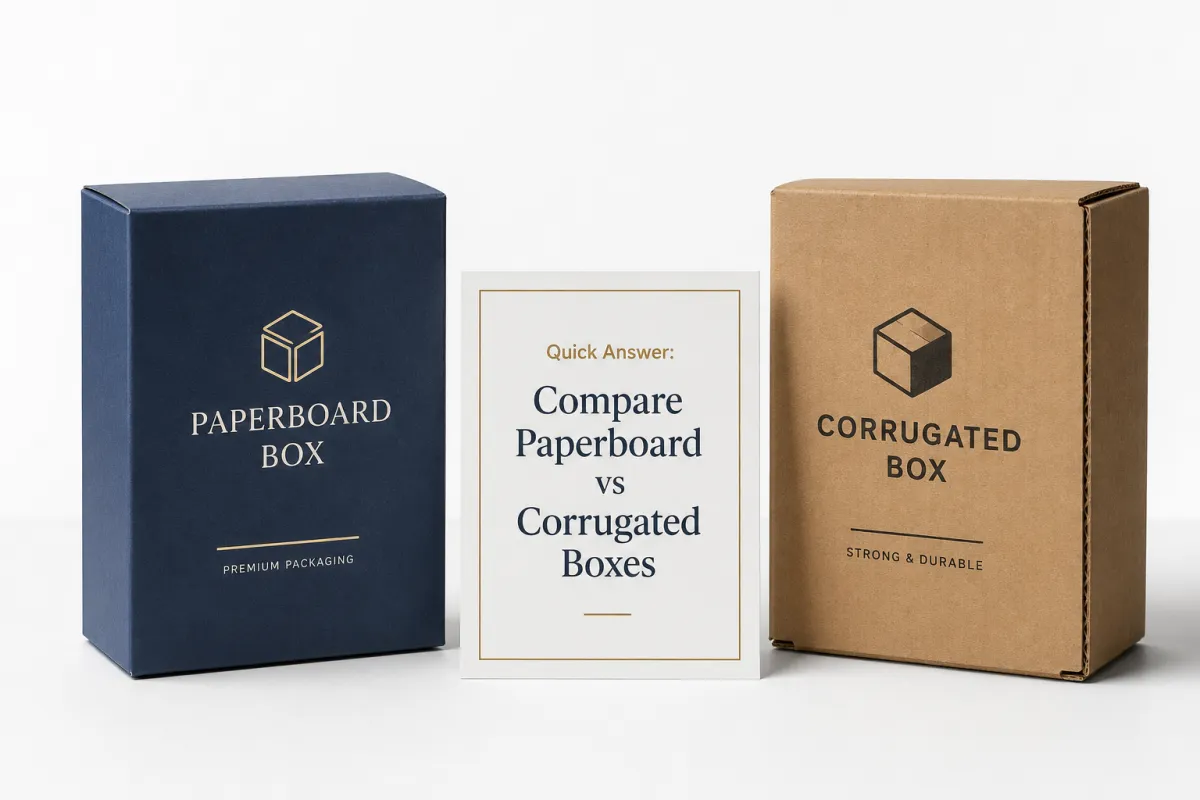
The short rule I give clients after they compare paperboard vs corrugated boxes across a few real samples is simple: choose paperboard for retail presentation, lighter products, and brands that need the package to help sell the item; choose corrugated for shipping abuse, heavier loads, and routes where the box will be stacked, tossed, or repacked. That split is practical, and it holds up under real production pressure. A 120 ml serum in a paperboard carton behaves very differently from a 3.5 kg candle set in a double-wall shipper, and the packaging spec should reflect that difference before anyone approves artwork or signs off on tooling. I prefer this rule because it cuts through a lot of the drama before the drama gets expensive.
Look at paperboard vs corrugated boxes from the outside in, and the differences show up fast. Paperboard gives you a smoother print face, tighter folds, and a more refined hand feel; a 350gsm C1S or 400gsm SBS board can hold fine type, foil blocking, and spot UV without the texture interruptions that come with fluting. Corrugated brings flutes, air gaps, and much better compression resistance, especially in E-flute at around 1.5 mm, B-flute at roughly 3 mm, or C-flute near 4 mm. Those flutes are not decoration. They are the reason a corrugated shipper survives a 30-inch drop better than a thin carton wrapped around the same item. I have seen people try to argue with physics in a conference room in Ningbo, which is always a fun meeting until the test results arrive.
Buyers who compare paperboard vs corrugated boxes only by unit price miss the bigger cost center: damage. I have seen a $0.15 paperboard carton protect a $14 serum just fine when it lived inside a padded mailer, and I have also seen a $0.32 corrugated mailer still lose money because the artwork looked flat, the customer judged the brand as basic, and the unboxing video dragged conversion down. Packaging costs money. It also shapes perception. Sometimes the difference between “premium” and “plain” is just a few panels, a better board finish, and a cleaner fold at the dust flap, which is annoyingly powerful.
My rule is blunt. If the package lives on a shelf, paperboard is usually the first candidate. If the package travels through parcel hubs, pallet corners, and maybe a wet porch in Atlanta, corrugated usually makes more sense. Compare paperboard vs corrugated boxes through that route map first, and a lot of weak specs never make it to purchase order. That alone has saved me from more bad launches than I care to admit.
“We thought the stronger box was the safer box,” a procurement manager told me after we compared paperboard vs corrugated boxes for a fragrance launch out of Foshan. “Turns out the stronger box was the one that matched the actual journey, not the one that simply felt thicker in my hand.”
How Do You Compare Paperboard vs Corrugated Boxes in Practice?
If you need the fastest practical answer, compare paperboard vs corrugated boxes by four variables: product weight, shipping distance, display requirement, and damage tolerance. Paperboard usually wins for retail-ready packaging, folding cartons, sleeves, and secondary packaging that must photograph well and print sharply. Corrugated usually wins for shipping boxes, mailers, and any SKU that needs edge crush strength, stacking strength, and better impact resistance across parcel networks.
That is the featured-snippet version, but the real decision is a little more nuanced. Compare paperboard vs corrugated boxes against the actual route, then add the product’s fragility, the number of handling touches, and whether the outer shipper already exists. If the item is going into a master carton anyway, a paperboard retail box can be the right choice even when the journey looks rough on paper. If the pack is doing all the work itself, corrugated deserves a closer look immediately. In practice, that is kind of the whole trick.
Top Options Compared: Paperboard vs Corrugated Boxes at a Glance
Before you compare paperboard vs corrugated boxes line by line, it helps to understand the structure behind each one. Paperboard for folding cartons is usually a single-sheet board, often 250gsm to 400gsm, with a coated or uncoated print face that takes fine typography and dense graphics cleanly. In practical sourcing terms, that might mean 300gsm ivory board for a tea carton, 350gsm C1S artboard for a skincare box, or 400gsm SBS for a premium electronics sleeve coming out of a converter in Xiamen. Corrugated is built from linerboard and a fluted medium, and that flute is what gives it edge crush strength, stacking resistance, and shock absorption. The whole thing is a bit less glamorous than a luxury mockup makes it sound, but the engineering is solid.
Compare paperboard vs corrugated boxes on crush resistance, and corrugated usually wins by a wide margin. Compare them on print surface, and paperboard usually wins. Compare them on weight, and paperboard is generally lighter for the same outer dimensions, which can matter in freight fees, pallet counts, and how many units a warehouse team can lift in one motion. Compare them on assembly speed, and the answer depends on whether the corrugated box arrives glued flat, self-locking, or built as a mailer with multiple folds. I have watched a line crew in Dongguan go from calm to irritated in about 90 seconds because one “simple” mailer turned out to have six more folds than anyone expected, plus a lock tab that needed an extra 8 mm of insertion depth.
Branding is the most visible split. Paperboard tends to feel retail-forward, precise, and designed. Corrugated reads more functional, especially if the kraft liner stays exposed. That does not mean corrugated cannot look premium. It can, especially with white-top liners, flexographic print, or litho-laminated wraps using 157gsm art paper on an EB-flute base. It just takes more planning. When clients compare paperboard vs corrugated boxes only by appearance, they often underprice the finishing work required to make corrugated feel like a premium object. That underestimation usually shows up as a surprise line item later, which is always a charming way to spend a Tuesday.
I saw that firsthand with a specialty tea brand in Hangzhou that wanted a luxury unboxing experience and a shipping-safe box in one structure. Their first instinct was to compare paperboard vs corrugated boxes as if they were interchangeable. They are not. The final spec used a 300gsm paperboard retail carton inside a 3 mm corrugated mailer, which gave us display quality on the inside and durability on the outside. That hybrid setup solved the shelf problem and the parcel problem without forcing one material to do both jobs badly. It also saved a lot of back-and-forth that, frankly, nobody needed.
| Attribute | Paperboard | Corrugated |
|---|---|---|
| Structure | Single-sheet board, usually 250gsm to 400gsm | Multi-layer board with fluting for cushioning |
| Print quality | Smoother surface, sharper type, richer finishes | Good, but flute structure can affect fine detail |
| Protection | Best for light items and secondary packaging | Best for transit, stacking, and impact resistance |
| Weight | Lower material weight | Usually heavier, especially with stronger board grades |
| Best use | Cosmetics, supplements, food cartons, small electronics | E-commerce, subscription kits, fragile goods, shipping boxes |
If you want a broader packaging mix, browse Custom Packaging Products and compare how folding cartons, inserts, sleeves, and shippers can work together instead of forcing one box style to handle every job. That is often the fastest way to compare paperboard vs corrugated boxes in a real purchasing workflow, especially when the SKU has to behave politely on a shelf in Seoul and still survive a courier route without falling apart on the first delivery attempt.
Detailed Reviews: When Paperboard Wins, When Corrugated Wins
Compare paperboard vs corrugated boxes in cosmetics, supplements, small electronics, and food cartons, and paperboard wins more often than first-time buyers expect. A 350gsm C1S carton with aqueous coating can hold a lip balm set, a vitamin bottle, or a phone accessory cleanly, especially if the product already has a retail-ready container or a molded pulp insert. The advantage here is the print face. It takes ink, foil, embossing, and spot UV well, which is why so many premium SKUs rely on it. I like paperboard for these jobs because it behaves like it was made to be looked at, which, to be fair, it was.
In a client meeting for a skincare line in Shanghai’s Minhang district, the buyer wanted corrugated because the supplier had said “stronger” five times in a row. I asked how far the product traveled. The answer was 220 miles from warehouse to boutique, plus a protective polybag and outer mailer already inside the distribution chain. Once we compared paperboard vs corrugated boxes against the real route, paperboard won immediately. The buyer saved 18 grams per unit, the carton looked better under store lighting, and the trade show samples photographed far better in daylight at 4 p.m. The design team practically sighed with relief, which is not something you hear often enough in packaging meetings.
Corrugated wins in e-commerce, subscription kits, and anything fragile enough to turn one bad corner crush into a full refund. If the box will be exposed to parcel sorting belts, repeated handling, or pallet stacking, corrugated is the safer engineering choice. I have seen this in frozen snack shipments from Milwaukee, battery accessories moving through Dallas fulfillment centers, and gift sets with glass bottles shipping out of Suzhou. The moment the product leaves a controlled shelf environment, the added flute structure starts earning its keep. I also admit that corrugated is the material I trust when I know a package is going to have a rough day, which happens more often than brands would like to believe.
A second reality check came from a negotiation I handled with a mailer supplier in Guangdong. The buyer wanted a luxury mailer for candles, and the discussion kept circling back to compare paperboard vs corrugated boxes as if print alone could solve rough handling. The first prototype was paperboard-only, and the corners showed wear after a basic simulated corner drop from 80 cm onto plywood. The final spec used a 3 mm corrugated base with a litho wrap on top, which cost more than the first quote but cut reported breakage from 3.2% to 0.6% over the first 4,000 shipped units. That is the kind of number that changes a finance meeting, and fast.
Hybrid approaches are where many smart teams land. A paperboard sleeve over a corrugated mailer gives you shelf-level branding and ship-level protection. Corrugated inserts inside a paperboard carton can stop product rattle without making the outer pack bulky. Paperboard trays inside a corrugated shipper help with presentation and part separation. When I compare paperboard vs corrugated Boxes for Brands with more than one channel, the winner is often neither material alone. It is the system. That answer is less dramatic than people want, but it is usually the correct one.
For transit validation, I would rather hear a supplier mention ISTA testing standards than tell me the board “feels thick.” ISTA 3A, ASTM D4169, and ASTM D642 give you a better framework for drop, compression, and distribution stress. Compare paperboard vs corrugated boxes without test data, and you are guessing. Compare them with a distribution profile, and the answer gets much clearer. I have had suppliers in Ningbo get defensive about that question, which is always a clue that the sample did not travel as well as the sales pitch.
Sustainability matters too, but only after function. FSC-certified paperboard and FSC-certified corrugated both exist, and recycled content can be specified for each. I have also seen buyers chase a recycled claim that caused higher damage rates, which then increased replacement shipments and waste. Compare paperboard vs corrugated boxes with end-of-life and shipping failure in view, and the greener option is usually the one that makes fewer total trips through the supply chain. A box that arrives broken is not especially virtuous, no matter how nice the recycled-content line looks in a presentation deck.
Price Comparison: Material, Printing, and Freight
Compare paperboard vs corrugated boxes on price, and the first mistake is staring only at the quoted unit cost. A folding carton might come in at $0.15 per unit for 5,000 pieces, while a corrugated mailer might quote at $0.29 per unit for the same volume. That does not mean the folding carton is automatically cheaper in the finished business sense. If the corrugated option reduces damage, saves on dunnage, and lowers repack labor, the total landed cost can flip. I have watched that happen enough times to know the invoice is only one part of the story.
The cost stack I look at includes board grade, print method, finishing, die tooling, glue complexity, MOQ, and freight cube. Paperboard often saves money on premium graphics because CMYK, foil, embossing, and soft-touch lamination can all be built into the same surface cleanly. Corrugated can look cheaper at first because the structure is simple, but once you add high-end print, white-top liners, specialty coatings, or inserts, the bill rises quickly. Compare paperboard vs corrugated boxes carefully and the surface treatment often becomes the real money line. I have had clients in Shenzhen nearly fall out of their chairs when a “simple” premium mailer quote doubled after the finishing options were added in.
| Scenario | Typical Unit Cost at 5,000 Units | What Drives the Price | Hidden Cost Risk |
|---|---|---|---|
| Paperboard folding carton, 4-color print, matte aqueous | $0.15 to $0.22 | Board thickness, coating, glue flap, die complexity | Weak ship protection if used alone |
| Paperboard carton with foil and spot UV | $0.25 to $0.38 | Finishing passes, registration, slower throughput | Higher scrap if artwork is crowded |
| Corrugated mailer with 2-color print | $0.29 to $0.45 | Flute grade, liner quality, print method, die cuts | Bulkier freight cube, more warehouse space |
| Corrugated shipper with litho wrap and insert | $0.42 to $0.68 | Wrap application, insert tooling, assembly labor | Branding looks strong, but unit labor rises |
Hidden costs matter more than most suppliers admit. If a paperboard carton fails one in every 200 units, the replacement freight and customer service time can erase the board savings. If a corrugated box takes 20% more warehouse volume because the caliper is larger, you may pay for extra pallet moves or longer storage. Compare paperboard vs corrugated boxes with pallet count, carton nesting, and cubage in the model, not just the invoice. I have had one buyer in Chicago say, with total sincerity, that “space is basically free.” I almost choked on my tea.
I had one procurement call where the buyer wanted to save $0.06 per unit by switching a cosmetics line from paperboard to corrugated. I asked about storage. Their warehouse charged by pallet position, and the corrugated design increased pallet footprint by 14% because the box did not nest as tightly. The switch looked good on paper, then cost more in space, freight, and labor. That is why compare paperboard vs corrugated boxes with the whole supply chain in the room, not just the packaging buyer. Otherwise you end up solving one problem and quietly creating three more.
One more number buyers should track is damage rate. A 2% failure rate on 50,000 units is 1,000 replacements, and a replacement shipment can cost more than the original box depending on the route. Compare paperboard vs corrugated boxes against that risk, and freight sometimes becomes the silent tie-breaker. The stronger box is not always the cheaper box. The lighter box is not always the better buy. The right one is the one that holds the line on both damage and margins, even if it makes the spreadsheet a little less exciting.
Process & Timeline: From Dieline to Delivery
Compare paperboard vs corrugated boxes in production, and paperboard usually moves faster when the structure is straightforward. A simple folding carton with one dieline, one print pass, and a standard coating can move from proof approval to delivery in 12 to 15 business days, assuming the artwork is final and the board is in stock at the converter in Dongguan or Kunshan. Corrugated can be just as fast for a plain shipper, but once you introduce flute testing, custom inserts, or a litho-laminated wrap, the lead time expands quickly. In practice, the difference usually shows up in approvals, not in the raw machine time.
The normal sequence stays similar across both materials. First comes dieline approval, where the panel sizes, tuck flaps, and insert dimensions are locked. Then comes structural sampling, because the pretty mockup is useless if the product rattles or the box bows under load. After that comes artwork proofing, and this is where delays hide. If the buyer keeps changing a barcode, a legal panel, or a foil position, the clock resets. Compare paperboard vs corrugated boxes at the proof stage and the differences become obvious: paperboard proofing leans on print fidelity, while corrugated proofing has to include structure and transit behavior too. I have seen perfectly good schedules wobble for days because someone wanted to move a tiny icon 4 mm to the left.
When I visited a converter in Suzhou that ran both carton and corrugated lines, the production manager said the same thing three different ways: the board was not the bottleneck, the approvals were. He was right. A 1 mm shift in a cut line can change tuck fit, insert pressure, or stacking performance. A special coating such as soft-touch, matte varnish, or anti-scuff film can add another day or two if the curing window changes. Compare paperboard vs corrugated boxes with the production calendar in mind, and you avoid the common mistake of promising sales a launch date before the samples have even survived assembly. Nothing makes a project manager sweat like realizing the hero product is waiting on a proof that was “basically done” last Thursday.
For more technical programs, I ask suppliers how they test compression and transit performance. If they can speak to edge crush strength, bursting strength, or a relevant distribution profile, I trust the quote more. If you want a wider view of packaging construction, the reference points at ISTA, The Packaging School, and other packaging industry resources are useful cross-checks before you compare paperboard vs corrugated boxes with a factory team.
The most common delay, in my experience, is artwork that looks finished but is not production-safe. A buyer sends layered files with missing fonts, then asks for a metallic stamp line in the wrong spot. Another asks for a full-bleed photo on a corrugated flute pattern that can only hold coarse detail. Compare paperboard vs corrugated boxes early, and you spot those traps before the press schedule gets messy. Compare them late, and the schedule becomes expensive. I have lived through both versions, and only one of them is fun.
How to Choose Between Paperboard and Corrugated Boxes
Compare paperboard vs corrugated boxes using a simple decision stack: product weight, shipping distance, display requirement, budget, and sustainability goal. If the item weighs under about 500 g, sits on a shelf, and needs strong branding, paperboard is usually the first draft. If the item exceeds that weight, ships through parcel networks, or has a history of corner damage, corrugated deserves the first draft. That is not a law of nature, just the pattern I have seen after a lot of samples, a lot of tape, and a few too many bruised corners.
Here is the scenario matrix I use with buyers. If the box sits on retail shelves for more than 50% of its life, paperboard usually leads. If the product is sold Direct to Consumer and travels through two or more handling stages, corrugated usually leads. If the package must do both, the answer is often a hybrid. That is the practical lens I use whenever clients compare paperboard vs corrugated boxes and expect a one-line answer. I usually tell them the one-line answer is available after the actual route is mapped, not before.
- Retail-first SKU: Choose paperboard for cosmetics, supplements, confectionery, and accessories that benefit from precise print.
- Shipping-first SKU: Choose corrugated for e-commerce, fragile goods, glass items, and heavier kits.
- Dual-channel SKU: Use a paperboard carton inside a corrugated shipper or add a corrugated sleeve and insert system.
- Budget-sensitive launch: Compare paperboard vs corrugated boxes on damage rate, not only unit price, before you commit.
The questions you should ask a supplier are practical, not decorative. Ask for board thickness, flute type, print limitations, minimum order quantity, tooling cost, and the exact timeline from proof approval. Ask whether they can supply FSC-certified board if chain-of-custody matters. Ask what happens if the box must pass a drop test or a compression test. Compare paperboard vs corrugated boxes with those answers on one sheet, and you will spot the weak quote fast. I have had suppliers in Guangzhou get very quiet when those questions appear, which usually tells me enough.
I also ask for physical samples, not just PDFs. A sample tells you whether the glue flap fights the hand, whether the board cracks at the fold, and whether a magnetic flap, tuck top, or auto-lock bottom actually works at packing speed. One buyer once insisted the paperboard carton was “too flimsy” until we timed assembly on the line: 11 seconds per unit for paperboard versus 19 seconds for a more complex corrugated design. Compare paperboard vs corrugated boxes like an operator would, and labor often becomes the real deciding factor. The box that looks smartest in a deck is not always the one the line crew will forgive.
If your team is still sorting through formats, the right next step is usually to review Custom Shipping Boxes alongside your retail carton specs. That side-by-side view makes it easier to compare paperboard vs corrugated boxes without treating every SKU as if it needs the same box. It also tends to end the “one size fits all” argument, which is a small miracle in itself.
Our Recommendation: Compare Paperboard vs Corrugated Boxes by Use Case
My recommendation is direct. Use paperboard when shelf appeal, compact form, and high-detail print matter more than brute transit strength. Use corrugated when stacking strength, courier handling, and product safety carry more weight than visual refinement. Compare paperboard vs corrugated boxes by use case, and you stop overbuying protection on some SKUs and underbuying it on others. That saves money, yes, but it also saves a lot of awkward postmortems after a launch goes sideways.
For cosmetics, supplements, small electronics, and food cartons, I lean paperboard first, especially if the product already has a secondary shipper or a tight insert. For e-commerce, fragile glass, subscription kits, and heavy bundles, I lean corrugated first. I have seen too many teams try to make one board do both jobs. Usually, that means a package that is too plain for retail or too weak for shipping. The compromise sounds elegant until the first customer complaint lands, and then everyone is back in the conference room trying to remember who approved the “temporary” spec.
One final anecdote stays with me. During a supplier negotiation for a seasonal gift set in Ningbo, the brand kept splitting the difference between paperboard and corrugated and ending up unhappy with both. We finally stopped comparing paperboard vs corrugated boxes as if they were rivals and started treating them as layers. Paperboard handled the front-of-house experience. Corrugated handled the back-of-house abuse. The result was a cleaner unboxing, fewer returns, and a lower total packaging waste bill because the redesign cut repacks. Honestly, that was the moment the finance team stopped arguing and started asking for more SKUs to audit. I still smile thinking about it, mostly because it is rare to see everyone in the room agree before lunch.
If you are deciding this week, audit your SKUs, measure the actual product dimensions to the nearest millimeter, request both samples, and run a quick drop test before you order. Compare paperboard vs corrugated boxes with the product in the box, not the box on a spec sheet, and the answer becomes much easier to defend internally. The takeaway is pretty simple: map the route, measure the fragility, and test the sample in the same conditions the finished pack will face. Do those three things, and the right material usually stops arguing for itself.
Is paperboard or corrugated better for shipping fragile products?
Corrugated is usually the safer choice because the flute structure absorbs impact and handles stacking pressure better. Paperboard can still work for fragile items if the product is light and protected by inserts or an outer shipper, but the margin for error is smaller. I would not gamble on paperboard alone if the package has a rough journey ahead, especially through parcel hubs that sort 8,000 to 12,000 parcels per hour.
Which is cheaper when you compare paperboard vs corrugated boxes for small runs?
Paperboard often looks cheaper for small retail-style runs because it can use simpler structures and lighter board. Corrugated can become the better value if damage prevention, freight efficiency, and lower replacement rates matter more than the upfront unit price. I always tell buyers to add the “what if it breaks?” line to the math, because that line is very rarely zero, and a 2% failure rate on 10,000 units is 200 replacements you did not plan for.
Does corrugated always print worse than paperboard?
Not always. Paperboard usually gives a smoother surface for fine type, photos, and premium finishes, but corrugated can still look polished if the design is built around the flute and print method from the start. A white-top 3 mm B-flute with litho wrap can look excellent in a showroom in Los Angeles, as long as the artwork respects the board instead of fighting it.
How do I decide between paperboard and corrugated for e-commerce packaging?
Use corrugated when the box will travel through parcel networks, face drops, or carry heavier products. Use paperboard only if the item is light, well-protected, and the outer shipper adds enough strength to protect it. I usually ask one question first: if the package gets kicked, stacked, or tossed onto a porch in Portland, do you still sleep well?
What should I ask a supplier before ordering either material?
Ask about material thickness, finishing options, minimum order quantity, production timeline, and transit-performance testing. Request physical samples so you can compare rigidity, print quality, and assembly speed before you commit. If the supplier gets vague at that stage, I take that as its own kind of answer, especially if they cannot name the board grade, the coating, and the proof-approval date in the same sentence.