Custom Adhesive Labels for Clothing That Stick, Scan, and Ship Cleanly
Custom adhesive labels help clothing brands package products cleanly, carry scanning and pricing data, and keep presentation consistent from pack line to shelf. On a folded tee, polybag, mailer, tissue wrap, or retail insert, the label has to do more than look good in a proof. It needs to hold, remove, print legibly, and survive the actual handling conditions of the order.
For apparel buyers, these are pressure-sensitive labels used for branding, identification, and packaging workflows. They can carry size information, SKU codes, price points, barcodes, seasonal graphics, or short promotional messages. They are often applied to polybags, cartons, paper wraps, clear bags, and product inserts. Used well, they reduce hand labor and keep packaging consistent across changing seasonal runs.
The practical value is control. A clear label spec lets a buyer decide how the package should look, how long it should hold, and whether it needs to remove cleanly later. That matters for retail packaging, warehouse scanning, and launch timing.
If the label is part of a broader system that includes Custom Labels & Tags or broader Custom Packaging Products, treat the adhesive spec as part of the package design, not a decorative extra. That usually prevents the most expensive failures.
A label can be inexpensive and still create avoidable cost if it fails after printing. The real cost includes relabeling, labor, delays, and packages that no longer match the approved proof.
What Custom Adhesive Labels Do for Clothing Brands
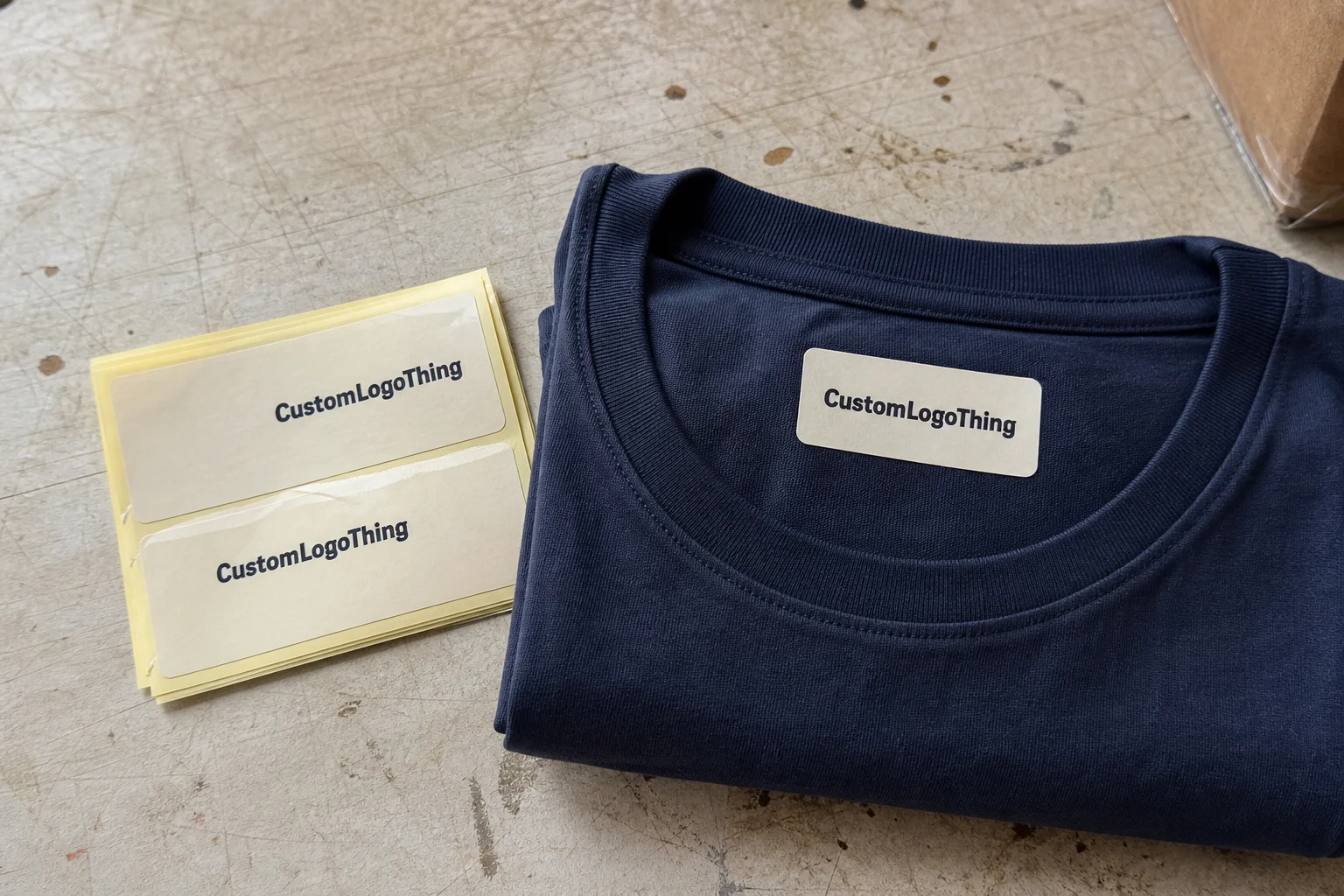
Apparel teams use adhesive labels for a few core jobs. A label may identify size and price on a folded shirt, carry a barcode for pick-and-pack, seal tissue around a premium item, or provide a short launch message for a limited run. The format is simple, but the role is not. It has to apply cleanly, survive handling, and still look intentional when the customer opens the package.
Compared with woven or sewn-in branding, adhesive labels solve a different problem. Woven labels are part of the garment. Adhesive labels support shipping, display, and temporary messaging. Confusing those jobs usually leads to the wrong material choice or unrealistic expectations.
Typical use cases include:
- Size and price labels for folded garments
- Brand seals on tissue, polybags, and garment bags
- Barcode or SKU labels for warehouse scanning
- Short-run seasonal graphics for changing collections
- Temporary promotional labels for bundles, launches, or markdowns
The appeal is visual, but the stronger argument is operational. A consistent label spec reduces handling time and keeps the pack line from improvising. That matters more as volume rises.
How Adhesive Labels Behave on Fabric, Film, and Paper Surfaces
The adhesive is what decides whether the order succeeds. Stickiness is not a single property. It depends on the surface, the temperature, the pressure applied during placement, the time the label sits before removal, and the finish underneath it.
Apparel packaging often mixes surfaces in one order: kraft paper, film, coated board, clear plastic, and tissue. Each behaves differently. Paper fibers can grab an adhesive and make removal messy. Film often gives a cleaner bond but may show edge lift if the adhesive is under-specified. Soft fabrics create the most risk because they can trap fibers, pull at the surface, or leave residue if the label is meant to come away later.
The main adhesive families are straightforward. Permanent adhesives are for long hold. Removable and low-tack adhesives are used when the label needs to come off without damage. Freezer-safe adhesives hold in cold storage or chilled shipping. Heat-resistant options help when packages may sit in warm conditions or travel through hotter routes.
Strength alone is not the right buying metric. The better question is what surface, temperature range, and removal behavior the order actually needs. A label that survives application in a controlled office can behave very differently after twelve hours in a truck or a few days in humid storage.
Direct application to fabric is possible in some cases, but it should not be assumed. Cotton, brushed knits, fleece, and textured blends can all create more adhesion risk than a coated carton or polybag. If a label will touch a garment directly, test the exact material instead of guessing.
Materials and Finishes That Shape the Final Result
Material choice changes both cost and performance. Paper labels are common because they are economical, easy to print, and suitable for dry environments. BOPP is a smart step up when the package may face moisture, handling, or shipping friction. Polyester is better when durability and stability matter more than a lower unit price. Clear, metallic, and textured stocks are usually chosen for presentation.
Finish matters as much as stock. Matte is calmer and reads more editorial. Gloss is brighter and feels more retail-forward. Soft-touch gives a premium hand feel, though it can show scuffing. Clear labels can disappear on some surfaces, which works for minimal branding. Metallic accents support a limited-edition feel, but they make small text harder to read if the layout is crowded.
Shape also affects cost and usability. A round label can soften the look of a tissue seal. A rectangle is usually easier for barcodes, SKU text, and small production details. Complex die cuts can look polished in a proof, then slow down application or increase waste during production.
Contrast is one detail buyers often miss. Small type on reflective stock can look refined on screen and become difficult to read under warehouse lighting or on a folded sleeve. If the label carries a barcode, size code, or care cue, legibility should win over decoration.
The best match is the one that fits the garment, shipping method, and shelf environment together. A value line does not need a luxury finish to look credible. A premium launch does not need a heavy metallic surface if the result harms readability. The label should support the product, not compete with it.
That is also where the package context matters. A label that looks right next to custom printed boxes may fail on tissue or a glossy mailer unless the finish is chosen with the actual application in mind.
Custom Adhesive Labels Pricing, MOQ, and Quote Factors
Pricing usually comes down to six variables: material, adhesive type, print method, size, finish, and quantity. A label can look simple until a buyer adds specialty stock, a custom die shape, or multiple SKUs. Then the quote changes quickly.
For working ranges, a simple paper run at around 5,000 pieces may land near $0.05 to $0.12 per unit. BOPP often sits around $0.08 to $0.18. Polyester, metallic, or other specialty constructions can move into the $0.10 to $0.30 range, depending on coverage, finishing, and complexity. Those figures are directional, not fixed pricing.
| Option | Typical Use | Relative Cost | Notes |
|---|---|---|---|
| Paper | Hang tags, tissue, short-run branding | Low | Best for dry environments and clean, simple graphics |
| BOPP | Polybags, cartons, shipping packs | Low to medium | Better moisture resistance; useful for retail packaging |
| Polyester | Barcode labels, rough handling, longer hold | Medium to high | More durable and dimensionally stable |
| Specialty metallic or clear | Premium launches, limited editions | High | Stronger shelf impact, but more design sensitivity |
MOQ matters because setup costs are spread across the run. Smaller quantities usually raise the per-label price. Reorders often price better because the press setup and approved artwork already exist. If the label is part of a recurring line, keeping the spec stable is usually more economical than changing the structure for a small savings.
Quote problems usually come from missing detail. If a buyer leaves out size, finish, laminate, color changes, removal requirements, or the exact surface, the estimate may move once proofing starts. Rush timelines, multiple versions, and special packing instructions also add cost. A low unit price is not helpful if the order fails the first application test.
Ask what the quote includes. Proofing, shipping, packaging, and reprint terms are often handled differently from supplier to supplier. If those items are not included, the unit price is only part of the story.
Production Process, Timeline, and Turnaround Expectations
A label order usually moves through a predictable sequence: brief, artwork, proof, revision, production, finishing, packing, and shipping. Delays tend to happen before the press begins. Missing specifications, slow approvals, custom die creation, and coordinating multiple SKUs are the most common bottlenecks.
For a straightforward order, turnaround often lands around 12 to 15 business days from proof approval. More complex jobs can take longer. Specialty materials, multiple label versions, or unusual adhesive requirements will extend the schedule. Expedited production is possible in some cases, but it reduces room for correction and usually increases cost.
Apparel launches create timing pressure because garment production, packaging, and shipping all have to line up. One colorway may be ready while another is still waiting on final approval. A milestone-based schedule is more useful than a single date because it shows where the risk sits.
For shipping-heavy programs, transit testing is worth discussing. A supplier should be able to speak clearly about adhesion and handling under expected conditions. For cartons or distribution-heavy packs, asking about ISTA transit testing guidance is reasonable. If a material is being sold as sustainable, it is also fair to ask about FSC chain-of-custody standards for paper or board-based stocks.
Not every order needs the same level of testing. A small seasonal label for tissue wrap has a different risk profile than a barcode label that will live in a warehouse system. Match the process to the job.
Common Mistakes That Cause Labels to Fail
Most label failures come from small assumptions. The first mistake is treating all surfaces as though they behave the same. They do not. A coated carton, a matte mailer, and a brushed fabric wrap each create different adhesion conditions.
The second mistake is choosing the wrong adhesive for the removal requirement. A permanent adhesive on a label that should come off cleanly can leave residue, tear the substrate, or pull fibers from the surface. A low-tack adhesive on a label that needs to survive shipping may lift at the corners before the order reaches the customer.
The third mistake is ignoring the real environment. Moisture, dust, cold storage, skin oils, and repeated handling all affect performance. A label that looks perfect at application can fail after it sits in a cold cart or gets handled on a busy pack line.
Design creates its own failure mode. Metallic effects, dark backgrounds, and small type can reduce contrast enough to hurt barcode scans and production legibility. In apparel, where the label often sits on folded packaging, the viewing distance is short and the margin for clutter is small.
Size errors are just as common. A label that fits the screen may not fit the actual fold, mailer panel, or carton face. If the label needs to land on a precise area, a physical mockup is more useful than a digital proof.
- Test the exact substrate instead of a similar one
- Confirm whether clean removal is required
- Check barcode readability after finish selection
- Compare label size against the real fold or panel
- Verify performance after handling, not only at application
Expert Tips and Next Steps Before You Order
Start with a one-page spec sheet. List the size, shape, stock, adhesive type, finish, quantity, application surface, and whether the label needs to remove cleanly. That document removes ambiguity, and ambiguity is where quote errors usually begin.
If the label will touch premium garments or fragile packaging, ask for a physical sample or press proof. Screens hide important details: tack, residue, edge lift, and scan performance often look different in the hand than they do on a monitor.
For multi-item orders, compare two practical options side by side. One can be built for presentation. The other can be built for durability. The right answer is not always the prettier one, and it is not always the cheapest one either.
Treat the label as part of the larger packaging system. If the garments ship in tissue, inserts, mailers, and boxes, the label should fit the same visual language as the rest of the package. A good label supports the whole experience instead of creating a weak point in it.
Before approving the order, confirm four things:
- Whether the quote includes proofs, shipping, and reprint policy
- Whether the adhesive matches the exact surface and dwell time
- Whether the finish supports the barcode or small text
- Whether the timeline fits launch, replenishment, and freight planning
For apparel teams balancing cost, speed, and presentation, the best label is usually the one that prints cleanly, applies consistently, and removes uncertainty from the pack line.
What are custom adhesive labels used for in clothing?
They are commonly used on hang tags, folded garments, polybags, tissue wrap, shipping cartons, and product inserts. They help brands apply size, branding, and SKU information quickly without sewing or other labor-heavy steps. They are usually not a replacement for permanent care or compliance labels on the garment itself.
Can custom adhesive labels be applied directly to garments?
Sometimes, but only after testing the exact fabric, finish, and removal requirement. They usually perform better on packaging surfaces than on soft, textured, or delicate textiles. If residue, fiber pull, or edge lift matters, ask for a removable or low-tack adhesive and test first.
Which adhesive is best for clothing labels that remove cleanly?
A removable or low-tack adhesive is usually the starting point when clean removal matters. The right choice still depends on dwell time, temperature, moisture, and the surface it will touch. Always test on the exact application surface before placing a production order for custom adhesive labels.
How do I compare custom adhesive label quotes?
Compare the full spec, not just unit price: size, stock, adhesive, finish, quantity, and print method. Check whether proofing, shipping, packaging, and reprint policies are included. Make sure the quoted turnaround matches your launch schedule and inventory timing.
What should I ask before reordering adhesive labels for apparel?
Ask whether the previous stock, adhesive, or finish is still available or has changed. Confirm whether the old order performed well on the exact garment or packaging surface. Request a refreshed proof if artwork, colors, sizing, or application conditions have changed, because the lowest-risk reorder is usually the one that matches the original custom adhesive labels spec closely.

