Custom Aluminum Labels for Apparel: Specs and Pricing
Custom aluminum labels do more than identify a garment. Used well, they act like a small badge of intent. They add weight to the design language, survive handling that would shred a paper tag, and make a product feel finished rather than assembled from loose parts. That is why brands keep using custom aluminum labels on denim, outerwear, bags, uniforms, and hard-wearing trims while the rest of the packaging system does the quieter work around them.
They are easy to misunderstand if you only look at them as decoration. These are rigid metal labels, usually cut from aluminum sheet or tag stock, then printed, embossed, engraved, anodized, or color-filled depending on the look and durability target. They are not stickers, and they are not soft woven tags with a metallic sheen. The construction is closer to a hardware component than a textile accessory.
The real question buyers should ask is not whether the label looks good in a sample photo. It is whether the label still looks good after a garment has been worn, washed, packed, unpacked, bent, and handled by someone who does not care about the brand story. That is where the specification matters more than the artwork.
Custom aluminum labels for apparel: why they punch above their weight
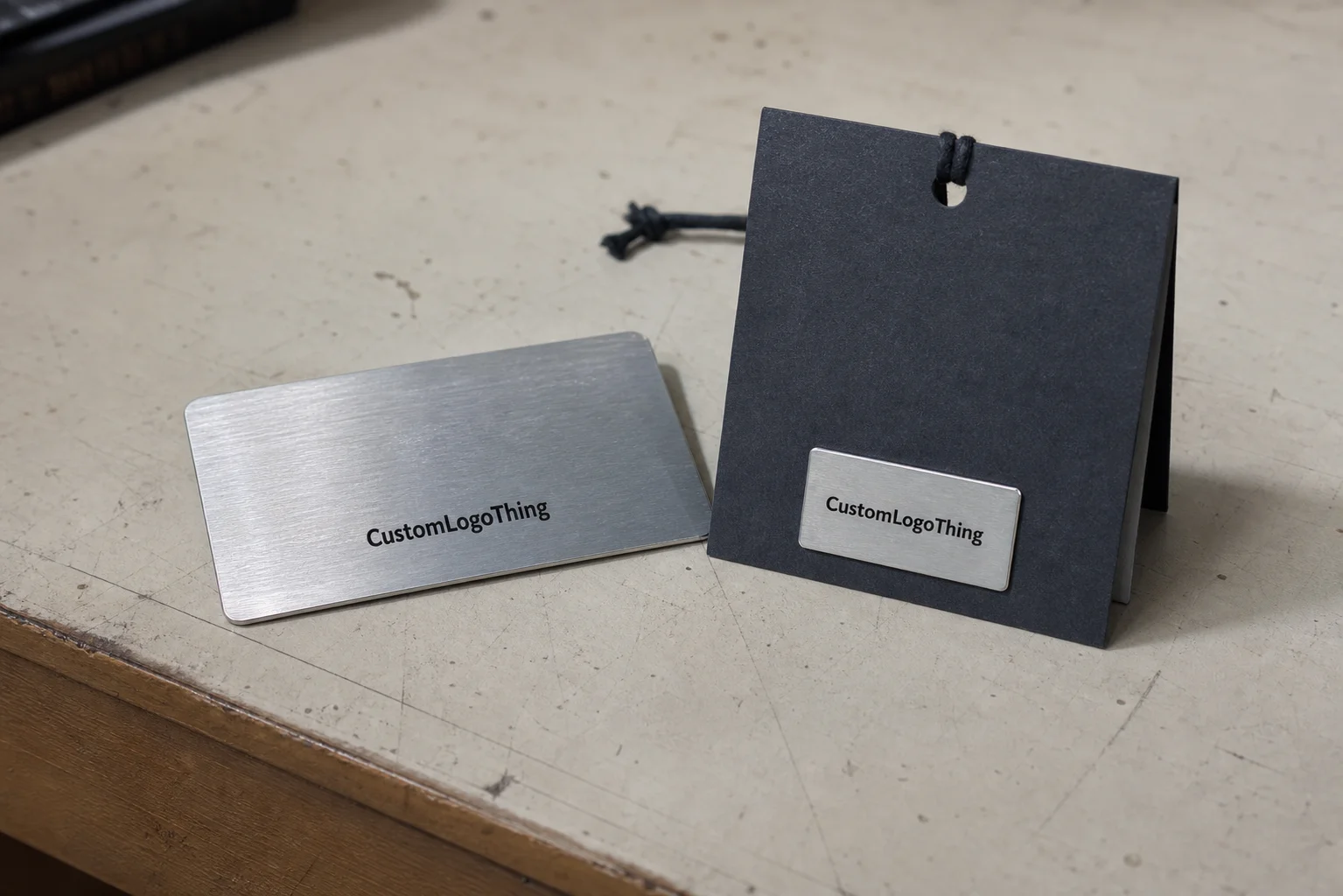
A small metal label can change how an entire garment is read. On a denim jacket, canvas bag, work shirt, or travel case, the label often acts like a visual anchor. It makes the product look planned. In a crowded category, that single cue can do more for perceived value than a larger print run, a louder hangtag, or a flashy carton.
That is also why custom aluminum labels belong in the same conversation as product packaging. The label is one piece of the brand system, not a separate decision. If the carton, insert card, hangtag, and garment trim all speak the same visual language, the product feels more expensive because the details agree with each other. If one piece feels cheap, the gap shows fast.
Aluminum is attractive for practical reasons, not just visual ones. It is lighter than steel, easier to shape than many buyers expect, and available in a wide range of surface treatments. It can feel restrained and technical with a brushed finish, or more assertive with embossing, anodizing, or a polished face. The material gives enough room to tune the tone without changing the core construction.
There are limits. Lightweight tees, babywear, and soft knits usually do not benefit from a rigid metal label. Comfort matters, and so does flex. On those garments, the badge can feel intrusive or out of place. Heavier fabrics, outerwear, bags, and workwear give the label enough structure to do its job without fighting the material.
If the brand is trying to communicate durability, utility, or premium restraint, metal often beats louder options. One well-made label usually carries more authority than several weaker decorative touches. The trick is matching the label to the product, not just the logo file.
How the metal construction works on clothing
The basic build is straightforward. An aluminum blank is cut to size, then decorated by printing, engraving, embossing, debossing, anodizing, or filling recessed areas with color. Each method changes the look and the wear behavior. There is no universal best option; there is only the option that fits the garment, the budget, and the expected use.
Edge treatment matters more than many first-time buyers expect. Rounded corners and clean deburring reduce snag risk and make the piece more comfortable against the body. Sharp edges or rough cuts can turn a good design into a practical problem, especially on apparel that moves a lot or sits near the skin. Bags and rigid goods give you more tolerance. Clothing does not.
Attachment is its own decision. Sewing, riveting, heat attachment in limited applications, and pressure-sensitive adhesive are all possible, but they do not perform equally across all fabrics. Adhesive can work on some hard surfaces and low-flex products. For garments that are laundered repeatedly, mechanical attachment is usually the safer route. If a supplier recommends adhesive for a wash-heavy textile without asking follow-up questions, the spec discussion is not deep enough yet.
Surface prep changes the final result too. Brushed, matte, polished, coated, or anodized surfaces all alter the way artwork reads and how visibly the label shows wear. Fine copy tends to hold up better on controlled, lower-glare surfaces. High-gloss metal can look strong in a sample and then expose micro-scratches after a few cycles of handling. That is not a defect in the material; it is a mismatch between finish and use.
For apparel lines that need both branding and garment information, many buyers split the work. The metal label handles the front-facing identity, while Custom Labels & Tags carry size, care, and internal information. That division keeps the premium detail clean and preserves readability where it matters.
For heavier garments, denim, outerwear, and accessories, the format is usually a strong fit. For soft apparel, the calculation changes. The cost is not just the label itself; it includes the added handling, the attachment method, and the chance that the piece will be rejected if the fit feels wrong in use.
Material, finish, and adhesion choices that change the result
Three decisions move the outcome most: thickness, finish, and attachment method. Everything else sits underneath them.
Thickness affects both durability and feel. Thin aluminum is lighter, cheaper, and easier to integrate into garments with limited structure. Thicker stock feels more substantial and resists distortion, but it raises cost and can feel intrusive on thin fabrics. Most apparel buyers land in the middle unless the garment is unusually heavy or the label is expected to take abuse.
Finish determines tone. Brushed aluminum reads clean and controlled. Polished metal is more reflective and can feel premium at first glance, but it also shows fingerprints and abrasion more readily. Matte and coated surfaces usually help with legibility, especially when logos include fine lines or small text. If the art depends on contrast, glare is not your friend.
Attachment deserves the same level of attention as the face artwork. Permanent adhesive is useful on hard goods and other low-flex applications. For garments, stitching or riveting usually holds better under repeated wear and laundering. Hybrid builds can make sense when a label needs both a precise visual position and strong physical retention. The garment decides the method more often than the design team does.
Quality control on the finish is worth asking about before the order starts. If the label is printed or coated, ask how the bond is tested. A common reference is ASTM D3359, which is used to evaluate coating adhesion. Not every supplier will cite a formal standard in the first conversation, but a competent one should be able to explain how they check whether the finish stays put.
A label spec only works if it survives the garment it is attached to. The logo does not need to be louder. It needs to stay intact.
That same logic applies to packaging. A brushed metal badge paired with soft-touch cartons and restrained product packaging feels coherent. A bright, reflective label next to a heavily printed box can still work, but the design needs intent. Otherwise the pack looks assembled from separate vendors rather than designed as one system.
Cost drivers, MOQ, and unit pricing
Pricing for custom aluminum labels depends on size, thickness, finish, artwork complexity, attachment method, and order quantity. Raw aluminum matters, but it is rarely the main cost driver. Setup, tooling, proofing, and finishing tend to move the number more than buyers expect, especially on smaller runs.
MOQ shapes the quote because fixed costs do not disappear at low volume. If the supplier has to create tooling, prepare proof files, and run inspection for a few hundred pieces, those costs are spread thinly across fewer units. At 5,000 pieces, the same setup cost is diluted. That is why a small order can look disproportionately expensive even when the label itself is physically simple.
A useful way to think about pricing is as a band, not a promise. The ranges below are realistic planning numbers, not locked rates. Artwork, attachment, packing requirements, and shape complexity can move them quickly.
| Attachment / build | Best use | Typical unit range | Main tradeoff |
|---|---|---|---|
| Adhesive-backed aluminum | Hard goods, inserts, low-flex applications | $0.18-$0.50 at higher volumes | Weak choice for repeated laundering |
| Sew-on aluminum label | Jackets, denim, uniforms, bags | $0.24-$0.70 depending on finish | Requires sewing operation |
| Riveted metal label | Denim, workwear, accessories | $0.30-$0.90 depending on hardware | Visible hardware, more labor |
| Embossed or color-filled label | Premium apparel, branded packaging systems | $0.35-$1.10 depending on complexity | More setup and tighter QC |
Those ranges assume a fairly standard production environment. Custom shapes, multiple colors, serial numbering, specialty coatings, or unusual packing requirements can move the order into another bracket quickly. If a quote arrives with one flat number and no questions about the spec, that price is probably too thin to trust.
Request tiered pricing at 250, 500, 1,000, 5,000, and 10,000 pieces if the project is serious. That reveals the breakpoints. Sometimes the move from 500 to 1,000 barely changes the unit cost. Sometimes it changes the economics enough to affect the product margin. Guessing is a poor substitute for a real quote ladder.
For broader line planning, compare the label spend against the rest of the package. If you are already buying Custom Packaging Products, the real question is whether the metal label changes the customer’s perception enough to justify the extra cost. In some apparel lines, it absolutely does. In others, the same money belongs in better fabric, cleaner printing, or sturdier shipping protection.
If the label is traveling with the product through distribution, transportation testing can matter as well. ISTA test methods are useful when labels, cartons, inserts, and shipping packs are part of the same delivery system. And if the rest of the pack-out uses paper components, FSC-certified materials at fsc.org are worth considering.
Production steps and turnaround: from proof to shipment
The workflow is usually predictable. It begins with artwork review, then spec confirmation, then a digital proof. If samples are needed, they happen before the full run. After approval, the order moves into production, finishing, inspection, and shipment. The sequence is ordinary, which is exactly what you want. Ordinary production is easier to control.
Most delays come from missing information, not from the equipment. Unclear dimensions, last-minute copy changes, inconsistent color references, and vague placement notes all slow the process. A poor artwork file creates a chain of follow-up questions, then a revised proof, then another check. That loop eats time and increases the chance of a missed detail.
Turnaround depends on complexity. A standard shape with ready artwork and one finish can move quickly. A custom shape, multiple colors, or unusual hardware adds time. If the supplier promises a very short lead time without asking what the label is supposed to do, the estimate is probably optimistic.
A realistic schedule often looks like this:
- Artwork review and quotation: 1-3 business days.
- Digital proof: 1-2 business days after specs are confirmed.
- Sample or preproduction approval, if needed: several extra days.
- Production and finishing: usually 7-15 business days for standard jobs, longer for complex builds.
- Inspection and shipment: 1-3 business days depending on freight method.
One question matters more than most buyers realize: when does production actually start? Some vendors start after proof approval. Others wait for payment confirmation and locked artwork. That detail affects lead time, budgeting, and the internal launch schedule. It is not a minor admin point. It is the clock.
Ask whether rush service changes the price, the queue position, or both. Those are different things. A faster shipping method is not the same as a genuine production rush. If the line is already tight, that distinction can decide whether the launch holds or slips.
For brands that care about package branding as much as garment branding, the proof stage is where the system should be checked as a whole. If the label finish, carton stock, and insert paper do not belong together, fix that before the run starts. Once production is moving, even small changes become expensive.
Common mistakes that waste money or ruin the label
The first mistake is choosing from a sample card and ignoring the garment. A label can look excellent in a flat photo or in the hand and still fail once it is sewn onto a curved seam, bent in transit, or washed repeatedly. Samples are useful. They are not the full condition.
The second mistake is undersizing the mark. Too small and the logo loses legibility. Too large and the label starts to fight the garment, especially on lighter pieces. People often optimize for space in the artwork file and forget what a customer sees from arm’s length.
The third mistake is using the wrong attachment for the fabric. A stiff metal label on lightweight knitwear is asking for discomfort or distortion. An adhesive-only build on a garment that gets tugged, flexed, or laundered often will not last. The fabric and the use case should drive the decision, not the desire to keep the spec simple.
The fourth mistake is approving a proof too quickly. This is where reorders are born. Buyers glance at the mockup, assume the spacing is right, and move on. Then the final run arrives and a logo sits a few millimeters off, a finish is shinier than expected, or the placement conflicts with another trim. By then, the savings from speed are gone.
If the proof does not spell out size, finish, attachment, and placement, it is not a proof. It is a guess with formatting.
Packaging mismatches are another common problem. If the garment ships in clean retail packaging but the label looks thin or fragile, customers notice the inconsistency immediately. The opposite can be true as well. A premium label cannot rescue weak product packaging, but a poor label can drag down an otherwise solid presentation.
That is why many brands treat the label and packaging as one decision set. The label does not need to carry the whole brand. It only needs to do its part without creating friction.
What to lock down before you request quotes
If you want an accurate quote, make the supplier work from specifics. Define the size, shape, finish, attachment method, quantity, intended garment, and expected wear conditions before you ask for pricing. Without that, the number you get back will be a rough placeholder, not a buying tool.
Good files help too. Send vector artwork, Pantone references if color matters, and a simple placement mockup. A fuzzy logo in a message thread usually leads to fuzzy pricing. Clear files lead to clearer proofs, fewer revisions, and less room for expensive assumptions.
Here is the shortlist worth sending with the request:
- Exact dimensions or a target size range.
- Shape, including corner radius, cutouts, or custom contours.
- Finish, such as brushed, polished, matte, anodized, or coated.
- Attachment method, including sewing, rivets, adhesive, or a hybrid build.
- Quantity breakpoints for comparison.
- Garment type and expected wash frequency.
- Any packaging coordination with the rest of the line.
If you are still deciding between label types, compare them against the full product presentation. Sometimes the right answer is a metal badge. Sometimes it is a softer woven tag and better custom printed boxes. The better decision is the one that fits the product and the channel, not the one that simply feels more premium in isolation.
Ask for a finish reference if surface feel matters. A tiny change in sheen or texture can change the way the label reads on the garment. Buyers notice that more than they think because they do not just look at labels. They touch them.
For a tighter brand system, align the label spec with the rest of the package branding. If the apparel line already has a clear visual language, custom aluminum labels should reinforce it, not introduce a second personality.
FAQ
Are aluminum clothing labels durable enough for washed garments?
Yes, if the label is specified for the garment and attached correctly. Sewn, riveted, or otherwise mechanically fixed labels usually hold up better than adhesive-only options on fabric. Edge treatment and finish quality matter too, because wash wear and abrasion expose weak spots quickly.
What is the best attachment method for metal apparel labels?
Sewing or riveting is usually the safer choice for garments that see regular wear. Adhesive backing is better suited to hard goods or low-flex applications, not every textile use case. The correct method depends on fabric thickness, wash frequency, and whether the label needs to stay permanent.
Why do custom aluminum labels cost more at low quantities?
Because setup, tooling, and proofing do not shrink with the order size. When those fixed costs are spread across fewer units, the unit price rises quickly. Larger quantities usually improve pricing because production efficiency increases.
How long does production usually take for aluminum garment labels?
Simple jobs move faster when the artwork is final and the spec is straightforward. Complex finishes, samples, or changes after proof approval add time. A useful quote request asks for both lead time and turnaround, not just a price.
What should I send to get an accurate quote for aluminum labels?
Send the size, shape, quantity, finish, attachment method, and intended garment or product. Include vector artwork, Pantone references, and a clear placement mockup if you have one. If the label needs to survive washing or heavy wear, say so up front. That changes both the build and the price for custom aluminum labels.


