Custom clear tote bags look straightforward until someone has to actually buy them. Transparent body, logo on it, done. That is the fantasy. The real order lives or dies on thickness, handle build, closure style, size tolerance, and whether the bag passes the venue, retail, or packaging job it was supposed to handle.
From a buyer’s standpoint, these bags sit between product packaging and a reusable carry item. That means they have to do two things at once: hold up in use and still look clean enough to represent the brand. If the material is too soft, the bag slumps. If it is too rigid, it looks cheap or awkward. If the print is heavy-handed, the whole point of clear construction starts to vanish.
That is why the spec matters more than the logo. Most quote trouble starts with a vague brief and ends with a bag that is “close” in ways that do not help anyone. For event kits, stadium entry, trade shows, campus programs, or retail merch, the bag has to fit the actual use case first. Branding comes after that.
If the tote is part of a larger packaging system, it helps to treat it that way from the start. Matching inserts, cartons, and labels can make the whole program feel deliberate instead of improvised. There is a difference between a bag with a logo and a package that was planned.
Why Clear Totes Look Simple but Are Not Simple to Buy
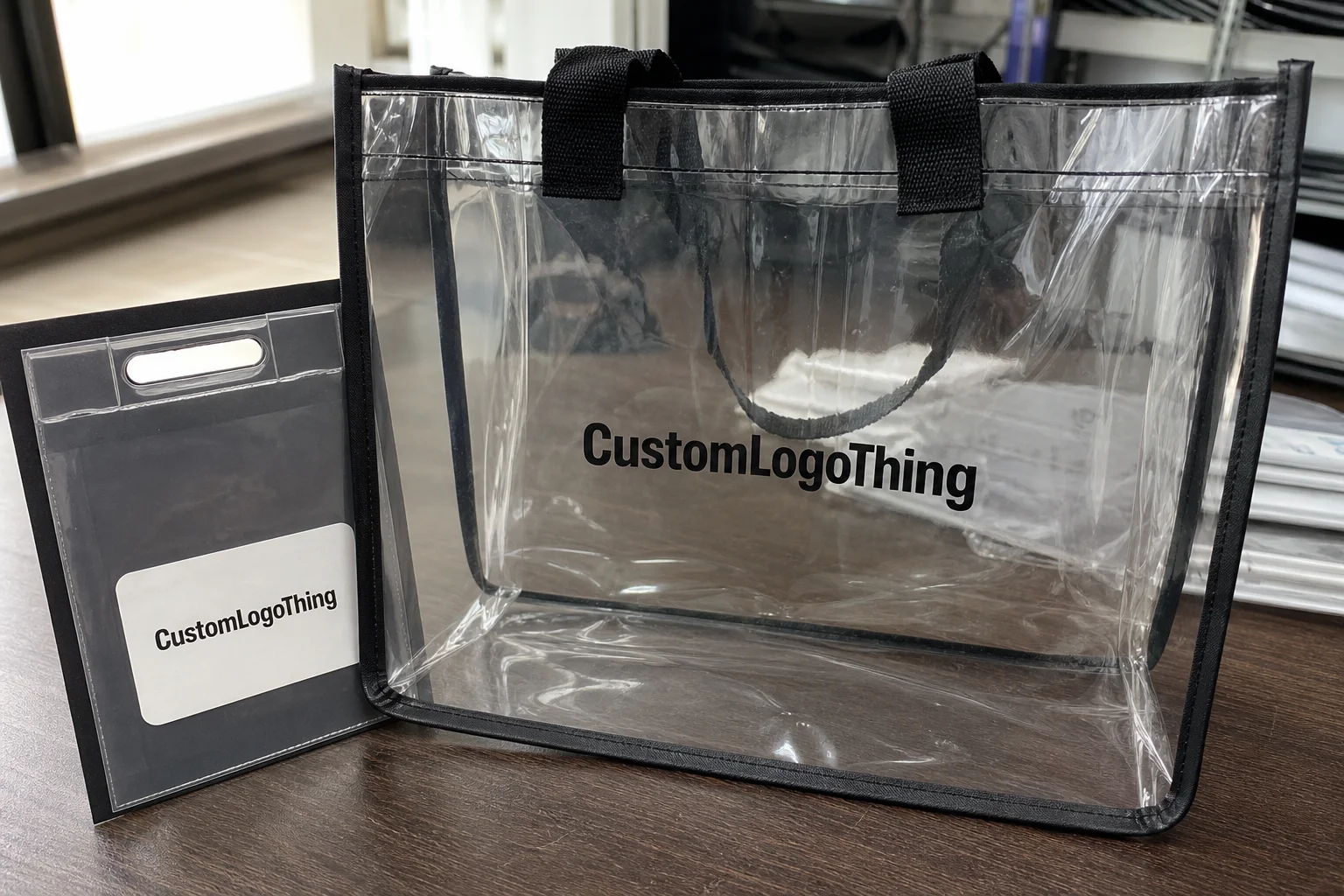
The first mistake is assuming transparency makes the product easy. It does the opposite. A clear bag exposes every production decision. Weak seams show. Poor edge finishing shows. Cheap hardware shows. So do odd proportions and low-grade film that wrinkles the minute it leaves the carton.
Use cases vary more than buyers expect. Stadium bags need to satisfy policy rules on size and closure. Retail bags need to look polished on a shelf or in a display stack. Event kits need to be light enough to carry around all day. Campus and lifestyle programs often want a bag that feels reusable, not disposable. Those are not the same requirements, even if the bag looks similar in a catalog.
Material choice changes the feel immediately. PVC is common because it gives strong clarity and predictable cost. TPU is softer and often reads as more premium. EVA has a more flexible hand and can look slightly matte. Polypropylene is usually the budget option, especially for lighter-duty work. None of these are interchangeable just because they are clear.
The logo is rarely the hard part. The body dimensions, handle length, gusset depth, and closure type are where a lot of quote differences appear. Two suppliers can both say “clear tote” and still mean very different structures. That is why a decent spec sheet saves time. It stops everyone from guessing.
The cheapest-looking bag is usually the one with the weakest structure hidden inside it.
What Makes Custom Clear Tote Bags a Spec Item
A proper tote is a system. Body panels, side gussets, bottom panel, handles, seams, trim, and closure all affect the final result. If one part is underbuilt, the bag feels flimsy. If one part is overbuilt, it can become stiff, heavy, or annoying to carry. The product has to hit a narrow middle ground.
That balance is the reason custom clear tote bags should be treated like a spec item, not a generic promo giveaway. The buyer is not just picking a size. They are deciding how much structure the bag needs, how much logo coverage makes sense, what the user will carry in it, and whether the bag is supposed to be disposable-looking or reusable-looking.
Customization options are broader than most first-time buyers expect. You can change the finished size, gauge, trim color, handle style, zipper style, snap type, pocket layout, and the placement of the logo. Some builds stay almost fully transparent with a small mark on the edge. Others use a colored border, a printed panel, or a branded strap to make the bag feel more complete.
That choice affects how the tote is perceived. Strong graphic coverage can work well for retail packaging or a fashion-forward merch program, but it can also reduce the clean, compliant look that makes a clear bag useful. In security-driven settings, too much coverage is a problem. In retail, too little can make the product feel unfinished. The right answer depends on the job.
Buyers often overlook one practical detail: the bag has to survive handling after production. A tote that looks fine flat on a table can still fail in distribution if the handles pull loose, the seams split, or the closure bends the top edge out of shape. That is why reinforcement points matter. They are not decoration. They are the parts that keep the bag from falling apart after the first few uses.
If the tote is part of a broader package branding system, think about the stack, not just the bag. Inserts, cartons, and labels should work together visually. A clear tote can look polished next to a Custom Printed Box and a clean insert. It can also look cheap if everything around it was chosen separately and nobody checked the combination.
Material, Gauge, and Hardware: What Actually Changes the Bag
Material choice comes first because it changes the bag’s appearance, feel, and cost structure. PVC tends to give the clearest look and the most predictable unit price. TPU gives a softer touch and usually a better premium feel. EVA works well when flexibility matters more than crystal-clear transparency. Polypropylene is practical for budget jobs, though it often reads as less refined.
Gauge, or thickness, changes more than many buyers expect. A thin build around 0.25 mm may be fine for light promotional use, but it creases easily and feels basic. Around 0.35 mm to 0.5 mm, the bag starts to hold its shape better and feels more substantial in the hand. Beyond that, the bag gets stiffer and more expensive. In colder environments, thicker PVC can feel even harder, which matters if the tote is meant for repeated use.
Hardware is where the quote creeps up a little at a time. A stronger zipper, better snaps, rivets, a reinforced handle wrap, a bottom board, or seam taping all cost something. None of those line items sounds dramatic on its own. Put them together and the price moves fast. That is usually the moment a buyer realizes the bag was never a simple bag.
For practical ordering, separate the use cases. Light promo use, daily retail use, and compliance-heavy event use should not share the same spec. A light promotional tote can get by with thinner film and minimal hardware. A retail tote needs better finish quality and stronger reinforcement. A venue bag needs exact sizing and a closure that stays within policy.
Testing can help, but only if it is tied to the real build. If a supplier gives film performance data, ask what test method was used and whether it applies to the final material. For transit-sensitive programs, it is also fair to ask whether the packed goods were checked against an ISTA-style shipping approach. If the tote is being kitted with inserts or sent through a distribution chain, the packaging has to survive more than a neat sample photo.
| Material | Typical Feel | Best Use | Rough Unit Cost at 1,000 | Rough Unit Cost at 5,000 |
|---|---|---|---|---|
| PVC | Clear, firm, predictable | Stadium, retail, general promo | $1.20-$2.10 | $0.78-$1.35 |
| TPU | Softer, smoother, more premium | Upscale retail, repeat use | $1.80-$3.20 | $1.15-$2.10 |
| EVA | Flexible, slightly matte | Lifestyle promos, lighter carry | $1.10-$2.00 | $0.72-$1.30 |
| Polypropylene | Light, practical, less premium | Budget events, basic giveaway use | $0.85-$1.55 | $0.55-$0.98 |
If the order includes paper inserts, sleeves, or product cards, ask for FSC-certified paper components. That does not turn the tote itself into a sustainable product, but it does improve the rest of the packaging stack. Small details matter when the bag is being sold or handed out as part of a branded kit.
Pricing: What Drives the Number Up or Down
Pricing is mostly a function of material, size, thickness, print coverage, hardware, packaging, and quantity. If a quote ignores one of those inputs, the comparison is already shaky. The lower number is often just the less complete number.
MOQ affects the unit price because setup costs get spread across the run. A 500-piece order usually costs more per bag than a 5,000-piece order with the same design. That is not a trick. It is just how the labor, cutting, printing, and packing cost gets distributed. Buyers who understand this stop wasting time trying to force a tiny order into a bulk price.
These are the most common cost drivers:
- Full-panel printing that covers more of the bag than planned.
- Special closures such as heavy magnets or specialty zippers.
- Interior pockets, rigid base boards, or extra compartments.
- Individual polybags, printed sleeves, or retail-ready packing.
- Tight color matching against a specific brand standard.
A fair comparison only works if each supplier is quoting the same build. One quote may include freight. Another may leave it out. One may include cartons, another may bill them separately. A low unit cost means very little if the rest of the scope is not the same.
As a rough buying frame, simpler builds sit near the low end of the price table above. Add better hardware, thicker film, or heavier branding and the number moves up quickly. That is normal. The bag is not becoming “overpriced” just because the spec is more complete. It is becoming more complete, and those parts cost money.
For a retail packaging program, a good way to compare options is to build three versions of the same tote: basic, mid-tier, and premium. That gives you a real view of where the money goes. Comparing a stripped-down quote against a fully built sample is how people talk themselves into bad purchases.
Production, Lead Time, and QC
The production flow is simple on paper and annoying in practice. Inquiry first. Spec confirmation second. Proof or drawing next. Sample approval after that. Then mass production, inspection, packing, and freight booking. If one approval is delayed, the timeline moves with it. There is no hidden shortcut.
Time usually gets lost in the same few places. Artwork revisions. Missing source files. Late decisions on print coverage. A request to “make it pop” without any usable print direction. Hardware that was assumed available but is actually backordered. None of that is glamorous. It is also where schedules slip.
A standard order can move fairly quickly if the build is simple and approvals are fast. Once the bag includes custom hardware, unusual trim, or insert matching, the schedule stretches. A realistic window for many standard runs is 12 to 20 business days after proof approval, plus freight time. More complex builds can take longer, especially if a sample round is needed before mass production starts.
QC should be practical, not theatrical. Check the seal lines. Check handle attachment. Check zipper travel. Check print position. Check whether the clear film has scratches, clouding, or uneven thickness. If the order includes rigid inserts or cartons, confirm that they fit the finished bag rather than the nominal size on the sketch. People lose money when the drawing is right and the assembly is wrong.
One useful rule: if a sample was made with different materials, different print coverage, or different hardware than the production run, treat it as a reference, not approval. A “close enough” sample is not a reliable sample. That is especially true with transparent products, because small changes are visible immediately.
For buyers managing events or retail launches, shipping matters too. Bags nested too tightly can deform. Bags packed too loosely can scuff. Mixed programs that include cartons, inserts, and totes should be checked as one system, not three separate orders. That keeps the final presentation intact and reduces rework.
Ordering Mistakes That Wreck Quotes
The biggest mistake is asking for a quote without locking the real spec. Size, closure, thickness, and handle length all need to be set before pricing starts. If those details are still floating, the sample will drift, and the quote will mean very little.
Another common error is assuming a venue-approved bag will automatically work as retail packaging, or the reverse. Stadium rules care about size, opacity, and closure limits. Retail packaging cares about shelf appeal, touch, and branding. Same object. Different standards. If the job is not clear, the bag ends up mediocre in both directions.
Artwork also causes more delays than it should. Low-resolution files create blurred logos. Too many colors raise print cost. Vague placement notes create arguments over positioning. Missing bleed or safe-area guidance means extra proof rounds. None of this is difficult. It just needs to be decided early.
Quote comparisons break when one supplier includes freight, cartons, and assembly while another does not. A lower unit price can hide higher packaging charges, customs handling, or a separate charge for kitting. Ask every supplier to quote the same scope: unit cost, packaging method, freight basis, and add-ons. Otherwise the numbers are not comparable.
The cheapest quote is often the one that removed the most detail.
That is especially true with custom clear tote bags. Once the buyer starts asking for better structure, cleaner branding, or tighter compliance, the order stops behaving like a generic promo item. It becomes a custom build. The pricing changes because the job changed.
What to Lock Before Requesting Samples
Before asking for samples, define the use case, target quantity, budget ceiling, delivery window, and any compliance rules. If the tote needs to meet a venue policy, say that up front. If it is going into retail, say that too. The clearer the brief, the less time gets wasted fixing assumptions later.
Ask for a simple spec sheet or drawing. It should show the finished size, material, thickness, closure, handle style, logo placement, and reinforcement points. That one page does more to control the order than a long email thread full of vague approval language.
Get pricing at multiple quantities. A quote at 500, 1,000, and 5,000 units shows the actual breakpoints. That makes it easier to decide whether to trim features, raise volume, or keep the spec steady. Real buying decisions usually come from tradeoffs. One number rarely tells the story.
If the tote is part of a larger branded packaging program, compare it against the rest of the system. Do the inserts match the print tone? Does the carton fit the final bag size? Does the bag feel consistent with the rest of the presentation? Those details are not extras. They are the difference between a clean program and a pile of mismatched parts.
For buyers working across events, retail packaging, and promo runs, the cleanest way to handle custom clear tote bags is the same way you would handle any other production item: define the spec, proof it, approve the sample, and compare finished details, not just price. That approach keeps surprises to a minimum and makes the quote meaningful.
Once the spec is locked, the order gets easier to manage. Build it like a real product and not a guess. That is what separates a useful run from a stack of clear plastic that only looked right in the inbox.
Frequently Asked Questions
What are custom clear tote bags usually made from?
Most are made from PVC, TPU, EVA, or polypropylene. PVC is common for clarity and cost control, TPU feels softer and more premium, EVA is flexible, and polypropylene is usually the lighter budget option. The right choice depends on whether the tote is for events, retail, or repeated daily use.
How much do custom clear tote bags cost per unit?
Unit cost depends on size, thickness, print coverage, hardware, and quantity. Lower-MOQ orders usually cost more per bag because setup and labor get spread across fewer units. A quote only makes sense when every supplier is using the same material and construction spec.
What is a realistic lead time for custom clear tote bags?
Simple builds with fast approvals can move quickly, while fully custom bags with special hardware need more time. Artwork changes, sample revisions, and busy shipping periods are the most common delays. The fastest way to shorten lead time is to send complete specs up front.
Can custom clear tote bags meet stadium or event rules?
Sometimes, but the bag has to match the venue’s size, opacity, and closure rules exactly. Do not assume a clear bag is automatically approved just because it is transparent. Check the event policy first, then spec the tote to fit those limits.
What should I send to get the fastest quote on custom clear tote bags?
Send target quantity, finished size, material preference, thickness, handle style, closure type, and print details. Include delivery destination and deadline so freight and production timing can be estimated correctly. If you already have artwork, send the highest-quality file available so the proof process does not stall.


