Buyer Fit Snapshot
| Best fit | Custom Embossed Packaging projects where brand print, material claims, artwork control, MOQ, and repeat-order consistency need to be specified before quoting. |
|---|---|
| Quote inputs | Share finished size, material target, print colors, finish, packing count, annual reorder estimate, ship-to region, and any compliance wording. |
| Proofing check | Approve dieline scale, logo placement, barcode or warning zones, color tolerance, closure strength, and carton packing before bulk production. |
| Main risk | Vague material claims, crowded artwork, missing packing details, or unclear freight terms can make a low unit price expensive after revisions. |
Fast answer: Custom Embossed Packaging: From Touch to Shelf Impact should be specified like a repeatable production item. The safest quote records material, print method, finish, artwork proof, packing count, and reorder notes in one written spec.
Production checks before approval
Compare the actual filled-product size with the drawing, then confirm tolerance on folds, seals, hang holes, label areas, and retail display edges. Reserve space for logos, QR codes, warning copy, and material claims before decorative graphics fill the panel.
Quote comparison points
Review material grade, print process, finish, sampling route, tooling charges, carton quantity, and freight assumptions side by side. A quote is only useful when the supplier can repeat the same color, closure quality, and packing count on the next order.
Why does custom embossed packaging get noticed before it is read?
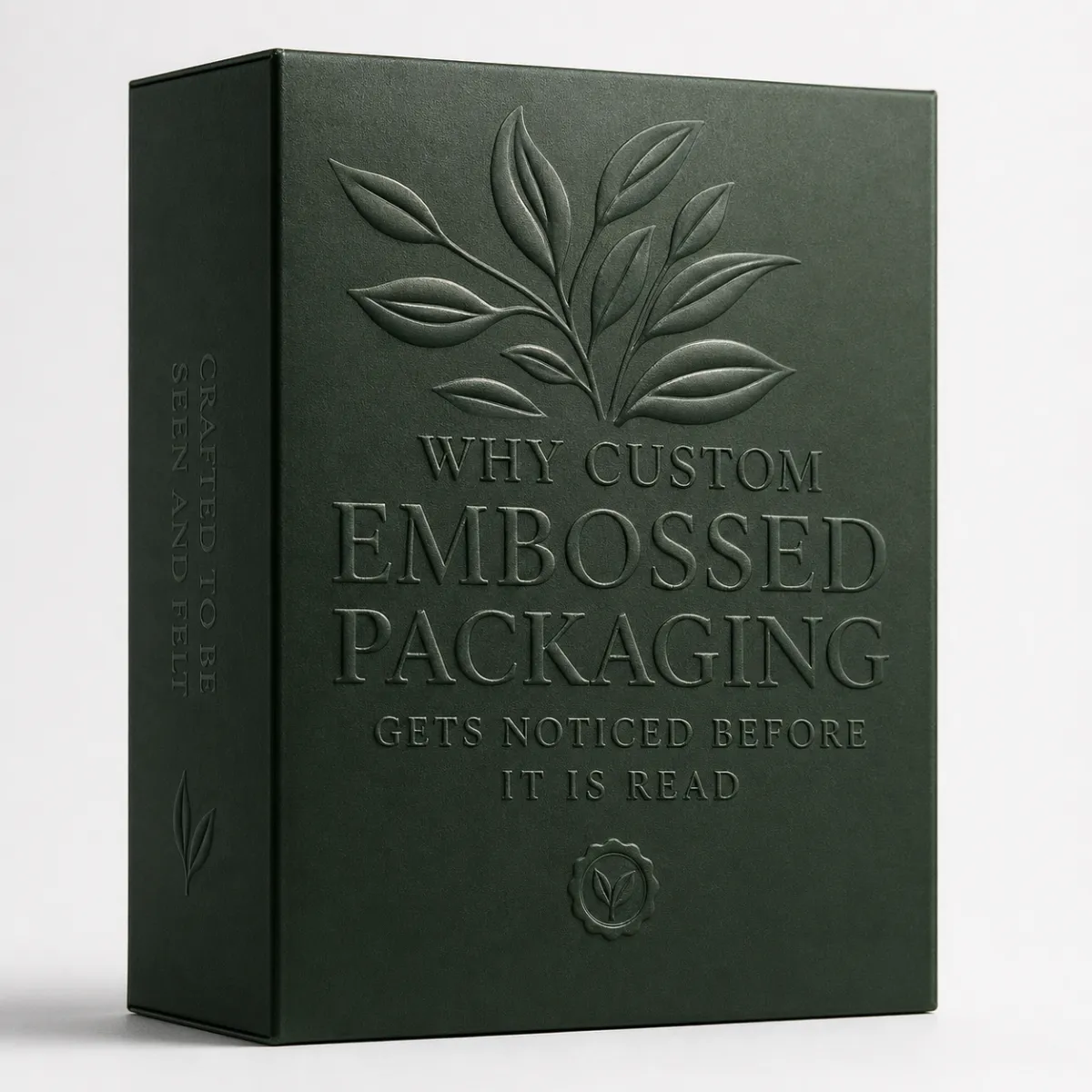
A shopper often touches a box before they can read every line of copy, and Custom Embossed Packaging takes advantage of that split second. A raised emblem, pressed frame, or shallow pocket of texture sends light in different directions, so the carton looks less flat and more intentional. In a retail aisle filled with visual noise, that small shift can signal quality before the message is even read. In premium paperboard packaging, people who decide between similar SKUs tend to rely on exactly these non-verbal cues because the first judgment is often about perceived care, not content.
At its core, Custom Embossed Packaging is a manufacturing effect that physically forms the material: heat and pressure push design lines into paper, paperboard, or selected flexible sheets through a die. The result is real depth, not a printed imitation. This matters because raised or recessed surfaces create shadow, edge transitions, and a structure the eye can track. That is why custom embossed packaging can influence shelf performance and perceived value when print alone is too ordinary. It works as a silent spokesperson, saying, “this package was made to be handled.”
Not all premium finishes compete on the same terms. Foil catches light and shouts glamour. Matte varnish softens glare and can protect surface color. Soft-touch lamination changes how a package feels as the fingers move across it. custom embossed packaging does something less optical and more geometric: it changes form. Form anchors memory, especially when the hand verifies what the eyes see. That is where embossed design outlives many decoration-first choices.
| Technique | Main effect | Best use | Common limitation |
|---|---|---|---|
| Embossing | Raised form and shadow | Logos, seals, borders, premium panels | Fine detail can flatten on weak stocks |
| Debossing | Indented form and texture | Minimal branding, tactile labels, restrained luxury | Deep recesses can crush on thin cartons |
| Foil stamping | Reflective shine and contrast | Decorative marks, signature accents, gift lines | Shine does not add physical depth |
| Soft-touch lamination | Velvety feel and muted glare | Luxury retail packaging, cosmetics, electronics | Can reduce crispness if paired with tiny emboss detail |
| Matte varnish | Low sheen and clean appearance | Modern product packaging and branded packaging systems | Mostly visual, not tactile |
Categories use custom embossed packaging for different reasons. Snack and food brands often embed seals, badges, or heritage frames to feel trustworthy on quick shelf passes. Cosmetics teams usually choose logos, monograms, and lid details because sensory cues influence purchase confidence. Wine and spirits marketers rely on crests, medallions, and neck textures that support tradition and heritage. Supplement packaging tends toward restrained marks that preserve readability under bright retail light. Electronics and collectibles often apply embossing to opening mechanics like flaps and inner lids where the reveal moment needs a tactile cue.
The strongest execution is often quiet rather than loud. A design that barely shouts in the first glance can still trigger repeated touch, and repeated touch is what often converts a casual glance into a deliberate shelf decision. That is the practical reason custom embossed packaging earns attention, then retention, then consideration.
"If the tactile feature does not earn a second look in the hand, it probably will not earn a second thought on the shelf."
How is custom embossed packaging made, from file to die?
Quality starts before the press, in the prepress room where artwork gets converted into clear, printable structure. Good vector cleanup separates what will be raised, recessed, or untouched. Line width becomes an immediate production variable: thin strokes vanish under pressure, and interior corners snap shut as soon as the die catches too much edge. When a file carries too many tiny counters or dense linework, the final custom embossed packaging can read as blurred texture instead of a crisp signal.
Tooling selection then follows project reality. Short and forgiving runs may begin with simpler rule-based steel or mother-metal systems when the graphic is broad and repeatable. Higher-detail artwork usually demands CNC-etched dies that hold shape at the same edge sharpness through long runs. A first production sample can look fine even with basic tooling, but a second batch in six weeks may drift if the same detail is pushed through variable die quality and setup. At that stage, many packaging teams either win repeatability or start counting avoidable delays.
Press behavior is where most early estimates fail. Pressure, dwell, platen depth, temperature, and stock moisture together define the final impression profile. A dense board can accept cleaner depth with controlled force while a coated stock might respond faster and show micro-cracking if the bite is too aggressive. Even room humidity shifts how fibers flex, so a print that looks stable in one plant can behave differently in another facility. That is why operators ask specific questions: “What paper is in stock? What coating is used? Where should depth stop before it becomes a structural issue?” In this step, the right question list saves money.
Registration becomes critical whenever embossing sits next to print, varnish, and die-cutting. Each stage has a tolerance window, and missing those windows compounds as the sheet moves. Practical workflows use marks, pilot sheets, and stable handling routes to hold consistency. If the emboss sits near a fold line or glue flap, orientation notes must be explicit, because a simple flip at the wrong moment can turn a precise feature into a warped one. custom embossed packaging is not a one-step art asset; it is a chain of controlled operations.
Proofing is best handled in stages. A digital proof helps with placement and spelling, but it cannot represent tactile quality. Hard proofs reveal edge behavior, panel stress, springback, and panel recovery. The key test is whether the raised area survives handling and still reads cleanly after light press and fold operations. If recovery rounds out detail, the team either loosens depth, changes stock, or adjusts profile before production approval.
Key factors for custom embossed packaging quality
Substrate choice is the first variable that determines whether custom embossed packaging holds definition or collapses into a mushy edge. Caliper, rigidity, fiber structure, and coating behavior decide how much depth survives pressing and how often distortion appears near folds. Heavier paperboards generally absorb detail better, but they are not automatically the right choice if budget or shipping performance is tight. Coated material can deliver sharper lines than uncoated stock, yet too much pressure can still trigger micro-crack growth at boundaries.
Depth and radius controls make or break the look in production. A feature that is too shallow disappears after stacking, while too deep a relief can split corners or warp adjacent print. A safe mark usually uses broad transitions and restrained curvature. A logo that reads at 2 mm depth on rigid board may need a lighter profile on recycled stock if fiber stability is lower. The right proportion depends on material behavior, not design ambition.
Ink and lamination sequencing matter as much as die depth. Dense ink films can flatten fine transitions before embossing even starts. Some gloss or anti-scratch layers improve the visual premium and reduce scuffing, but they may dampen tactile readability. If touch is part of the design intent, test the finish stack during proofing instead of after approval. A typical production order—print, dry, emboss, finish—only works when each step is tuned for depth retention in the final substrate.
Packaging architecture adds another layer of risk. A beautiful flat sample can fail when folded if the embossed shape crosses a stress line. Deep marks placed beside a glue seam can transfer pressure into seam failure or board telegraphing. Opening edges, lid edges, and corner zones move during forming, so a feature should be positioned where the board stays stable during assembly. Calm geometry usually wins over dramatic complexity in these zones.
Multiple production windows require lot-to-lot consistency, which is often where brands lose reliability. Machine-to-machine differences, operator behavior, and stock variation can all alter depth and edge quality. A simple lot checklist keeps things objective: approved stock, coating, depth target, die orientation, and visual tolerance range. For retail packaging programs, that consistency is not optional; it is the quality contract.
Material standards and handling benchmarks are not decoration; they define the reality check. The ISTA test library helps teams align distribution-grade expectations, while FSC remains a practical reference for traceability discussion when sustainability is part of the packaging brief. These tools do not replace craftsmanship, but they clarify minimum performance expectations before large quantities lock in.
Quick quality matrix for custom embossed packaging
- Logo-only emboss - Best for clean, premium identification; low risk; works well on most coated paperboard.
- Frame emboss - Good for structure and shelf order; stronger visual presence, but it needs good panel space.
- Full-panel depth effect - Strong tactile impact; higher tooling and setup sensitivity; best when the stock is stable.
From a production standpoint, custom embossed packaging rewards restraint. One assertive mark usually reads faster, survives transport better, and keeps quality checks simpler than a scattered field of small motifs. That principle becomes obvious when rejection data gets compared across batches: fewer tactile variables usually mean fewer avoidable failures.
A step-by-step guide to planning your custom embossed packaging launch
Start with the function, then assign the finish. Shelf pull, premium repositioning, anti-tamper signaling, and authenticity can all use custom embossed packaging, but each target pushes artwork and tooling differently. If awareness is the goal, the mark should register at a short distance. If hand-feel drives purchase, the cue should be unmistakable in less than a second of touch. If authenticity is the core, discreet placement can support verification without inviting imitation.
After purpose, define hierarchy. Too many embossed elements create visual clutter and manufacturing complexity. A strong program usually starts with one primary tactile anchor—logo, seal, monogram, or product symbol—and leaves the rest of the panel for supportive graphics. Every extra element increases risk, tooling time, and recheck frequency, especially for custom runs with tight tolerance windows.
Material and finishing should be paired before the first production ticket is written. Teams often choose stock in one session, finish in another, and move to die design last; that sequence invites misalignment and extra costs. It is smarter to choose substrate, coating, print treatment, and emboss depth together, then map execution order with the converter. Our Custom Packaging Products section can still help with structure-level planning when you need format context before artwork finalization.
Clear tolerances belong in the brief as plain language, not vague preferences. Instead of open-ended quality goals, specify what is acceptable and what is not: no edge bleed on key shapes, no stress cracking around crests, no interference with glue zones, and a practical depth window that production can hold. Clarity in the spec reduces argument and shortens correction cycles.
Proof approval should progress in layers, not in one pass. A structural proof confirms form, a brand proof confirms presentation, and handling simulation confirms the reality of real-world use. Digital files and static proofs cannot predict board movement under stack pressure or post-fold recovery. Side-by-side evaluation against a stable benchmark sample gives procurement and design teams the same reference language.
The final release checklist should include artwork approval, dieline confirmation, color checks, carton quantity, variance limits, approved material lots, and adjustment allowances for tooling in launch conditions. Early projects often underestimate final calibration needs, yet a small tuning window after pilot helps stabilize a full production program. The approval sample should be treated as a controlled starting point, not a one-time success photo.
"A clean launch is usually the result of good decisions made early, not dramatic fixes made late."
For premium families, this is also where system thinking matters. A raised crest on the carton face means little if labels, inserts, or shipping units fight a different language. Brands with good outcomes align touch, layout, and finishing across the full packaging path so the first hand-feel and the final unpack feel like the same promise.
Common mistakes in custom embossed packaging and how to avoid them
The first and most common error is overfilling a small area with detail. Tight curves, mini text elements, narrow counters, and crowded lines are seductive in design software yet frequently fail in paper and pressure. custom embossed packaging is physical work; the die has to translate design into depth without shearing. A cleaner result usually comes from stronger geometry, bigger spacing, and fewer micro motifs.
The second recurring mistake is testing on one material and running production on another. Prototype paper can behave differently than approved full-run stock, and that mismatch delays launch with false positives. A practical response is a locked material list with approved alternates and explicit exceptions before tooling begins. Multi-SKU producers benefit most from this discipline because it removes argument during scheduling crunch.
The third issue appears when teams ignore environmental conditioning. Moisture and storage conditions can alter press response and post-press recovery in ways that no design team notices until palletized shipment. Dry-room proofs can look sharper than cartons that travel through humid zones. Aligning samples and production to expected environmental conditions prevents expensive redesign cycles in the middle of a campaign.
The fourth issue is treating folds and seams as afterthoughts. Embossing too near score lines or fold transitions often causes deformation during forming. That usually surfaces late because the flat proof can look correct. Keep depth away from stress points, and use simple test folds before final release to confirm board behavior through assembly.
The fifth challenge is budgeting around unit price alone. Tooling, die retuning, sample rounds, freight for hardware, and rework potential sit outside the simple per-unit cost line. That gap is where projects appear underquoted and then overrun. A credible program model should include setup, sampling, production, and contingency so finance and marketing are aligned from the start.
A clear ownership map prevents confusion when problems appear. Keep this error taxonomy visible throughout production:
- Design errors - The artwork is too fine, crowded, or misplaced; owned by brand and design.
- File errors - Incorrect scale, weak layer separation, alignment and dieline gaps; owned by prepress.
- Tooling errors - Depth, radius, or die-fit defects; owned by converter and tooling supplier.
- Handling errors - Warping, crush, scuffing, and stack damage; owned by production and logistics.
When ownership is explicit, recovery is faster and repeatability improves. That is the real difference between a striking prototype and a scalable branded packaging program built around custom embossed packaging.
Expert tips that make custom embossed packaging easier to scale
Scaling succeeds when teams concentrate on impact, not quantity of effects. One clear tactile element—logo, seal, or brand motif—usually survives repeat runs better than a decorative field of many touches. That approach reduces registration risk and speeds operator judgment on the press floor. custom embossed packaging scales best when the core gesture remains obvious and reproducible.
Pilot production is worth every hour spent. A run of 20 to 50 units can expose corner crush, edge loss, stack marks, and handling issues that static proofs miss. Run the pilot through realistic paths: mailer insertion, tray placement, retail-ready stacking, and transport transitions. If the tactile cue survives actual use, the feature has a chance to survive volume.
Pair visual approval with physical quality gates. A side-by-side reference model catches depth reduction and edge softening that a monitor review can miss. Keeping a sealed master sample and comparing future production against that sample avoids interpretation drift across time, shifts, and operators. For repeat campaigns, that benchmark protects consistency better than repeated conversations.
Repeat-run discipline is your guardrail. Downtime, maintenance, die maintenance, and seasonal starts can shift press behavior. Operators with a repeat-run playbook—including approved batch, depth target, and acceptable variance—recover faster and waste less material. A line may still need tuning, but tuning becomes a measured adjustment instead of improvisation.
Build artwork architecture for adaptation, not rigidity. Layered files let teams swap seasonal marks and SKU text without rebuilding the die system. A modular structure supports campaigns that evolve while preserving a recognizable tactile signature. That matters for brands expanding from one launch to a full family of SKUs without blowing tooling budgets.
Track defects every month and review patterns, not isolated incidents. Repeating creases, depth drift, tear lines, and registration slippage should trigger supplier discussions before they turn into recurring reject batches. Those review loops convert custom embossed packaging from a creative experiment into a repeatable process with measurable savings.
Custom embossed packaging costs and production timeline
Custom embossed packaging cost usually breaks into tooling setup, prepress and sample work, and per-unit manufacturing impact. Setup is mostly fixed. Sampling varies with revision count and complexity. Per-unit impact moves with stock, relief depth, finish stack, and process stability. For many paperboard jobs, a simple single-element emboss can add roughly $0.08 to $0.20 per unit at 5,000 pieces. Multi-level or deeper effects can increase that to $0.20 to $0.45 per unit or more depending on the run design, geometry, and supplier throughput. These figures are planning boundaries, not guarantees.
Tooling costs follow detail and material demands. A basic die remains relatively contained, while advanced contours or larger repeat areas raise setup spend. Smaller volumes feel that fixed setup more acutely, while larger volumes spread it across more units. That relationship works for custom embossed packaging only when approvals stay controlled and re-tuning does not multiply.
| Planning factor | Typical effect on cost | Typical effect on schedule | Buyer takeaway |
|---|---|---|---|
| Simple logo emboss | Lower tooling and lower reject risk | Faster proof cycle | Good for first-time custom embossed packaging |
| Deep multi-level relief | Higher tooling and more sampling | Longer approval window | Best for premium lines with enough volume to justify it |
| Emboss plus foil | Higher setup and tighter registration | More inspection points | Strong shelf effect, but less forgiving |
| Emboss on recycled board | May need wider radii or extra tuning | Possible extra sample round | Great option if sustainability goals matter |
Production windows usually follow this path: artwork lock, die build, sample proofing, approval, production, and final inspection before shipping. Multi-week timelines are common, especially when the first proof suggests depth correction or placement refinement. Straightforward, single-tool programs can move faster, yet planning one correction round in advance keeps teams from building false urgency into impossible schedules.
Many teams overlook hidden line items that appear only when logistics gets real. Hard tooling freight, extra test sheets, rework, storage delays, and expedited transport each have their own cost curve. Staged financial checkpoints—deposit on tool release, balance on approval, and approved terms for post-signoff changes—help both buyer and converter manage uncertainty with fewer escalations.
Retail-linked programs deserve backward planning. Shelf build schedules, distributor windows, and merchandising deadlines rarely move for style reasons. A custom embossed packaging timeline should therefore be planned from final delivery date backward through production constraints and not simply by adding buffer to design start date. That simple shift often avoids the most expensive deadline pressure.
Next steps after learning about custom embossed packaging
The best move after concept review is a short internal checklist with clear owners before any tooling is ordered. The brand owner owns visual intent. The structural designer verifies dieline and fold behavior. The buyer manages quantity and budget confidence. The production manager validates process flow and handling. With those roles set, custom embossed packaging decisions move with less friction.
Pull two or three benchmark samples from the same category and score them quickly but honestly. Compare depth, edge clarity, shelf fit, and how the package feels after a short handling cycle. A compact scorecard cuts through meeting fatigue and can expose execution gaps that design reviews miss. For premium cosmetics cartons, for instance, the right benchmark should match target shelf behavior, not just internal taste.
Next, pick one core SKU and run a pilot-to-scale path with strict observation: die performance, depth repeatability, board recovery, and real handling stress. Capture defects and corrections in one shared log, then scale only after consistency is proven. If you need a structured menu of compatible formats, the branded packaging options and custom printed boxes pages are useful references for balancing structure, finish, and program scope.
Draft preflight requirements now even if launch is still weeks away. Include minimum line widths, safe margins, emboss depth notes, and finish-order instructions. Shared standards reduce interpretation risk and shorten quoting, approval, and repeat decisions. They also make trade-offs between raised detail, foil, soft-touch, and matte systems much easier to defend.
The practical conclusion is straightforward: custom embossed packaging is not a decorative add-on. It is a manufacturing decision that affects brand perception, operational rhythm, and the durability of the package in real hands. If you need packaging that supports trust and shelf pull while staying manageable on the production floor, build it from a disciplined first brief through a controlled carton count at the end.
What is custom embossed packaging and where is it most useful?
It is a process that physically raises or indents graphic elements in packaging materials using custom dies. Custom embossed packaging is most useful when first-touch recognition matters, including premium gifting lines, refill systems, relaunches, and crowded shelf categories. The method fits identity-driven elements like logos, patterns, and seals, but it is a poor match for dense text runs or very thin flexible films that cannot hold clean depth.
How long does custom embossed packaging usually take before full production?
Typical lead time passes through design finalization, die construction, proof approval, and full production, and usually spans several weeks depending on the project scope. Single-tool jobs can move quickly. Multi-station dies, extra samples, or tight quality tolerances can extend schedules. Budgeting at least one correction cycle is a practical rule, especially for first-time runs of custom embossed packaging.
What drives custom embossed packaging costs compared with flat packaging?
Tooling and die preparation create the largest early cost because setup is paid before unit output starts. Unit costs then shift with stock, relief depth, press settings, finish choices, and how often rework is needed. Higher volumes lower per-piece cost once the setup is absorbed, but only if revision loops remain controlled and production quality stays consistent.
Which materials work best for custom embossed packaging without losing detail?
Rigid paperboard and quality coated cartons hold edge definition best for most short- and medium-run detail projects. Lightweight papers can still perform if the relief is conservative and radii are widened to protect fibers. Smooth laminates can be combined with custom embossed packaging for strong visuals, but early sample testing is required because anti-glare and slip layers can reduce tactile clarity.
Can I correct small custom embossed packaging mistakes without starting over?
Minor issues can be corrected after first proofing by adjusting depth, die radius, or pressure while retaining the same base die. Major geometry errors, such as wrong scale, incorrect panel placement, or critical registration failures, often require additional tooling review and may still need controlled rework. The safest route is structured approval gates so adjustments are captured pre-production rather than after full conversion.

