Buyer Fit Snapshot
| Best fit | Custom Pillow Box Packaging projects where brand print, material claims, artwork control, MOQ, and repeat-order consistency need to be specified before quoting. |
|---|---|
| Quote inputs | Share finished size, material target, print colors, finish, packing count, annual reorder estimate, ship-to region, and any compliance wording. |
| Proofing check | Approve dieline scale, logo placement, barcode or warning zones, color tolerance, closure strength, and carton packing before bulk production. |
| Main risk | Vague material claims, crowded artwork, missing packing details, or unclear freight terms can make a low unit price expensive after revisions. |
Fast answer: Custom Pillow Box Packaging: How It Works and Costs should be specified like a repeatable production item. The safest quote records material, print method, finish, artwork proof, packing count, and reorder notes in one written spec.
Production checks before approval
Compare the actual filled-product size with the drawing, then confirm tolerance on folds, seals, hang holes, label areas, and retail display edges. Reserve space for logos, QR codes, warning copy, and material claims before decorative graphics fill the panel.
Quote comparison points
Review material grade, print process, finish, sampling route, tooling charges, carton quantity, and freight assumptions side by side. A quote is only useful when the supplier can repeat the same color, closure quality, and packing count on the next order.
Custom Pillow Box Packaging: How It Works, What It Costs, and Why It Keeps Getting Chosen
Custom pillow box packaging can look modest on a screen, and that is part of the appeal. A compact curved carton feels considered without looking overbuilt, which is why it often performs well for beauty, gift, promo, and small retail items. For brands comparing Custom Packaging Products, this format usually sits in a practical middle ground between plain mailers and heavier rigid boxes.
The reason is structural, not just visual. A pillow form can frame a small product, hold up to normal handling, and stay lighter than premium rigid structures. That makes it useful when teams want shelf presence without adding unnecessary freight, storage, or packout complexity. In many programs, that middle lane is where branding and operations finally agree.
For compact SKUs, custom pillow box packaging often delivers strong value because it supports a premium feel without the footprint of more complex packaging. It is not always the best choice, but it frequently solves a common problem: design wants a polished presentation while supply chain wants something efficient to store, ship, and assemble. In real launches, this format often outperforms simple pouches on presentation and rigid shells on cost.
What catches teams off guard is how much the final result depends on technical inputs. Board grade, dieline accuracy, score depth, print coverage, and finishing choice all affect how the carton folds, how it holds shape, and how much it costs per unit. In other words, the look of custom pillow box packaging is usually the result of manufacturing decisions, not decoration alone.
If a team treats this as a styling exercise first, the pilot run often exposes the missed details. If the project starts with structure, fit, and handling, the result tends to scale more cleanly. That approach is what turns the format from a nice idea into a useful packaging system.
What Is Custom Pillow Box Packaging?
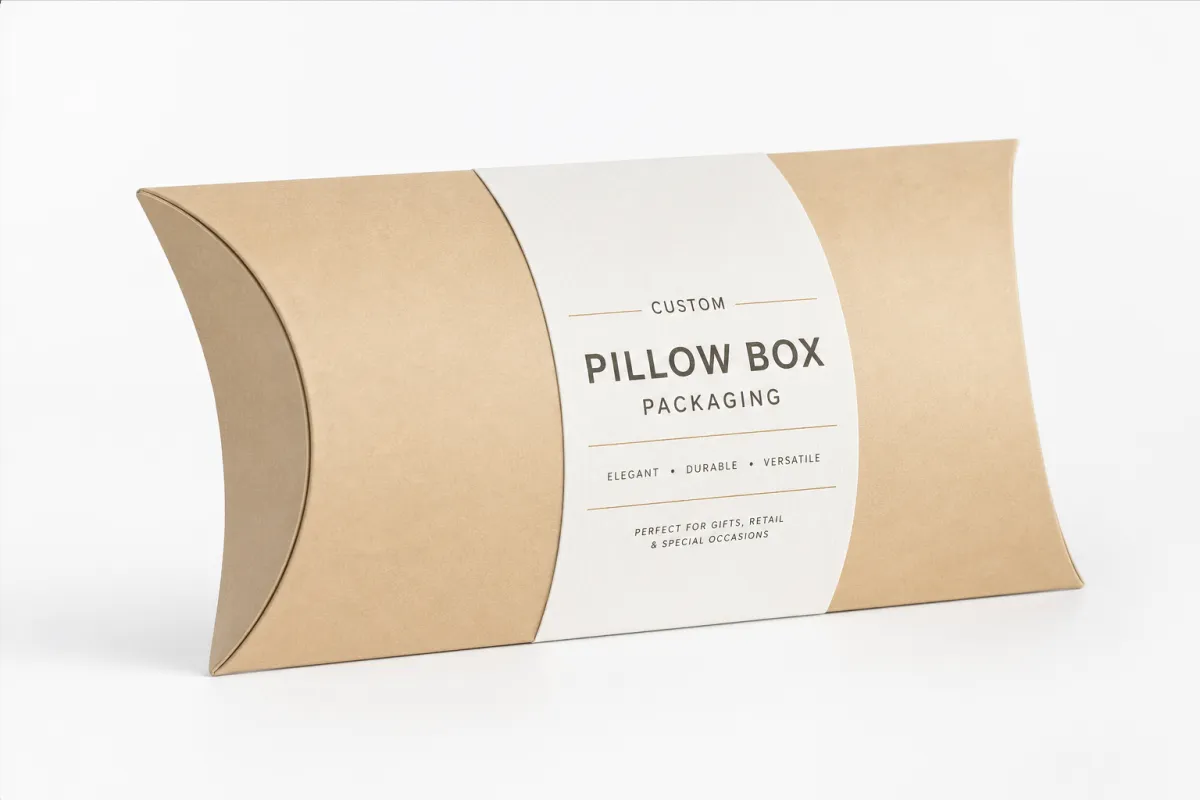
Custom pillow box packaging is a folded paperboard carton with a curved profile that resembles a pillow when assembled. It usually ships flat and is formed during packing or fulfillment. Side panels fold inward, the center panel defines the body, and the end geometry controls how securely the carton closes and how the shape settles around the product.
What makes the format useful is not only that it looks distinct, but that it changes how a small item is perceived at first glance. In gifting and retail settings, the curve feels curated without becoming ornate. On smaller shelves, that shape often draws attention faster than another rectangular carton, especially when the visual field is crowded.
The format works best with a fairly specific product profile. Jewelry, lip care, sample kits, tea sachets, gift cards, compact candles, accessories, chargers, and small wellness items are common fits. Bulky or irregular products can still work, but only if the structure is tested before full commitment. If the item needs pressure resistance, an insert, or shipping-level durability, those factors should be part of the specification from the beginning.
I have seen teams approve a beautiful concept and then get stalled at fulfillment because the product, board caliper, and fold tolerance were not aligned. Score depth, material stiffness, and internal clearance are not details you can fix after artwork approval. They are the foundation of whether the box will actually work.
Done well, custom pillow box packaging can feel premium without competing with the product itself. The strongest examples usually say "this belongs on a shelf" and then let the contents do the rest.
- Best for: small, lightweight products with clear retail intent
- Common uses: jewelry, cosmetics, accessories, samples, candles, and promo items
- Main benefit: premium look without the weight and infrastructure cost of rigid packaging
- Main limitation: fit and durability risks on bulky or heavy items unless reinforced and tested
Compared with many Custom Printed Boxes, pillow cartons usually allow enough print space for a logo, short message, and color direction while still keeping the product as the main focus. Packaging that competes with the product can feel overworked; packaging that supports it usually performs better across mixed channels.
The lowest unit price only wins when it does not trigger slower packout, higher damage rates, or weaker shelf communication.
Simple briefs are not simplistic. They are often faster because the constraints are clear early. More complex briefs can still work, but structure and artwork should be solved in sequence rather than all at once. A reliable pattern in successful launches is product-to-box alignment before decorative ambition.
How Does Custom Pillow Box Packaging Work?
The production path is straightforward in theory, but execution can punish small mistakes. A die-cut board sheet is scored and folded, then formed into the curved profile. The center panel defines volume and stability; the side flaps and end geometry create closure tension and help the carton hold shape during handling.
The dieline is the real operating document, not just an attachment for artwork. It locks finished dimensions, fold lines, glue zones, and safe print areas after conversion. If the dieline is wrong, the box can end up with drifting graphics, awkward curves, and poor fit tolerance. That is why stronger suppliers validate the dieline before final production sign-off.
Most custom pillow box packaging ships flat. Flat shipment improves pallet density and reduces warehouse stress during launch peaks when storage space is already tight. Assembly can happen at a benchtop, in fulfillment, or at retail prep, but repeatability determines whether the format can survive real volume.
Printing is not only a surface decision; it is also a performance decision. A full-color exterior can create urgency and visual energy, while one-color runs usually simplify color control and keep the design calm. Interior print is often underestimated because it can improve unboxing and add instructions or brand cues without much added complexity.
Closure engineering is a common fault line. A friction tuck can look elegant if tolerances are tight, while a reinforced end structure can improve resilience for distribution. Loose closure creates handling risk; overly tight closure slows packout and can fatigue operators. Physical sample checks catch those issues before they turn into rework.
At volume, many teams standardize one base architecture across SKUs. They keep shell sizes grouped, then vary inserts or graphics. That is one of the strongest ways to preserve speed and brand consistency in retail packaging programs with multiple items in the same family.
Relative to rigid packaging, custom pillow box packaging usually improves material efficiency and storage handling. Compared with plain sleeves, it gives stronger enclosure and a more memorable shape. That tradeoff is why buyers keep using it when visual distinction and practical logistics both matter.
Operationally, the value is often two-sided: reduced storage volume and stronger shelf language. For beauty and gifting categories, that combination can be the difference between "nice" and ready for scale.
- Dieline: the flat template governing shape, fold behavior, and assembly reliability
- Scoring: fold lines that control consistency, repeatability, and seam strength
- Tuck closure: the end geometry that holds the carton and affects user experience
- Flat shipment: lower volume in storage before conversion into final form
In supplier discussions, this is where teams separate average vendors from stronger vendors. The best supplier teams read every drawing as a manufacturing problem, then produce cartons that assemble easily and hold up in repeated handling. A beautiful sample with unreliable fold behavior is a warning sign, not a win.
Use an internal movement test before locking the structure. If the product shifts inside the carton, most shoppers and handlers perceive lower quality before they read any copy. Inserts, trays, and light supports can solve movement with modest cost compared with returns or scrap. That test becomes even more important when parcels, not hand-packed displays, are the main route.
Cost and Pricing Factors in Custom Pillow Box Packaging
Material is usually the first major pricing lever in custom pillow box packaging, and board choice often drives the earliest jump. Standard 14 pt and 16 pt structures are commonly lower cost. Heavier 18 pt SBS and similar stiffness systems increase conversion cost, and they are not automatically better unless the use case needs the added rigidity.
Size also shifts price in ways teams often underestimate. Larger cartons consume more substrate and ink, but very compact cartons can become expensive too because tolerances tighten and waste can climb. High curvature in small runs can create additional make-ready and trimming waste. The most reliable way to avoid surprises is to price from real dimensions from the start.
Print coverage influences cost directly. One-color artwork is usually the most affordable route. Full-bleed coverage adds ink usage, prepress time, color matching effort, and possible rework. Interior print, specialty coating, foil, embossing, debossing, and soft-touch lamination each move cost by their own rules. In many programs, finish selection becomes the second-largest cost driver after board and run length.
Volume remains a major variable, but price drops are rarely linear forever. Moving from 1,000 to 5,000 units often creates a bigger per-unit reduction than moving from 5,000 to 10,000, although that varies by supplier and machine capacity. The practical pattern is consistent: low volume pays for setup more heavily, while higher volume rewards stable files and fewer revisions.
Hidden costs can appear after the first quote. Insert systems, barcode validation, optional windowing, scuff-resistant finishes, kitting, and special packing workflows can change landed cost materially. Distribution plans with mixed loads and extra protective secondary packaging also add labor and handling time. So the format looks simple in CAD, but can become more complex during supply chain execution.
| Option | Typical Unit Range | What Drives the Price | Best Use Case |
|---|---|---|---|
| Basic one-color board with standard tuck closure | $0.18 - $0.30 | Lower print coverage, simpler die, fewer finishing steps | Samples, promos, low-risk retail items |
| Full-color custom printed boxes on 16pt to 18pt board | $0.28 - $0.52 | More ink coverage, prepress time, and tighter color control | Beauty, accessories, gift-ready retail packaging |
| Premium finish with soft-touch, foil, or embossing | $0.45 - $0.90 | Extra setup, specialty materials, and added finishing passes | High-margin gifts, seasonal launches, boutique brands |
| Recycled or FSC-style certified board with modest print | $0.24 - $0.48 | Material sourcing, certification paperwork, finish compatibility | Brands emphasizing sustainable package branding |
Those ranges are directional and should not be treated as fixed promises. Actual pricing depends on trimmed dimensions, run size, press setup quality, and production location. The structure and finish stack usually influences the outcome more than the shape by itself.
If sustainability is part of your policy, board sourcing can matter as much as visual design. FSC-linked sourcing appears in many procurement conversations, and the FSC framework can help procurement teams keep documentation clean. For practical environmental decisions, EPA's Sustainable Materials Management framework can help with recycled content and end-of-life assumptions, while ISTA-style testing remains a better risk check than assumptions under rough shipping conditions.
Pricing logic is straightforward but often misunderstood. The carton is not cheap because the shape is magical; it is efficient because it uses material well. The moment you add premium finish, protective inserts, and strict color requirements, you are buying a different product family. The quote reflects the system, not just the silhouette.
In several programs I have reviewed, labor speed overtook paper premium as the hidden cost pressure. If a carton takes 12 seconds to fold versus 25 seconds across 5,000 units, the labor impact is easy to calculate. That is why speed and consistency are pricing variables, not soft observations.
Custom Pillow Box Packaging Process and Timeline
Quick projects begin with clean inputs, not fast opinions. Packed product dimensions, realistic order quantity, and channel expectations need to be confirmed before design starts. A retail shelf launch, a subscription giveaway, and an e-commerce shipment each create different structural demands, so one-size assumptions usually fail.
After the brief comes dieline validation or build. Skipping this step is where teams lose the most time later. A shape can look correct and still fail when folded if panel proportions are off by millimeters. Fold geometry, logo placement around curved areas, and bleed safety all depend on this document.
Proofing should happen in layers. Digital proofs are fast for color and alignment checks, but physical prototypes test the real world. You need to ask whether it closes cleanly, whether the product moves, whether the finish survives repeated opening, and whether the closure stays reliable after handling. A flat proof alone cannot answer all of that.
Timeline length usually follows complexity, not just decoration level. A basic carton with standard materials and clean fit can move quickly once artwork is locked. Coatings, embossing, inserts, or complex closure reinforcement add meaningful queue time. Revisions, especially late copy edits, are often the schedule killer because they affect prepress, proofing, and production sequencing.
A practical benchmark for straightforward jobs is 12 to 15 business days from proof approval. For enhanced runs with heavier finishing and structural variation, 15 to 25-plus business days is more common. Freight, customs, and regional handling windows sit on top of production, so track them separately. If artwork is still changing while press time is already moving forward, the schedule is unstable.
- Brief: define packed product size, expected volume, channel, print intent, and finish limits
- Dieline review: lock fold geometry, panel proportions, and artwork safe zones
- Proofing: complete digital proofs, then sample structure where tolerance is tight
- Production: print, die-cut, finish, and convert into final carton form
- Delivery: ship flat, store efficiently, and assemble at packout with repeatable process
On paper, this is a linear flow. In practice, it behaves like a feedback loop. A logo change can require fresh artwork, and a size tweak can require a new sample. Teams that finalize dimensions early protect both cost and momentum.
Multi-SKU programs get cleaner when shared standards exist. If board spec is consistent across a family, conversion steps shrink, procurement gets simpler, and color control improves. Shared finish logic also helps reduce variation-driven rechecks across suppliers.
Channel changes should affect acceptance criteria too. Retail-focused programs may survive narrower handling assumptions; parcel programs cannot. Parcel handling introduces bin transfers, conveyor edges, top pressure, and repeated touches, so seam and edge durability should be validated for that scenario before launch. If it passes both shelf and parcel tests, it is more likely to hold up after launch.
Common Custom Pillow Box Packaging Mistakes
Most errors begin with measurement confidence that is too high. Teams often infer dimensions from lifestyle mockups and then discover fit issues after filling starts. Curved structures give very little forgiveness, so tolerance errors become expensive quickly.
Overstuffing is another frequent issue. A pillow carton can look full and premium in a photo, but physical force has limits. Bulky contents can distort the curve and weaken seams, especially when products shift during transit. At that point the issue is no longer aesthetic; it becomes a reliability risk.
Another common blind spot is delayed shipping validation. A carton that looks great under office light can bend or open in a warehouse-to-customer route if it was never tested for rough handling. Scuffing and bent panels are often warning signs, not final outcomes. If parcels are part of distribution, ISTA-style exposure assumptions should be mandatory inputs, not optional checks.
Print defects are a quieter drain. Low-resolution source art, missing font clarity, tight color traps, and bleed omissions usually do not show up as dramatic failures at first, but they reduce perceived value quickly. Drift on a curved panel looks like a casual error to shoppers. On larger runs, corrections are expensive and time-consuming.
Skipping physical sample review is usually where teams pay for optimism. Samples validate fold logic and stack behavior, reveal closure fatigue, and create the first tactile benchmark. Teams that rely only on approved PDFs frequently discover structural failure after the production decision is already too far along to fix cheaply.
- Measure packed dimensions, not just visual mockup dimensions
- Build tolerance windows for inserts or trays that alter internal volume
- Validate both shelf and shipping scenarios before full approval
- Check bleed, type clarity, and logo position before print commitment
- Require physical sampling for finishes, inserts, and tight structural fits
Packaging clutter is its own kind of mistake. Limited panel area plus too much messaging usually creates a rushed tone even in premium categories. I usually see better performance from one clear message and one supporting cue than from a panel that tries to explain everything at once.
Gift-led custom pillow box packaging especially benefits from restraint. Buyers scanning gift racks do not evaluate every word; they respond to cues like clarity, intention, and finish quality. Too much copy reduces perceived confidence. A clean hierarchy usually lands better under quick decision pressure.
Expert Tips for Better Shelf Appeal and Efficiency
Start with the product hierarchy before opening the design file. Structure answers protection and handling first; graphics answer brand signal second. If those are reversed, the result can look decorative in the office and unreliable in the field. I have seen this mismatch repeatedly in launches where teams were visually excited but operationally unprepared.
Pair finish choice to the operating context. Matte and soft-touch surfaces can improve perceived quality in minimalist and upscale collections by reducing glare. Gloss can increase impact when contrast is a strategic part of the brand. If your route involves handling loops and abrasion, aqueous coating is often the practical compromise between durability and design direction.
Opening quality deserves the same scrutiny as print. A package that opens and closes consistently with low effort feels premium before the customer reads a single claim. Human behavior starts with touch and motion, not copy length. That is one reason many strong runs prioritize closure behavior over extra visual details.
Treat packout speed as a real KPI. If each carton requires extra seconds to fold, labor cost and handling mistakes both rise. In one line I reviewed, a 13-second improvement on a 7,000-unit run moved margin more than a premium color change. Production teams can usually tell you if the design is too fussy for daily use.
Visual simplicity often beats visual complexity in almost every shelf environment. One strong motif, one concise statement, and one accent can outperform five elements with mixed intent. The effect compounds across a line when multiple SKUs share the same structure and visual logic.
Cross-SKU programs should resist redesigning every cycle. A stable architecture for panels, finishes, and color references improves procurement predictability and reduces nonconformance across runs. It also lowers the chance of one batch drifting in tone or fold behavior and creating QA issues.
Channel should steer the format decision. Retail launch priorities may reward visual speed and recognizability. DTC shipping prioritizes structural resilience and abrasion resistance. Sampling campaigns prioritize speed and consistency. Custom pillow box packaging can support all three, but only if the brief ranks constraints clearly from day one.
For teams comparing Custom Packaging Products, the practical benchmark is labor seconds per unit plus waste impact. That measure often exposes the best option earlier than unit price alone. A lower-priced carton can become expensive once it slows packing, while a slightly higher-priced one can save money if it folds and ships more cleanly.
A useful three-point shelf and hand test is simple. First, check folding comfort and closure confidence in hand. Second, check logo readability and color consistency at shelf height. Third, check shape distinction at a distance. If it clears all three, the design usually performs better than it appears in a static mockup.
The strongest carton is not always the most decorated one. It is the one that communicates clearly, protects adequately, and folds fast enough to support real operations.
Next Steps to Plan Custom Pillow Box Packaging
Before requesting quotes, build a one-page criteria sheet. Include packed dimensions, target quantity, finish preferences, finish restrictions, and any window or insert requirements. Add channel context explicitly: retail shelf, subscription gifting, event activation, or direct shipping. These inputs affect cost and risk far more than the final art preview.
Use normalized assumptions when comparing suppliers. A 16 pt board quote and an 18 pt board quote are not apples-to-apples unless you normalize the material baseline. The same goes for finish level, barcode support, and coating assumptions. Without normalization, your "cheapest" comparison often becomes a false winner.
Short-run physical samples are worth the inconvenience. They are especially important for fragile items, tight tolerances, and premium campaigns with high brand sensitivity. A sample proves geometry, fold behavior, and tactile quality far more effectively than iterative mockups.
Before confirming volume, test against storage, shelf flow, and shipping realities. Confirm stack stability, scuff durability, and closure retention after repeated opens. Most late surprises happen because teams approved the sample and then forgot the channel-specific friction points.
When planning wider packaging portfolios, keep decisions measurement-based. Combining custom pillow box packaging with other product packaging styles works better when each format is measured the same way: tolerance, print repeatability, packout speed, and damage response. That is how packaging becomes long-term infrastructure instead of a one-off campaign.
Custom pillow box packaging can be the right call for compact SKUs, but only if structure, cost, and channel assumptions are locked early. It is one of those formats that either feels inevitable once built right or expensive fast if you skip the basics. If you treat it as a system, test it, and monitor it with real operating data, custom pillow box packaging can stay useful across multiple launches instead of becoming a one-season experiment.
Takeaway: choose the format only after you have measured your item tolerance, your packout motion, and your shipping route, then lock a spec stack that your team can execute week after week without improvisation.
What products are best for custom pillow box packaging?
Small, lightweight products perform best: jewelry, cosmetics, candles, accessories, gift cards, and promo samples. Fragile goods usually need inserts or trays to avoid movement and protect delicate edges. Bulky or heavy goods can be done, but only when a reinforced structure and pre-production testing are part of the plan.
How much does custom pillow box packaging usually cost?
Cost is mainly driven by board stock, carton dimensions, print coverage, finish type, and order volume. Smaller runs usually have higher per-unit costs because setup and tooling are spread across fewer boxes. Foil, embossing, windows, inserts, and custom finishing typically create major jumps, so compare options with those items separated in the estimate.
How long does custom pillow box packaging take to produce?
Simple printed cartons can move quickly when dieline and artwork are correct from the start. Special finishes, multiple revisions, and required physical sample rounds increase timeline time. In most projects, clean product dimensions and stable artwork reduce delay more than creative back-and-forth.
Can custom pillow box packaging use recycled materials?
Yes. Recycled and FSC-style certified board options are common in this format, but the material should be validated for stiffness and coating compatibility early. If sustainability is central to brand positioning, lock material and finish assumptions before quoting and confirm behavior with physical samples.
What should I send for an accurate custom pillow box packaging quote?
Include precise packed dimensions, expected quantity, target colors, chosen finish, and whether inserts or windows are required. Clarify final use: retail display, e-commerce shipping, gifting, or promo bundling. If dielines and approved artwork exist, share them early so vendors can avoid assumption-based revisions.

