Custom Gable Box Packaging: Request Specs and a Quote
A checkout bag is cheap. It moves product from point A to point B and that is about it. A custom gable box does more work: it carries like a bag, stacks like a carton, and gives the handoff a cleaner finish the moment the customer leaves the counter.
That is why gable formats keep showing up in food service, retail packaging, gift sets, and small kit orders. The shape is practical, but it still gives you room for printed panels, brand color, and a more deliberate unboxing moment. If you need other structures too, see our Custom Packaging Products for formats that pair well with this style.
Why a Custom Gable Box Beats a Plain Bag at Checkout
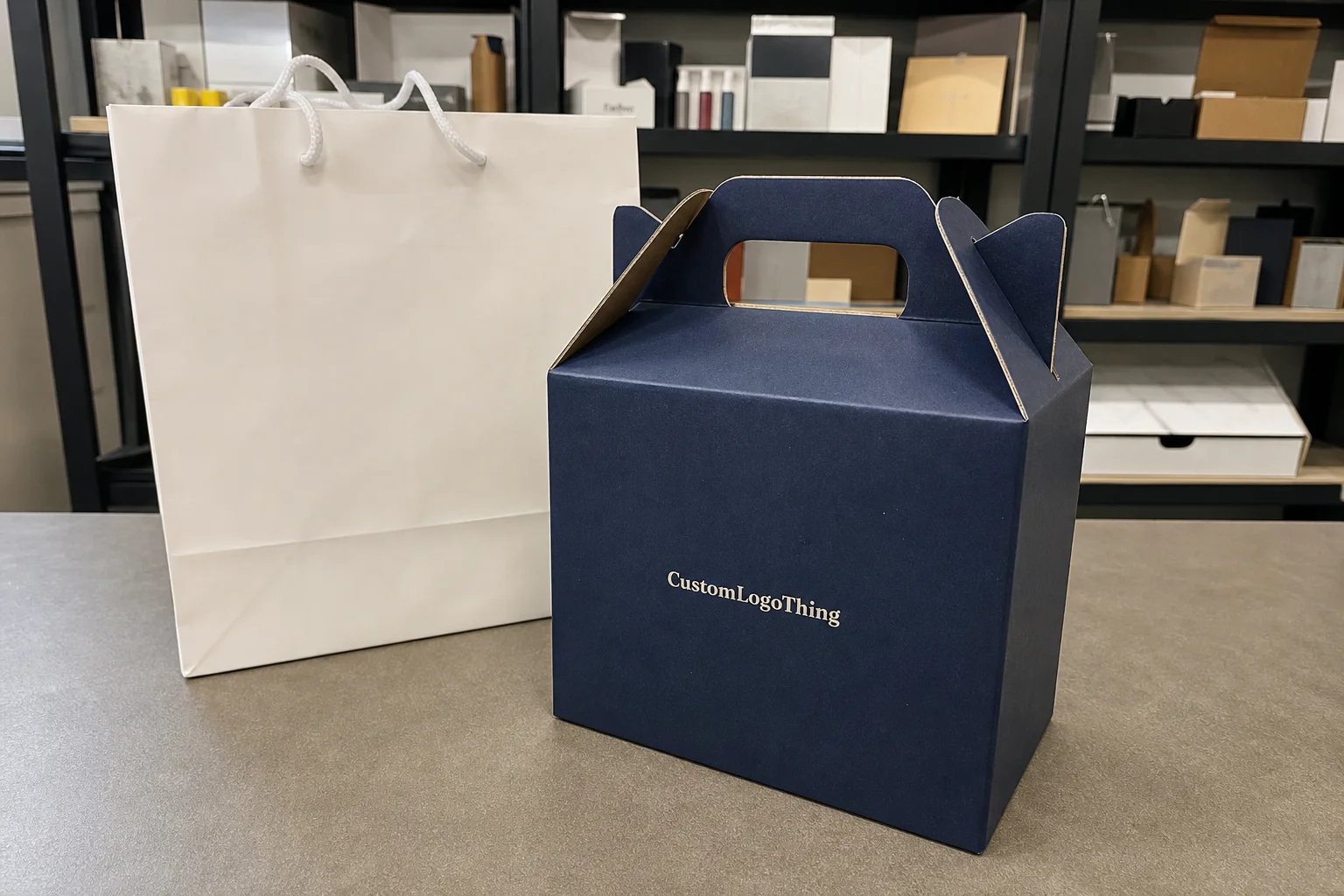
Picture a lunch counter at noon, a pop-up retail table, or a gift order with three smaller items packed together. A bag will carry it, but it does not organize the handoff. A custom gable box adds structure, a built-in handle, and a more polished first impression without forcing staff to assemble a complicated packout.
That mix is the appeal. The gable shape behaves like a small carton, while the top handle makes it easy to carry with one hand. For the buyer, that often means fewer add-ons: less tissue management, fewer labels, and less need for secondary packaging just to make the order feel complete. In practice, the right box can improve presentation and simplify the packing line at the same time.
It also changes perceived value. A plain bag feels temporary. A printed box feels deliberate. That matters in retail packaging and food-service packaging because the customer is not just judging the item inside; they are judging how much care the brand seems to put into the handoff. When the outside looks organized, the contents usually feel more premium before the box is even opened.
From a packaging design standpoint, the gable format sits in a useful middle ground. It is more structured than a paper bag, but less rigid and expensive than a full mailer box. That makes it a sensible option when a project needs Custom Printed Boxes that look intentional and still store efficiently.
"The best package does several jobs at once: carries cleanly, protects the product, and reinforces the brand without adding unnecessary labor."
There is also a plain operational benefit. Front-of-house teams usually want packaging that does not fight them during rush periods. A box that opens cleanly, holds shape, and stacks without collapsing saves time. That is the part buyers often miss when they focus only on shelf appeal.
How the Fold, Handle, and Closure Work
A gable box starts as a die-cut blank that folds into side panels, a base, and a top section that rises into a peaked roof. The handle is usually integrated into the top panel, so the customer can carry the package without a separate bag insert. Flat on a sheet, it is compact. Assembled, it is surprisingly functional.
The closure matters more than many buyers expect. Some versions use tuck tabs that lock in place. Others rely on interlocking flaps with no adhesive. That choice affects assembly speed, tamper resistance, and how well the box survives repeated opening. If staff need to pack hundreds of units in a rush, adhesive-free designs can save real time. If the contents are sensitive or expensive, a tighter lock may be worth the small tradeoff in speed.
Compared with a carryout bag, the gable format has better sidewall structure and better stack behavior. Compared with a mailer box, it is usually faster to load and easier for front-of-house use. Compared with a standard takeout carton, it offers a more visible branding surface and an obvious carry handle. None of that makes it universally better. Weight, fill height, and the product's center of gravity still decide whether it works.
That top geometry also changes usable space. A box can look roomy on paper and still pinch the contents near the peak. If the item is tall, awkward, or top-heavy, ask for internal dimensions rather than guessing from outside measurements. That one habit prevents a lot of fit issues later.
For buyers comparing formats, the right question is not "Which box looks nicest?" It is "Which one loads fastest, protects the product, and creates the fewest exceptions on the line?" That is the point where a custom gable box starts to make sense.
Cost, MOQ, and Unit Economics
Pricing usually comes down to five variables: board stock, print coverage, finishing, insert requirements, and quantity. Dieline complexity matters too. A simple one-color box with a clean cut pattern will price differently from a full-bleed CMYK carton with coated panels and a custom insert. The cleaner the spec sheet, the cleaner the quote.
MOQ is not a random barrier. It exists because setup costs, cutting time, and print prep have to be spread across the run. At low quantities, those fixed costs push the unit price up. At larger quantities, the economics improve because the same setup is absorbed across more boxes. Buyers often focus on the lowest line item, then discover the landed cost is worse once freight, samples, and reprints are included.
| Spec mix | Typical use | Approx. unit cost at 1,000 | Approx. unit cost at 5,000 |
|---|---|---|---|
| Light kraft board, 1-color print, no insert | Carryout, events, simple kits | $0.65 - $1.05 | $0.32 - $0.58 |
| 350gsm SBS, 2-color print, aqueous coat | Retail gifts, branded packaging | $0.88 - $1.40 | $0.44 - $0.78 |
| Premium board, full-bleed CMYK, spot treatment, insert | Higher-end product packaging | $1.20 - $2.10 | $0.62 - $1.10 |
Those ranges are not promises. They move with board availability, print coverage, finishing, freight, and current factory load. They still show the pattern buyers need to see: once the run gets large enough to absorb tooling and press setup, the per-unit price can drop fast. A good quote should make that breakpoint obvious.
Ask for pricing at multiple quantities, not one. A 1,000-piece price can look fine until you compare it with 3,000 or 5,000. Sometimes the inventory jump is small relative to the unit savings. Sometimes it is not. That depends on storage space, sell-through speed, and how long the product stays in the assortment.
Compare the same spec sheet line by line. Same internal dimensions. Same board grade. Same finish. Same insert. Same lead time after proof approval. If those do not match, you are not comparing quotes. You are comparing different products wearing the same label.
Production Process and Lead Time
A clean production run usually follows a predictable sequence: brief, dieline selection, artwork setup, proof approval, prepress, printing, die-cutting, folding, packing, and shipment. The order is simple. The delays are not. Most late jobs start with missing dimensions, slow artwork revisions, or approvals that sit idle while everyone waits on one more email.
For a first-time order, expect more review time than a reorder. The supplier needs to confirm structure, art placement, and production tolerances. A repeat job is faster because the dieline, print settings, and packing method already exist. That is one reason reorder customers usually move through production with fewer surprises.
Standard timelines for a straightforward project often land around 12 to 15 business days after proof approval, then shipping on top of that. More complex work can stretch into 18 to 25 business days, especially if the box needs special coating, inserts, or a heavier round of artwork review. Tight deadlines are possible, but only when the spec is locked early.
That is also where transit testing enters the picture. If the box will ship through parcel networks, ask whether the structure has been evaluated against relevant distribution assumptions such as ISTA transit testing guidance. A retail box that survives a counter handoff is not automatically ready for parcel compression, vibration, or corner impact.
One practical rule keeps projects on track: lock the artwork after the dimensions are confirmed, not before. Reversing that order creates wasted rounds of proofing. In packaging work, the art file is usually not the hard part. The hard part is matching the art to the actual fold geometry.
Specs That Change Performance: Board, Coatings, and Inserts
Material choice sets the tone for the whole job. A lighter board lowers cost, but it can flex under stack pressure. A thicker board improves stiffness and hand feel, which matters for premium product packaging or gift packs. Buyers often ask for "stronger cardboard," but that is too vague. The better question is how much rigidity the product needs, and whether the box will be carried, stacked, or shipped.
For paper-based packaging, thickness, caliper, and finish work together. A matte surface softens the visual effect and hides minor scuffs. Gloss tends to look brighter and can sharpen printed color, but it may show fingerprints more easily. Aqueous coating gives basic scuff resistance and faster handling. Spot varnish or spot gloss can add emphasis to logos or illustrations, though it should be used with restraint. Too many effects can make a box look busy instead of premium.
Sourcing matters too. If sustainability claims are part of the brief, ask whether the board is FSC-certified and whether the supplier can document it. For brand owners that need a chain-of-custody story, the FSC certification framework is the benchmark to check, not a vague "eco-friendly" claim.
Inserts are worth the added cost when the product can move, tip, or break. A partition, cradle, or simple die-cut insert can keep bottles upright, separate components in a kit, or stop delicate goods from rattling in transit. That extra structure can also improve the customer experience because the contents arrive in the arrangement the brand intended.
Use the product itself to drive the spec. Food, gifts, retail kits, and event packaging do not need the same materials. A bakery order may prioritize grease resistance and quick assembly. A gift set may prioritize presentation. A shipment kit may need better crush resistance and tighter fit control. One box style can serve all three use cases, but not with the same build.
There is also a tradeoff buyers should not ignore: every added finish, coating, or insert raises the likelihood of a production delay if the supplier has to source it separately. That is not a reason to avoid upgrades. It is a reason to decide early instead of treating the spec like a moving target.
Common Mistakes That Raise Cost or Cause Damage
The most common error is oversizing. Buyers add "just a little extra room," then discover the contents shift in transit. Empty volume looks harmless on a drawing. In a real box, it creates movement, presentation problems, and sometimes crushed corners because the product never stabilizes inside the pack.
Artwork problems come next. Low-resolution logos, incorrect bleed, and heavy ink coverage can all raise costs or delay approval. If the file is built for a different dieline, the print may land awkwardly across folds or near the handle cutout. That is not just an aesthetic issue. It can weaken the visual impact of the whole package.
Shipping conditions are another blind spot. A box that looks excellent on a shelf may underperform if it faces moisture, repeated stacking, or long transit cycles. Compression, humidity, and abrasion are real. So are seasonal changes. If the box will travel through a parcel network, it should be spec'd with those stresses in mind, not just retail appearance.
Skipping a sample is probably the most expensive shortcut. One prototype can reveal a weak lock, a poor hand feel, or a fit issue that would be costly to fix after mass production starts. That is why experienced buyers ask for a dieline, a printed proof, and at least one physical sample before full approval.
Short version: most failures do not come from the concept. They come from assumptions. The box looked right in a mockup, but the internal space was wrong. The print looked fine on screen, but the fold lines were not considered. The budget looked reasonable, but the insert was omitted. Those are preventable mistakes.
Another one: assuming the handle can carry any load just because it exists. It cannot. The structural limit depends on board grade, fold design, glue points, and what is inside the box. A bakery box and a bottle kit should not be treated as the same thing, even if the outline looks similar.
Expert Tips and Next Steps for a Cleaner Quote
If you want a fast, accurate quote for a custom gable box, start with the numbers that matter most. Send the exact internal dimensions, target quantity, product weight, print goals, and any insert or coating requirements. If the product is irregular, include the widest point and the tallest point. Suppliers can work with that. Guesswork slows everything down.
Ask for three items before you approve production: a sample, a dieline, and a proof. The sample confirms fit. The dieline confirms structure. The proof confirms artwork placement and color expectations. When those three checks line up, the chance of a production dispute drops sharply.
For shipments that will face rough handling, ask how the structure relates to common parcel testing logic, including drop and vibration expectations. If the box is part of a larger shipping system, it may be worth checking whether the build fits the assumptions behind ISTA or similar transit methods. That does not mean every box needs formal testing. It means the box should be judged against the journey it will actually take.
Use a simple comparison method when you receive multiple quotes:
- Match the same dimensions and board grade.
- Check whether print, coating, and inserts are included or excluded.
- Compare lead time after proof approval, not just the promised delivery date.
- Ask whether freight, tooling, and sample charges are separate.
Once the spec is stable, a custom gable box becomes easy to buy and easier to repeat. That is the real advantage of a disciplined packaging brief: fewer surprises, fewer revisions, and a better box the second time you order it.
For a supplier-ready order, use this checklist: internal dimensions, quantity, product weight, print method, finish, insert needs, target lead time, and shipping destination. Send that as one clean brief. It saves back-and-forth, and it usually produces a better quote for the same custom gable box spec.
FAQs
What size should a custom gable box be for my product?
Measure the product at its widest point, then add room for loading, closure, and any insert or tissue. Use internal dimensions first; outer dimensions matter later for shipping and shelf planning. If the item is irregular, request a sample dieline before approving production.
How much does a custom gable box cost per unit?
Unit cost depends on size, board grade, print coverage, finish, and quantity. Smaller runs usually cost more per box because setup costs are spread across fewer units. Ask for pricing at multiple quantities so you can see the breakpoints clearly.
What is the usual lead time for custom gable boxes?
Lead time is usually driven by proof approval, print complexity, and current production capacity. First-time custom orders often take longer than repeat orders because artwork and dielines need review. Build in extra time if you need special coatings, inserts, or tight delivery dates.
Do I need inserts or coating on a gable box?
Use inserts when the product can shift, tip, or break during handling or shipping. Choose a coating when you need better scuff resistance, moisture resistance, or a cleaner retail finish. For food or gift use, the right finish can improve both protection and appearance.
What files are best for printing a custom gable box?
Vector files are preferred for logos, text, and line art because they hold sharp edges at production size. Artwork should follow the supplier's dieline and bleed requirements to avoid trimming issues. If the design is complex, request a prepress check before full approval.


