Buyer Fit Snapshot
| Best fit | Custom Glass Jar Packaging Wholesale for Brand Growth projects where brand print, material claims, artwork control, MOQ, and repeat-order consistency need to be specified before quoting. |
|---|---|
| Quote inputs | Share finished size, material target, print colors, finish, packing count, annual reorder estimate, ship-to region, and any compliance wording. |
| Proofing check | Approve dieline scale, logo placement, barcode or warning zones, color tolerance, closure strength, and carton packing before bulk production. |
| Main risk | Vague material claims, crowded artwork, missing packing details, or unclear freight terms can make a low unit price expensive after revisions. |
Fast answer: Custom Glass Jar Packaging Wholesale for Brand Growth should be specified like a repeatable production item. The safest quote records material, print method, finish, artwork proof, packing count, and reorder notes in one written spec.
Production checks before approval
Compare the actual filled-product size with the drawing, then confirm tolerance on folds, seals, hang holes, label areas, and retail display edges. Reserve space for logos, QR codes, warning copy, and material claims before decorative graphics fill the panel.
Quote comparison points
Review material grade, print process, finish, sampling route, tooling charges, carton quantity, and freight assumptions side by side. A quote is only useful when the supplier can repeat the same color, closure quality, and packing count on the next order.
Custom Glass Jar Packaging wholesale is never just a container decision. In practice, the failures usually begin at the edges: the cap profile, liner compatibility, label register, or shipper spec. I learned that lesson years ago after watching a brand lose a full holiday season to a repeatable seal issue that looked fine in photos and failed on the line. For brands that need steady replenishment and shelf-ready launches, custom glass jar packaging wholesale becomes the control layer that keeps both cost and presentation from drifting out of range.
Glass is still relevant because it does things most alternatives cannot. It blocks odor migration better than many plastics, gives customers visual confidence, and communicates value on both shelf and desktop. In foods, beauty, wellness, and home fragrance, that trust is often part of the sales argument before anyone tastes, rubs, or scents the product. A clever program here is not “cheaper jar or pricier jar”; it is the right balance of fit, finish, and repeatability from first pilot run to repeat reorder.
The cheapest jar is never the cheapest landed package if half the run arrives with loose caps, chipped rims, or a carton that cannot survive parcel handling.
If you are planning a branded roll-out, you have to treat the jar as one link in a chain, not the star of a one-off sample photo. The outer shipper, insert strategy, and retail display language either amplify the jar or expose every weak spec in your system. Our Custom Packaging Products and Wholesale Programs pages are useful starting points when you want the package to work as part of a full architecture instead of a disconnected decision.
Why Custom Glass Jar Packaging Wholesale Pays Off
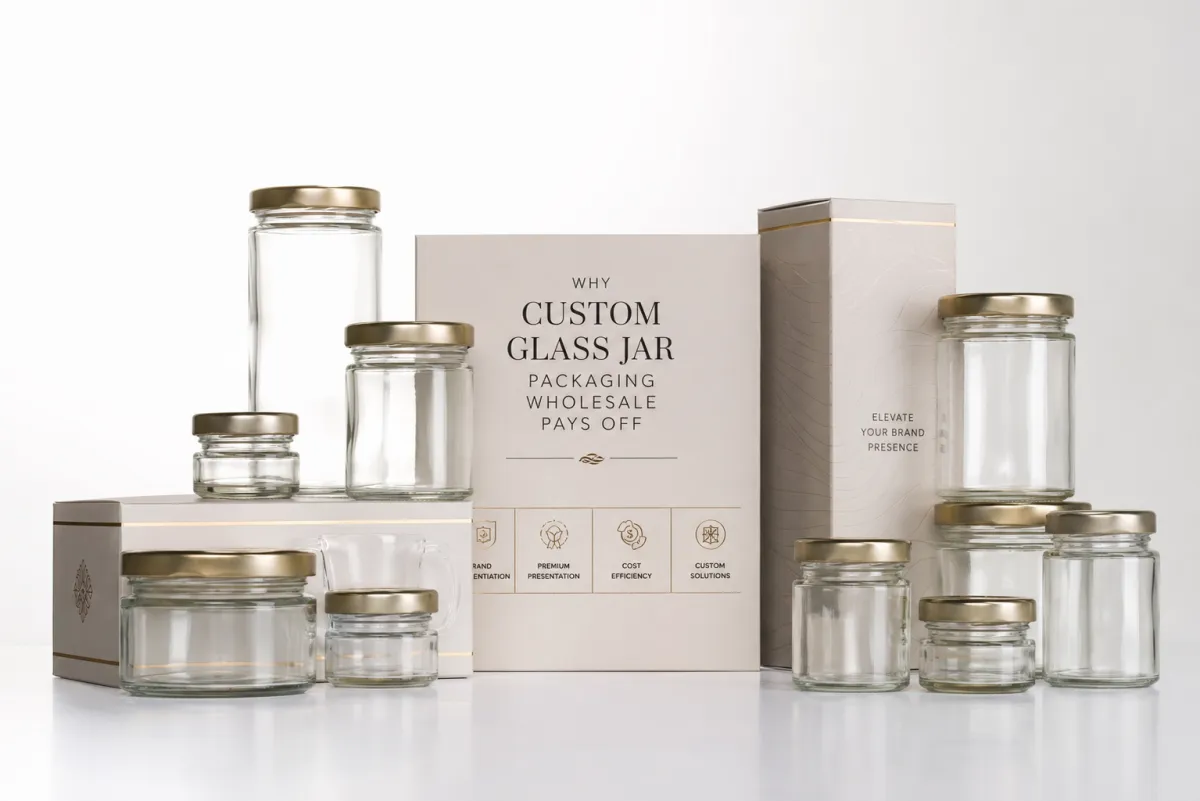
In many launches, the glass body is the least complicated part to get right. The real breakpoints happen when the cap doesn't match the neck finish tolerance, the filler catches, or the liner behaves poorly with a solvent-heavy formula. One supplier quote can look great, and the first pallet can still fail because the full stack load was designed around a different shipping geometry. That is where custom glass jar packaging wholesale earns its keep.
Volume helps, but consistency helps more. A 10,000-piece run does not just reduce per-piece cost; it locks process variables so quality teams are not relearning the same fixes every quarter. In my own sourcing reviews, teams that hold body, neck, and decoration standards across batches usually see fewer artwork revisions, fewer line stoppages, and fewer “almost acceptable” rejections that disappear only after expensive overtime. For mature programs, that consistency is usually the strongest margin protector.
Glass still has a practical edge in products that can pick up scents, oils, or light exposure quickly. Food packaging often needs a clean inert option; wellness formulas often need a premium unbroken visual impression; candles and dry goods rely on shelf clarity and emotional quality. If freight costs are razor thin, you still run the numbers before committing to glass style because a premium package can become expensive overnight once damage claims and returns are included.
Sometimes a conservative design beats an aggressive one. A straight-sided jar with a proven closure can out-perform a dramatic silhouette that slows filling or increases transit damage. That tradeoff is not creative defeat; it is operational discipline. When the same jar family serves grocery, e-commerce, and gift channels, you need predictable durability as much as visual charm.
The programs that scale well are usually the ones that plan for variation before launch. If seasonal labels, different scents, or alternate bundle kits are coming, build that into the initial spec rather than treating each reorder like a fresh project. A disciplined spec sheet is the sign of a team treating custom glass jar packaging wholesale as a scalable process, not a custom quote by exception.
Custom Glass Jar Packaging Wholesale Product Details
Jar geometry changes everything, not just how pretty it looks on screen. Shape influences label adhesion, fill stability, capping torque, display footprint, and shelf blocking. In this field, a small change in shoulder radius can quietly change your reject rate. The common families remain straight-sided, round, wide-mouth, squat, and specialty profiles, but each one carries a usage profile you should map before art is even approved.
Straight-sided profiles usually win on manufacturability and label reliability. They are efficient for line speed and straightforward cartonization. Wide-mouth jars are better for heavy or chunky products, especially where spoon access and hand filling are real, not theoretical. Squat profiles read premium on shelf and can feel substantial, though they can alter center-of-gravity stacking behavior. Specialty profiles belong to brands with enough volume to justify extra setup attention and still need to perform in real-world shipping, not just concept images.
Color and finish are where technical and marketing decisions collide. Flint glass gives maximum product visibility, and for many food and cosmetics categories, that visibility directly affects conversion. Amber glass is a practical choice when UV sensitivity matters, and it can reduce formulation risk in travel or warehouse exposure. Frosted, coated, or etch-like treatments can create a more tactile shelf identity, but they can also change perceived cleanability and label readability. The most defensible custom glass jar packaging wholesale choice is the one matched to the product and its channel constraints, not the one with the loudest finish.
Closures are not decoration; they are performance controls. For food programs, lug-style closures still dominate for their tight, familiar seal behavior, while screw caps are common in multiproduct lines that need flexible SKU handling. In beauty and wellness, a smoother closure profile may better fit unboxing expectations, but only if the seal remains reliable. Liners are where many teams get surprised: foam, pulp, foil, or pressure-sensitive barriers each influence moisture retention, reseal performance, and customer perception. Match cap and liner to the actual product chemistry and storage conditions, not to the print moodboard.
Decoration strategy is often where costs spiral if not controlled early. Screen printing is usually stable and repeatable for simple marks with predictable color counts. Hot stamping can elevate a premium segment with metallic cues, while frosting or coating can protect shelf presence without heavy full-surface print. Labels remain the fastest adaptation route for seasonal or multi-market SKUs because you can update copy faster than fully retooling the glass body. That said, labels add edge conditions at handling points, so treat label edge clearance like a technical spec, not a design afterthought.
Category context should guide the full decision, and that includes how the product reaches the customer. Food packaging needs consistent fill behavior and robust sealing windows. Candle clients often need stable bases, heat-safe handling assumptions, and decoration that remains legible after routine movement. Beauty brands usually prioritize tactile premiuming and a controlled branded panel that supports repositioning. For gift packages, outer presentation becomes a direct part of value, so carton architecture and coordinated printing matter more than many teams admit.
Glass also performs better when integrated with adjacent packaging parts. In a multi-SKU launch, labels, divider geometry, insert depth, and carton art should all be planned together, otherwise the jar can look impressive in isolation and fail as a system. That mismatch costs time the exact moment fulfillment staff discovers an incorrect clearance or a label that rubs in motion. So yes, the jar can be simple, but the surrounding ecosystem must stay intentional for custom glass jar packaging wholesale.
- Straight-sided jars: Best for stable labeling, predictable stacking, and broad SKU adaptation.
- Wide-mouth jars: Preferred for thicker products, scooping use-cases, and hand-fill operations.
- Squat jars: Strong shelf presence for premium lines, with added weight and stability impact.
- Specialty profiles: Useful when the profile itself builds brand memory and merchandising differentiation.
If you want to compare options quickly, map jar, closure, decoration, and outer packaging together instead of in separate folders. Our Custom Packaging Products catalog and Wholesale Programs pages can help teams evaluate that complete stack without pretending any component is separate from the rest.
What Should You Check Before Ordering Custom Glass Jar Packaging Wholesale?
Good quoting starts with an unusually specific spec sheet. In custom glass jar packaging wholesale, capacity labels and practical working volume should be documented together, then converted into fill behavior at speed. Neck diameter, finish code, body OD, height, wall gauge, and tolerance range are not trivia—they are failure points if they are missing from the first round. Two jars with the same nominal volume can behave entirely differently when one has a different shoulder angle or wall profile.
That is where real-world tradeoffs appear. A lighter jar lowers freight cost, but thin glass can increase tipping risk and damage odds if the protective architecture is weak. A wider opening improves user access, but it can demand a heavier closure and new liner stack-up. A taller body might help retail visibility, yet require different tray geometry, corner reinforcement, or divider layout. Planning custom glass jar packaging wholesale with filling and freight together prevents expensive revisions later.
Sample governance is where quality plans are made or broken. Ask for clear body samples, closure samples, and artwork-ready prototypes before lock stage. Art that looks perfect on a flat proof can still distort on a shoulder or near a label curve; if you only catch that after production, the cost to fix it is usually painful. A good practice is to request at least two proof loops: mechanical fit and visual execution.
Compliance and transport testing cannot be an afterthought in serious programs. Food-contact and cosmetic plans should include confirmed material declarations and relevant compatibility testing from the supplier. For mixed e-commerce and wholesale distribution, ask whether transit testing includes edge cases like drops, vibration, and humidity shifts. ISTA references are common starting points for packaging stress expectations, and EPA recycling guidance helps with claims and messaging where applicable. If these inputs are missing from the quote, ask for them before you sign.
Use this checklist before approving:
- Capacity: Confirm nominal fill size and practical usable volume after tolerances.
- Neck finish: Match cap and liner to exact threading or profile specification.
- Wall thickness: Balance crush resistance, transport risk, and unit weight.
- Weight: Verify loading efficiency on pallets and transport-rate implications.
- Tolerance range: Ensure capping, labeling, and filling equipment can accept variation.
- Decoration area: Confirm print limits, minimum font sizes, and wrap positions.
Secondary packaging also needs early definition. If inserts, molded pulp, or foam supports are required, verify clearance and compression strategy before production. If cartons are custom branded, their internal dimensions must include the whole protective stack, not just the bare jar. That one decision alone often decides whether a wholesale program gets treated like a reliable supply chain or an occasional field issue.
My practical habit, after years of seeing teams get surprised, is simple: collect three samples as separate checkpoints—a plain body sample, a decorated sample, and a closure/liner fit sample. It is boring, but it usually prevents a bad first batch from becoming a reorder headache. In practical terms, small control loops cost less than later rework.
How Much Does Custom Glass Jar Packaging Wholesale Cost?
Unit costs for custom glass jar packaging wholesale are usually controlled by a handful of variables you can actually predict before production starts: shape, volume, wall profile, color, finish method, closure type, tooling scope, and shipping lane. If you compare only the jar line item, you will miss the larger bill created by cartons, inserts, freight mode, and handling risk. That’s why landed cost planning is the only number that helps in executive meetings.
MOQ strategy can make or break launch flexibility. Stock containers often support smaller pilots for test markets or short campaigns. Custom-decorated stock adds artwork and color controls, and usually needs a bigger commitment. Fully custom molds bring branding clarity and design differentiation, but tooling and sampling overhead push MOQ and lead-time expectations much higher. For custom glass jar packaging wholesale, the right MOQ is the one that keeps sell-through momentum while limiting aging inventory.
Based on recent supplier comparisons across Asia and North America, a plain stock jar in around a 5,000-piece build frequently lands in a similar range to what many buyers already budget for basic packaging. Decorated stock options usually move up with print and coating complexity, while fully custom decorated lines with specialized closures can rise quickly depending on setup complexity and color standards. Fully custom mold pricing is often quote-based because setup and tooling are not linear. The key discipline is to decompose the quote, so you know where each dollar really belongs: glass, decoration, closure, protection, or transport.
Here is a practical comparison used during sourcing review meetings.
| Program Type | Typical MOQ | Typical Unit Cost | Best Fit | Notes |
|---|---|---|---|---|
| Stock jar, plain | 1,000-5,000 | $0.22-$0.55 | Trials, refill programs, standard retail SKUs | Fastest path, lowest setup risk, limited décor |
| Stock jar with label or frosting | 2,500-10,000 | $0.35-$0.95 | Brand refreshes, gift-ready SKUs, mid-tier programs | Balanced approach to visual impact and volume control |
| Custom decorated jar | 5,000-20,000 | $0.45-$1.40 | Premium launches and strong package branding | Print setup, color matching, and carton planning are critical |
| Fully custom mold | 10,000+ | Quote-based | Distinctive shape strategy and long-term line ownership | Tooling, sampling, and lead-time management add complexity |
There are always hidden costs, and this is where many sourcing teams get blindsided. Sample charges, tooling, special inserts, premium cartons, corner-board upgrades, and extra transport cushioning all shift real spend. If products travel far or are fragile, better corner reinforcement and vibration protection are not optional, they are risk mitigation. In custom glass jar packaging wholesale, the best price is the one that includes those non-obvious line items at the start.
Tiered pricing can work well in SKU families if you are disciplined about shared components. Grouping compatible sizes, closure families, or label structures into one production path can reduce setup waste and logistics friction. But don’t force a single line if each SKU has different sealing requirements, because a unified run with bad compatibility can cost more in returns than it saved on setup. Always model both alternatives with sensitivity to carton count and labor impact.
One caveat before any final sign-off: freight rates, tariff changes, and customs treatment can shift landed cost by more than 10% in high-volume seasons. I mention this because it happened in multiple buyer programs last year, and nobody liked explaining unplanned cost drift to sales. Treat quotes as a starting point, then confirm final all-in totals before the contract window closes.
Custom Glass Jar Packaging Wholesale Process and Timeline
A reliable sequence matters, and it usually runs: scope, quote, sample, proof, pre-production review, production, packing, and shipment. Skip any of those and your risk rises. The goal is not paperwork; it is avoiding the hidden rework that shows up as late-line labor or warehouse claims. Teams that document this sequence tend to recover from surprises faster.
Sample windows and production windows are different clocks. Stock jars can move quickly when existing inventory exists, while custom-decorated stock usually needs proof correction cycles and production prep. Fully custom mold work has additional design and test-shot stages that are difficult to compress. A practical planning model is often 7-15 business days for sampling, 12-30 business days for production after approval, plus transport time based on mode.
Delays have familiar fingerprints. Artwork revisions after proof, closure substitutions after sample, carton counts changed by weight drift, pallet specs changing after warehouse review. These are not catastrophic events; they are process facts. The advantage of a mature custom glass jar packaging wholesale team is usually not “fewer problems,” but faster detection and containment.
Buffer planning is cheap insurance, especially for launch windows tied to retail or holiday calendars. If cartons, labels, inserts, and shippers are all involved, one delay in artwork can cascade across fulfillment, printing, and booking. That means your original release date should account for two dependencies: technical approvals and transit uncertainty. If your brand calendar is aggressive, don’t just compress production; protect the critical approvals.
A clean launch schedule is usually built by protecting the approval path, not by squeezing production windows until they crack.
Communication is infrastructure. The production side needs formulation type, target viscosity, and fill environment. The logistics side needs destination mode—parcel, LTL, or container—and the exact service level expectation. The decoration side needs panel size, print limits, color standards, and whether the design is front-only or wraparound. In a strong custom glass jar packaging wholesale workflow, each team gets the same reference package before first production start, so details are not repeated from scratch each time.
Why Choose Custom Logo Things for Glass Jar Packaging
Custom Logo Things is useful for teams who need more than a static quote file. The stronger value is operational alignment: jar body, closure behavior, decoration limits, and freight choices should be decided together, not in separate conversations. That integration is where many buyers pay extra without realizing why.
In mixed packaging builds, jar, label, divider, and carton requirements all influence each other. A brand can easily end up with mismatch costs when the jar is approved but the shipper is still assuming a different load profile. What matters is whether the supplier can see that mismatch early and flag it before production. If they can, your team spends less time firefighting and more time supporting launch execution.
Quality quotes should be transparent by section. A professional quote calls out unit glass cost, decoration setup, optional services, sample freight treatment, and expected lead assumptions. If these are buried in notes and phone calls, you are paying for ambiguity. In a mature marketplace, custom glass jar packaging wholesale is competitive, and clarity usually saves money faster than the lowest headline unit number.
Repeatability is where long-term value appears. If your first batch worked, the next batch should mirror it closely enough that operations are stable. That includes cap torque behavior, print placement, and carton integrity after repeated handling. Seasonal rollouts and multi-SKU families are especially vulnerable to drift, so supplier discipline here is worth premium consideration.
There is practical value too. Sample alignment, closure validation, decoration guidance, and freight-aware packing can save several coordination hours per reorder. In my work, the biggest difference between a supplier and a partner is what happens after quote acceptance: do they still ask the right questions when volume changes? Good partners help you avoid expensive design compromises on short notice.
If your roadmap includes jars plus bottles, cartons, or promotional packaging, evaluate the full system architecture before finalizing any one item. Our Custom Packaging Products and Wholesale Programs pages can be useful when that alignment needs to happen across channels.
Next Steps for Custom Glass Jar Packaging Wholesale
If you are ready to move, the fastest way to get a useful quote is not to ask for price immediately; it is to confirm usage constraints first. Confirm capacity, shape logic, neck finish, closure type, decoration intent, MOQ target, and shipping destination together. That single set usually converts vague discussions into realistic proposals.
Then, gather the materials that reduce friction: preferred dimensions, artwork files or style references, rough forecast by quarter, and a sample pack for comparison. Even when branding is flexible, those basics let the supplier suggest whether screen print, label, frosting, coating, or a plain finish best fits your line speed and margin. The cleaner your brief, the closer your quote gets to actual production cost.
If your build includes a retail or e-commerce launch, request two sample paths: one for functional fit and one for final appearance. That simple move catches sizing and handling issues before approval, and it is especially useful when carton and insert components are included. It is a practical habit that saves teams from discovering defects at the exact moment inventory is already committed.
Use this final buyer sequence before final approval:
- Set target fill size, actual usable volume, and tolerance range.
- Lock neck finish and confirm closure/liner compatibility with product type.
- Choose decoration route based on channel, shelf goal, and budget reality.
- Pair MOQ strategy with sales forecast and reorder cadence.
- Demand sample jar, closure, and final proof checks before approving production.
- Verify carton, divider, pallet, and transportation requirements together.
The takeaway is straightforward: treat custom glass jar packaging wholesale like a production system, not a visual purchase. Compare total landed cost, and if a slightly higher unit price avoids returns, shipping claims, and extra labor, it may be the better business move. That is not a tradeoff slogan; it is usually the one that keeps cash flow steadier and launches repeatable.
One practical disclaimer from the field: conditions change with region, material sourcing, and transport conditions, so confirm final rates and compliance documents in writing before issuing a purchase order. I say this because almost every expensive rework I’ve seen came from assumptions that were never converted into explicit specs.
What is the typical MOQ for custom glass jar packaging wholesale?
MOQ depends on whether the order is for stock, custom-decorated stock, or fully custom mold work. Stock bodies usually support smaller starts, while higher design complexity generally pushes volume expectations upward. Ask each supplier for MOQ by SKU, and separate the asks for jar, closure, and decoration to avoid blending incompatible commitments for custom glass jar packaging wholesale.
How do I choose the right closure for custom glass jar packaging wholesale?
Match closure type to viscosity, required sealing strength, and consumer use. Food and cosmetic lines should validate liner compatibility and reseal behavior as part of the pre-production checks. Request jar-and-cap fit samples and ask for handling simulation, because a cap that seems fine on paper may loosen or stress the finish under repeated use in real conditions for custom glass jar packaging wholesale.
How long does custom glass jar packaging wholesale usually take?
Timelines vary by complexity, sample cycle, and the shipping method. Stock options with no tooling can start faster, while custom decoration and fully custom molds usually require longer lead time. Build in artwork revision and freight booking buffers, especially if your program also includes custom printed cartons and inserts for custom glass jar packaging wholesale.
Can custom glass jar packaging wholesale include decoration and labeling?
Yes. Common routes include screen printing, frosting, hot stamping, and labels, often in combination. The right choice depends on budget, channel, and how many SKUs you expect to evolve after launch. Confirm artwork limits, color accuracy process, and print or label placement before approval so the chosen process does not become a bottleneck for custom glass jar packaging wholesale.
What should I prepare before requesting a quote for custom glass jar packaging wholesale?
Prepare target capacity, preferred profile, closure and liner preferences, decoration type, unit forecast, and destination details. Include fill method and handling notes so the supplier can align specs with line speed and warehousing. If possible, send reference photos, even rough ones, because context helps the team prevent costly assumptions and gives you a more accurate landed-cost estimate for custom glass jar packaging wholesale.

