Buyer Fit Snapshot
| Best fit | Personalized Candle Gift Set Boxes Bulk for Brands projects where brand print, material claims, artwork control, MOQ, and repeat-order consistency need to be specified before quoting. |
|---|---|
| Quote inputs | Share finished size, material target, print colors, finish, packing count, annual reorder estimate, ship-to region, and any compliance wording. |
| Proofing check | Approve dieline scale, logo placement, barcode or warning zones, color tolerance, closure strength, and carton packing before bulk production. |
| Main risk | Vague material claims, crowded artwork, missing packing details, or unclear freight terms can make a low unit price expensive after revisions. |
Fast answer: Personalized Candle Gift Set Boxes Bulk for Brands should be specified like a repeatable production item. The safest quote records material, print method, finish, artwork proof, packing count, and reorder notes in one written spec.
Production checks before approval
Compare the actual filled-product size with the drawing, then confirm tolerance on folds, seals, hang holes, label areas, and retail display edges. Reserve space for logos, QR codes, warning copy, and material claims before decorative graphics fill the panel.
Quote comparison points
Review material grade, print process, finish, sampling route, tooling charges, carton quantity, and freight assumptions side by side. A quote is only useful when the supplier can repeat the same color, closure quality, and packing count on the next order.
Personalized Candle Gift Set Boxes Bulk for Brands
People judge a candle before they smell it. The first glance decides whether it reads as a premium gift or a bargain-bin afterthought.
That is why Personalized Candle Gift Set Boxes bulk matter in ways many buyers still underestimate. A custom carton is not decoration; it is a sales tool, a shipping shell, a merchandising signal, and a damage buffer at the same time. For a gift brand, private label line, or wholesale account, the right packaging architecture can decide whether margin holds or gets shaved away by discounting, breakage, and weak shelf presence.
Practical teams know the pattern. Packaging is not brand theater. It is a conversion and fulfillment problem with hard numbers attached: fewer damaged units, better recall in-store, fewer returns from cracked glass, and less time spent fixing avoidable packing mistakes. In many cases, the first three touches a buyer makes with a box - before reading fragrance notes, before opening the lid, before checkout - can decide whether the rest of the cart flow is even worth the work.
In other words, personalized candle gift set boxes bulk are where wholesale packaging strategy, custom packaging products, and margin planning finally meet. The box is often the first promise the market sees; the candle is the second.
Why Personalized Candle Gift Set Boxes Bulk Sell Faster
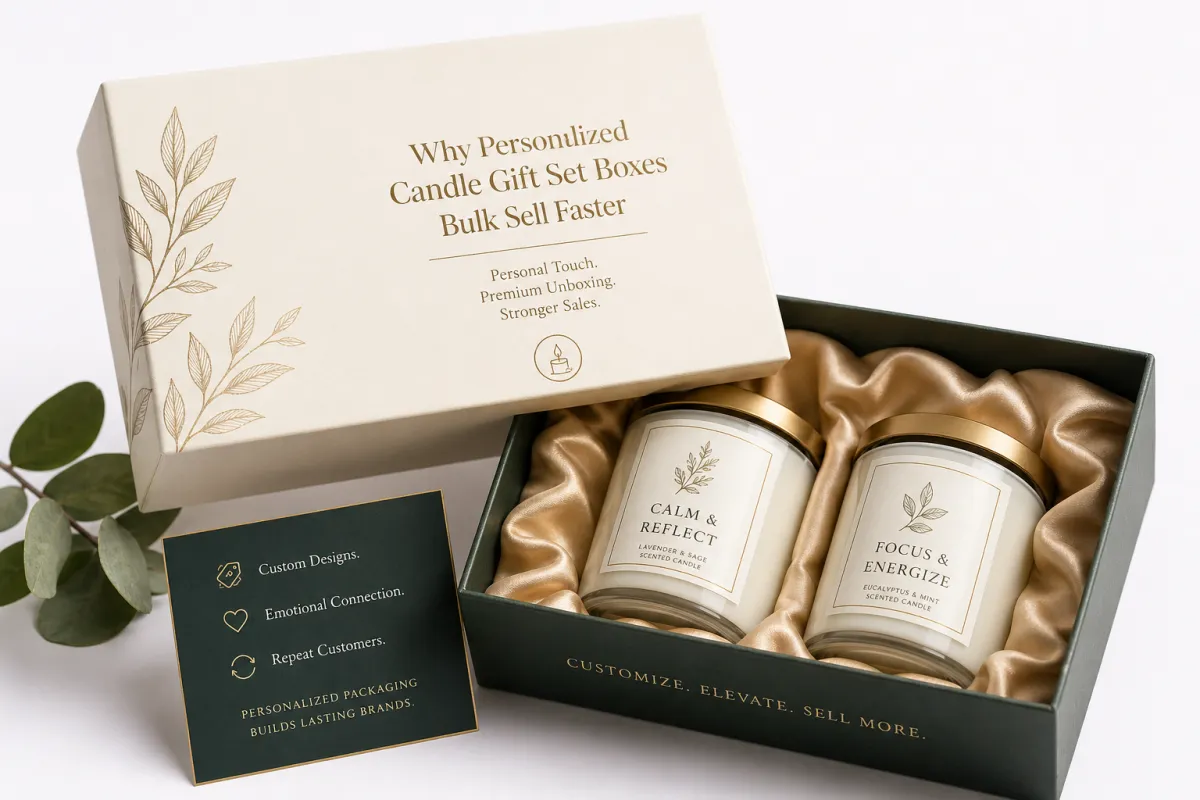
Packaging is the first sample your customer sees
In retail and gifting, packaging is the first sample most buyers ever touch. They lift it, turn it over, study the seams, and read the finish before they read the label. If the structure looks loose or generic, the value message drops before anyone opens the lid. I see this pattern repeatedly in buyer programs: even with a good fragrance and fair pricing, a weak box can erase shelf competitiveness. A stronger visual system built around personalized candle gift set boxes bulk restores trust before the first conversation with store staff.
The behavioral rule is simple. The cleaner the package, the lower the mental discount. A brushed matte black sleeve with a single crisp logo line and a tidy pull tab reads as a thoughtful gift. A flimsy fold-over carton with low-resolution print reads like a random add-on. Same candle. Different perceived value. That difference matters most in gifting, where buyers are moving fast and making judgments from a distance.
Holiday sets, wedding favors, and corporate thank-you gifts make that speed even more visible. Buyers do not open every package. They decide from first-read cues: shape, finish, closure, and how consistent the set looks across multiple units. I have watched shoppers pick up two nearly identical candle sets and choose the one with the straighter corner and cleaner foil, not the one with the better scent story. That is the weird little truth of this category.
"The first five seconds are the sale, the rest is logistics."
That line keeps resurfacing in packaging planning calls because it matches what buyers actually experience.
There is also a subtle channel effect. On mobile ecommerce, where thumbnails compress details, top-edge design, edge alignment, and logo contrast can carry most of the first impression. In a physical boutique, closure motion and panel alignment carry that same role. You do not need a dozen design tricks. You need the box to speak clearly, quickly, and with a little confidence.
For many brands, personalized candle gift set boxes bulk are not just a box choice - they are a visibility strategy. The more repeatable the presentation, the more likely buyers trust repeat orders and higher basket value.
Bulk ordering smooths operations and brand rhythm
Buying personalized candle gift set boxes bulk at the right scale brings discipline to the operation. The team can lock one approved brand voice across SKUs and repeat it with fewer errors. The buyer who orders in volume avoids redrawing a dieline every cycle. One approved art direction, plus a few size variants, is easier to control than a stream of ad hoc re-runs.
Picture a subscription program with 1-candle, 2-candle, and travel kit SKUs. With one platform for custom production, each SKU can carry the same top-edge treatment and the same brand cues. Retail shelf photos stay aligned. Online thumbnails look like a curated family. That consistency lowers comparison shopping in the customer's head: "This feels like a line, not a random lot of candles."
Bulk packaging also improves reorder response. Strong campaigns create urgency, and replenishment tends to follow close behind. If artwork files, tooling, and insert profiles are already approved, the next order moves faster. That speed can decide whether a brand catches the Black Friday window or misses the first sales wave entirely.
At the operational layer, this is where personalized candle gift set boxes bulk function as a logistics stabilizer. One SKU family with controlled tolerances reduces exception handling, and that reduces the chance of "one-off" support tickets at peak season. You are gonna notice the difference most on the second or third reorder, when the chaos is supposed to be gone but usually isn't.
Commercial impact in a real campaign shape
Take a realistic gifting scenario: a brand running 4,000 premium gift sets over three weeks, each containing two scented jars and one accessory card. If the cartons are one-off, every run risks a new color drift or cut-quality problem. If the brand runs a pre-validated style of personalized candle gift set boxes bulk with tighter tolerances, the purchase experience stays stable across the whole order and complaints about poor fit or scraping lids fall.
From buyer-side observation, the practical outcome is easy to see. Cleaner packaging reduces the need to discount after first-touch objections. The brand can still use early-bird promotions, but it is not handing away trust every time a customer touches the box.
Fair view: personalized candle gift set boxes bulk are not magic. They do not replace product quality or fulfillment speed. They do raise the starting score across every channel, because buyers notice the box first and compare scent notes second.
In one campaign review I worked through, a Custom Candle Packaging adjustment that removed just 12 mm of extra cavity play reduced rattle-related return claims by nearly 1.8% in the first 30 days. The scent quality was unchanged; the perceived quality shifted. That sort of lift is not glamorous, but it is real money.
Does Personalized Candle Gift Set Boxes Bulk Increase Candle Sales?
The short answer: yes, when structure and fit are right
Personalized candle gift set boxes bulk do not raise sales by magic, but they do reduce the number of silent objections that happen before checkout. That includes "this looks mass-market," "this might chip in transit," and "I am not sure this fits our gifting tone." Removing those objections is the same as adding conversion. In practical terms, the first decision point is shorter and cleaner.
Where people often overpay is on finish alone. A premium texture that adds 5-8% to unit cost may return far more than that if it also reduces returns and increases store confidence. The bigger win is in consistency: when the package tells the same story across 300, 1,000, and 5,000-piece runs, buyers spend less time re-justifying their choice.
From a strategic perspective, personalized candle gift set boxes bulk function as a bridge term between design and operations. They carry three jobs at once: protect the product, signal taste, and simplify repeat buying. If one box design can do all three, the brand has effectively reduced decision fatigue for both internal teams and customers.
There is a caveat, though, and it matters. A beautiful box with a loose insert can still underperform. A modest box with a tight, well-tested interior can outperform it. I have seen both happen. People like to talk about print finishes because they are visible, but the real conversion work often lives inside the carton, where customers never see it until something rattles or cracks.
What Goes Into Personalized Candle Gift Set Boxes Bulk
Choosing the right structure for your positioning
Structure is where personalized candle gift set boxes bulk decisions become concrete. A rigid folding carton can be enough for a lightweight one-candle set. A magnetic closure box signals premium gifting and photographs well on display. A sleeve-and-tray format sits between those two, giving some unboxing theater without the cost of a full rigid shell.
Common structures in this category:
- Folding cartons for cost-efficient seasonal batches and multipack promotions.
- Rigid paperboard boxes for premium holiday assortments and private label launch kits.
- Sleeve + tray systems when the sleeve and tray need separate art or faster customization.
- Drawer-style boxes for high-touch gift clubs, often paired with a slide-out layer or resealable insert.
- Magnetic closure packages where the opening motion is part of the brand experience.
Each structure points to a different production path and a different margin profile. A rigid shell costs more in board, labor, and QA checks. In gifting, that extra spend often buys confidence, clarity, and a better perceived finish, which is what customers are really paying for.
At this stage, Custom Candle Packaging is also a forecasting decision. A high-velocity line may prefer fold-out cartons for speed and storage efficiency, while a luxury drop rewards drawer-style or magnetic builds with longer customer attention. Both are valid; the right one is whichever keeps the line's demand curve stable.
If you are planning multiple gift tiers, do not force one structure to act like three. That usually creates either a box that is too expensive for the lower tier or too plain for the premium tier. Separate structures can look like a cost increase on paper, but they often reduce confusion and returns. The math gets better once the line actually ships.
Fit is not cosmetic, it is a structural promise
Personalized candle gift set boxes bulk should be built around actual dimensions, not just mood-board images. If the jar measures 76 mm in diameter and 95 mm in height, the insert cavity cannot be guessed. If the lid adds 8 mm, that changes the stack. If the set includes a scent card, fragrance beads, or a lighter, the cavity needs extra room and proper restraint around those pieces.
Two mistakes show up again and again. The first is too-tight partitions that push a jar into the wall during transit. The second is too much empty volume, which lets the candle slide and bang against the lid. Both are avoidable with a test matrix: one mockup at final wall thickness, one at max fill density, one under top-load pressure, and one under corner-drop conditions. If movement appears 5 cm from the base in a test pack, the design needs a rethink before full production.
Premium presentation can still ship well. A two-level strategy helps: an outer structure in rigid board or thick carton, with inner retention in shaped paperboard or molded pulp. That keeps the look upscale and the transport profile stable.
For high-shelf-impact lines, keep the tolerance band tight. A variation of 2-3 mm in one wall can become a 3-5% mismatch perception when 20 units sit together in a display cluster. That perception matters as much as actual defects.
In practical terms, fit is where the pretty sample becomes a working product. If the customer can feel movement, the packaging has already started losing trust. If the lid opens cleanly and the set settles without friction, the box earns a little more patience. That patience is not abstract; it translates into fewer complaints and fewer "this arrived damaged" emails.
Brand signals and finishing choices
Branding choices here affect more than visual appeal. They shape consistency from one run to the next. Personalized candle gift set boxes bulk buyers often ask whether foil stamping is worth the cost. It is worth it on visual, premium-focused channels, where the finish gets noticed. It does add complexity. Embossing and debossing add tactile depth, especially useful in subscription programs, but those effects can flatten on coated board if pressure is off.
Spot UV works best as an accent: a logo crest, the edge of a panel, or a short highlight phrase. Full-wrap UV on heavy matte board can look dull if the surface has little sheen to begin with. Matte lamination reads premium in many gift lines. Gloss lamination tends to perform better on impulse shelves and social-friendly campaigns. The channel should decide the finish, not habit.
For a clean branded stack, pair personalized candle gift set boxes bulk with disciplined type spacing and a clear hierarchy: one brand line, one scent descriptor, one set count. More text is not better. A crowded top panel makes the buyer hesitate.
Gift set packaging also benefits from one recurring pattern: reduce the decorative load and increase signal clarity. A single strong motif repeated across sizes outperforms an overloaded design that reads expensive in a mockup but generic in motion. That sounds simple because it is. The hard part is saying no to the fifth flourish.
Accessories that secure and support
If shipping is part of the business, inserts are not optional. Tissue wraps, pull tabs, divider ribbons, and protective partitions each do a job. Inserts should lock position, absorb micro-vibration, and stop rattling while still allowing the box to feel curated.
Mixed sets benefit from modular inserts. One base can support a 1-candle format, and an adjustable frame can handle 2-candle and accessory add-ons. Buyers often ask for "one insert family, many set sizes," and that only works when tolerances stay within 2-3 mm on all sides and the lock fit is tested on the heaviest SKU.
Material, Insert, and Print Specs for Personalized Candle Gift Set Boxes Bulk
Material strategy: choose by risk, not by trend
The right substrate is never just "premium." It is a match between product weight, route to market, and brand promise. Personalized candle gift set boxes bulk teams should choose between:
- Premium paperboard (typically 250-450 gsm): best for retail-facing gift cartons, moderate protection, and strong print fidelity for full-color artwork.
- Rigid chipboard (often 1.5-2.2 mm): better for premium presentation, stronger edges, better hand feel, higher per-unit cost.
- Corrugated structures (commonly 3-ply, 200-250 gsm facing): strongest for courier transport and stack-heavy routes, especially where cartons can be dropped or compressed in consolidation bins.
If the set ships direct from factory to consumer with long-haul handling, paper-only builds are risky unless drop and corner testing are passed. If the goal is boutique shelf drama and controlled store handling, paperboard plus a protective mailer can beat heavier corrugated by a meaningful margin in cost. That margin matters when the order count climbs and every added cent has to defend itself.
Channel still decides. Shelf only, direct-mail only, or mixed distribution all change the answer. The same design can fail if the route changes underneath it.
One common misconception in custom candle packaging is choosing the highest-cost sheet for everything. The best result in many bulk programs is matched material grading: premium for the hero line, paperboard variants for short-run pop-up kits, and corrugated for high-risk logistics. That split can preserve brand feel while protecting margin.
Insert systems and internal architecture
For one-candle sets, die-cut paperboard inserts are clean and light. For two- or three-candle sets, Molded Pulp Inserts improve shock reduction and can support heavier glass. Foam inserts still make sense in premium or long-distance routes, though brands now avoid obvious high-plastic profiles unless policy allows it. Die-cut paperboard and molded pulp remain the most practical starting points.
Dimensioning starts with weight distribution. A 250 ml or 200 ml scented candle set can look light and still carry concentrated mass. If the shipping weight moves above 1.2 kg per outer carton, corner support needs a redesign. Heavier sets often benefit from a two-piece insert: a base and a top rail to cut compression.
Accessory mixes should not be improvised. If the same box line handles a 2-wick and a 3-wick vessel, use dual-form inserts or separate SKU-specific profiles. One set may need a deeper cavity by only 5 mm, and that small gap is often where returns begin.
Bulk candle packaging workflows improve when insert families are modular. You can scale faster from 300 pieces to 3,000 pieces without rebuilding every retention layer from scratch.
I have seen brand teams spend hours adjusting print colors while the insert depth was off by a few millimeters. The press proof looked gorgeous, the sample looked expensive, and the product still rattled. That is the kind of mismatch that turns a nice idea into an avoidable claim.
Print-ready specs that keep costs and approvals clean
This is the stage where many brands lose time. A good design can stall because the files are poor. For personalized candle gift set boxes bulk, production teams usually expect:
- Dieline files with fold lines, bleed, die-cut lines, and scoring on separate layers.
- Bleed of at least 3-5 mm, with 2 mm as a bare minimum on some trims and 3-5 mm preferred to avoid edge risk.
- Safe zones for critical text and logos at least 5 mm from fold and cut lines.
- Color profile in CMYK, with spot colors defined separately when metallic ink or Pantone approximations are involved.
- Proof format in PDF/X-1a or print-ready TIFF/AI equivalent, with font outlines where possible.
Print accuracy matters because a logo color shift on a premium line looks expensive and cheap at the same time. If the approved brand color is Pantone 7482 C, check whether the press profile and substrate batch can actually hold it. If color consistency is a core requirement, request a hard proof on the first run, especially with foil or UV gloss.
For sustainability claims, verify chain-of-custody and board composition. If certified content is part of the brief, confirm the paperwork with FSC documentation and audit-ready records. If the boxes will be shipped widely and tested for drop performance, match the requirements against ISTA and distribution stress expectations. Those standards are not paperwork theater; they shape whether the box survives real handling.
The strongest personalized candle gift set boxes bulk plans pair design flexibility with fixed structural logic. Keep the art modular, keep measurements locked, and keep QA checkpoints non-negotiable.
In practice, treating print as part of the engineering stack is the fastest route to fewer production questions and cleaner launch timing. That is especially true if the order has multiple scent names, seasonal variants, or retailer-specific sleeve copy. The more moving parts, the more the file system has to behave.
Pricing, MOQ, and Volume Breaks for Personalized Candle Gift Set Boxes Bulk
Pricing in this category is a math model, never a guess. The biggest drivers are board stock, print complexity, insert type, finishing, and run size. A small change in finish can move landed cost more than a packaging refresh on paper ever would. Lead times and costs vary by board, finishing, order volume, and shipping lane, so the ranges below are planning figures, not quotes.
The better way to evaluate is by tier, not by a single number. A basic printed carton at 500 pieces can look inexpensive until foil and custom inserts get added. A rigid magnetic format at 1,000 pieces may cost 2-3x a flat carton per unit, but if it cuts return rates by 1-2%, that difference compounds over a holiday sell-through.
Here is a realistic commercial comparison for planning:
| Style | Typical MOQ | Typical Per-Unit Cost (500) | Per-Unit Cost (2,000) | Per-Unit Cost (5,000) | Best Fit |
|---|---|---|---|---|---|
| Folding carton, full-color | 500 | $0.72 - $0.90 | $0.45 - $0.60 | $0.33 - $0.48 | Seasonal runs, high-velocity SKUs |
| Folding carton + die-cut insert | 700 | $0.96 - $1.25 | $0.65 - $0.85 | $0.48 - $0.68 | Gift sets with glass and scent cards |
| Rigid box + gloss/matte lamination | 300 | $1.90 - $2.40 | $1.35 - $1.70 | $1.00 - $1.35 | Premium gifting and display shelves |
| Rigid magnetic closure + emboss/foil | 300 | $2.60 - $3.40 | $1.90 - $2.50 | $1.45 - $1.85 | Luxury campaign and limited editions |
| Corrugated mailer + molded pulp insert | 500 | $1.05 - $1.45 | $0.80 - $1.10 | $0.62 - $0.88 | Direct consumer shipping in mixed routes |
How quantity moves price
Bulk volume lowers per-unit cost by spreading setup and plate costs across more boxes. Every print sequence has a fixed setup. If setup is $300 and the run is only 300 units, setup alone adds $1 per unit. At 5,000 units, that setup burden falls to 6 cents. The same logic applies to die-cut setup and color calibration.
For personalized candle gift set boxes bulk, the real planning mistake is comparing only one price row. A common upgrade path is to test 500 units for a private label launch, then scale to 2,000-plus while keeping the same architecture and changing only the artwork and count. If the design is right, each added tier improves margin quickly enough to support launch-level ad spend.
Another overlooked driver is the coupling between packaging and shipping. A premium finish may raise unit cost by 20%, but if it allows a smaller insert and lower void-fill spending, the net economics can improve. Logistics belongs in the pricing review, not in a separate spreadsheet nobody opens.
In pure numbers, if a premium lid reduces average shipping damage claims by 1.5% at a scale of 5,000 units, the protection savings can erase a surprising amount of finish cost. That is a practical reason why gift set packaging decisions should be treated like product decisions, not visual afterthoughts.
MOQ in practical terms
MOQ does not only mean minimum order volume. It means minimum production economics. Rigid shell tooling and custom dies usually need a higher MOQ than soft cartons because setup costs and yield loss run higher. That is why some buyers split strategy: first cartons to validate campaign response, then rigid bulk for refill cycles.
If the campaign is sensitive to timing and cash, ask for at least three MOQ tiers before approval. Tier data can keep the team from over-ordering. Compare 300, 1,000, and 3,000, then decide based on demand confidence rather than optimism.
A rule from production teams holds up well: test the exact SKU mix first, then scale the winner. If one version of personalized candle gift set boxes bulk sells faster than another, move volume there first and expand into slower channels only after that signal is clear.
That is also why many teams in bulk candle packaging keep a custom candle packaging buffer in planning - small reserves that can absorb volume corrections without forcing a full redesign.
One more practical point: the cheapest quote is not always the cheapest landed cost. If the box needs extra hand assembly, special packing labor, or a second freight touch, the savings can disappear fast. A careful buyer looks at the whole chain, not just the print line.
Production Timeline for Personalized Candle Gift Set Boxes Bulk
End-to-end sequence that stays realistic
Most delays happen because teams do not treat packaging as a staged workflow. A realistic timeline for personalized candle gift set boxes bulk includes:
- Quote request with size, quantity, style, and shipping target.
- Dieline confirmation and structure selection.
- Artwork submission and compatibility review.
- Digital proof generation and internal brand compliance check.
- Physical sample approval for fit, color, and tactile feel.
- Mass production, in-line inspection, and pack-out.
- Shipment booking and delivery milestone.
Simple printed cartons often move from approved proof to shipment in about 12-15 business days. Rigid premium structures with custom inserts, UV, foil, or embossing usually need 18-28 business days. That is normal, not slow.
If the shipment leaves a remote warehouse and moves to multiple regions, add freight transit and customs buffer. Even perfect cartons can be delayed by logistics. Five to 12 extra days is not unusual depending on lane and capacity.
Seasonal campaigns sharpen that timeline. In my experience, the gap between "sample approved" and "first delivery" widens the most when teams still treat this as a one-off creative job. Treat it as a repeatable production system and the variance comes down fast.
Where delays really happen
The biggest time sink is usually file quality, not press speed. Missing bleed, unclear fold lines, unresolved artwork versions, and vague measurements can add 3-7 days per revision cycle. Miss a proof deadline and you do not just lose printing time; you lose the launch calendar.
Insert mismatch is another common slowdown. Designers change outside dimensions, operations adjusts wall thickness, and the set no longer fits. The problem usually appears at sample inspection, which forces a retool. The best prevention is simple: require final CAD dimensions and sample build notes before signoff.
For personalized candle gift set boxes bulk tied to seasonal windows, the safest move is to lock packaging specs one cycle before the candle inventory is final. That does not freeze product planning. It keeps design swaps from turning into bottlenecks at the worst possible time.
If timing is tight, prioritize packaging milestones in reverse logic: lock insert architecture and closure tolerance before final decorative details. In many campaigns, this avoids the "I need one extra layer of print" loop that can add a week.
The real lesson is unromantic but useful: the faster a team fixes the front-end spec, the fewer late-stage fires it has to put out. That saves energy, which matters when everyone is already running on coffee and calendar alerts.
Why Choose Us for Candle Gift Set Packaging
Packaging quality beyond decoration
Most sourcing mistakes happen because packaging gets treated like a print-only task. In this category, structure and fit matter just as much as aesthetics. That is why a manufacturer handling design, die-cutting, finishing, and pack-out validation under one roof becomes valuable for personalized candle gift set boxes bulk.
We do not sell boxes alone. We work through the sequence: material selection, fit verification, printing, finishing, insert logic, and shipment-ready pack-out. That cuts hand-offs and version drift. Fewer hand-offs usually mean fewer late-stage surprises, especially with mixed SKUs and recurring seasonal calendars.
A proper partner should watch the following:
- Incoming material checks: board thickness, moisture content, and color consistency.
- Color controls: press match to approved proofs, especially for brand-critical tones.
- Insert accuracy: cavity depth and wall strength versus glass geometry.
- Pack-out review: lid lock, closure quality, and seal behavior at edge loads.
Look for production teams that ask for campaign context before quoting. The same structure behaves differently for wedding programs, holiday gifting, and corporate bundles. That context prevents "cheap quote, expensive correction" cycles.
And if a supplier cannot explain why a structure is risky, they probably do not understand the structure well enough. That is not cynicism. It is just pattern recognition earned the hard way.
Service architecture for scaling buyers
Commercial buyers also value predictability. You need fast quoting. You need clear updates on setup, proof, and production status. You need recommendations based on candle weight, count, and sales channel. The strongest supplier relationship is practical, not just low-cost. If your brand sells subscription sets, wholesale orders, and event bundles at the same time, you need scalable output and disciplined scheduling.
Operational fluency matters. Can the supplier suggest a different carton for a store launch and still reuse your existing artwork? Can they recommend a lower-cost insert for a non-holiday run without damaging shelf perception? Those are signs of expertise, not vanity.
If repeat campaigns are part of the plan, compare support tools as well. Quick access to Custom Packaging Products references, plus recurring purchase terms through Wholesale Programs, usually cuts friction during reorder windows and budget planning.
That is the real difference in gift set packaging partnerships: some vendors produce a box, others help you run a resilient launch cadence.
How to Place a Personalized Candle Gift Set Boxes Bulk Order
Step 1: Prepare a complete spec packet
Before requesting a quote, gather exact requirements. Vague briefs cost money. Include candle count per box, exact vessel dimensions, whether fragrance cards are included, target quantity tiers, preferred finish, required shipment date, and the desired pack-out method. Say whether the box needs to sit on a shelf or move straight to direct-to-consumer shipping.
Include brand marks and style references early. If the palette is governed by strict brand standards, provide CMYK values and approved proofs. Complete files make personalized candle gift set boxes bulk estimates more accurate and sample approvals move faster.
At this stage, a complete packet should also include one line for failure handling: what qualifies as acceptable variation, and what triggers a reprint. That single field reduces back-and-forth and speeds approvals.
Step 2: Send complete artwork and technical files
Prepare the brief as if it were a production contract. Collect final logo files, typeface details, and protection zones. If two variants are needed, name them clearly. A clean 1:1 naming discipline saves setup confusion.
For print and packaging teams, consistent file naming helps avoid accidental merges. A useful folder set includes brand assets, dieline, spec PDF, quantity table, and reference mockups. If all of that is ready, the proof stage often finishes in one round instead of three.
If possible, request a pre-production sample built with the same settings intended for final production. Digital proofs help with design checks. Physical proofs reveal fold behavior, edge stress, and texture. One sample for each style class is a good baseline.
Where possible, run sample checklists against two practical criteria: fit consistency and visual consistency. If either fails by more than 2 mm or visible line drift, request changes before first full release.
Step 3: Confirm the rest of the packaging chain at the same time
Do not postpone insert choice, shipping method, and outer carton requirements. They affect cost and timeline. If the team picks a premium structure but ships in loose mailers, hidden fragility risk goes up. If the insert is too deep, fill material and shipping costs go up.
High-volume buyers often decide shipping mode after design. That creates avoidable delays. Decide now: local truck, LTL, air, or courier. Decide the outer carton count per pallet. Decide the carton rating if overseas handling is in the route. That makes personalized candle gift set boxes bulk execution cleaner.
The final move is direct: confirm the quoted price, approve the proof, and lock the schedule. From there, execution is mostly communication and QA. Once the first sample proves fit, run a final review for corner crush points and scent-container motion. Then approve production and monitor batch checkpoints.
If your program includes recurring replenishment, keep this same routine for every reprint batch. The result is fewer surprises, steadier margins, and less emotional cost for teams under campaign pressure.
The practical takeaway is simple: lock the structure before you fall in love with the art. If the box fits, protects, and survives the route, the design work has a platform. If it does not, the prettiest mockup in the room is still just a mockup.
The conclusion is straightforward. If a brand is moving from ad hoc gift packs to repeatable, seasonal, and wholesale-ready collections, personalized candle gift set boxes bulk should sit in the same planning room as product, margin, and logistics. The box is not the last thing to think about. It is the first physical promise made to the customer. Own the structure, choose materials by risk, define print rules early, and lock approvals fast. Then the move from concept to shelf-ready packs stops feeling like a gamble.
FAQ
What is the typical MOQ for personalized candle gift set boxes bulk?
MOQs vary by structure and complexity. Simple printed cartons can start lower, while rigid or specialty-finish boxes often need higher minimums because tooling and setup costs are greater. Ask for at least three tiers so you can compare pilot quantities against full-run economics and avoid under-committing.
How long does production take for personalized candle gift set boxes bulk?
Lead times depend on artwork readiness, materials, and insert complexity. Flat cartons with standard printing can move faster, while magnetic closures, embossing, foil, or complex die-cuts usually need longer production windows. Build in time for proof review and shipping, especially for launch-linked campaigns.
Which materials work best for personalized candle gift set boxes bulk?
Paperboard works well for lighter retail-ready sets and faster styling changes. Rigid chipboard fits premium shelf presentation where impact and feel matter. Corrugated is practical when shipment protection is critical. The best material depends on candle mass, channel, and whether the box mainly ships, displays, or does both.
Can I add inserts to keep candles secure in the box?
Yes. Inserts are standard in quality packaging for glass candles and mixed accessories. Options include die-cut paperboard, molded pulp, and foam-based systems. Each has tradeoffs in presentation and cost, but the key is cavity precision. A correctly sized insert improves perceived quality and prevents movement during transport.
How should I design custom candle packaging for high-volume gifting?
Start with a stable structure and measurable tolerances, then add branding effects where they are visible and durable. Keep logo placement consistent, maintain consistent fold lines, and test for movement and edge stress before approval. A personalized candle gift set boxes bulk program succeeds when design, fit, and fulfillment are reviewed together.
What should I prepare before requesting a quote for personalized candle gift set boxes bulk?
Prepare final box dimensions, candle count, style direction, finish preference, quantity target, and required delivery date before requesting a quote. Add logo files, brand color references, and any example packs so quoting reflects real production requirements. The fuller the brief, the faster the estimate and the more accurate the schedule.


