Buyer Fit Snapshot
| Best fit | Custom Hemp Rope Handle Bags Eco projects where brand print, material claims, artwork control, MOQ, and repeat-order consistency need to be specified before quoting. |
|---|---|
| Quote inputs | Share finished size, material target, print colors, finish, packing count, annual reorder estimate, ship-to region, and any compliance wording. |
| Proofing check | Approve dieline scale, logo placement, barcode or warning zones, color tolerance, closure strength, and carton packing before bulk production. |
| Main risk | Vague material claims, crowded artwork, missing packing details, or unclear freight terms can make a low unit price expensive after revisions. |
Fast answer: Custom Hemp Rope Handle Bags Eco: Material Claims, Seal Quality, and Freight Cost should be specified like a repeatable production item. The safest quote records material, print method, finish, artwork proof, packing count, and reorder notes in one written spec.
Production checks before approval
Compare the actual filled-product size with the drawing, then confirm tolerance on folds, seals, hang holes, label areas, and retail display edges. Reserve space for logos, QR codes, warning copy, and material claims before decorative graphics fill the panel.
Quote comparison points
Review material grade, print process, finish, sampling route, tooling charges, carton quantity, and freight assumptions side by side. A quote is only useful when the supplier can repeat the same color, closure quality, and packing count on the next order.
The first thing most bags lose is not the print, it is trust: if a customer cannot carry it comfortably, no graphics will rescue the first impression. That is exactly why Custom Hemp Rope Handle Bags eco are getting repeated attention from teams designing branded handoff moments. I have watched wine labels, boutique brands, and farm-market programs move from generic kraft handles to hemp ropes, then discover their repeat-carry rate improved even when footfall was steady, not growing.
From a buyer’s lens, the handle is not decoration, it is the engineering statement. It controls load behavior, perceived quality, and whether the recipient keeps the bag after checkout. In boutiques, wine stores, apparel labels, event programs, gifts, and trade show kits, custom hemp rope handle bags eco bridge practical packaging and branded merchandising: strong enough to carry, classy enough to show, and durable enough to avoid the floppy collapse that cheap paper carriers usually get after one trip.
At first glance the format sounds simple: paper shell, rope handle, done. In reality, every project either clears or stalls on detail control. Paper grammage, gusset ratio, rope size, finish chemistry, adhesive type, and print architecture all shift performance in the real world—inside a truck, on a crowded queue, and during reuse at home. I have been called in on projects where one wrong detail, usually rope position or top-edge reinforcement, turned a premium concept into a return reason.
For teams who already buy Custom Packaging Products such as custom printed boxes, the same logic holds: bag format is only part of the experience, and structure is half the story. The rope adds a brand cue in the customer hand, which is a different kind of touchpoint than a display carton. You can call it a packaging decision, but it also becomes a behavior decision.
Quick rule: if the contents are heavy, fragile-ish, or likely to be carried in public, custom hemp rope handle bags eco usually outperform standard paper with punched loops. The handle is a structural element, and structural reliability keeps people using the item longer.
What Makes Custom Hemp Rope Handle Bags Eco Different?
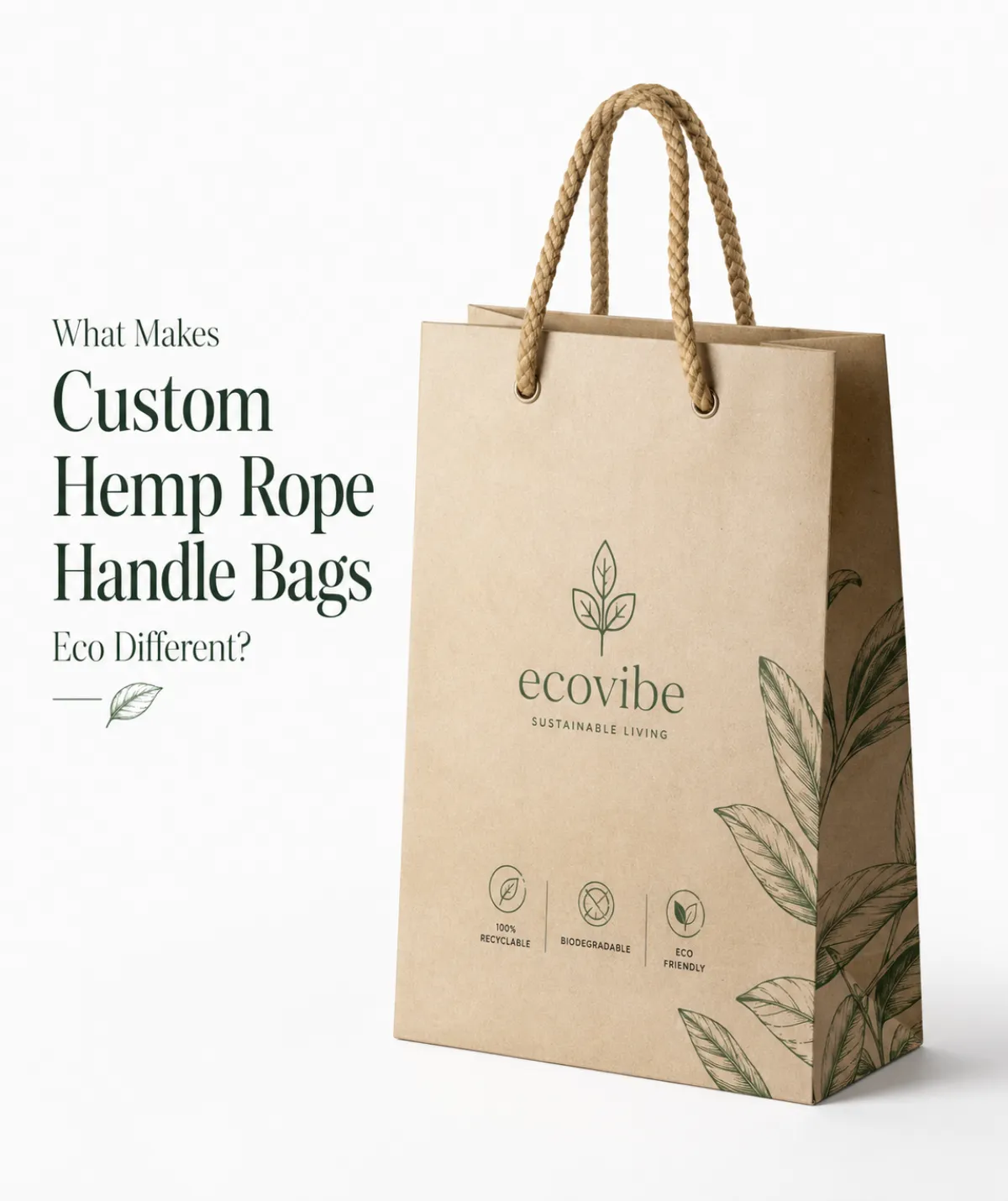
custom hemp rope handle bags eco differ from typical carry packs because the handle is treated as a load-bearing system, not a token attachment. In many basic paper models the handle is where failure starts: small tears, edge fatigue, or stitching stress appear before the rest of the bag has done anything wrong. Once customers feel that drag, the whole package reads as disposable. The moment that happens, no amount of logo polish can recover the value.
In typical builds, a paper or paperboard body carries the load while hemp rope takes repeated pulling and lifting. I see this used as a practical upgrade for brands that want premium cues without moving every unit into rigid cartons. In real campaigns, these bags hold up particularly well for apparel, candles, wine accessories, cosmetics, and event kits where the package should feel like part of the brand, not merely temporary wrapping.
Usage context matters a lot. Boutique retail, seasonal promotions, wine tours, conference handouts, and farm-to-retail events often prefer this format because it supports handoff speed and on-floor movement. I have seen customers in hotel lobbies and airport kiosks pick up the same bag type repeatedly because the handle feels stable and less “cheap” from the first grab.
Materials comparison is useful, but no single one owns the answer. Cotton can be familiar and soft but can sag in heavier use. Jute can be rustic and visual, but can be too coarse for premium gifting if the hand feel gets too rough. Plastic handles may look clean at first and are sometimes cheaper, yet they may undermine the sustainability story in front of skeptical buyers. custom hemp rope handle bags eco often land in the useful center: natural image, durable hold, and a premium signal without the rigidity and cost of full rigid packaging.
One correction I keep making in client workshops: first look does matter, but reusability drives value over time. If the bag survives three or four extra uses, then the real ROI is no longer just display cost; it is repeated exposure in daily environments where your paid campaign is absent.
Eco claims only work when the full stack is tested. Hemp fiber is meaningful, but paper grade, ink system, coating chemistry, and edge reinforcement define actual environmental and field performance. If the coatings are not recyclable in your market, or the adhesive compromises delamination, your claim is half-true at best. A system-level view is required for any serious custom hemp rope handle bags eco program.
How Custom Hemp Rope Handle Bags Eco Are Built
Start with the shell: most custom hemp rope handle bags eco are built from kraft paper, coated art paper, recycled board, or laminated structures depending on weight and finish target. A light carry model might sit at 180gsm to 230gsm. A heavier format for gifts or bottle-safe use often moves to 250gsm to 350gsm with reinforcement around the rim and base. Those specs feel technical, but you feel them in hand the first time a full bag is lifted.
Next is rope geometry. Hemp rope offers a stable grip and a distinct visual language. Thin rope can look elegant but may dig into fingers under higher load. Thick rope is kinder over long carrying time and usually reads stronger, but too thick can unbalance thin profiles. For custom hemp rope handle bags eco, the right spec starts with payload and user expectation, not moodboard preference.
Attachment is where many teams underestimate risk. You can have beautiful rope stock and still get complaints if knots, tabs, or reinforcement are weak. Three common systems appear: knotted-through holes with reinforced backing, folded stitching patches under the top edge, or mechanical/adhesive reinforcement panels. In my experience, the third-stage failure point is always near the edge, never in the center fold.
Branding options are broader than people think. Flexographic printing is efficient for straightforward graphics and bigger quantities. Offset gives sharper detail where logos or color-critical packaging needs better registration. Matte finish often suits the natural character of rope better than high gloss; soft-touch can increase hand feel, especially on premium retail lines. Foil, emboss, and spot UV can add layers, but every extra surface treatment needs to be justified because too much polish can fight the natural texture story.
A lot of packaging teams split decisions into “structure” then “style,” and that sequence creates mismatch. custom hemp rope handle bags eco rarely look cohesive if the colorway and finish pretend the bag is glossy while the rope is meant to read natural. If you are aiming at premium but sustainable positioning, the best set is usually natural rope, medium kraft, controlled palette, and a restrained print architecture.
Sustainability language should stay technical, not promotional. Recycled content percentages, FSC chain-of-custody, water-based ink percentages, and whether a coating is currently recyclable or compostable are materially different. Adhesives can change recyclability without changing visual appearance. A supplier using “eco-friendly” as a headline phrase should back it with layer-level data. For forest chain verification, verify with the FSC documentation set. For logistics stress behavior, ISTA-aligned tests help before shelf distribution.
In real production workflows, these are the lines that keep things moving:
- Dimensions: width, gusset depth, height, and opening shape
- Paper or board weight, plus coating and lamination structure
- Rope diameter, diameter tolerance, and attachment method
- Print colors, full-coverage areas, and finish behavior
- Expected load range: average, max, and abuse scenarios
- Quantity, destination, and final ship date
With those locked before proofing, the later stages become less about redesigns and more about consistency. That is usually when suppliers hit the original design intent.
What Drives Cost and Pricing for Custom Hemp Rope Bags
Pricing for custom hemp rope handle bags eco is driven by a stack of variables, not just unit count. Yes, quantity drives leverage, but print complexity, board profile, rope specification, finishing, and handling support can shift cost faster. A 1,000-piece and 10,000-piece campaign might use the same drawing, yet the economics diverge because setup and manual processing are allocated differently.
For practical comparison, one sample format can move from one pricing bracket to another if one variable changes: paper type, print colors, lamination, rope size, or edge reinforcement. On several projects I reviewed, a light kraft build with one-color print and direct folds came in close to a “basic” line, while a heavier art paper version with extra inks and embossing doubled the effective per-unit range.
Unit price is only one layer. Real decisions should be made on landed cost. Freight, setup, proofs, corrections, and risk of rush changes often erase the cheapest per-piece headline. In campaign-heavy environments, a $0.10 difference can disappear the moment a late revision pushes shipping method to air.
| Spec Level | Typical Use | Indicative Unit Price at 5,000 Pieces | What Usually Changes the Cost |
|---|---|---|---|
| Light retail bag | Apparel accessories, small gifts, event handouts | $0.45-$0.70 | Lower paper weight, simpler print, smaller rope diameter |
| Midweight premium bag | Boutique retail, candles, cosmetics, small boxed sets | $0.70-$1.10 | Heavier stock, reinforced top edge, improved finish, wider print coverage |
| Heavy-duty presentation bag | Wine, gift bundles, premium brand packaging | $1.10-$1.80 | Thicker board, stronger handle attachment, premium coatings, foil or embossing |
These numbers are directional. A heavy creative brief with complex artwork on a short run can cost more than a larger but simpler program. That is exactly why side-by-side quotes must normalize all spec parameters before price is interpreted. It avoids “cheap-looking” comparisons where one supplier is actually quoting different construction entirely.
Scale does reduce some costs, especially in cutting and finishing, but only when forecast confidence is high. Overbooking creates dead inventory. Underbooking creates emergency production and premium freight. Both can hurt more than an extra dollar in materials.
The useful internal question is not “What is the cheapest quote?” but “What configuration gives the best carry strength, retail perception, and total program cost?” For custom hemp rope handle bags eco, that framing protects teams from buying aesthetics without function.
The Ordering Process and Timeline for Hemp Rope Handle Bags
Most projects follow this sequence: brief, costing, dieline, artwork, proof, sample, production, quality check, shipment. It looks straightforward on paper. On a shop floor, delays come from whichever step has the least-defined decision. A missing detail in dimensions or file format can freeze an otherwise smooth schedule.
Kick-off clarity is everything. Confirm use case, target weight, dimensions, quantity band, print method, finish, and planned launch date before sample production begins. For custom hemp rope handle bags eco, handle placement and fold allowances are structurally sensitive; getting those late will often create redesign loops and extra cost.
Timeline realism is practical, not negotiable. Sampling and approval usually take several business days. Production can take weeks, especially when heavy board, custom embossing, or higher coverage print are involved. Freight adds a third layer: mode, route, and port congestion can make a comfortable schedule feel suddenly tight.
Artwork quality is a hidden bottleneck. Vector files are generally faster than raster-dependent submissions because they scale and separate colors cleaner. Spot-color and brand color matching need to be locked early or revisions multiply. In mixed print areas and repeating motifs, proof comments can become detailed and should not be rushed.
When timelines get tight, send this first:
- Exact dimensions and maximum load profile
- Vector artwork files and approved Pantone references
- Handle count, spacing, and load target
- Print coverage and finish priority
- Quantity with allowed overrun tolerance
- Delivery address and hard deadline
That reduces avoidable edits. With custom hemp rope handle bags eco, strong up-front information almost always translates into shorter cycles and fewer quality interruptions.
Practical field rule: finalize the dieline before final art approvals. What looks balanced on screen can fail when folded edges and top openings are added for production tolerance. In many premium programs, the printable area shrinks by the time the bag becomes real geometry.
Common Mistakes When Specifying Hemp Rope Handle Bags
The most common miss is choosing a rope profile before confirming load requirements. A gorgeous rope is not enough if the top edge and body cannot carry the product. The force path is simple: weight pushes through the body, into sidewalls, then into the handle interface. If one point is under-engineered, distortion and edge pull show up fast.
Another recurring issue is underbuilt structure. Gusset depth, board thickness, and reinforcements decide how the bag behaves beyond first glance. A sample that looks acceptable at the table can buckle with actual bottles. If the line team allows only token testing, they are gambling on customer patience.
Sustainability language can create legal or reputational risk when it is vague. “Recycled” without source percentages, “water-based” without adhesive disclosure, and “eco” without recyclability limits is not enough. Ask for the complete material sheet and certification scope, then align internal marketing language with those facts.
Timing mistakes are expensive, especially in launch windows. Event programs and seasonal drops have no patience for late rework, and one missing variant can force air freight or emergency fallback packaging. I have seen teams absorb higher freight costs to avoid missing a planned launch by one week, and that decision is sometimes the least painful choice.
Color behavior across materials is often misunderstood. Rope, paper, coating, and ink are not independent. On warm kraft, a deep ink and natural rope can feel premium. On bright white stock with high gloss, that same color logic can feel cold. It is not failure; it is material interaction, and it must be accounted for in the spec.
If the bag is carrying a bottle, the handle is a structural choice, not a style choice.
That principle usually decides quality outcomes. Function first, finish second, branding third is a better order. Teams who reverse that sequence often end up patching structure after a campaign is already booked.
The final blind spot is framework comparison. Comparing custom hemp rope handle bags eco directly against rigid custom printed boxes only helps if you compare the right use cases. Boxes protect and stack, bags communicate and carry. Neither replaces the other; they simply cover different use scenarios.
Expert Tips for Better Branding, Strength, and Sustainability
Pick one performance objective and prioritize it before styling. Sometimes that objective is comfort in hand; other times it is visibility in a crowded shelf. Once you choose, every decision—paper stock, rope profile, print density, finish—should support it. Trying to push every cue equally almost always creates visual and structural conflict.
Load-aware pairing is the core optimization lever. Light goods often do better with a finer rope and simpler finish. Heavier categories like apparel bundles, bottles, and boxed sets need stronger reinforcement, denser body stock, and often wider hand space around attachment points. In field use, customer comfort and confidence usually beat a pretty motif on a single pass by a lot.
Think of the rope as part of your visual architecture. Balanced contrast can be powerful: dark rope on natural paper or light rope on darker print zones. Handle placement can also shift the whole impression; too inward and users reach uncomfortably, too outward and the bag can look unfinished.
Inserts and short cards are a surprisingly efficient branding layer. They can explain reuse guidance, handling life, and end-of-life pathways without forcing the main structure to become complex. One practical card often increases post-purchase touchpoints much more than adding another print pass to the main panel.
Ask clear questions, and write down answers:
- What exact paper or board weight is proposed for each layer?
- Is the material chain FSC-certified and within scope?
- What is the rope diameter, and what load does each option support?
- Which inks and coatings are specified for your region’s recycling stream?
- What is your normal production defect rate on this format?
A supplier that answers confidently on these points is usually confident in execution. If responses are vague, it may be a sign that process documentation is not as mature as the design deck suggests. That is a red flag you should not ignore.
For sustainability checks, the same references remain useful but not sufficient by themselves. FSC helps validate chain-of-custody logic; ISTA-style distribution testing helps catch damage risk. Neither replaces your internal testing protocol. If your customer base is environmentally literate, honesty in limitations is part of trust. Be explicit: “recyclable where accepted” is better than “100% recyclable” if you do not have universal coverage.
In mixed packaging programs, split formats by function. Use rigid custom packaging products where protection and stacking dominate, and deploy custom hemp rope handle bags eco where handling, brand interaction, and repeat visibility matter. In a lot of programs this split reduces total cost and improves customer perception simultaneously.
Strong rule: if a bag can’t survive normal carry distance in the hands of real customers, it is not premium, even with flawless artwork.
Next Steps: Spec, Sample, and Approve With Confidence
Build a short one-page technical brief first. Include use case, load, dimensions, print requirements, finish preference, quantity range, and required date. In my experience, that one document prevents 60–70% of avoidable proof delays because everyone can compare against the same target.
When possible, request two or three production-intent samples. Compare rope feel, stiffness, fold memory, and ease of carry over at least one day of normal use. A rope that seems fine in a single handoff can become uncomfortable after several carries, and that is exactly where real customer friction starts.
Quote evaluation gets cleaner when unit price and timing are reviewed together. A lower piece price can still lose if lead time is misaligned with a launch window. A stronger but slightly higher quote can be the safer choice if execution quality and schedule confidence are materially better.
Then freeze the decision chain and stick to it: finalize specification, approve proof and sample, confirm shipping lane and handling assumptions. That sequence reduces late surprises and lowers the chance of last-minute rework. I am not saying it eliminates all issues, but it lowers total stress by a huge margin.
Here is the sequence that has worked repeatedly in real projects:
- Write a precise use-case brief with load and timeline
- Request quotes with matching technical specs
- Lock dieline and validate handle placement before final artwork
- Approve first sample with movement testing, not just visual review
- Confirm freight method, cut-off date, and delivery buffer
- Place order early enough to absorb one correction round
If your program includes retail launches, gifts, or event kits, treat custom hemp rope handle bags eco as a core handoff channel, not an afterthought layer. When the spec is clear and the schedule is realistic, the bag does more than carry a product. It carries credibility, especially when you also design for actual reuse.
Final takeaway: if you are gonna win with custom hemp rope handle bags eco, specify for real load, verify claims with documents, and only then optimize visuals. The most reliable brands I have seen succeed because they test structure first, measure performance under real use, and let marketing speak through results, not adjectives.
Are custom hemp rope handle bags eco better than cotton-handle bags?
custom hemp rope handle bags eco generally feel firmer and can express a stronger natural texture than many standard cotton-handle alternatives. Which performs better depends on payload, style goals, and durability requirements. Cotton is still a valid option for softness-focused programs, but hemp rope tends to read as more structural in premium carrying use.
How much do custom hemp rope handle bags eco usually cost?
Cost depends on quantity, dimensions, paper weight, rope size, print and finish complexity, and delivery timing. Small-volume orders often carry higher per-piece costs because setup and quality checks are spread across fewer units. For custom hemp rope handle bags eco, landed-cost comparison usually gives the clearest view of true spending.
What details should I send before requesting a quote?
Send exact dimensions, expected load, target quantity, print requirements, finish preferences, and delivery date as early as possible. Include vector artwork when available and a short usage note (bottles, apparel bundles, gifts, or retail carry). For custom hemp rope handle bags eco, matching structure to real use is where the strongest and fairest quote starts.
How long does production take for hemp rope handle bags?
Typical flow is sample/proof, production, then shipment, with timing affected by complexity, seasonality, and route. Standard programs often need several weeks, but delays are commonly approval-driven rather than machine-driven. In custom hemp rope handle bags eco projects, a stable design brief usually saves the most time.
Can custom hemp rope handle bags eco be reused or recycled?
Yes, they are often designed for reuse when rope and reinforcement are built for repeated loads. Recycling depends on exact combinations of paper, coating, ink, and adhesive used for the specific run. If local recycling coverage is limited, include practical reuse and end-of-life instructions so the packaging still performs as part of a responsible program. In simple terms, custom hemp rope handle bags eco should be designed for second use, third use, and real handling, not one transaction only.

