Custom leather duffle bags get judged fast. At check-in, in a hotel lobby, or on a retail shelf, people decide in seconds whether the bag reads as premium, practical, or forgettable. That is why custom leather duffle bags are such a revealing sourcing project: the leather, hardware, logo placement, and silhouette all work together, and one weak choice can drag down the whole impression.
For buyers, this is not only a style decision. It is a specification decision, a branding decision, and a cost decision at the same time. A leather duffle can sit beside branded packaging, executive gifts, or premium product packaging and still feel consistent with the brand if the details are handled well. Miss those details, and the bag starts to feel like a generic travel item with a logo on top.
That difference matters more than many teams expect. A small shift in logo size or placement can move the same bag from “luxury carry-on” to “promotional giveaway.” The construction did not change. The perception did. That is the whole challenge with this category.
If you are sourcing custom leather duffle bags, think like a buyer, not a shopper. Ask what the bag needs to communicate, how long it needs to last, and what it should cost landed, not just ex-works. Those three questions shape everything that follows.
What custom leather duffle bags are and why they stand out quickly
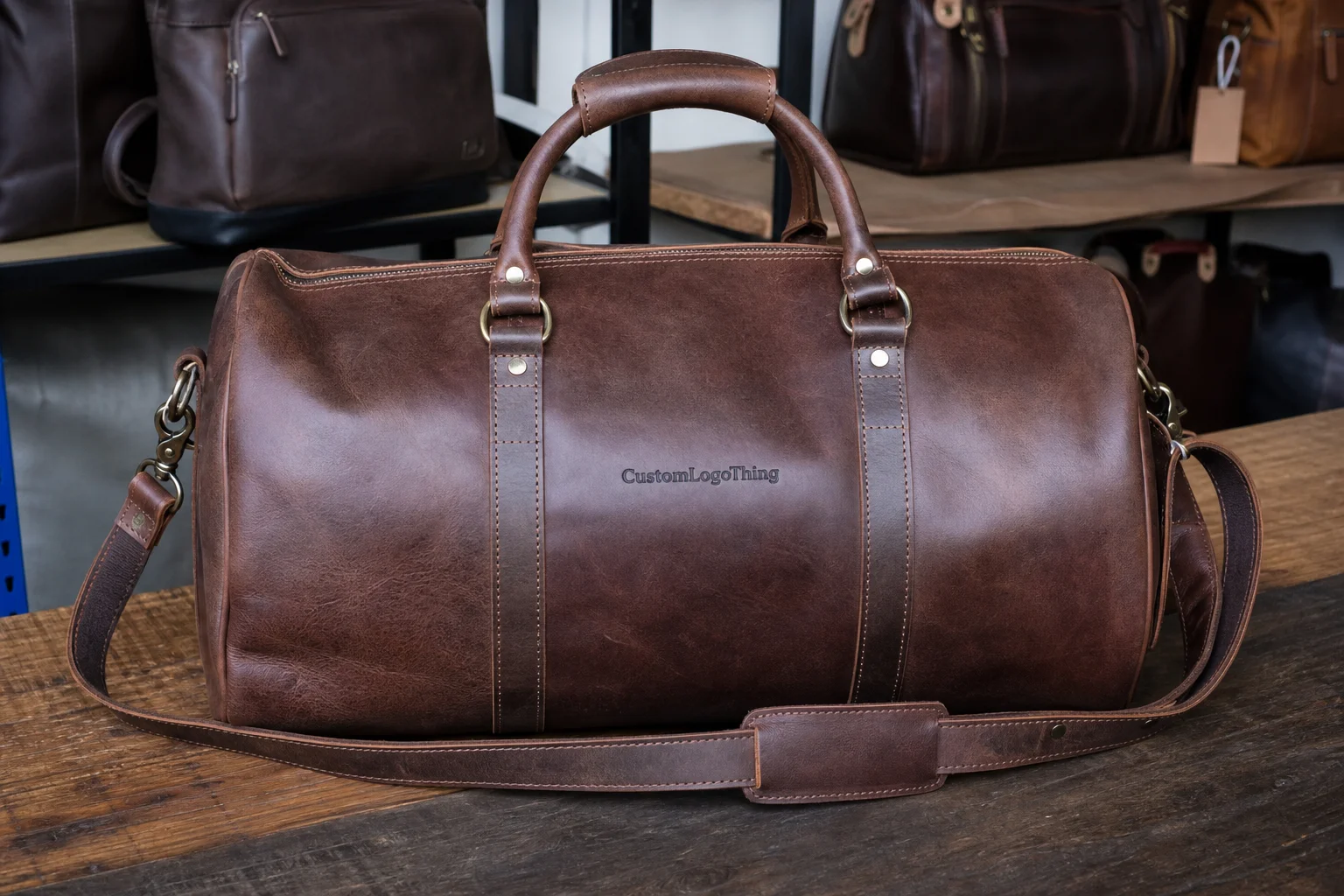
A true custom leather duffle bag is built around buyer-defined specifications. That usually includes size, leather type, lining, zipper grade, strap style, hardware finish, logo method, and internal organization. In practice, a custom build can range from a simple overnight bag with one logo plate to a more engineered travel piece with a shoe compartment, padded shoulder strap, trolley sleeve, and multiple pockets.
Leather changes the value signal immediately. Compared with canvas or polyester travel bags, leather usually carries a higher perceived price, a longer expected lifespan, and a stronger memory after use. If a recipient carries the bag for airport trips, business travel, or weekend stays, the brand gets repeated exposure in a way lower-cost items rarely deliver.
Many teams underestimate how much the logo treatment affects the final read. A debossed mark on the lower front panel can feel understated and premium. The same logo, oversized and centered in foil, can push the piece toward louder promotional territory. Placement, scale, and finish shape the message as much as the bag structure itself.
From a sourcing angle, this is closer to specifying retail packaging than buying apparel. You are making choices that affect presentation, durability, and perceived value at once. That is why a structured brief matters far more than a vague request to “make it look expensive.”
“The fastest way to weaken a premium bag is to overcomplicate it. Fewer signals, better materials, cleaner execution.”
How the customization process moves from idea to sample
The strongest projects follow a predictable path. First comes the brief: target use, audience, quantity, budget range, and desired finish. Then comes material selection, logo mockups, pattern development, sampling, revisions, final approval, and bulk production. Skipping any of those steps usually creates a problem later, and later is always more expensive.
There are two broad ways to customize. One is off-the-shelf customization, where a supplier starts with an existing bag shape and adjusts a few elements such as color, lining, or logo. The other is fully made-to-order construction, where size, panel layout, pocket count, and structure are developed from scratch. Off-the-shelf customization makes sense for smaller budgets and faster timelines. Fully made-to-order construction works better when the bag has to fit a specific use case or brand standard.
Samples matter because they reveal what drawings cannot. Leather swatches show grain and color consistency. Hardware samples show whether the zipper pull feels substantial or flimsy. Stitch references show whether the sewing line is tight enough for premium positioning. This is also where buyers catch dimension errors, handle drop issues, or logo placement that looks perfect on a mockup but awkward on the actual bag.
Good communication checkpoints reduce risk. Before bulk order approval, confirm the approved leather color, zipper style, lining fabric, logo size, and any tolerances on bag dimensions. If a buyer signs off too early, they may discover later that the bag is 15 mm smaller than expected or that the logo embossing is too shallow to read clearly.
The sample stage also saves money. A second revision on a sample may cost a few hundred dollars and delay production by a week or two. Correcting a bulk run can cost far more, especially if the error involves tooling, leather cutting, or logo placement across a large order. In sourcing terms, the sample is not a delay. It is insurance.
Key specifications that shape quality, durability, and branding
Leather type is the first major quality signal. Full-grain leather keeps the most natural surface character and usually ages the best, but it is also the most expensive. Top-grain leather is slightly more processed and often gives a cleaner look with more uniform texture. Genuine leather is a broader, lower-cost category, and buyers should not assume it performs like the higher grades. Coated or finished options can improve stain resistance, but they may reduce the natural feel that many premium buyers expect.
Construction details matter just as much as the leather itself. Look closely at stitching density, especially on handles and stress points. Check zipper grade and whether the zipper track feels smooth under load. Inspect the base reinforcement, because a bag that sags when packed never feels premium. Handle attachment is another weak point; if the attachment points are under-specified, the bag can fail long before the leather does. Linings should resist abrasion, especially if the bag will carry shoes, chargers, or grooming items.
Logo method changes the tone of the entire piece. Embossing and debossing usually feel restrained and expensive. Foil stamping can look sharp, but it depends heavily on color choice and leather finish. Metal plates work well for a more formal or corporate feel. Sewn-on patches are useful when the brand wants contrast or a more casual look. The right option depends on the leather surface and the message the bag needs to carry.
Function should not be an afterthought. A shoe compartment can be genuinely useful for travel retail or executive gifting. A trolley sleeve helps if the bag will be used with rolling luggage. Padded shoulder straps improve comfort on heavier builds. Interior pockets help with organization and reduce the “black hole” effect that annoys users after the first trip.
Different end uses call for different builds. Corporate gifting often benefits from cleaner lines, lighter internal structure, and understated branding. Premium merchandising may justify more decorative finishes and presentation packaging. Executive welcome kits usually need better organization and a more restrained logo. If the bag is part of a broader branded packaging program, it should feel consistent with the rest of the package branding system, not like a random add-on.
Industry standards such as ISTA testing protocols can help buyers think about transit durability, while FSC sourcing principles become relevant if the bag is bundled with paper-based inserts or presentation materials. That connection matters more than many teams realize when the overall unboxing experience includes custom printed boxes or other premium product packaging elements.
| Logo method | Look and feel | Typical fit | Relative cost impact |
|---|---|---|---|
| Emboss / deboss | Quiet, premium, understated | Executive gifts, luxury travel | Low to moderate |
| Foil stamping | More visible, polished, sharp | Retail and premium promotional | Moderate |
| Metal plate | Formal, durable, branded | Corporate programs, hospitality | Moderate to higher |
| Sewn patch | Casual to heritage | Lifestyle and retail collections | Moderate |
Custom leather duffle bags cost, pricing, and MOQ factors
Pricing is driven by a few core variables: leather grade, bag size, hardware complexity, logo method, packaging, and volume. A larger bag uses more material, and more material usually means more waste in cutting, more sewing time, and more inspection. Hardware can also move the number quickly. A basic zipper and standard pulls cost less than reinforced zippers, metal feet, or heavy-duty clasps.
MOQ, or minimum order quantity, matters because leather goods are labor intensive. A supplier may be willing to make 100 pieces, but the unit price will almost always be higher than at 500 or 1,000 pieces. Pattern setup, cutting, stitching, logo tooling, and inspection take nearly the same amount of planning whether the run is small or medium. When the labor is spread across fewer units, each bag carries more overhead.
Buyers often overlook hidden costs. Sampling can be charged separately. Tooling for embossed logos or metal plates may be a one-time expense. Additional colorways can create extra material sourcing complexity. Rush production may require labor reallocation. Specialty presentation packaging adds cost too, especially if the bag ships in a branded dust bag, rigid box, or retail packaging sleeve.
For planning, think in landed value rather than unit price alone. A bag at $28 that lasts three years and supports premium gifting can be a better business decision than a $16 version that feels cheap after the first trip. The comparison should include durability, presentation, and the risk of rework, not just the headline number.
Buyers should ask for itemized quotes. A good quote separates leather, hardware, lining, logo work, sampling, packaging, and freight. That makes tradeoffs visible. Without that breakdown, two suppliers might both say “$24 per unit,” while one includes premium lining and better zippers and the other hides inferior materials behind a lower headline price.
Typical unit pricing can vary widely by specification, but for planning purposes buyers often see a basic custom leather duffle bag land in a broad range that reflects leather grade and complexity rather than size alone. The more useful question is not, “What is the cheapest quote?” It is, “What exactly is included, and what failure points are being paid to avoid?”
Production steps, timeline, and lead time expectations
A realistic timeline starts with the brief and ends with shipping, not with factory approval. For a standard custom run, buyers may spend a few days on briefing and artwork, one to two weeks on sampling, several days on revisions and final sign-off, two to six weeks on production depending on complexity, and additional time for quality control and transit. That can stretch or shrink based on order size and the supplier’s workload.
Delays usually come from familiar places. Leather sourcing can slow if the requested color or finish is not in stock. Hardware backorders can hold the run. Sample revisions can add a week if the first pattern misses the spec. Holiday congestion matters too, especially for export shipments and factory schedules. Shipping method is another variable; air freight is faster but more expensive, while sea freight can save money if the launch date allows it.
Customization complexity changes lead time in a practical way. One logo placement is easier than two. One material combination is easier than three. A simple internal layout moves faster than a bag with shoe storage, padded sleeves, and contrast trim. Each extra feature adds a decision point, and decision points are where production waits happen.
The smartest planning habit is to work backward from the event date. If the bags are needed for a conference, corporate milestone, or retail drop, build in a buffer for sample revisions and freight delays. A one- or two-week cushion can prevent a lot of expensive panic. Too many sourcing plans slip simply because the buyer assumes the sample will approve on the first try. That is optimistic, not strategic.
Milestone tracking keeps the process visible. Buyers Should Know when artwork is due, when the sample is expected, when pre-production approval is required, and when pre-shipment photos are available. That accountability is especially useful when the bag is part of a larger branded packaging rollout involving other items or custom printed boxes.
Common mistakes buyers make when ordering leather travel bags
The first mistake is choosing by appearance alone. A bag can look beautiful in a photo and still perform poorly because the leather finish scuffs easily, the handle feels stiff, or the bag collapses when filled. Buyers need to ask how the material wears, not just how it photographs.
The second mistake is weak artwork. If the logo file is fuzzy, too small, or poorly proportioned, the embossing can lose definition and the final piece may look sloppy. This happens more often than teams expect, especially when a marketing file is sent instead of a production-ready vector file.
Hardware gets underestimated all the time. Zippers and clasps are often the first failure points. If those parts are under-specified, the bag can fail before the leather shows meaningful wear. That is a bad trade, because the visible part of the bag may still look fine while the user experience falls apart.
Over-customizing is another trap. Too many pockets, contrast trims, stitched panels, and decorative add-ons can make the bag heavier, more expensive, and less elegant. Every extra detail creates cost and assembly complexity. Sometimes the better bag is the simpler one.
Timing mistakes are costly too. Ordering too close to launch leaves no room for sample revisions or transit delays. A buyer may think they are saving time by skipping the sample. In reality, they are borrowing trouble from the bulk order.
Practical tips for a stronger first run
If the goal is a premium feel, start with one hero color and one logo treatment. That makes approvals easier and keeps the design disciplined. Buyers often get tempted by contrast stitching, multiple zippers, and mixed materials. Those things can work, but they also increase the number of ways the bag can miss the mark.
Ask for a physical sample whenever possible. If that is not practical, insist on a detailed pre-production photo set showing the front, back, side, base, zipper, handle attachment, and logo placement. The point is to inspect the actual execution, not just a polished marketing render.
Specify dimensions in a way that leaves no room for interpretation. State the target length, width, and height, and note acceptable tolerances if needed. Also describe carry comfort. A bag that feels fine on paper may be awkward on the shoulder when loaded. For travel products, comfort is not optional.
Test the bag against a real use case before final sign-off. Ask whether it works for a weekend trip, executive gifting, or retail display. That sounds basic, but it catches a surprising number of issues. A high-end-looking bag that is annoying to use will not earn repeat brand impressions.
Compare like-for-like quotes only. Do not mix a top-grain leather sample from one supplier with a genuine leather sample from another and call that a price comparison. That is not procurement. That is confusion. Better comparisons produce better decisions.
If your broader program includes Custom Packaging Products, keep the bag aligned with the rest of the touchpoints. Color, logo tone, and finish should echo the same brand language. A leather duffle in one visual system and the packaging in another can create a disconnected experience.
Next steps for sourcing custom leather duffle bags
Start with a one-page spec sheet. Include size, leather type, hardware color, logo method, lining, quantity, and target use. That one document saves time because it forces the buyer to make decisions before the supplier starts quoting. It also makes it easier to compare vendors without losing track of what changed.
Gather two or three reference images that show the style you want, plus one that shows what you do not want. That negative example is surprisingly useful. It prevents the classic sourcing problem where everyone agrees on “premium” but means something slightly different.
Request an itemized quote, sample timeline, and MOQ confirmation before approving design direction. Then ask for proof on stitching, zipper strength, and logo placement. If a supplier cannot show those checkpoints clearly, the risk shifts back to the buyer.
Use the final approved sample as the benchmark for inspection at shipment. Document the leather color, logo size, hardware finish, stitch count, and dimensions so the next reorder is easier to control. That kind of recordkeeping is boring, but it is what separates a repeatable sourcing program from a one-off purchase.
Buying custom leather duffle bags is really about balancing fit, finish, and brand story. Get those three right, and the bag does more than carry items. It carries the brand well, which is the real point.
Frequently asked questions
What should I ask before ordering custom leather duffle bags?
Ask about leather type, logo method, MOQ, sample cost, production lead time, and shipping method. Request itemized pricing so you can see exactly what changes the unit cost, including packaging and tooling if applicable.
How do custom leather duffle bags usually get branded?
Common methods include embossing, debossing, foil stamping, metal plates, and sewn-on patches. The best option depends on the leather finish and how premium you want the final look to feel.
What affects the price of custom leather duffle bags the most?
Leather grade, hardware quality, order quantity, and customization complexity usually have the biggest impact. Sampling, tooling, packaging, and rush timing can also raise the final cost.
How long does production typically take for a custom leather duffle bag order?
Lead time usually includes sampling, approvals, production, quality control, and shipping. Complex designs, larger quantities, and material shortages can extend the timeline.
How can I reduce mistakes on my first custom leather duffle bag order?
Start with a clear spec sheet, approved artwork, and one sample before bulk production. Keep the design focused so you can judge quality instead of getting distracted by too many features.

