Buyer Fit Snapshot
| Best fit | Custom Pillow Boxes with Logo Printing projects where brand print, material claims, artwork control, MOQ, and repeat-order consistency need to be specified before quoting. |
|---|---|
| Quote inputs | Share finished size, material target, print colors, finish, packing count, annual reorder estimate, ship-to region, and any compliance wording. |
| Proofing check | Approve dieline scale, logo placement, barcode or warning zones, color tolerance, closure strength, and carton packing before bulk production. |
| Main risk | Vague material claims, crowded artwork, missing packing details, or unclear freight terms can make a low unit price expensive after revisions. |
Fast answer: Custom Pillow Boxes with Logo Printing: Material, Print, Proofing, and Reorder Risk should be specified like a repeatable production item. The safest quote records material, print method, finish, artwork proof, packing count, and reorder notes in one written spec.
Production checks before approval
Compare the actual filled-product size with the drawing, then confirm tolerance on folds, seals, hang holes, label areas, and retail display edges. Reserve space for logos, QR codes, warning copy, and material claims before decorative graphics fill the panel.
Quote comparison points
Review material grade, print process, finish, sampling route, tooling charges, carton quantity, and freight assumptions side by side. A quote is only useful when the supplier can repeat the same color, closure quality, and packing count on the next order.
I still remember standing on a factory floor outside Shenzhen, in Dongguan’s manufacturing belt, watching a stack of custom pillow boxes with logo printing come off the line at a plant running two Heidelberg presses and a Bobst die-cutting station. They looked simple from a distance. Then I picked one up, felt the curved die-cut shape in my hand, and thought, “Ah, there’s the trick.” That curve is why these boxes feel nicer than plain folded cartons, even when the material cost is only a few cents more. On that run, the board was 350gsm C1S artboard, and the difference between “plain” and “premium” was mostly in the shape, the finish, and the way the logo sat on the face panel. I’ve had that same little realization more than once, usually right before someone asks why a box that looks simple took so much planning. Because, well, paper likes to keep its secrets.
If you sell jewelry, candles, cosmetics, apparel accessories, or promo items, custom pillow boxes with logo printing can do a lot of quiet work for your product packaging. They’re light, easy to store flat, quick to assemble, and surprisingly good at turning a basic item into something that feels giftable. I’ve used them for client launches where the box did half the branding work before the customer even touched the product, including a lipstick set shipped out of Guangzhou and a tea sampler packed in Yiwu for a holiday promotion. Honestly, I think that’s the sweet spot: a package that doesn’t shout, but still makes people feel like they bought something worth opening carefully.
There’s a limit, of course. If you want to ship a heavy glass bottle or something fragile, you may need inserts, stronger board, or a different structure altogether. Pretty packaging that collapses in transit is just expensive trash. Cute trash, maybe, but still trash. I’ve seen one too many “beautiful” boxes arrive looking like they lost a fight with a delivery van between Shenzhen and Los Angeles, and nobody wants to explain that to a customer.
What makes custom pillow boxes with logo printing worth the attention is the balance of simplicity and polish. Add matte lamination, and the box feels calm and premium. Add gloss, and the color pops harder under retail lights. Add foil, and you get the “small gift, bigger value” effect that clients love for retail packaging. I’ve watched a plain kraft pillow box jump from “sample” to “boutique” with one well-placed gold foil logo, especially when the foil was stamped on a 3,000-piece run using a copper die in a Guangzhou finishing shop. That kind of transformation still makes me grin, even after years of staring at presses, board samples, and finish charts until my eyes begged for mercy.
For brands trying to improve package branding without blowing budget, this style is one of the safest bets. You’re not paying for extra structure you don’t need. You’re paying for presentation, speed, and a shape people remember. And if I’m being honest, memory is half the battle in packaging. People forget ads. They remember the little box that made them feel like the product inside had a story, especially when the box arrived with a clean one-color logo and a crisp fold that held up in a poly mailer from Ningbo.
Custom Pillow Boxes with Logo Printing: What They Are and Why They Work
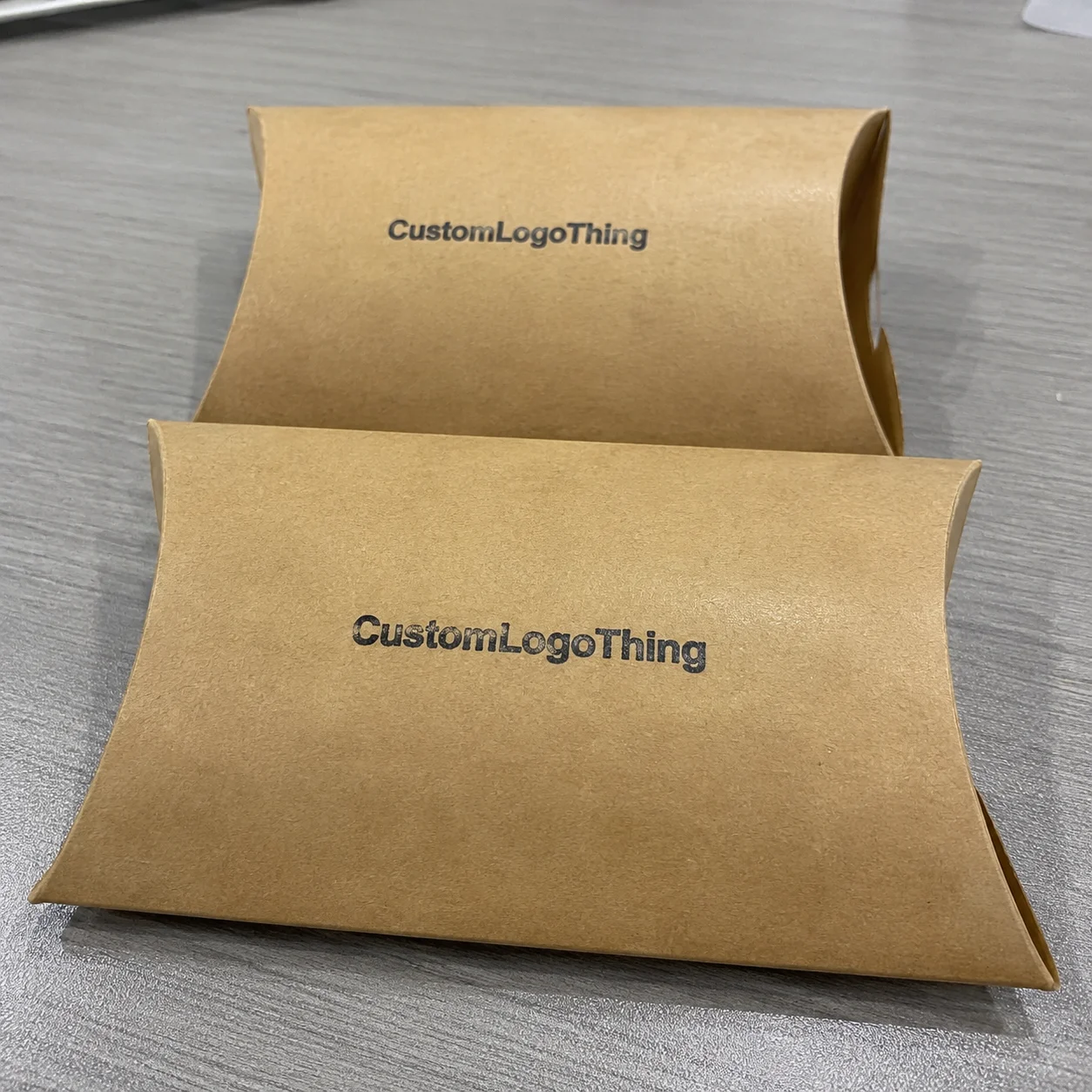
Custom pillow boxes with logo printing are folded cartons with curved sides that resemble a pillow when assembled. They typically ship flat, pop into shape by hand, and close with tuck-in flaps. In plain English: they’re small, curved paper boxes that look more finished than a sleeve and less formal than a rigid setup box. I’ve always liked that in-between personality. They’re not trying too hard, which is refreshing in a packaging category that sometimes behaves like it’s auditioning for a luxury runway, even when the board is just 28pt or 350gsm C1S.
They show up everywhere for a reason. I’ve seen them used for earrings in a mall kiosk, soap bars in a spa set, hair accessories in a subscription kit, and even chocolate truffles at a holiday event in Shanghai. The structure is familiar, but the branding makes each use case feel tailored. That’s why custom pillow boxes with logo printing work so well for brands trying to upgrade ordinary items into branded gifts. When a customer sees a shape they recognize but a finish they don’t expect, the product suddenly feels more considered, especially if the logo is foil-stamped or printed in deep Pantone 186 C rather than a generic off-the-shelf black.
On one client visit in Guangzhou, a cosmetics founder told me she wanted “something that doesn’t scream packaging.” We tested three styles. The pillow box won because it felt soft in the hand, took a clean one-color logo, and fit neatly inside a shipping mailer without chewing up cubic weight. That matters. In my experience, the best custom printed boxes are the ones that look expensive without acting expensive in production. I think that’s a very underrated goal, actually. Fancy is nice; manageable is better, especially when your target landed cost needs to stay around $0.22 to $0.35 per unit at 5,000 pieces.
The finish choices can change the entire mood. Matte feels quiet and modern. Gloss feels brighter and more commercial. Foil gives you that reflective punch that people notice from a display shelf. Spot UV can add contrast, but only if your artwork has enough breathing room. If you cram too much into a tiny face panel, the box starts looking like a badly dressed business card. I’ve said this to more than one designer with a straight face, and yes, the room usually goes quiet for a second. On a pillow box with a face area close to 3.5 x 1.5 inches, restraint usually beats ambition.
Custom pillow boxes with logo printing are not ideal for everything. Heavy jars, sharp-edged tools, and fragile glass need more protection. You can absolutely strengthen the package with a paper insert, corrugated support, or thicker board, but that changes cost and structure. I usually tell clients to test a filled sample before ordering 5,000 units. Saves money. Saves headaches. Saves the inevitable “why does this look squashed?” email, which, I swear, always arrives on a Friday afternoon after the warehouse in Dongguan has already closed for the day.
For brands wanting strong branded packaging without complicated assembly, this style is a practical middle ground. It’s not trying to be a Luxury Rigid Box. It’s trying to be smart, attractive, and efficient. And honestly, that’s enough for a lot of products. More than enough, in some cases, especially when you’re selling accessories, sample kits, or seasonal gift items at a retail price point between $12 and $38.
“We thought the box was a small detail. Then customers started posting photos of the packaging before they even opened the product.” — a skincare client I worked with in a warehouse meeting outside Guangzhou
How Custom Pillow Boxes with Logo Printing Actually Get Made
People love asking for a price first. Fair. But with custom pillow boxes with logo printing, the production path affects everything from cost to color accuracy to whether your logo lands cleanly near the curved edges. I’ve seen good artwork ruined by a bad dieline and weak proofing. That’s not the printer being dramatic. That’s just geometry being rude, especially when the die line is built for a 4.25-inch-wide box and the artwork was only ever mocked up on a screen.
The process usually starts with the dieline, which is the flat template showing folds, cut lines, glue areas, and safe zones. If the dieline is wrong by even 1/16 inch, a logo that looked centered in the PDF can end up too close to the curve or fold. On a pillow box, that’s not a tiny problem. The curved face makes misalignment more obvious. I remember one job in a Shenzhen facility where a brand insisted the logo “looked fine” on screen, and then the first sample arrived with the mark hugging the fold like it was trying to escape. We fixed it, but not before everyone in the room made that same tight-lipped expression printers know all too well.
Here’s the usual production flow for custom pillow boxes with logo printing:
- Dieline setup and structural review
- Artwork placement and bleed adjustment
- Printing via digital printing or offset printing
- Lamination or coating
- Die-cutting and creasing
- Folding, packing flat, and carton boxing
For small runs, digital printing is often the faster route. If you want 250 or 500 pieces and need quick proofing, it can be the easier option. For larger runs, offset printing usually gives more consistent color and better per-unit economics. I’ve seen offset jobs hit the sweet spot on 5,000-piece orders, especially when the brand uses one or two dominant colors and wants clean repetition. Digital has its place; offset has its own. The trick is not pretending they’re interchangeable just because both involve ink and optimism. On a 1,000-piece run from a plant in Dongguan, offset usually wins once the press setup is already dialed in.
Material choice matters too. Most custom pillow boxes with logo printing use:
- SBS paperboard for a smooth, bright surface
- Kraft stock for a natural, earthy look
- Textured specialty paper when the brand wants a tactile feel
At our Shenzhen facility, I once watched a supplier switch from standard SBS to a lightly textured white stock for a candle launch. The client wanted “less pharmacy, more boutique.” That one material swap added around $0.03 to $0.06 per unit depending on quantity, but the perceived value went up enough that nobody complained. That’s the kind of tradeoff people miss when they only compare unit price. A tiny increase on paper can save a whole lot of explaining later, particularly when the box goes from a plain matte board to a soft-touch laminated finish.
Timelines depend on how much you change. A straightforward job with a ready dieline and final artwork can move fast. If you need a new structure, foil, embossing, or revised color proof, the clock stretches. In many cases, simple custom pillow boxes with logo printing can be turned around in about 12–15 business days from proof approval, while more complex work may need 2–4 additional days for finishing and inspection. Shipping is its own beast. Always count that separately. Shipping has a talent for behaving like a surprise guest who shows up late, eats everything, and leaves a mess.
For brands that want to compare production options, I point them to our Manufacturing Capabilities page first. It saves time because we can match the job to the right print method, board, and finishing line before anyone starts guessing. And guessing, in packaging, is where budgets get grumpy.
How Do Custom Pillow Boxes with Logo Printing Affect Cost and Print Quality?
Pricing for custom pillow boxes with logo printing is not mysterious. It’s just a pile of variables, and people often only look at one. Usually the wrong one. I’ve had clients fixate on unit price while ignoring setup fees, which is like buying a plane ticket and forgetting baggage charges exist. Then they act surprised when the “cheap” quote turns out to be expensive in the boring, paperwork-heavy way nobody likes, especially on a 3,000-piece order leaving a factory in Guangzhou.
The biggest cost drivers are quantity, size, stock thickness, ink coverage, and finish type. Add custom inserts or window cutouts, and the price rises again. A clean one-color kraft box at 5,000 pieces can cost dramatically less per unit than a full-color, foil-stamped, spot UV version at 250 pieces. That’s not a surprise. That’s manufacturing math. Paper, ink, tooling, finishing, and labor all want their piece of the pie. On an actual quote sheet, the difference between a simple 350gsm C1S artboard box and a specialty laminated build can be as much as $0.08 to $0.15 per unit depending on the finish stack.
Here’s a simple pricing table I use when clients ask for direction on custom pillow boxes with logo printing:
| Option | Typical Use | Price Impact | Notes |
|---|---|---|---|
| Digital printing on SBS | Small runs, fast launches | Higher setup value, better for 250-500 pcs | Good for detailed artwork and short deadlines |
| Offset printing on SBS | Mid to large runs | Lower unit cost at volume | Better color consistency on longer runs |
| Kraft stock with 1-color logo | Natural or eco look | Usually cost-efficient | Great for simple branded packaging |
| Foil + emboss | Premium retail packaging | Meaningful added cost | Best used sparingly on the logo only |
| Spot UV on matte lamination | High-contrast branding | Moderate to high added cost | Needs strong artwork spacing |
For actual numbers, I’ve seen custom pillow boxes with logo printing land around $0.15 per unit for 5,000 pieces on simple kraft builds, while more common medium-to-larger runs often sit closer to $0.18 to $0.42 per unit depending on size, board, and finish. If the quote is far below that, I start asking what got left out. Sometimes it’s shipping. Sometimes it’s board quality. Sometimes it’s both, which is always fun in the worst way. A quote that looks too good usually has a little ghost hiding in the details.
Color and print quality also affect value. If you’re printing a full-bleed background, watch for scuffing on the fold lines. If your logo has thin serif text, make sure the printer can hold the detail. If you need exact brand color, ask about a Pantone match or at least a controlled CMYK target. I’ve had one retail client reject 800 boxes because a deep blue went slightly purple under the coating. The line looked fine to casual eyes. The brand manager’s eye, however, was trained like a hawk with a spreadsheet. I still laugh about that one, mostly because nobody else in the room was laughing at the time.
Quality checks should include fold memory, glue strength, and panel registration. A box can look beautiful and still open too loosely or crack near the curved edge. That’s why I prefer asking for sample photos, press proofs, or a small run before scaling up. You’re not paying for paper only. You’re paying for predictable behavior. Predictable is underrated. Predictable keeps production teams from developing new stress lines in their foreheads.
If you need a broader look at what we build, our Custom Packaging Products page is a good starting point. It helps compare custom printed boxes by structure, not just by price tag.
For sustainability-minded brands, you can also check the FSC standards directly at fsc.org and packaging guidance from the Packaging School and packaging.org. I’m a fan of using real standards instead of vague “eco-friendly” claims nobody can prove. If a claim can’t survive a plain-English question, it probably shouldn’t be printed on the box.
Step-by-Step: Ordering Custom Pillow Boxes with Logo Printing
The best orders start with product measurements, not box style. I know, that sounds obvious. Yet people still send me a logo and say “make it fit.” Fit what? A serum vial? A bracelet card? A candle tin? With custom pillow boxes with logo printing, the product dimensions decide everything from the box width to the panel height to whether you need a paper insert, and even a 2 mm change can matter when the final box is only 6 inches long.
Step one: measure the product in its actual final form. Include any inner sleeve, tissue, or insert. If the item is irregular, note the widest point. A box that fits a 2.5-inch item on paper might be useless if the closure overlaps the thickest point by 3 millimeters. I’ve seen that mistake more times than I care to admit. There’s nothing like the look on a brand owner’s face when a “perfect fit” turns into a box that needs both thumbs and a prayer to close.
Step two: choose the stock and finish based on use, not just appearance. For lightweight jewelry, an SBS board around 250-350gsm can work well. For higher perceived value, soft-touch lamination on a smooth board feels polished. Kraft is better if the brand wants an earthy, handmade feel. Custom pillow boxes with logo printing should match the product story, not just the logo color. A good box should feel like it belongs to the item, not like it wandered in from a different meeting.
Step three: prepare artwork properly. Use vector files like AI, EPS, or PDF. Outline fonts. Add bleed. Keep critical text inside the safe zone. If your logo sits too close to the curved edge, it will look like it’s falling off the box. That is not the premium look anyone asked for. For a curved pillow panel, I usually like to keep the logo at least 0.125 inch away from any fold or cut boundary.
Step four: request a proof. I prefer a digital proof first, then a physical sample if the job includes foil, embossing, or tiny type. A proof is cheap insurance. On a client call in 2022, one brand owner shrugged off the proof review and said, “It’s just a small box.” The first batch arrived with the logo 4 mm too high, and every box looked slightly off-center. Four millimeters. That’s all it takes to turn a clean design into a very expensive shrug.
Step five: confirm the timeline in writing. Ask what happens if the dieline needs revision, if the coating needs correction, or if a color shift falls outside the approved tolerance. Custom pillow boxes with logo printing orders go smoother when the scope is clear. Vague expectations are where budgets go to die. I’m not being dramatic; I’ve just seen too many projects slide sideways because everyone assumed someone else was handling the obvious part.
Step six: inspect the first batch before you sign off on the full run. Check the fold, the glue, the logo placement, the finish, and the flat-packed count. Open a few boxes. Fill a few boxes. Stack them. Ship a test carton if needed. That sounds tedious because it is. It also prevents reorders based on bad assumptions, and it keeps you from discovering a glue issue after 1,200 units have already left the warehouse in Shenzhen.
“We saved nearly $600 by choosing a stock dieline instead of a new structure, then spent that money on better foil.” That was one of the smartest small packaging decisions I’ve seen a startup make.
If you’re comparing options, ask suppliers to quote the same specs every time: material, size, quantity, print method, finish, and shipping terms. That’s the only way to compare custom pillow boxes with logo printing without getting trapped in half-truths and optimistic sales language. The less vague the quote, the fewer surprises later. And surprise is fine for birthdays, not for production invoices.
Common Mistakes People Make With Custom Pillow Boxes with Logo Printing
The first mistake is using a logo that’s too small. Pillow boxes don’t give you much face area, especially once the box curves in. If your mark needs squinting, it’s too small. I’ve watched brands cram a tiny logo and five lines of copy onto a panel that could barely handle one strong brand mark. Predictably, it looked busy and weak at the same time. Impressive in the worst possible way. I still have a soft spot for ambitious layouts, but not when they’re fighting the box itself on a 3.5-inch panel.
Another common mistake is ignoring the safe area. The curved ends and fold lines are not decoration. They are structural boundaries. Put text too close to them, and you risk misalignment, cut-off letters, or warped imagery. With custom pillow boxes with logo printing, clean spacing is the difference between boutique and bargain-bin. It’s also the difference between “nice” and “why does that logo look like it’s sliding downhill?”
People also choose finishes because they sound premium, not because they fit the product. Foil on a playful kids’ accessory line can feel too formal. Gloss on a minimalist wellness brand can feel loud. Matte is often the safest middle option, which is why I recommend it so often. Not because it’s exciting. Because it works. There’s a place for drama in design, but packaging usually benefits from a calmer personality, especially in a New York or Los Angeles retail setting where the box may be opened under bright LEDs.
Ordering the wrong size is another classic. A box that’s too tight bulges at the curve and stresses the paper. A box that’s too loose makes the product slide around and look cheap. For custom pillow boxes with logo printing, a test fit is cheap. Guessing is expensive. And the worst part is how avoidable it all is. One ruler, one sample, one less headache. That’s usually enough to avoid a reprint on a 2,000-piece run.
Skipping proof approval is where a lot of trouble starts. Never assume the printer will fix weak files automatically. They might catch something. They might not. A low-resolution PNG can look fine on your screen and turn fuzzy in print. Small text can disappear. Brand colors can drift. Print vendors are not mind readers, and I say that with affection. Real affection, actually. The good ones want a clean file just as much as you do, especially when the job is being run on offset equipment in Guangzhou or digital equipment in Dongguan.
Finally, people forget storage and shipping. Flat-packed boxes are efficient, yes. But 10,000 boxes still take space. If your warehouse charges by pallet or cubic foot, that matters. I’ve seen a client order more custom pillow boxes with logo printing than they could store comfortably, then leave half the cartons in a hallway. Which, to be fair, is one way to create a fire code discussion. Not my favorite method, though, especially if the cartons were shipped in from a factory near Ningbo and arrived on 40 x 48 inch pallets.
Expert Tips for Better Design, Faster Turnaround, and Smarter Spend
Keep the design bold. Pillow boxes are compact, so simplicity wins more often than people expect. One strong logo and one supporting brand color usually beat a crowded layout with five fonts and a gradient trying to do too much. For custom pillow boxes with logo printing, restraint often looks more expensive than decoration. I know that sounds almost too simple, but simple is often where the money actually shows, especially when the box is printed on 350gsm C1S artboard with a matte aqueous coating.
I also recommend using one strong brand color plus black or white if you want fewer color-match headaches. A two-color layout is easier to control than a five-color one, especially on smaller runs. When a client insists on six colors for a 2.5-inch panel, I usually ask one question: “Which of these colors is helping sales?” Silence usually follows. Then someone clears their throat and suddenly the palette gets much more reasonable, often dropping the quote by $0.04 to $0.07 per unit.
If speed matters, choose a standard size and standard finish first. Then customize the artwork. That’s faster than inventing a new structure, especially for custom pillow boxes with logo printing tied to a launch date, trade show, or holiday drop. A stock dieline can save days. Sometimes more. I’ve watched teams lose a week arguing over a corner radius nobody will ever mention again once the product hits shelves, whether the boxes were packed in Shenzhen or shipped to a fulfillment center in Dallas.
Ask for a production sample or press proof when brand color accuracy is critical. This is especially true if your brand uses a specific shade of red, green, or navy that customers recognize instantly. I’ve seen a subtle color drift make a whole product line feel off. Most customers can’t name the issue, but they feel it. That’s why color control matters in package branding. If the shade is wrong, the whole piece feels a little nervous.
Negotiate smarter by separating setup cost, finishing cost, and shipping cost. Don’t accept one chunky quote and hope it’s fair. Ask for line items. Ask for price breaks at 250, 500, 1,000, and 5,000 units. Real supplier negotiations get much better when the numbers are visible. “What changes at 1,000?” is a better question than “Can you do it cheaper?” Cheaper is not a plan. It’s a wish, and wishes don’t balance spreadsheets.
Reuse the same dieline across multiple SKUs if the size range allows it. That’s one of the cleanest ways to reduce future cost for custom pillow boxes with logo printing. I helped one cosmetics brand standardize three scent variations onto a single structure, and they saved enough on repeat runs to fund upgraded foil on the hero SKU. That’s how smart branding packaging decisions should work: same structure, better storytelling. Fewer surprises, more consistency, less frantic production email energy.
If you want other product formats, compare them against your pillow box plan rather than starting from scratch. Our Custom Packaging Products page gives you a way to benchmark retail packaging options before you commit to a single structure.
For shipping durability, I like to reference actual testing standards instead of hope. ASTM and ISTA testing guidelines are useful references when products travel a long way or face rough handling. You can review transportation testing concepts at ista.org and environmental packaging considerations at epa.gov. No, those sites won’t magically pick your box size. They will keep you honest about performance and sustainability, which is more useful than it sounds when you’re staring at a pallet and trying to guess whether it will survive freight.
And if you need a broader capability check before ordering custom pillow boxes with logo printing, our Manufacturing Capabilities page explains what we can handle in print, finishing, and assembly. That beats guessing and hoping the vendor can “figure it out later,” which is how projects get weird. Very weird, sometimes.
Next Steps for Ordering Custom Pillow Boxes with Logo Printing
If you’re ready to move forward with custom pillow boxes with logo printing, build a simple checklist before requesting quotes. Include product dimensions, target quantity, preferred board, finish, artwork format, and deadline. That five-item list will save you more time than a 12-email thread with “just one more question” buried in every reply. I have a special dislike for those threads, mostly because they always seem to multiply right when everyone should be making decisions, and a one-week delay can easily become 10 business days if the proof sits untouched.
Then gather reference images. I usually tell clients to send two or three examples of what they like and two examples of what they dislike. That’s the fastest way to align on packaging design. A mood board can work, but actual box photos work better because you can compare finish, structure, and logo placement directly. It also keeps the conversation grounded in something real, which saves everyone from drifting into vague adjectives like “clean” and “premium” without agreeing on what those mean.
When you request quotes, make sure every supplier is quoting the same job. Same material. Same size. Same print method. Same finish. Same shipping terms. Otherwise you’re not comparing pricing. You’re comparing guesses. And guesses are a terrible way to buy custom pillow boxes with logo printing. A suspiciously low quote can be a beautiful trap if the specs aren’t identical, especially if one supplier is quoting from Shenzhen and another is quoting from a trading office in Hong Kong without the same freight terms.
Ask who owns the dieline, how proofs are approved, what the turnaround is, and whether there are extra charges for revisions. I’ve seen clients get surprised by “artwork adjustment” fees that should have been spelled out from day one. That’s why I prefer written confirmations. It keeps everyone sane. Mostly. Enough, anyway, to avoid the kind of back-and-forth that makes your inbox feel like it’s chewing glass.
Plan your reorder point early. If your sales trend upward, don’t wait until the last pallet is empty before placing the next order. Printing and freight both have their own timing, and custom pillow boxes with logo printing are no exception. Reordering at the last minute is how brands end up stuffing products into plain cartons and calling it a strategy. I’ve watched that happen, and the enthusiasm level in the room drops fast, especially when the next production slot in Guangzhou is already booked for another 7 to 10 days.
Here’s the short version: start with the product, not the box. Pick the finish based on function, not hype. Ask for proofs. Check the first batch. Repeat what works. That’s how you keep custom pillow boxes with logo printing practical, attractive, and profitable. That’s also how you avoid the weird middle ground where the packaging looks like it wanted to be fancy but didn’t quite commit.
If you want help choosing a structure or comparing options, Custom Logo Things can walk you through the specs, pricing breaks, and print choices without the usual packaging fog. I’d much rather give you a clear answer than a poetic one. Packaging should sell the product, not confuse the buyer. And if a box can do that with a little style and a decent logo, even better.
FAQs
How much do custom pillow boxes with logo printing usually cost?
Cost depends on quantity, box size, stock, print coverage, and finishing. Smaller runs usually have higher per-unit pricing because setup costs are spread over fewer boxes. For simple builds, I’ve seen custom pillow boxes with logo printing land around $0.15 per unit for 5,000 pieces and around $0.18 to $0.42 per unit on medium-to-larger quantities, while specialty finishes can push it higher. Ask for price breaks at 250, 500, 1,000, and 5,000 units so you can see where the best value starts. If a quote seems unusually low, I’d poke at the details before celebrating.
What is the typical turnaround time for custom pillow boxes with logo printing?
Simple jobs can move quickly if the dieline is ready and artwork is approved. New artwork, special finishes, or structural changes add proofing and production time. In many cases, straightforward custom pillow boxes with logo printing can ship in about 12–15 business days from proof approval, while more complex projects need extra time for samples, revisions, and shipping. Build in a buffer. Packaging delays like to show up uninvited, usually right when someone says, “We have plenty of time.”
What file format is best for logo printing on pillow boxes?
Vector files like AI, EPS, or PDF are best for sharp logo edges. Use outlined fonts, include bleed, and keep important elements inside the safe zone. Low-resolution PNGs or JPGs can work poorly, especially for tiny text on custom pillow boxes with logo printing. If the artwork was built in Canva or exported at screen resolution, ask for a print-ready version before you approve anything. Your future self will thank you, probably with a very relieved sigh.
Can custom pillow boxes with logo printing hold heavier products?
Yes, but only if the stock thickness and closure design are appropriate. Heavier items may need inserts, stronger board, or a different box style. I always recommend testing the packed box before ordering in bulk. For some products, custom pillow boxes with logo printing are perfect. For others, they need reinforcement to avoid bending, cracking, or opening too easily in transit. A little testing up front is a lot cheaper than replacing product that arrived looking exhausted.
What finish looks best for custom pillow boxes with logo printing?
Matte gives a clean, modern premium look and hides fingerprints well. Gloss makes colors pop and can feel more vibrant. Foil, embossing, and spot UV work best when used selectively, not everywhere. For many brands, matte is the safest option for custom pillow boxes with logo printing because it balances appearance, readability, and cost without overcomplicating production. If you want the safe choice That Still Feels polished, matte usually wins that argument.