Custom size label stickers matter most when the size is almost right but not quite. A label that is even a little too wide can crowd a fold, clip a logo, or force a packer to place it off-center just to make it fit. That small mismatch changes how the entire package reads.
Size also affects application speed, material waste, and how well the label survives handling. A clean print on the wrong format is still a bad label. A label that fits the surface well can make simple packaging look deliberate without adding unnecessary cost or complexity.
Why sizing matters more than most buyers expect
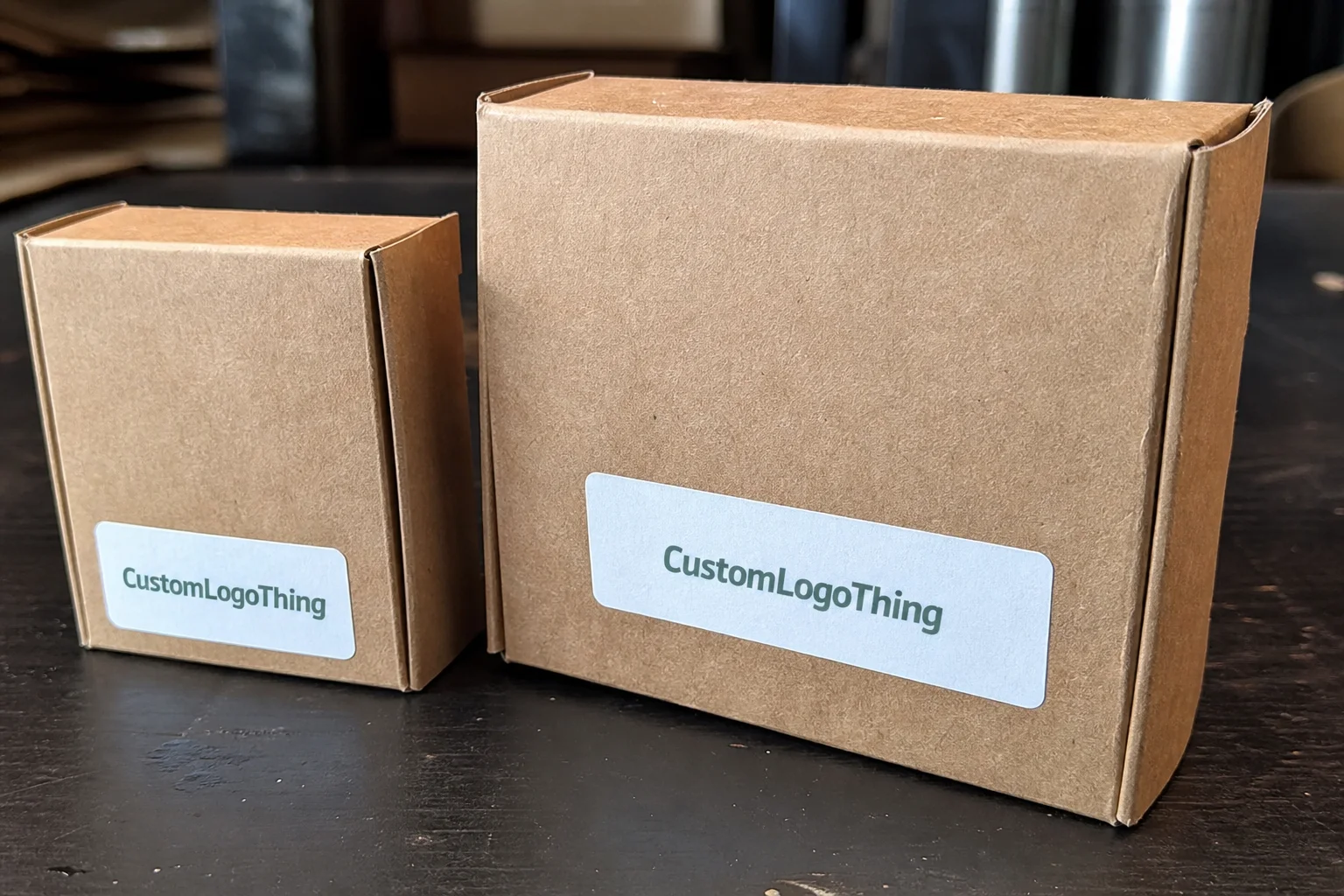
Most buyers start with artwork. That is understandable, but the package surface should come first. A design that looks balanced in a mockup can feel cramped on a folded tee, too small on a mailer flap, or oversized on a tissue wrap. The surface sets the limit, not the file.
Small size changes have outsized visual impact. Move a label by 1/8 inch and the white space shifts. Move it by 1/4 inch and the package can read differently. On apparel packaging, that can be the difference between intentional and improvised.
There is also a production angle. When the label fits the panel well, application is faster and more consistent. If it is awkwardly sized, the pack team adjusts by hand, which increases crooked placement, edge lift, and rework. The per-unit cost is small, but the waste adds up across a run.
Size is not a decoration choice. It affects handling, legibility, adhesion behavior, and how unified the package looks.
The practical starting point is the real packaging, not a digital mockup. A ruler on the actual surface tells you what fits once folds, seams, curves, and flaps are accounted for.
How custom size label stickers are made and applied
Custom size label stickers start with three decisions: finished size, shape, and surface. Those decisions drive the rest. A label for a carton panel behaves differently from one for a soft mailer or a textured kraft sleeve, even when the artwork is identical.
Once the size is set, the dieline becomes the anchor. Bleed needs room beyond trim, and safe margins matter more as labels get smaller. On compact formats, text that sits too close to the edge can look clipped even when the cut is technically correct.
Proofing is where most avoidable errors are caught. A digital proof confirms dimensions and placement. A physical sample is better when fine type, multiple layers, or a finish that changes the surface is involved. That extra step is useful when the label must match other packaging elements, such as insert cards or secondary wraps.
Application method matters too. Small runs are often hand-applied, which is fine for slower packouts or limited SKUs. Higher-volume operations usually prefer rolls because they dispense faster and more consistently. If the team is labeling at speed, the format should support that workflow.
For brands coordinating a broader packaging system, it helps to align the label spec with Custom Labels & Tags so type scale, finish, and dimensions stay consistent across the full set.
Material, adhesive, and finish choices that change performance
Material affects both cost and durability. Paper stocks are usually the right answer for indoor packaging that will be handled once or twice and then discarded. They print cleanly, keep costs down, and work well when the label mainly needs to create a polished presentation. Film stocks such as BOPP are better when moisture, friction, or repeated contact are part of the label’s life cycle.
Adhesive choice matters just as much. Permanent acrylic adhesive is the default for many shipping packs, retail boxes, and clothing mailers because it holds through transit and casual handling. Removable and repositionable adhesives make sense for temporary promotions or packages that need to stay clean after the label is removed. On recycled mailers, kraft, and lightly coated surfaces, the adhesive should be tested on the final substrate, not on a generic sample sheet.
Finish changes the visual result and the feel in hand. Matte reduces glare and keeps type readable under mixed lighting. Gloss pushes color saturation and can make a brand palette feel more vivid. Soft-touch creates a more premium tactile effect, but it adds cost and should be used only when the package benefits from that specific feel.
Finish also affects how the label stacks, slides, and rubs against neighboring materials. A matte paper label may be fine on an insert card, while a gloss film version performs better on a mailer that gets tossed into a tote, loaded into a bin, and shipped across a warehouse. The use case matters more than the sales description.
For buyers who care about sustainability, paper sourced through FSC-certified supply chains can be a sensible option when the application allows it. Packaging guidance from packaging.org is useful when appearance, recovery pathways, and production realities need to be balanced rather than treated as separate decisions.
| Option | Typical use | Usual MOQ | Rough unit cost at 5,000 pieces | Notes |
|---|---|---|---|---|
| Matte paper | Short-term clothing packaging, inserts, retail presentation | 250 to 500 pieces | $0.05 to $0.11 | Good for clean print and lower cost, but less resistant to moisture and scuffing |
| BOPP film | Mailers, handled packages, higher-scuff environments | 250 to 500 pieces | $0.07 to $0.15 | Better for moisture and abrasion; a stronger choice when the package travels farther |
| Soft-touch or specialty finish | Premium branded packaging and presentation pieces | 500 to 1,000 pieces | $0.10 to $0.22 | Elevated feel, but extra coating and setup steps raise the cost |
Production steps and lead time from proof to shipment
The production path looks simple on paper. In practice, there are several chances to lose time if the file is not ready. Artwork intake comes first. The vendor checks resolution, bleed, color build, die alignment, and whether the supplied dimensions actually match the intended size. A file can look right on screen and still be wrong for print.
After review comes proofing. This is where the buyer confirms the final size, shape, copy placement, and finish details. Then comes approval, and only then does production move forward. If the design requires a custom die, the job may need an additional setup step before printing starts. Unresolved artwork is usually the real schedule risk.
For straightforward digital jobs, turnaround often falls in the 5 to 8 business day range after proof approval. More involved orders, especially those with specialty laminates, unusual cuts, or larger quantities, can run 10 to 15 business days or longer depending on queue time and finishing complexity. Shipping is separate, so a job can be complete and still appear late if transit is ignored.
Quality control happens at several points. Operators check color consistency, cut accuracy, edge quality, and whether the labels release cleanly from the liner. For rolled orders, the team also checks unwind direction and spacing so the labels dispense properly at the pack station. A bad unwind direction can slow the line more than a slightly slower print run ever would.
Three things slow orders most often: late artwork changes, unclear size specifications, and approval delays. A proof held for two days is rarely still a two-day delay. The quickest jobs are usually the ones that were prepared cleanly from the start.
If the packaging will move through distribution and not just sit on a shelf, some teams also compare the label structure against broader transit testing guidance. Organizations such as ISTA publish useful packaging test resources for compression, vibration, and handling risk. That matters when the label is part of a system, not a standalone object.
Pricing, MOQ, and unit cost: what drives the quote
Quotes for custom size label stickers are built from a small set of variables. Finished size, shape, material, adhesive, finish, color count, and total quantity all feed the final number. A special die cut or a layout that leaves a lot of unusable sheet space usually costs more because it reduces production efficiency.
MOQ and unit cost move together. A small test order is useful, but the setup work is spread across fewer labels, so the per-piece price rises. Once quantities climb into the low thousands, setup costs fade and the unit price drops. A run of 250 pieces and a run of 5,000 pieces can feel like different pricing models because they are.
Paper labels usually sit at the lower end of the cost range, BOPP lands in the middle because of added durability, and specialty finishes move up because they require more processing. None is inherently better. The right choice is the one that survives the handling the package actually gets.
Do not compare quotes by headline price alone. Check whether proofing is included, whether the quantity is quoted as sheets or rolls, whether shipping is embedded in the number, and whether die charges or special coatings are already part of the total. A quote that looks higher can still be the better value if it includes costs another vendor left open.
For buyers managing labels alongside mailers, tissue, inserts, and Custom Packaging Products, it helps to compare the label line item against the full presentation budget. A label rarely exists alone. It sits inside a larger system, and the economics make more sense once that system is visible.
Common sizing mistakes that create waste or returns
The first mistake is designing to a mockup instead of the actual surface. A label can look perfect on a flat screen and still fail on a folded garment bag, a curved mailer, or a textured box panel. Real packaging steals space in ways software does not show.
Small type creates a second kind of trouble. Thin fonts, tight line spacing, and narrow borders become hard to read once the label is scaled down. A line weight that looks crisp in a file preview may disappear in print, especially on matte stock or on packaging with folds and seams. If the label needs to do real work, clarity matters more than cleverness.
Adhesion testing is another common miss. Kraft mailers, coated cartons, recycled papers, and slick films all respond differently. A label that holds on one surface may lift at the corners on another because the adhesive never reached full contact. The final substrate is the only surface that counts.
Finish choice can also be delayed too long. Matte and gloss do more than change appearance. They change glare, contrast, and the tactile read of the package. If the finish does not match the rest of the presentation system, the label can look disconnected even when the print itself is excellent.
The clean fix is usually the boring one. Measure the real surface, allow for bleed and safe area, test the adhesive on the actual packaging, and approve the proof only when it reflects how the label will be used.
How to choose the right specs and place the order
A useful order starts with a short list of facts: application area, quantity, substrate, finish, and artwork format. If the design is still changing, wait. Even a small layout change can trigger a new proof cycle or force a different die, which is an avoidable way to lose time.
If the package is customer-facing and sensitive to presentation, ask for a sample or a low-volume test run before committing to the full quantity. That is especially sensible when the label will sit beside custom printed boxes or a complete branded packaging system. A test run shows how the label behaves on the real surface, under real handling, with real lighting.
There are a few practical questions worth asking before approval. Is the adhesive suited to the package material? Is the output sheeted or rolled? Does the proof show true finished size? Are there any setup, die, or finishing charges that would change the total? These questions are what keep the order from drifting into preventable problems.
For a first order, the safest route is straightforward. Measure carefully, choose the material that matches the handling environment, and lock the size before the quote is accepted. That gives the vendor enough information to produce the order cleanly, without back-and-forth that usually adds cost and slows delivery.
The best labels do their job quietly. They fit the surface, survive the handling, and leave the package looking resolved rather than assembled in pieces. That is a higher standard than a pretty mockup, and it is the one worth using if the packaging has to work outside the screen.
What size should custom size label stickers be for folded apparel packaging?
Measure the actual flat panel or wrap area first, not the digital layout. Leave enough room for margins so the artwork does not feel crowded once it is on the package. If the label needs to sit across a fold or seam, test that condition before approving the full run.
Which material is best for custom size label stickers on clothing mailers?
BOPP is usually the stronger choice if the mailer will see moisture, friction, or a lot of handling. Paper is fine for short-term indoor packaging and lower-cost presentation use. The final choice depends on the surface, the handling environment, and whether the label needs to survive transit.
Can I order a small quantity if I am testing a new clothing label design?
Yes. A smaller order is useful for checking size, color, and adhesion on real packaging before a larger run. The tradeoff is higher cost per piece because setup is spread across fewer labels. If the design is still changing, a test run is usually the smarter spend.
How long does production usually take for custom size label stickers?
Simple jobs can move in about 5 to 8 business days after proof approval. Specialty finishes, uncommon shapes, and larger volumes can push that closer to 10 to 15 business days. Shipping time is separate, so the full calendar often depends on transit as much as production.
Why do custom size label stickers lift on some clothing packaging?
The surface may be textured, dusty, oily, or too lightly coated for the adhesive to bond properly. Different substrates need different adhesive behavior, and the only reliable check is testing on the actual packaging material. If the label has to bridge a curve or seam, that test becomes even more important.


