Plain envelopes get the mail out the door. That’s their job, and they do it without fuss. Custom stickers for envelopes do more than close a flap. They add branding, signal care, and turn an ordinary mailpiece into something that looks considered before anyone opens it. For invitations, thank-you mailers, direct mail, and ecommerce inserts, that small adhesive detail often does more visual work than the envelope stock itself.
For buyers, the appeal is practical. A sticker gives you a polished finish without committing to a full custom envelope run. That usually means lower setup complexity, fewer artwork variables, and a much easier approval process. It also gives teams a way to standardize mail presentation across campaigns, even when the contents change from one send-out to the next.
There’s another reason these stickers keep showing up in packaging programs: they scale well. A short invitation batch, a mid-size promo mailer, and a larger fulfillment run can all use the same basic format if the dimensions and adhesive are chosen correctly. That kind of flexibility is useful when a brand wants a consistent look without paying for a different envelope every time.
Why custom stickers for envelopes change the first impression
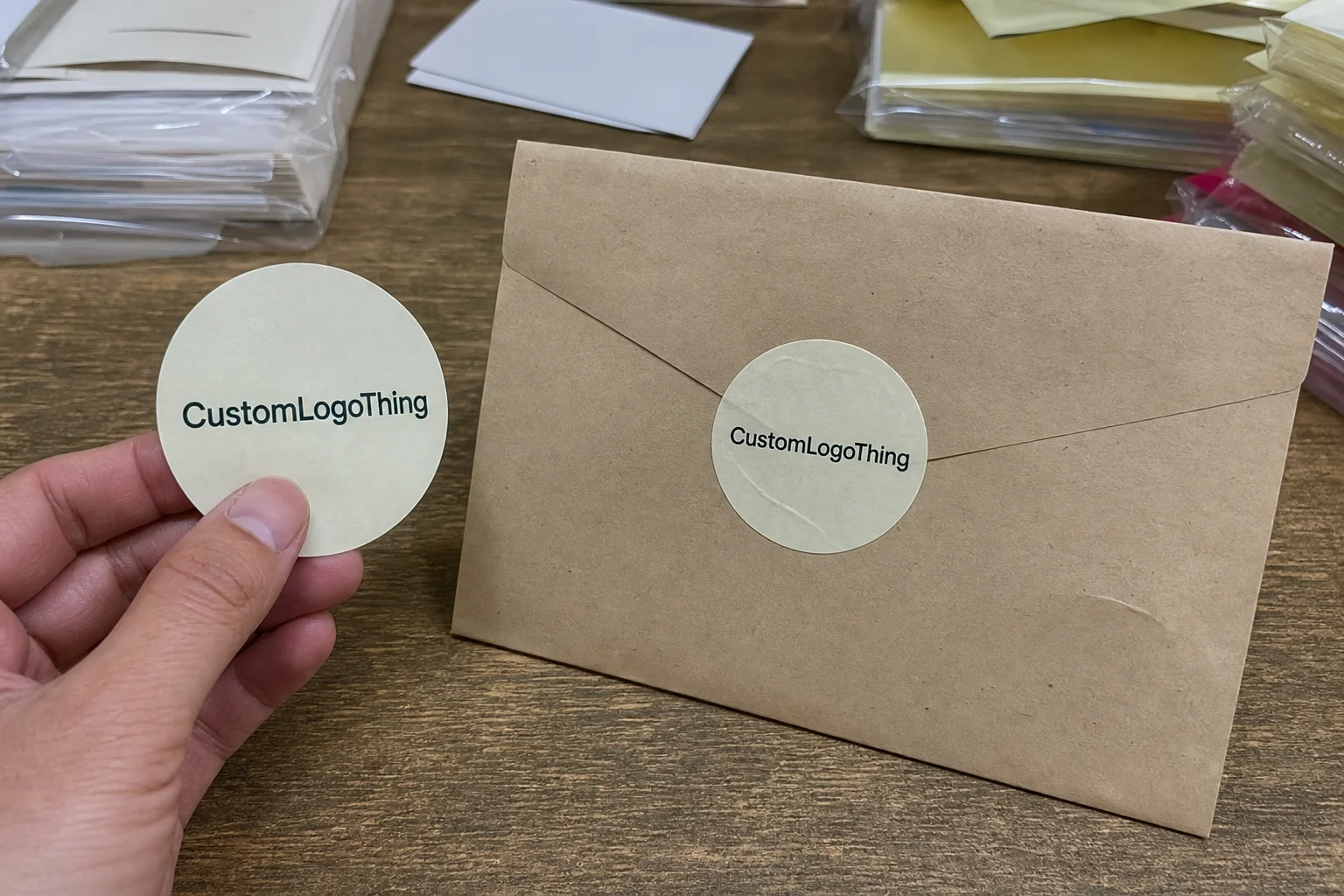
A good envelope sticker changes the tone of the whole piece. People notice the seal first, especially on plain kraft, white, or recycled envelopes. A logo, campaign mark, or short line of copy on the flap immediately tells the recipient that the mailing was planned, not assembled as an afterthought.
Custom stickers for envelopes are adhesive labels used to seal, brand, or decorate envelopes without changing the envelope stock. That makes them useful for weddings, corporate correspondence, promotional mailers, subscription inserts, and event invitations. The envelope stays simple, while the sticker carries the visual cue that ties the package together.
That matters because the first touchpoint shapes expectations. A mailer that looks clean and intentional creates a better opening experience, which is exactly why these stickers are so common in branded packaging and broader package branding programs. They can echo the same visual system used on Custom Packaging Products, or coordinate with Custom Labels & Tags when the mailer is part of a larger campaign.
Buyers usually reach for envelope stickers for three straightforward reasons:
- They cost less than custom-printed envelopes in many quantities.
- They simplify assembly because the team only has to manage one envelope and one seal format.
- They make a plain mailpiece feel finished without adding much production complexity.
The visual return is often better than teams expect. A small seal on the flap can make a standard envelope feel like part of a larger brand system, especially when the color, finish, and size are matched to the stock underneath. That is the kind of detail people notice even if they cannot explain why the piece feels more polished.
“The envelope is the first handshake. The sticker is the part that tells people whether the handshake was thoughtful or rushed.”
How the sticker and envelope pairing actually works
The sticker can serve a few different roles, and the role changes the spec. It may seal the flap, cover a closure point, act as a tamper-evident label, or simply sit on the front face as a brand marker. Those jobs overlap, but they are not identical, and the differences matter when choosing size, adhesive, and material.
For a sealing application, the sticker has to cross the flap seam and hold on both sides. That requirement sounds simple, but it affects everything from shape to surface area. A sticker that is too small can look neat in a digital mockup and still fail once it hits a textured or recycled envelope. In production, coverage is more important than style.
Application method also changes the buying decision. Hand-applied stickers are fine for short runs, wedding mailings, and low-volume event kits. Machine-applied or pre-applied stickers make more sense when the quantity climbs and labor starts to matter. If a team is sealing thousands of envelopes, even a few seconds per piece becomes real cost.
Material compatibility is where many orders go off track. Paper stocks are a natural fit for uncoated envelopes and stationery-style mailers. BOPP and vinyl handle moisture and handling better, so they’re useful when the mail will move through more hands or sit in transit longer. Clear films are a good option when the design should sit lightly on the envelope instead of adding a block of color.
Envelope finish matters too. Matte envelopes tend to pair well with matte or uncoated stickers, especially for wedding, editorial, and premium stationery work. Glossy stock can accept more vivid finishes, but it also shows surface mismatch more quickly. Recycled and kraft envelopes often have more texture, which can reduce initial tack if the adhesive is too light. If the project matters, ask for a sample on the actual stock rather than assuming a proof will tell the full story.
Finish changes the mood of the piece. Matte feels softer and quieter. Gloss reads brighter and more retail-oriented. Clear can disappear in a nice way when the design should feel like it belongs on the paper rather than sitting on top of it.
Key specs that affect cost and performance
Sticker pricing is mostly a function of a few specific variables: size, shape, material, adhesive, print coverage, finish, and quantity. Those are the levers that move the quote. Everything else is usually detail, not the main cost driver.
Standard shapes such as circles, squares, and rectangles are usually the most economical because they are simple to cut and easy to run in volume. Custom dies add more visual identity, but they also add setup and often a higher minimum. If the sticker is doing a straightforward sealing job, a clean standard shape can be the smarter choice.
Material choice changes both performance and price:
- Paper labels: best for stationery, invitations, and indoor mailers with light handling.
- BOPP film: a practical option when moisture resistance and durability matter.
- Vinyl: durable, though often more than most envelopes require.
- Removable adhesive: useful for temporary closures, but it should be tested carefully on textured stock.
Quantity has a strong effect on unit cost. Small orders carry more overhead per piece because setup, proofing, and packaging are spread across fewer stickers. As the run gets larger, the per-unit price usually comes down. Shipping can still be noticeable on small jobs, especially when the order is light enough that freight becomes a bigger percentage of the total than expected.
Finish and durability add another layer. Lamination, foil, and specialty inks can improve the look, but they also increase cost and may extend production time. They make sense when the envelope will be handled repeatedly, exposed to rough transit, or used for a launch where the finish is part of the presentation. For simple thank-you mail or short-lived event invitations, a premium finish can be unnecessary.
Rolls and sheets are worth considering early. Rolls are better for machine dispensing and faster high-volume assembly. Sheets are easier for hand application and short-batch packing. Choosing the wrong format does not always show up in the quote, but it can show up quickly in labor time.
| Option | Best for | Typical cost impact | Notes |
|---|---|---|---|
| Paper circle sticker | Invites, thank-you mailers | Lowest | Simple, clean, and usually efficient for light handling |
| Custom die-cut paper sticker | Brand-forward mailers | Moderate | More setup, stronger visual identity |
| BOPP or film sticker | Mail that gets handled more | Moderate to higher | Better moisture resistance and durability |
| Foil or specialty finish | Premium stationery or launch mailers | Highest | Looks refined, costs more, and can add production time |
Cost and pricing: what buyers should budget for
A realistic budget for envelope stickers should include more than the sticker price itself. Artwork setup, proofing, production, packaging, and shipping all affect the total. Rush charges can matter too, especially when a campaign date is fixed and production needs to move around other jobs.
For smaller runs, custom stickers for envelopes often sit at a higher per-unit cost because fixed setup costs are spread over fewer pieces. Mid-volume orders usually show the best value. As a rough working range, buyers may see small-run pricing around $0.20–$0.60 per piece depending on size, material, and finish, while larger runs can land lower when the job uses standard shapes and simple print coverage. Those figures are directional, not universal; final pricing always depends on the full spec.
Where budgets tend to drift upward is predictable:
- Choosing a larger size than the envelope actually needs.
- Adding extra print colors for a design that could be simplified.
- Upgrading to a premium finish that does not change the recipient’s experience much.
- Selecting a custom shape when a standard circle or rectangle would look just as strong.
There are simple ways to keep the order efficient. Standard shapes are usually easier on price. Clean artwork prints better and reduces the chance of rework. Grouping the sticker order with other packaging components can also help with freight planning, especially if you are already ordering Custom Packaging Products for the same campaign window.
When requesting quotes, the most useful questions are practical ones:
- What is the unit cost at two or three quantity tiers?
- Is there a die charge or setup fee?
- How long is the production window after proof approval?
- Does the finish change the price or the lead time?
- Are sheets and rolls priced differently?
That may sound basic, but basic questions are what expose hidden costs before the order is locked in.
Production process and timeline from proof to delivery
The production path is usually familiar: brief, artwork setup, digital proof, approval, print, cut, finish, pack, and ship. A well-organized supplier keeps those stages clear. A messy one turns a simple order into a long thread of corrections and delays.
Simple jobs with ready-to-print artwork move faster than custom shapes or specialty finishes. A clean run can often move through proofing and production in about 7–12 business days after approval. More complex orders, especially those with foil, unusual dimensions, or higher volume, can take longer. Seasonal work also pushes timelines. Holiday mailings, invitation batches, and launch packs tend to stack up at the same time, which makes planning matter more than usual.
Proofing is where buyers should slow down and check the details carefully:
- Logo placement — Is it centered and readable at normal viewing distance?
- Bleed — Does the artwork extend enough beyond the cutline?
- Cutline — Does the shape actually suit the intended use?
- Adhesive edge — Does it cover the flap seam properly?
- Envelope coverage — Does the sticker have enough width to hold securely?
Most timeline problems are ordinary, not dramatic. A file gets revised after approval. A stock option goes out of availability. A shipping delay adds a day or two. Those are the common reasons a small job slips, which is exactly why it helps to build margin into the schedule rather than hoping the deadline stays flexible.
If the mailing date is fixed, waiting until the last minute is expensive. Rush fees often climb faster than buyers expect, and there is little room to recover once the calendar is already tight.
Common mistakes when ordering envelope stickers
The most common mistake is size. Buyers often choose a sticker that looks right on a screen but does not work on the envelope itself. Too small, and it fails to cross the flap seam. Too large, and it overwhelms the piece or makes hand application slower than it should be. The goal is coverage with balance, not a sticker that dominates the whole envelope.
Adhesive choice is another place where projects go wrong. Textured paper, recycled stocks, and some kraft envelopes need stronger tack than smooth coated surfaces. If the adhesive is too weak, the sticker can lift at the edges or fail to seal cleanly. That’s more than a cosmetic issue; it can affect how the recipient handles the mailer and how professional the package feels.
Print contrast gets overlooked often. A light logo can disappear on kraft or darker envelope colors. If the background is busy or naturally textured, the design needs stronger contrast and fewer delicate details. Tiny type is risky on small-format envelope seals because it often becomes unreadable once the sticker is applied and viewed at arm’s length.
Skipping samples is another easy mistake. A digital proof shows layout, but it does not always show how the sticker will behave on real stock. Texture, recycled fibers, and envelope coatings can change the way the adhesive performs. If there is any doubt, ask for a sample or test the sticker on the actual envelope.
Application speed also matters more than many teams expect. A beautiful design can become inefficient if it takes too long to place or align. That is especially true when a fulfillment team is sealing a large batch and every extra motion multiplies across the run. In those cases, simpler shapes and clearer placement usually save time without sacrificing appearance.
Finish mismatch is the last common trap. High gloss may suit retail promotions, but it can feel out of place on rustic stationery or softer invitation work. The finish should support the tone of the envelope, not fight with it.
Expert tips for better envelopes, faster assembly, and cleaner branding
Give each sticker one main job. Seal, decorate, or brand. Trying to do all three in a tiny space usually creates clutter, and clutter is hard to rescue on small-format packaging. The best envelope stickers are straightforward, legible, and easy to apply.
Match the adhesive to the envelope stock instead of choosing purely by appearance. A solid bond is always more valuable than a pretty one that lifts. On textured or recycled paper, test before ordering in volume. On smooth white stock, there is more room to choose based on finish and design.
Use the sticker to support the rest of the mail experience. A logo, return address cue, QR code, or short campaign line can add function without crowding the design. For brands that care about packaging consistency, this is a useful place to connect the envelope to other materials, including custom printed boxes used elsewhere in the same program.
Keep the artwork readable at arm’s length. That is the real test. If the message only works when the envelope is held close, it is probably too busy for a seal. Strong shapes, concise copy, and clear contrast usually outperform decorative detail.
Ask for a test print or sample pack before approving a full run. That is especially useful with textured, dark, or recycled envelopes. One sample can reveal problems with adhesion, contrast, or size that would otherwise turn into reprints.
If you mail often, standardize sticker sizes across campaigns. Reusing a few reliable formats reduces decision fatigue, simplifies reordering, and makes assembly faster for the team. Consistency also helps with budget planning, because you are not re-evaluating every variable from scratch each time.
For sustainability-focused projects, ask about FSC-certified paper and recycled content when appropriate. If the mail will be handled heavily or needs to survive distribution conditions, testing against guidance from organizations such as ISTA can help frame expectations. For broader packaging and environmental context, EPA resources are useful background. Those references will not choose the sticker for you, but they can help shape better purchasing questions.
Next steps: how to order the right sticker run
Start with the envelope itself. Measure the flap and the visible face area before requesting a quote so the sticker size is matched to the actual mailpiece. Then decide what the sticker needs to do. If it is mainly a seal, the spec should favor coverage and adhesion. If it is mostly a brand marker, the layout can prioritize visibility. That choice shapes the rest of the order.
Ask for pricing at two quantity tiers. That gives a clear view of where the unit cost starts to improve and whether a slightly larger run makes financial sense. If the difference is meaningful, a larger order may be more efficient. If the gap is narrow, a conservative quantity protects cash flow and avoids leftovers.
Before approving production, check color, cutline, and adhesive placement against the actual envelope stock. Not a similar stock. The real one. The one that will actually be used in mail assembly. That is the only test that tells you whether the job will work in practice.
Plan the reorder window early enough to avoid rush charges. If the stickers are part of a wider packaging program, it can also help to align them with labels or other components so freight is consolidated and production timing stays cleaner. That matters more than buyers sometimes expect, especially when multiple items are needed for the same launch.
For teams comparing options, custom stickers for envelopes are a practical way to improve presentation without overcomplicating the envelope spec. They are scalable, economical in many runs, and surprisingly effective when the size, adhesive, and finish are chosen with the envelope stock in mind. Keep the design simple, test the surface, and Choose the Right format for the assembly method. That is usually enough to make the mailpiece look intentional and hold up through the handling it will actually face.
What size custom stickers work best for envelopes?
The best size is one that crosses the flap seam and still leaves the branding readable. Small decorative seals can work for invitations, but a functional closure usually needs more coverage than people expect. If the sticker is too small, it may look neat and still fail to do its main job.
Are custom stickers for envelopes cheap for small quantities?
Small quantities usually have a higher unit price because setup, proofing, and production overhead are spread across fewer pieces. Standard shapes and simpler materials are the easiest way to control cost on short runs. If the mailing is small, avoid unnecessary finishes unless they actually improve the result.
Which sticker material is best for kraft envelopes?
Paper stickers can work well for a natural look, but kraft usually benefits from stronger adhesive and higher-contrast printing. If the stock is rough or recycled, ask for a sample on the real envelope before committing to volume. Kraft is popular for a reason, but it can be unforgiving if the adhesive is too light.
How long does production usually take?
Turnaround depends on artwork readiness, sticker complexity, quantity, and finishing choices. A clean, straightforward order can often move through production in about 7–12 business days after approval, while specialty jobs take longer. Any revision after proof approval can extend the schedule.
Can custom stickers seal an envelope securely?
Yes, if the sticker is the right size and the adhesive is matched to the envelope surface. For mail that will be handled a lot, test the seal before ordering in volume so you can catch problems early. A secure seal depends on the spec, not just the artwork.

