Buyer Fit Snapshot
| Best fit | Die Cut Poly Mailers Wholesale projects where brand print, material claims, artwork control, MOQ, and repeat-order consistency need to be specified before quoting. |
|---|---|
| Quote inputs | Share finished size, material target, print colors, finish, packing count, annual reorder estimate, ship-to region, and any compliance wording. |
| Proofing check | Approve dieline scale, logo placement, barcode or warning zones, color tolerance, closure strength, and carton packing before bulk production. |
| Main risk | Vague material claims, crowded artwork, missing packing details, or unclear freight terms can make a low unit price expensive after revisions. |
Fast answer: Die Cut Poly Mailers Wholesale: Pricing, Specs & Lead Time should be specified like a repeatable production item. The safest quote records material, print method, finish, artwork proof, packing count, and reorder notes in one written spec.
Production checks before approval
Compare the actual filled-product size with the drawing, then confirm tolerance on folds, seals, hang holes, label areas, and retail display edges. Reserve space for logos, QR codes, warning copy, and material claims before decorative graphics fill the panel.
Quote comparison points
Review material grade, print process, finish, sampling route, tooling charges, carton quantity, and freight assumptions side by side. A quote is only useful when the supplier can repeat the same color, closure quality, and packing count on the next order.
Die Cut Poly Mailers Wholesale: Pricing, Specs & Lead Time
Die cut Poly Mailers Wholesale becomes a serious buying category the moment order volume starts climbing and the pack-out table begins to matter as much as the invoice. A brand shipping folded tees, socks, beauty kits, or subscription bundles can lose time on every order if the mailer is too flimsy, too loose, or awkward to seal. A well-built die-cut profile trims seconds from each shipment, lowers the odds of damage, and gives the package a cleaner first impression that feels planned instead of improvised.
Packaging carries more weight than its unit cost suggests. It affects labor, protection, brand presentation, and how often a customer is willing to reorder without hesitation. I have sat through enough packaging reviews to know that a slightly higher unit price can still be the smarter buy if it cuts rework, lowers returns, and keeps replenishment predictable. Buyers comparing Custom Poly Mailers with broader Wholesale Programs usually need a more practical question than "What is the cheapest quote?" The better question is what the full pack-out costs after labor, freight, setup, and waste are counted.
A packaging buyer gets better results from die cut poly mailers wholesale when the spec matches the product, the freight lane, and the brand standard. First runs and replacement orders both benefit from a clear starting point: fit, print coverage, closure strength, and delivery window. A quote built on those details is far easier to compare than a price request with no real product context.
Why Die Cut Poly Mailers Wholesale Change the Shipping Math
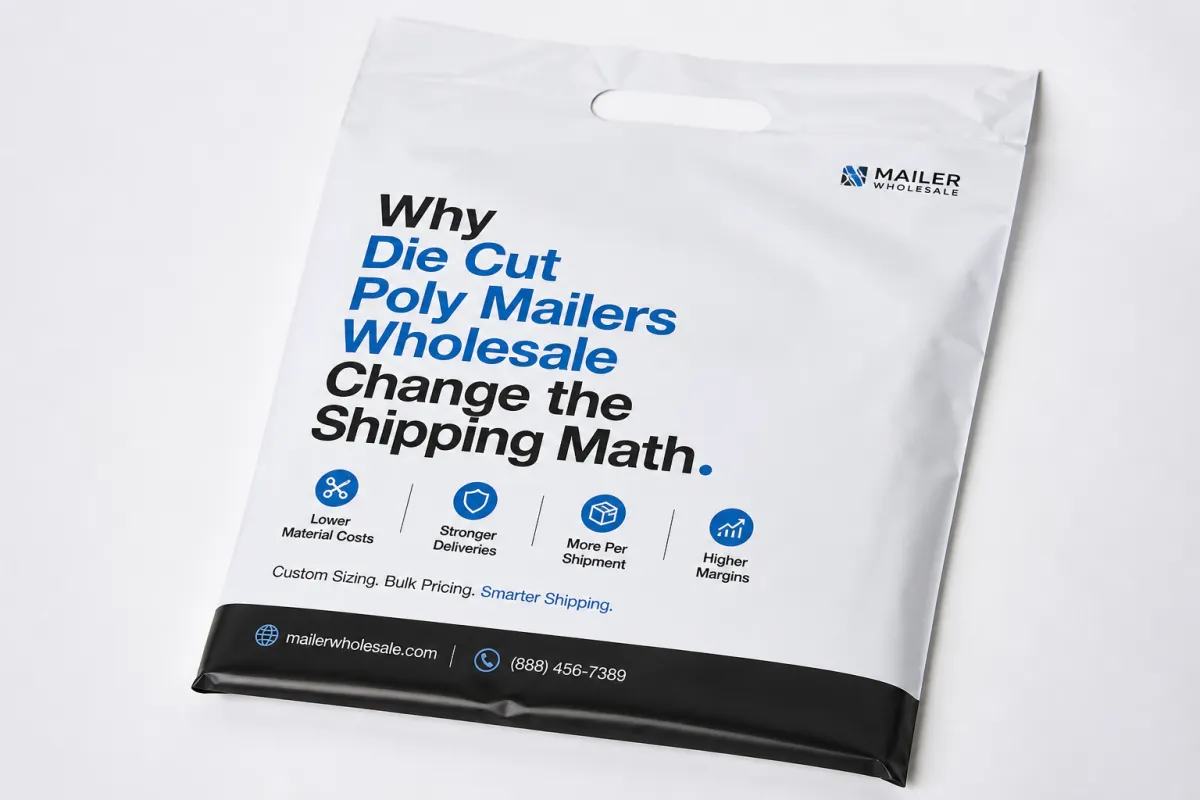
Die cut poly mailers wholesale change the shipping math because they affect the packing table, not just the supplier invoice. A bag that is too tight, too slippery, or weak around the seal slows the line every time it is used. That slowdown repeats across thousands of orders, which turns a small design flaw into a real operating cost. In a busy shipping shift, a few extra seconds per order can matter more than a tiny difference in unit price.
The die-cut shape also creates a cleaner opening profile. That detail sounds small until garments, accessories, or folded inserts are moving through the pack-out area and need to slide in without wrinkling the exterior. Apparel brands feel that benefit in the finished presentation because the item reaches the customer looking deliberate rather than crowded. Subscription kits with lightweight components gain a cleaner fill, less corner bulging, and fewer quick fixes with tape. Die cut poly mailers wholesale often win on that combination of speed and appearance.
One comparison gets missed often: a mailer that is a cent or two cheaper can become the expensive choice if it creates rework, damaged shipments, or a second print run after the first design misses the mark. Once labor, returns, and freight are included, the lowest quote is rarely the strongest one. Buyers who ship on a steady cadence usually care more about the full landed cost than the headline unit price. That is not fancy theory, just how the math behaves once the boxes start moving.
Wholesale buying changes the economics as volume rises. A steady monthly order pattern gives the supplier room to quote better pricing, hold color consistency, and reserve a more dependable production slot. That predictability is useful for apparel brands, cosmetic kits, and accessories that reorder in the same size month after month. Die cut poly mailers wholesale turn packaging from a last-minute purchase into a planned operating input.
Die cut poly mailers wholesale work best when three things are already clear: the packed product size, the monthly volume, and the branding standard. Without those, the quote may be technically correct and commercially useless. With them, the supplier can recommend the right gauge, adhesive, and print setup without wasting time or forcing guesswork.
A low unit price is not a win if the mailer tears, the seal fails, or the artwork forces a reprint.
For shipping programs with rougher transit conditions, buyers should think about testing early. Many teams use ISTA test methods as a reference for vibration, drop, and compression performance. Formal lab work is not required for every mailer, but the framework helps answer a practical question: is a thinner film enough, or does the order need a stronger structure?
Mailers also need to fit the rest of the shipping system. Outer cartons, inserts, labels, and protective paper all influence the same order. Die cut poly mailers wholesale should be reviewed in the context of the whole packaging spend, not treated like a stand-alone line item with no connection to the rest of the pack-out.
Die Cut Poly Mailers Wholesale: Product Details and Build Options
Die cut poly mailers wholesale usually refers to mailers with a shaped opening, handle, or cutout made with a steel rule die. That die-cut element can make the bag easier to open, easier to carry, or faster to pack depending on the design. Compared with a plain poly mailer, the shape often improves line speed and gives the package a more finished feel when it reaches the customer.
Material choice matters more than many first-time buyers expect. Most die cut poly mailers wholesale programs use polyethylene film in a thickness range that protects the contents without turning the mailer into an unnecessary expense. A lighter film can work well for soft apparel or inner-branding kits. A thicker structure is usually safer for longer shipping lanes or items with sharper corners. Common film thicknesses often sit around 2.5 to 3 mil, though some programs go higher when puncture resistance needs more attention.
Surface finish shapes both cost and appearance. Glossy white film gives strong print contrast and a brighter presentation. Matte finishes can look quieter and more refined. Opaque black or custom-colored films are useful when privacy matters or when the brand wants stronger shelf presence at delivery. Print method affects the result too. One-color flexographic printing usually works well for simple logos, while more complex graphics increase setup time and raise the cost per unit. Die cut poly mailers wholesale should be judged as a complete structure, because film, closure, print, and finish all influence the final performance.
Customization is usually where the business case becomes clear. Buyers can often choose size, opacity, adhesive closure, tear strip, print coverage, and, in some programs, a returnable adhesive strip. Every added feature changes price in a different way. Larger print coverage tends to raise ink and setup cost. A stronger adhesive or tear strip may add only a modest amount while improving the customer experience. That is why die cut poly mailers wholesale quotes should never be compared as though every option were identical.
Practical use cases are easy to map out. Apparel brands use die cut poly mailers wholesale for folded tees, leggings, loungewear, and socks. Beauty brands use them for lightweight kits, promotional sets, and sample bundles. Accessories brands use them for scarves, straps, phone accessories, and printed inserts. Weight is only part of the decision. Product shape, pack density, and presentation matter just as much. A flat item can still require a larger mailer once cards, tissue, or a return insert are added.
Branding sits at the center of the buying decision more often than people admit. The mailer is often the first physical touchpoint after checkout. The outside of the package can reinforce trust before the customer even opens it. A crisp logo, consistent color, and clean seal line can make a small brand look more established. For that reason, die cut poly mailers wholesale often belong in the brand system as much as in the shipping system. If you want a broader view of the packaging mix, it helps to think of the mailer the same way you would think about labels, inserts, and outer cartons from Custom Packaging Products.
Specifications That Matter Before You Order
Before asking for die cut poly mailers wholesale pricing, confirm the basic specification set. Finished dimensions, usable interior space, film gauge, seal type, print area, and color requirements all need to be set early. If those pieces are fuzzy, the quote will be fuzzy too. The supplier may also price one spec while you intend another, which creates avoidable friction before production even starts.
Size is the first place where orders go wrong. Buyers often measure the product itself and forget the packed shape. A folded garment with a card insert and tissue paper needs a very different mailer than the same garment alone. A 9.5 x 12 inch stack on the table can become a much tighter bundle once the fold is finalized and the closure flap is counted. For die cut poly mailers wholesale, the finished pack matters more than the flat product.
Film gauge and seal type deserve close attention. A weak adhesive can struggle on a long shipping lane. A film that is too thin can puncture on corners or tear near the die-cut area. Buyers who want a useful benchmark should ask how the supplier tests puncture resistance and tensile performance. References such as ASTM D1709 for impact and ASTM D882 for tensile properties can be helpful discussion points, even if the factory uses internal methods for routine checks. That kind of conversation usually signals that the supplier understands die cut poly mailers wholesale as a production category, not just a quoting exercise.
Opacity has real consequences too. If contents should not show through, the film needs enough masking strength to cover product color, print, or shape. That matters for branded apparel and retail subscriptions where the outside package should not reveal the contents before opening. For some businesses, the best die cut poly mailers wholesale choice is not the lowest-price option, but the one that prevents awkward visibility and keeps the unboxing experience consistent.
A simple test plan helps buyers avoid costly mistakes. Request a sample, pack it with the actual product, close it under normal line conditions, and inspect the final shape from several angles. Check whether the closure holds after a short period of pressure. Confirm that the print stays away from the seal edge. Make sure the mailer still looks clean after the product is inserted, not only before. That last step catches a lot of problems before a full order is placed.
Watch for spec mismatches that create waste. Oversized mailers can raise freight and make the parcel look sloppy. Weak seals can lead to failed shipments. Print too close to the closure edge can distort the logo or crack along the fold. Those are not minor issues. They are avoidable losses. Good die cut poly mailers wholesale programs reduce waste by aligning product size, film strength, and print layout before production begins.
If your program includes paper inserts, internal note cards, or outer cartons, FSC-certified paper sources may matter as part of the larger package. The FSC organization is a practical reference for buyers who want paper-based components to remain traceable. The poly film is a different material story, but the supply chain still benefits when each component is chosen with care.
Die Cut Poly Mailers Wholesale Pricing, MOQ, and Quote Structure
Die cut poly mailers wholesale pricing usually comes from several parts: unit cost, print setup, tooling or plate charges, freight, carton packaging, and any special finishing. Buyers often focus on unit price and ignore everything else. That is how a quote that looks strong can turn expensive once shipping and setup are added. A serious comparison starts with landed cost, not a single headline number.
MOQ depends on how customized the order is. Blank stock mailers usually carry the lowest minimums because the factory does not need to stage print plates or color changes. One-color printed orders typically sit in the middle. Fully custom programs with multiple print colors, special film colors, or high coverage often need a larger commitment because setup costs must be spread across more units. For die cut poly mailers wholesale, the minimum order quantity can range from a few hundred pieces for stock-style runs to several thousand for custom print programs.
Here is a practical comparison buyers can use as a starting point. These are broad market ranges, not universal quotes, because size, film gauge, print coverage, and freight lane all affect the final number.
| Program type | Typical MOQ | Approx. unit price | Setup or tooling | Common lead time | Best fit |
|---|---|---|---|---|---|
| Blank stock-style die cut mailer | 500 to 1,000 units | $0.10 to $0.18 | Usually none or minimal | 3 to 7 business days | Testing, small launches, temporary inventory gaps |
| One-color custom print | 1,000 to 3,000 units | $0.18 to $0.30 | $75 to $250 | 10 to 15 business days | Logo branding, recurring apparel shipments, starter wholesale runs |
| Full custom color and higher coverage | 5,000+ units | $0.24 to $0.48 | $150 to $500+ | 12 to 20 business days | Scaled programs, brand-heavy packaging, repeat replenishment |
Those ranges only become useful if every supplier is quoting the same spec. Ask for the same dimensions, the same film gauge, the same print count, and the same carton quantity. A different spec is a different product, even if the quote looks close at first glance. Die cut poly mailers wholesale buyers get better comparisons when they keep a simple quote checklist.
- Dimensions: finished size and usable interior space.
- Film thickness: gauge or mil rating.
- Print: number of colors, print coverage, and placement.
- Closure: adhesive type, tear strip, or returnable seal.
- MOQ: minimum order by size or by SKU.
- Freight: whether shipping is prepaid, collect, or quoted separately.
- Overage: how many extra units are included for production tolerance.
Compare landed cost with the same discipline you would use for any other wholesale packaging line. A quote with a lower unit price can still lose if freight is higher, sample charges are separate, or the supplier requires another round of proof corrections. Die cut poly mailers wholesale should always be evaluated on the actual order total, not on one number pulled out of context.
If the pack-out is predictable, the quote should be predictable too. The more the supplier has to guess, the more the buyer will pay for those guesses.
Volume breaks matter as well. Once an order crosses a certain threshold, the per-unit price can fall because the setup cost is spread across more bags. That is where planning pays off. If a brand knows it will use 8,000 units over a few months, one larger die cut poly mailers wholesale order may make more sense than several small buys that each trigger separate setup and freight charges.
Process, Timeline, and Lead Time for Die Cut Poly Mailers Wholesale
The process for die cut poly mailers wholesale usually begins with a product brief, moves into proofing, then continues through production and shipment. The steps sound simple. Delays usually happen at the handoff points. Artwork that is not press-ready, missing dimensions, or unclear color targets can add days before a press sheet is approved. Clean orders begin with finished specs and a decision already made about size and finish.
A practical timeline often looks like this: inquiry and spec review, quote approval, artwork submission, dieline check, proof review, sample confirmation if needed, production, packing, and shipping. Stock-based orders with simple artwork can turn faster. Fully custom orders with multiple print colors take longer. For die cut poly mailers wholesale, a realistic custom lead time is often 12 to 15 business days from proof approval, with longer windows if the order is large or the film specification is unusual.
Approval steps deserve more attention than they usually get. The dieline check confirms that the logo and text sit in the right place on the finished mailer. The print proof shows color, placement, and scale. A sample or preproduction example confirms that the finished bag looks right in hand, not only on screen. Final sign-off matters because changes after production starts can be costly. Careful buyers save time and money on die cut poly mailers wholesale by treating proof review as part of production, not as a casual checkpoint.
Rush orders are possible in some cases, but they are easier when the order is simple. Finished artwork, a standard film color, and a proven size can shorten the cycle. Complex coverage, special finishes, and larger MOQs make rush handling harder. The best die cut poly mailers wholesale plan is the one built before inventory gets thin, not after it does.
Packaging teams also need to account for shipping time after production. A factory may finish on schedule, but the delivery still depends on freight lane, destination, and seasonal volume. A buyer who says "lead time" but means "factory completion plus transit" is setting up confusion. Clear communication solves that. Ask for production time and delivery time separately, then compare the full window.
Once the first run is approved, repeat orders should become easier. Artwork should already be locked. Dimensions should already be tested. The supplier should know the target pack size and the expected monthly draw. That is how die cut poly mailers wholesale become a stable operating line instead of a recurring scramble.
Why Choose Us for Die Cut Poly Mailers Wholesale
Custom Logo Things is built for buyers who want practical packaging, not vague promises. The value of die cut poly mailers wholesale comes from repeatable specs, clear communication, and a quote that still makes sense after freight and print setup are included. That is the standard we aim for. Buyers comparing suppliers usually get the best result from the partner that explains trade-offs instead of hiding them.
Our process starts with the spec sheet. We help buyers confirm dimensions, print area, closure style, and film thickness before production begins. That matters because the wrong size or a weak closure can undo the whole order. For die cut poly mailers wholesale, a little guidance up front often prevents a bigger problem later. We also support buyers who want a small test run before a larger replenishment order, which is often the smartest way to validate fit and demand.
One advantage of a focused packaging supplier is fewer surprises. Marketplace listings often look cheap until the buyer discovers the print setup is not included, the size is slightly off, or the freight charge changes the economics. A direct quote process is easier to audit. It gives the buyer a clear path from brief to proof to shipment, and that is what wholesale packaging should do. If your buying plan includes broader packaging items, our Custom Packaging Products and Wholesale Programs are designed to make that comparison less messy.
We also pay attention to the details that decide whether the package feels professional. Print consistency matters. Seal strength matters. Packing behavior matters. When buyers request die cut poly mailers wholesale, they are not just asking for a film bag. They are asking for a repeatable system that protects the product and presents the brand well. That is why sample review before production is so useful. It is a small step with a large payoff.
If sustainability is part of the purchase criteria, we can help buyers think through the full package rather than only the mailer. Paper inserts, outer cartons, and printed materials may all need separate sourcing decisions. A clean supply chain is rarely one material. It is a set of choices that fit together. That is one reason die cut poly mailers wholesale should be reviewed as part of the overall customer experience, not in isolation.
The real buying question is not "Can I find a lower quote?" The better question is "Can I trust the product, the proof, the timeline, and the re-order path?" That kind of comparison saves time across the next several shipments. When the mailer is right, packing moves faster, the brand looks sharper, and the reorder decision gets simpler. That is the outcome most teams want from die cut poly mailers wholesale.
Next Steps to Order Die Cut Poly Mailers Wholesale
If you are ready to request die cut poly mailers wholesale pricing, start with the basics. Measure the finished packed product, not just the flat item. Estimate monthly volume. Decide whether the mailer needs custom print or can begin as a stock-style test. Identify the ship-to location so freight is quoted correctly. Those four steps make the first conversation more productive and usually shorten the quote cycle.
The best first message to a supplier is short and specific. Include dimensions, quantity, print colors, closure style, and any handling requirements. If the mailer must fit a folded garment with a card insert, say so. If the package needs an opaque film for privacy, say that too. The more concrete the brief, the better the die cut poly mailers wholesale quote will reflect the real need.
- Measure the packed item in its final fold.
- Choose the print approach and number of colors.
- Estimate the monthly and quarterly usage.
- Ask for a sample or proof before full production.
- Compare at least two or three quotes on the same spec sheet.
A sample or proof is especially smart when the product includes garments, inserts, or an unusual folding pattern. A mailer can look generous on paper and still be tight in real use. That is why die cut poly mailers wholesale orders benefit from a fit test before the full run is approved. It is cheaper to catch a sizing problem with one sample than with five thousand units.
When comparing suppliers, judge more than price. Look at the clarity of the quote, the detail in the proof, the responsiveness of the account contact, and the lead time they are willing to commit to. A good supplier makes the process feel organized. A poor one makes every answer feel conditional. For die cut poly mailers wholesale, that difference often predicts the production experience better than the headline number does.
If the order is tied to a launch, planning earlier is safer. Build in time for proof review, sample review, and freight transit. Then check the final date against the actual launch calendar, not the date the factory says the run will finish. That small distinction can prevent rushed decisions and expensive expedites.
Die cut poly mailers wholesale should be ordered only after the fit and quote are locked. Send the specs, confirm the sample, and make sure the landed cost still works once freight and setup are included. If the pack-out is right, the next step is straightforward: place the order and keep the specification stable so the next replenishment is easier than the first.
Frequently Asked Questions
What sizes are available for die cut poly mailers wholesale?
Stock sizes are often available for common apparel and accessory items, while custom sizing works better when the product has inserts or an unusual fold. Measure the finished packed item, not just the flat product, so the mailer has enough room for sealing without stretching. Ask for a sample fit test before ordering at scale, because a mailer that looks large on paper can still feel tight in production.
What is the typical MOQ for die cut poly mailers wholesale orders?
MOQ usually depends on whether the order is blank, lightly printed, or fully custom, with custom runs generally requiring a larger commitment. Color changes, special finishes, and multiple print placements can raise the minimum because setup work is spread across fewer units. If volume is uncertain, ask for a stock-size option or a test run so you can validate demand before scaling.
How do I compare die cut poly mailers wholesale pricing?
Compare total landed cost, not just unit price, because freight, setup, and sample charges can change the real cost per mailer. Check whether the quote includes print setup, overage allowances, and carton packing so you are comparing equal terms. Use the same spec sheet across suppliers to avoid false comparisons caused by different sizes, thicknesses, or print coverage.
How long does a die cut poly mailers wholesale order take?
Lead time depends on artwork approval, sample confirmation, order size, and whether the mailer is stock-based or custom produced. The fastest orders usually start with finished artwork and clear specs, which reduces proof corrections and back-and-forth. Add shipping time to the production window so the delivery date reflects the full timeline, not just factory completion.
Can I add custom printing to die cut poly mailers wholesale?
Yes, most wholesale programs support custom logos, brand colors, product messaging, and other print elements. Prepare vector artwork and confirm the approved print area before production so the design lands correctly on the finished mailer. If brand consistency matters, request a printed proof or sample to verify color, placement, and readability before the full run.
For the cleanest result, build the order around the packed product, confirm the print and closure details, and compare suppliers on landed cost instead of unit price alone. That simple sequence usually avoids the expensive mistakes and gets die cut poly mailers wholesale where they should be: fitted to the product, tuned to the shipping lane, and ready for repeat ordering without drama.


