If you are comparing hang tags vs belly bands, the useful question is not which format looks nicer in isolation. It is which one survives the way your product is displayed, handled, shipped, and opened. A small paper component can change how finished a product feels, but only if the stock, dimensions, and attachment method match the item instead of fighting it.
Buyers often focus on the unit price and miss the hidden labor. A hang tag can act like a tiny billboard for branding, pricing, care instructions, and compliance details. A belly band behaves more like a clean wrap that organizes a bundle, reinforces a box, or gives a set a tidy outer finish. Those are different jobs, even though both start as printed paper.
Quick Answer: When Hang Tags Beat Belly Bands
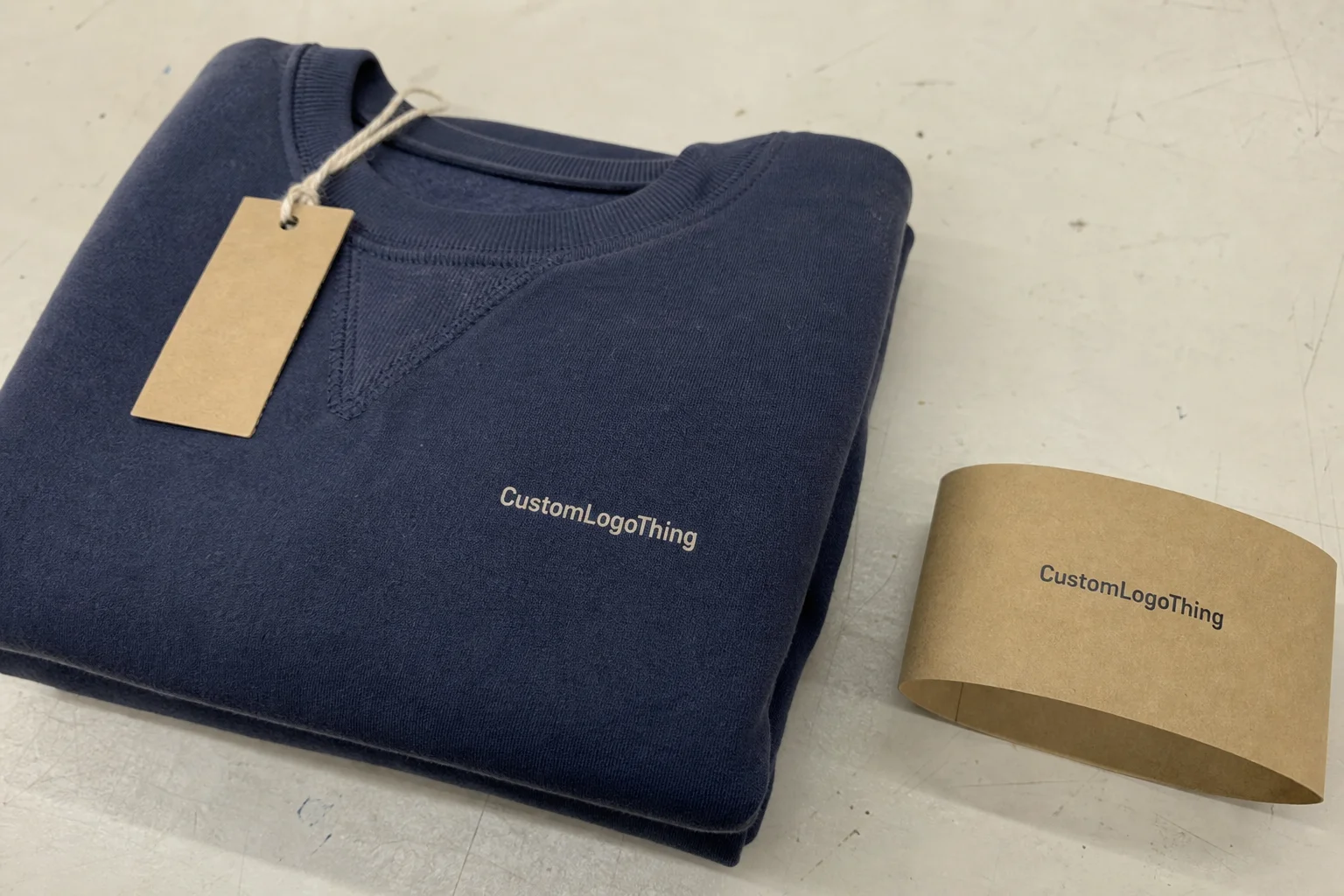
Choose a hang tag when you need visible branding, front-facing information, or a retail-ready presentation that attaches to the product itself. Choose a belly band when you need a wrap that holds pieces together, supports a sleeve or box, or creates a neat branded finish without adding much bulk.
That split sounds simple, but the less obvious part is production cost. The cheapest-looking format on a quote sheet is not always the cheapest once you add stringing, folding, gluing, kitting, and the time spent getting it onto the product. A flat tag on 350gsm cover stock with a drilled hole may be faster to run than a belly band that needs precise scoring, adhesive closure, and manual assembly.
From a packaging buyer’s point of view, the better format is the one that matches the sales channel first. If the item hangs on a peg, gets scanned in store, or needs size and price details visible immediately, hang tags usually win. If the product ships in a box, stacks on a shelf, or needs a sleeve-style wrap, belly bands often make more sense.
Practical rule: if the packaging needs to inform, advertise, and hang, use a tag. If it needs to gather, wrap, and organize, use a band.
That lens is more reliable than comparing design mockups alone. The format should solve a packaging problem before it tries to become a branding statement.
Top Options Compared: Materials, Formats, and Finish Choices
Hang tags usually start with a few familiar stocks: uncoated cover, kraft paper, textured paper, or coated board. Uncoated and kraft often feel warmer and more natural, which suits apparel, soap, candles, and handmade goods. Coated boards sharpen imagery and keep solids cleaner, which matters if the artwork uses fine lines, photography, or bold color blocks.
Paper weight changes how the tag behaves in the hand. A tag in the 300gsm to 400gsm range usually feels sturdy enough for retail without turning into a rigid plaque. Go too light and the tag curls or frays at the corners. Go too heavy and stringing becomes harder, especially if the hole punch is close to the edge. For higher-end presentation, buyers sometimes specify a thicker board with a smooth face and an uncoated back so the surface still accepts handwritten pricing or batch marks.
Finishes can shift the entire tone of the piece. A matte varnish keeps things understated, while soft-touch lamination, foil stamping, embossing, and spot UV push the look toward premium territory. None of those are free. A foil detail on a small run can add a noticeable cost jump, and spot UV only works well when the artwork has enough contrast and enough open space to avoid a muddy result. On small hang tags, restraint usually prints better than clutter.
Belly bands are usually made from lightweight card, paper stock, or narrow wrap labels. The right choice depends on what the band has to do. A 250gsm paper band may work well on a bakery box or gift set, while a lighter paper wrap may be enough for soap sleeves, jar bundles, or apparel folds. If the band must carry a barcode, ingredient list, or batch code, use stock that prints clearly and holds crisp folds without cracking at the score.
Attachment and closure matter more than many buyers expect. Hang tags can use string, elastic loops, twine, ribbon, staples, or slit-and-tab construction. Belly bands may use adhesive, tuck closure, scored folds, or a self-locking wrap. Each option affects the finished look, the assembly speed, and recyclability. If your team is trying to reduce mixed materials, a paper band with no plastic closure is easier to separate and easier to explain in sustainability copy.
| Format | Common Materials | Best Use | Typical Strength | Typical Tradeoff |
|---|---|---|---|---|
| Hang Tag | Uncoated cover, kraft, textured paper, coated board | Apparel, gifts, retail display, care and pricing info | High visibility and strong brand presence | Needs attachment hardware or manual stringing |
| Belly Band | Lightweight card, paper wrap, narrow label stock | Boxes, bundles, boxed sets, soap packs, mailers | Neat closure and organized presentation | Must be sized carefully and often needs folding |
For buyers comparing Custom Labels & Tags, the real issue is not which format prints better in theory. It is which one stays sharp after handling, shipment, and retail display.
Detailed Reviews of Real-World Use Cases
For apparel, hang tags remain the default for a reason. They carry size, price, SKU, origin, and care details without taking up garment space, and they attach cleanly to neck labels, seams, or straps. If the product is premium, a thick tag on 400gsm C1S or textured stock with a blind emboss can lift perceived value quickly. If the tag is too thin, too glossy, or too large, it starts to look like commodity retail instead of a curated brand.
There is also a practical retail point that gets overlooked: hang tags are easy for store staff to scan, clip, and restyle. That matters when the product is touched dozens of times before purchase. A tag with crisp die-cut corners and a centered hole tends to hang more predictably than a soft stock that twists on the peg.
For gifts and premium retail items, hang tags often do double duty as a branding piece and a story card. This works well when you want the customer to remember the maker, the material, or the origin story. The design still has to earn its place. Overpacked copy, tiny type, and cheap string can make good artwork feel rushed. A compact message on front and a small amount of functional detail on back usually performs better than a page of copy squeezed onto a small piece of board.
Belly bands are stronger for boxed sets, wellness kits, bakery cartons, and mailers. They add a clean outer layer that can hold a bundle together while still showing box artwork underneath. On soaps, candles, and multi-piece gift kits, a well-sized band can act like a signature wrap without hiding the product. In practice, they are especially useful when the outer packaging is already doing most of the visual work and the band only needs to add identity and structure.
Shipping changes the equation. A hang tag can crease or catch if the item moves around in transit, especially when attached with ribbon or twine that shifts inside the box. A belly band sits flatter and usually survives stacking better. For e-commerce, that matters more than many teams expect. A beautiful retail piece can arrive looking tired if the wrong format was chosen for a parcel instead of a shelf.
For food and bath products, the bands also help with tamper-evident presentation, though they are not a substitute for proper compliance packaging. A bakery carton band can hold a seasonal printed message while keeping the box visually closed. A soap sleeve band can keep a multi-bar set from sliding apart in transit. A gift wrap band can cover the seam line on a box lid without adding a full second layer of packaging. Each of those uses is small on its own, but together they make the product feel deliberate.
There is no universal winner. Both formats can look cheap if the material and artwork are mismatched to the product. A luxury candle wrapped in a flimsy belly band feels underbuilt. A basic soap with a giant foil hang tag can feel overstated. The best results happen when the format matches the pricing tier and customer expectation.
- Hang tags work best when visibility and storytelling matter.
- Belly bands work best when bundle control and tidy presentation matter.
- Both can look premium if the stock weight, finish, and sizing are appropriate.
Cost, Pricing, and MOQ Considerations
Cost is where many comparisons go sideways. Buyers often ask for “the cheaper one,” but the real answer depends on size, stock, print coverage, finishing, die-cuts, and how much handwork the format requires. A simple hang tag on standard cover stock may be less expensive than a custom belly band that needs scoring, folding, and adhesive closure. On the other hand, a belly band may use less material overall if it is narrow and printed simply.
As a rough benchmark, simple Printed Hang Tags in a run of 5,000 pieces can land around $0.08-$0.22 per unit depending on size, stock, and finish. Belly bands can start lower on raw material, sometimes around $0.05-$0.18 per unit, but labor can push the total higher if the band must be pre-folded, assembled, or matched to multiple package sizes. Special finishes like foil, embossing, or soft-touch lamination can raise pricing on both formats.
MOQ changes the decision too. Hang tags are usually easier to standardize across a line, but you may still need different SKUs for different garment types, sizes, or seasonal artwork. Belly bands tend to be more size-specific. If the box or bundle changes even slightly, the band dimensions may need to change with it. A brand with many pack formats can end up managing more band variants than expected, which is a real inventory cost even if the unit price looks favorable.
Assembly is another place where quotes can mislead. Ask what is actually included. Does pricing cover printing only, or does it include slitting, folding, stringing, kitting, adhesive, perforation, or packing by bundle? A quote that looks cheaper on paper can become more expensive once labor is added. That is usually the hidden line item that appears late, right when the schedule is already tight.
If you want to compare options fairly, ask for unit pricing at the same quantity, the same finish level, and the same level of assembly. Otherwise you are not comparing packaging formats; you are comparing incomplete quotes.
| Cost Factor | Hang Tags | Belly Bands |
|---|---|---|
| Material usage | Moderate to high, depending on size | Often lower per piece |
| Labor | Higher if stringing or attaching is needed | Higher if folding, gluing, or sizing is exact |
| Finish options | Strong for foil, embossing, spot UV | Works best with simpler layouts |
| MOQ sensitivity | Moderate | Higher when one band must fit many package sizes |
Process, Timeline, and Production Steps to Expect
Production for both formats usually follows the same basic path: artwork prep, proofing, material selection, print approval, finishing, cutting, and packing. Where they differ is the amount of precision work after printing. Flat tags are usually simpler because they can be trimmed, hole-punched, and packed with fewer finishing variables. Belly bands often need scoring and folding, which adds setup time and creates more room for error if the measurements are not exact.
Simple hang tags often move in about 10-14 business days after proof approval, depending on the print method, finishing, and quantity. Belly bands can take a little longer, often 12-18 business days, especially if they need custom sizing, adhesive, or kitting. If Pantone matching, foil stamping, or specialty stocks are involved, the schedule should include extra breathing room.
Three things tend to delay projects more than anything else. First, late dieline changes. Second, missing barcode or SKU details. Third, artwork that ignores fold lines, hole placement, or seam positions. These may sound small, but they create rework, and rework costs both time and money.
Ask for the proof type you actually need. A digital proof is fine for layout checks, but if you are trying to judge paper tone, finish feel, or how a folded band sits on the package, request a physical sample or a comp sample. If you are buying for a whole product line, a sample is usually worth the extra step because it exposes the problems that screen previews hide: curl, cracking at the fold, shadowing from adhesive, or a hole position that sits too close to the edge.
How to Choose the Right Format for Your Product Line
Start with the product, not the print. If the item hangs in a store, needs front-facing branding, or requires price and care details, hang tags are usually the better fit. If the product is boxed, bundled, or shipped as a set, a belly band often gives you a cleaner and more functional result.
Then look at the customer journey. Will the item be touched a lot, stacked on shelves, sent through parcel shipping, or gifted directly? A band that stays in place may be Smarter for Shipping, while a tag may be more effective on a retail peg where visibility matters most. The format should make the packaging easier to use, not harder.
For products with repeated handling, material choice matters as much as layout. Uncoated stocks are easier to write on and usually hide fingerprints better. Coated stocks hold sharper graphics but show scuffs faster. Soft-touch finishes look elegant but can pick up marks if the item is handled heavily before sale. That tradeoff is easy to miss in a mockup and obvious on a store shelf.
If sustainability is part of the brief, keep it practical. Use the least material that still does the job cleanly. That may mean a smaller tag on lighter stock, or a paper band with no plastic attachment. The EPA has useful guidance on waste reduction and materials management if you are reviewing disposal considerations: EPA recycling guidance.
For brands that care about responsible sourcing, paper certification belongs in the specification, not in a footnote. If you need FSC-certified stock, make that part of the brief. You can review certification standards at FSC. In gift, wellness, and lifestyle packaging, that kind of sourcing detail often supports the brand story more effectively than an extra finish layer.
Here is a simple decision framework:
- Is the product displayed hanging or standing? If hanging, lean toward a tag.
- Does the packaging need to hold multiple pieces together? If yes, lean toward a band.
- How much information must be visible right away? More info usually favors a tag.
- Will the package be shipped or stacked? Better stability usually favors a band.
- Do you need a premium tactile finish? Both can work, but tags often show finishes more clearly.
That is the practical way to choose between hang tags vs belly bands without turning the decision into a design debate.
Our Recommendation: Best Choice by Use Case
If I had to make the call by category, I would put hang tags first for retail apparel, story-driven gifts, and products that need visible pricing or care details. They are stronger for display, easier to brand at a glance, and more flexible when the tag itself is part of the sales message.
I would put belly bands first for boxed sets, minimalist packaging, bath and body bundles, bakery cartons, and mail-ready products that need a neat wrap. They are usually better at organizing the product and creating a tidy outer presentation with less visual clutter.
There is also a hybrid approach that works better than people expect. A simple belly band can secure a box or bundle, while a small hang tag adds story or gift messaging. That combination makes sense for premium gifting, holiday kits, and seasonal packaging where both structure and a stronger branded moment matter.
For buyers trying to balance perception and operations, the verdict is straightforward: use the format that solves the packaging problem first, then use print design to elevate it. If the item needs visibility, hang tags usually win. If it needs structure, belly bands usually win. If you are still stuck, prototype both on the actual product before you place the full order. That is the cleanest way to settle hang tags vs belly bands without guessing.
Next Steps: What to Request Before You Order
Before you request quotes, build a simple spec sheet. Include product dimensions, stock preference, finish, artwork content, attachment method, and any regulatory or barcode requirements. A clear spec saves rounds of clarification and reduces the chance of an inaccurate quote.
Ask for a digital proof and, if the project is important enough, a sample comparison. If you are deciding between hang tags and belly bands for the same product line, test both formats on the real item under real lighting. What looks polished on screen can behave very differently once folded, tied, wrapped, or placed on a shelf.
Confirm the quantity, turnaround target, and whether assembly, kitting, slitting, perforation, or stringing is included. If not, get those charges listed separately. That is the only fair way to compare apples to apples.
For products that must pass through retail handling or parcel shipping, ask how the format will hold up under abrasion, stacking, and repeated touch. If the package needs transportation testing, standards like ISTA can help frame the conversation, especially for shipped goods that need to survive distribution. You can review their testing resources at ISTA.
My final advice is simple: choose the format that best balances brand impact, cost, and handling in the channel where the product actually sells. That is how you make hang tags vs belly bands a packaging decision instead of a design debate.
Are hang tags vs belly bands better for retail packaging?
Hang tags are usually better when the product hangs on a peg or needs front-facing branding and information. Belly bands are often better for boxed products, bundles, or items that need a neat wrap without extra bulk. The better choice depends on display method, space for copy, and how much protection or closure the packaging needs.
Which costs less: hang tags or belly bands?
Belly bands can cost less in raw material, but folding, gluing, or assembly can add labor costs. Hang tags may cost a little more if they need stringing, specialty finishes, or thicker stock. The cheapest option is the one with the simplest production steps at your required quantity.
Do belly bands or hang tags work better for premium branding?
Hang tags usually feel more brand-forward when finished with textured stock, foil, embossing, or a custom cut shape. Belly bands can still feel premium when they are cleanly printed and sized well around a box or bundle. Premium perception comes from design, materials, and execution as much as the format itself.
What is the typical turnaround for hang tags vs belly bands?
Simple hang tags often move faster because they are flatter and usually require fewer production steps. Belly bands may take longer if they need precise scoring, folding, adhesive, or kitting. Artwork approval speed and finishing choices usually affect turnaround more than the format alone.
How do I choose between hang tags vs belly bands for a new product launch?
Choose hang tags if you need immediate shelf visibility, price labeling, or product storytelling. Choose belly bands if you need a compact wrap that keeps a set organized and looks clean in shipping or gifting. If both matter, test prototypes of each format on the actual product before placing the full order.


