Buy Logo Printed Hang Tags Bulk for Fast Custom Orders
A hang tag is one of the few parts of a product that gets handled before the product itself gets judged. That makes logo Printed Hang Tags bulk less like a stationery purchase and more like a small manufacturing decision with brand consequences. If the paper feels thin, the print density is uneven, or the hole tears during packing, the item starts with a discount in the shopper’s mind.
Bulk ordering solves a practical problem: consistency. One approved spec can cover multiple SKUs, colorways, and seasonal launches without forcing the team to renegotiate the basics every time a reorder comes up. That matters in apparel, accessories, candles, gift sets, and specialty retail goods where the tag is expected to look finished on day one and identical three months later.
There is also a cost reason. On a 5,000-piece run, a two-cent difference is $100. At 20,000 pieces, the same gap becomes $400. Small unit changes move quickly once the volume climbs, which is why paper choice, finish, and die-cut complexity deserve more attention than they usually get.
Why Bulk Hang Tags Change the Way Products Sell
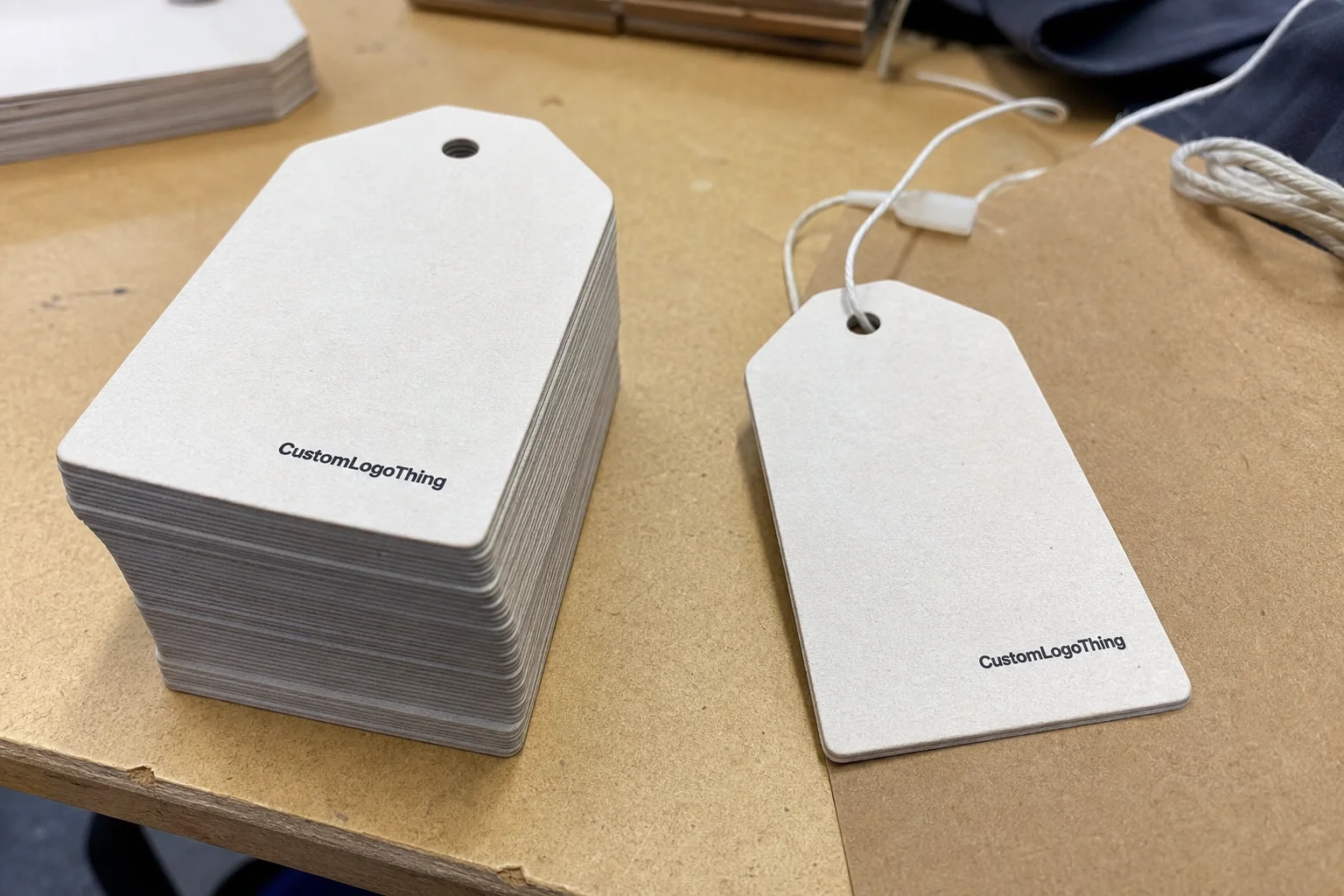
For most retail items, the hang tag is the first physical branding cue the buyer touches. It carries price, care information, barcode data, and the brand’s visual tone in one object no larger than a postcard. That is a lot of work for a piece of card stock. When it is done well, the tag quietly supports the sale. When it is done poorly, it pulls attention in the wrong direction.
Bulk ordering changes the equation because it turns the tag into a repeatable production asset. The size stays fixed. The cut line stays fixed. The color reference stays fixed. Teams do not have to rebuild the layout each time a new shipment lands, and that reduces the kind of drift that creeps in when tags are ordered in small, inconsistent batches.
A hang tag is small, but it carries a disproportionate amount of judgment. Buyers notice edge quality, print density, and hole placement long before they read the copy.
That is especially true in categories where presentation and handling live close together. A folded sweatshirt, a boxed candle, and a leather accessory are not the same packaging problem, but each one still needs a tag that looks intentional. The cheapest tag on paper is not always the cheapest tag in practice if it curls, scuffs, or slows down packing. Packaging labor adds up quickly; even ten extra seconds per unit becomes meaningful at scale.
There is another operational benefit that tends to get overlooked. When a product line uses the same tag spec across multiple items, the warehouse and packing team spend less time sorting exceptions. Fewer exceptions means fewer mispacks, fewer reprints, and fewer awkward situations where one SKU arrives with a slightly different tag stock than the rest of the range.
For brands that want the tag system and other packaging pieces to stay aligned, keeping everything under one specification file is more effective than treating each item as a one-off. If related assets are needed too, Custom Labels & Tags can keep the visual system consistent without forcing a rebuild every season.
Materials and Finishes That Hold Up in Retail
Paper choice does more than change the look. It changes how the print lands, how the tag feels in hand, and how much abuse it can survive during packing and retail handling. Coated cover stock usually gives the cleanest ink hold and the crispest edge definition. Uncoated stock feels softer and more natural, and it is easier to write on if the tag needs handwritten pricing, lot codes, or temporary notes. Kraft stock has a more grounded, tactile quality that works well for handmade goods and brands that want a less polished appearance. Specialty textured papers add depth, but they need more careful proofing because fine type can lose clarity on a rough surface.
Thickness matters too. Heavier board gives the tag more presence and helps it hang straight. That can be useful on premium apparel, boxed goods, or products displayed upright on hooks. Very light paper may save a fraction of a cent, but it can fold at the corners, curl in dry environments, and make the entire package feel less considered. A tag attached to a coat faces different handling than a tag tied to a candle. The stock should match the abuse, not just the mockup.
| Stock / Finish | Typical Look | Best Use | Typical 5,000-Piece Range |
|---|---|---|---|
| Coated cover, matte | Clean, modern, low glare | Apparel, accessories, retail basics | $0.10-$0.18 each |
| Coated cover, gloss | Brighter color, stronger contrast | Promotions, bold logos, high-saturation art | $0.11-$0.20 each |
| Uncoated or kraft | Natural, tactile, less reflective | Eco-led brands, handmade goods, casual retail | $0.09-$0.17 each |
| Textured specialty paper | Premium surface, softer printed edge | Gift items, luxury accessories, limited runs | $0.16-$0.30 each |
| Heavy board with soft-touch | Substantial, smooth, elevated feel | Higher-end retail, boxed products, premium programs | $0.22-$0.35 each |
Finish changes the result almost as much as the stock. Matte reduces glare under store lights and usually reads as quieter and more restrained. Gloss can make logos feel sharper and more saturated, but it also shows fingerprints and scuffs more readily. Soft-touch adds a tactile premium feel, although it is not the right answer for every line. If tags are handled heavily in transit, a finish that looks luxurious but marks too easily becomes a weak choice.
Print fidelity depends on substrate. Smooth coated stock gives the best results for solid logo blocks, small type, and thin rules. Absorbent or textured papers can mute color and blur fine detail if the artwork is too delicate. That is why proofs matter. A proper proof should show the live area, trim, hole placement, and how the logo edges will behave at final size, not just the general composition.
For shipments that need extra protection, some buyers think about the tag as part of the distribution system rather than just the brand system. If it has to survive abrasion, stacking, and transit vibration, that changes the tolerance for paper choice and surface treatment. The less obvious the retail environment, the more conservative the finish should be.
Sizes, Shapes, and Attachment Details That Affect Fit
Tag size should fit the product instead of competing with it. A large rectangle can look correct on outerwear or a tote bag, but the same size can overwhelm jewelry packaging or a compact accessory. Too small, and the tag disappears into the product presentation. That is not a neutral mistake; it usually makes the brand look less developed than it is.
Rectangles remain the default because they print efficiently and are easy to finish. Square tags work well for minimal or modern layouts. Rounded corners help reduce edge wear during packing and retail handling. Custom die-cuts can reinforce a brand identity, but they need a real reason. Extra tooling increases cost and can complicate cutting, stacking, and packing. A silhouette should solve a brand problem, not just add visual noise.
Attachment details deserve more attention than they usually get. Pre-punched holes make packing faster. Corner slits can remove the need for separate hardware. Strings, pins, and plastic fasteners each affect both assembly time and presentation. On a line that packs hundreds of units a day, a few extra seconds per tag becomes real labor. Hole placement also matters. If the punch sits too close to the edge, the tag can tear. If it sits too high or low, the tag hangs at an awkward angle.
The layout needs to account for barcode space, price fields, QR codes, and care copy before the final size is locked. It is easy to underestimate how much room those items take once the logo, margins, and trim allowances are already fixed. A tag that looks balanced in a design file can turn cramped at press size. That is why final proofs should be checked at actual dimensions, not just on screen.
Some buyers also specify tags to support a broader packaging system, not just a single item. In those cases, consistency matters more than novelty. If the same program uses inserts, labels, or other retail-facing assets, keeping the structure unified is usually smarter than treating each piece as a separate project. For those cases, Custom Labels & Tags helps keep the same production logic across different components.
Cost, Pricing, MOQ, and Quote Inputs
Pricing for logo printed Hang Tags Bulk depends on a small set of variables that carry most of the cost: stock, finished size, print sides, color count, finish, die-cut complexity, hole style, and packing format. The pattern is predictable. As the spec gets more custom, setup work increases, and so does the chance that the unit price moves up.
Minimum order quantity is usually shaped by press setup and finishing efficiency, not by the artwork itself. A simple design on an efficient sheet layout may hit a much better price at the next quantity tier than it does just above the minimum. That is why a quote at 4,900 pieces and a quote at 5,000 pieces can sometimes look surprisingly different. The machine does not care about round numbers, but the production plan often does.
For a useful quote, the supplier needs the final size, quantity, stock preference, print sides, finish, attachment method, and whether the tags ship loose or pre-strung. If the artwork is still in progress, that should be said plainly. Vague requests create vague pricing, and vague pricing usually turns into revisions later. The better the input, the less room there is for surprise after the proof stage.
Simple one-color tags on coated cover generally sit near the lower end of the market. Thicker board, soft-touch lamination, foil, or custom shaping can move the number up quickly. A practical buyer will usually ask for two or three comparable options. That makes the tradeoff visible. Sometimes the difference between a $0.14 tag and a $0.19 tag is not just finish; it is the decision to avoid a second production issue six weeks later.
For a rough planning benchmark, a straightforward 5,000-piece run may land around $500 to $900 depending on stock and finishing. Add specialty paper, heavier board, or extra operations, and the total can climb into the four figures fast. That is normal. The real question is whether the added cost buys stronger shelf presence, better handling, or fewer downstream problems.
Production Steps and Timeline Expectations
The production path is predictable, which is useful because it means most delays are avoidable. It usually starts with artwork review and preflight, then proofing, then approval, then printing, cutting, finishing, inspection, packing, and freight handoff. Specialty papers or custom die-cuts add more steps, which usually stretches the schedule by a few days.
Most delays happen before the press starts. Missing bleed, uncertain Pantone references, incomplete barcode data, or last-minute shape changes can slow the job more than the actual print run. Once proof approval is locked, the job should move with much less variation. Before that point, every open question adds friction.
Lead time and turnaround time are not the same thing. Turnaround describes the production window in the shop. Lead time includes proofing, revisions, manufacturing, packing, and shipping. That distinction matters when the tags are tied to a launch date, a store reset, or inventory that cannot miss the shelf window. A rush order can help, but only if the artwork is final and the schedule still allows for shipping.
For most standard bulk runs, a realistic planning window is often 7 to 15 business days after proof approval, with shipping added on top. Custom finishes, heavy board, specialty die-cuts, or complex packing can extend that. If a supplier promises an unusually fast timeline on a complex spec, the question is not whether it is possible. The question is where the shortcut is being taken.
If a program depends on FSC-certified paper, bring that up early. Paper traceability is easier to manage when the stock is selected before the quote is finalized. For buyers who use certified materials, the FSC system is a useful reference point for sourcing decisions.
How to Keep Reorders Consistent Across Seasonal Runs
Reorder consistency starts with a spec sheet that actually gets used. It should list the final size, stock, finish, hole placement, attachment method, and approved print file. If that information lives across multiple emails, the next run can drift without anyone noticing until the cartons are already on the dock. A good spec file removes guesswork and makes the next order look like the first one.
Artwork files matter too. Vector files preserve logo sharpness and type consistency better than flattened images. Keep the approved artwork, Pantone references, and proof images together. Color memory fades quickly between seasons, and a team trying to recreate a brand red from a loose PDF often ends up slightly off. That difference can be subtle on screen and obvious in a stack of finished tags.
One practical habit helps more than people expect: build a modest overage into the order. It covers spoilage, samples, and the units that get damaged during packing. It also gives the warehouse a small buffer for replenishment. In a fast-moving retail cycle, that buffer can keep a new print run from interrupting shipping just because a handful of tags went missing or were damaged in handling.
Quality control should check trim consistency, hole alignment, color tolerance, print registration, and packing count. None of these are glamorous, but each one protects the final impression. A tag that cuts cleanly on the first run should cut cleanly again if the spec does not change. That predictability is one of the main reasons to buy logo Printed Hang Tags bulk instead of treating each replenishment as a fresh creative exercise.
The best reorders are boring. That sounds unhelpful until you have had to fix a variation that was caught after thousands of units were already packed. Boring, in packaging, usually means controlled.
What to Prepare Before You Request a Bulk Quote
Before requesting logo Printed Hang Tags bulk, gather the basics: final size, quantity, material preference, print sides, finish, attachment method, and deadline. If the line includes several product variations, note whether each SKU uses the same tag or a different version. That one detail can change the quote structure and the production plan.
Send vector artwork if you have it. That is the best starting point for crisp type and clean logo edges. If the design is not fully finished, send the best available file and ask for a preflight review. A production team can usually confirm whether the layout needs bleed adjustment, font replacement, or barcode spacing before pricing is locked. That saves back-and-forth later.
It also helps to describe how the tag will be used. Apparel tags face different handling than candle tags, accessories, or gift packaging. Some products need better abrasion resistance. Others need a smoother writing surface. A clear end-use note improves the chance that the stock and finish recommendation will actually match the use case instead of just sounding premium on paper.
If the program is likely to repeat, ask about a saved spec file and a reorder path. Buyers who work through Wholesale Programs tend to care about that more than one-off shoppers because consistency and speed matter on the next cycle just as much as they do on the first. The strongest bulk order is the one that can be repeated without rebuilding the entire job.
How many logo printed hang tags bulk should I order to get better unit pricing?
Ask for pricing at the next quantity break above your target so you can see the real difference in unit cost. In many cases, the better price sits just above the threshold rather than right at the minimum. Add a small overage for spoilage, samples, and future replenishment so you do not have to start a small emergency run later.
Can I use my own artwork for logo printed hang tags bulk orders?
Yes. Vector artwork is the cleanest starting point because it preserves logo sharpness and type at press size. If the file is not fully print-ready, expect a proofing step to check bleed, trim, and color references. Sending fonts and Pantone values early reduces revisions.
What finish is best for retail hang tags?
Matte works well for a quieter look and easier readability under store lighting. Gloss can make color pop, but it shows fingerprints and scuffs more easily. If the tags will be handled heavily, a heavier stock with a protective finish is usually the safer choice.
How long does production usually take for bulk hang tags?
Simple orders may move through production in about 7 to 15 business days after proof approval, not counting shipping. Specialty stocks, custom die-cuts, or extra finishing steps usually extend that window. The real schedule should always include approval time and freight time, not just press time.
What should I include when asking for a quote on logo printed hang tags bulk?
Send quantity, size, material preference, print sides, finish, attachment style, and deadline. Include artwork files or a draft layout so the supplier can confirm whether the design is production-ready. A complete request is faster to price and less likely to change later.
For brands that need the first touchpoint to look controlled rather than improvised, logo printed hang tags bulk gives you a useful amount of control over appearance, cost, and repeatability in one specification. The paper choice, the size, the finish, and the quality checks all matter more than the tag’s physical size suggests. Get those decisions right once, and the system is easier to repeat the next time.


