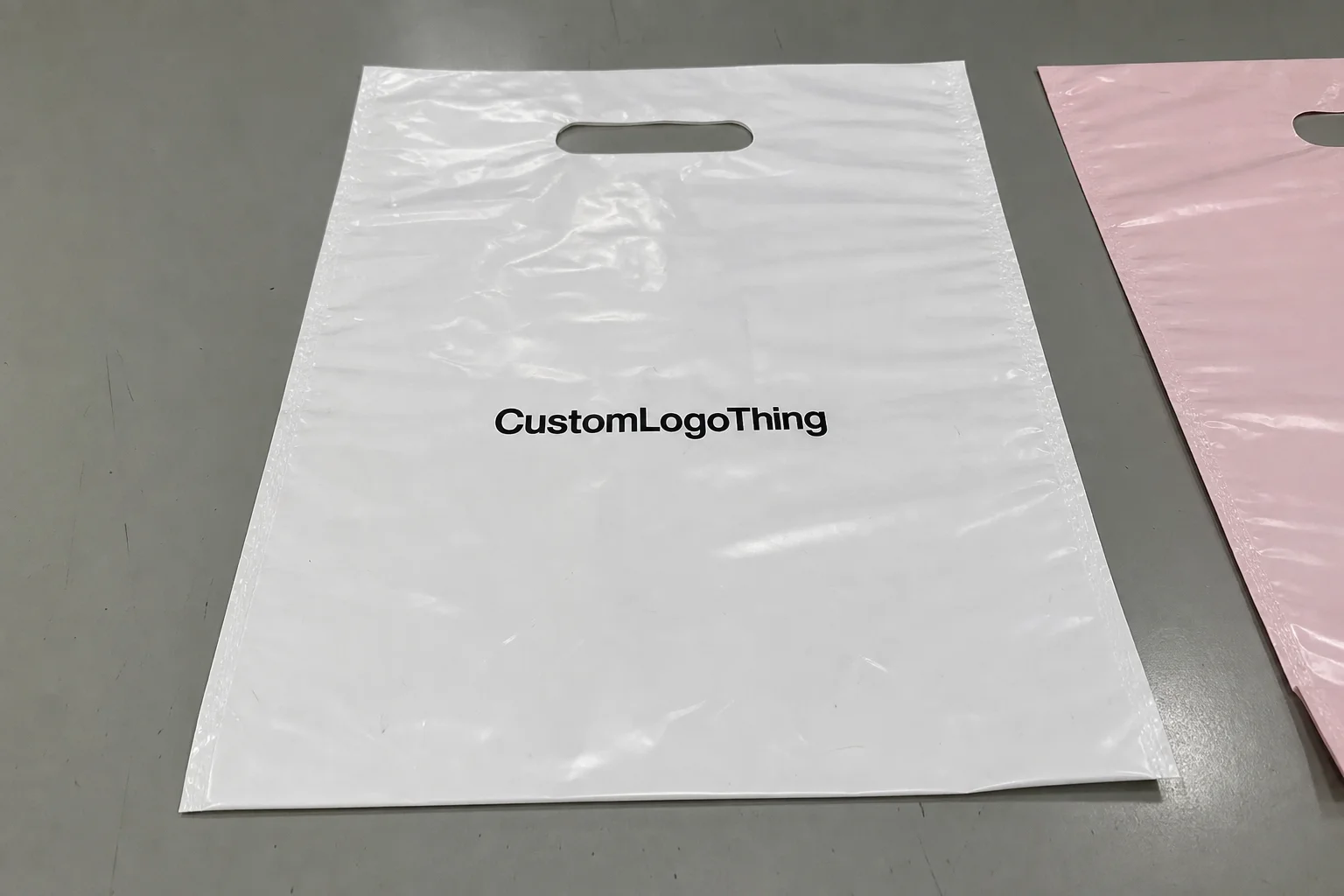
Your bag quote is only as good as the specs you send

Most custom plastic bag quotes go wrong for a simple reason: the inquiry is vague. A buyer sends a logo, asks for a “medium shopping bag,” and expects a final price. Then the missing details arrive one by one, and the number changes. That is usually not a trick. It is what happens when the first quote was built on half a product.
A useful logo printed plastic Bags Factory Quote Request needs more than artwork. The factory needs the bag style, dimensions, material, film thickness, handle type, print colors, print sides, packing method, order quantity, and delivery destination. Miss several of those and the first price is only a placeholder.
The cost swing can be sharp. A 10,000-piece order for a one-color logo sounds simple until someone asks the questions buyers often postpone: die cut or soft loop handle? LDPE or HDPE? 50 microns or 80? Single-side print or both sides? Flat bag or gusseted? Those changes can move the quote by 20% to 60%, sometimes more.
Many buyers assume printing is the main cost driver. Often it is not. Size, thickness, material, and bag construction usually matter more than a basic logo. A one-color design on a thick patch handle bag may cost far more than a lighter die cut bag with two colors.
Weak specs create a quality problem too. If carrying weight, resin grade, and seal performance are left open, some suppliers will quote the lightest workable structure to stay competitive. That can work for brochures, but it is risky for takeaway meals, boxed shoes, cosmetics, or products with sharp corners.
A low quote built on weak specs is not a bargain. It is just a delayed argument.
Clear inputs produce a cleaner price and a more stable production plan. Both matter more than a fast first number.
Choose the right plastic bag type before asking for factory pricing
The first choice is not color or finish. It is format. Bag type affects appearance, carrying comfort, line speed, and cost.
Common custom printed plastic bag types include:
- Die cut handle bags: clean retail appearance, moderate strength, widely used for apparel, promotions, and gift packaging.
- Soft loop handle bags: more comfortable to carry, more premium in feel, common in boutiques and cosmetics.
- Patch handle bags: reinforced handle area for better load capacity, often used for heavier retail merchandise.
- T-shirt bags: economical, fast to produce, standard for grocery, takeaway, and high-volume checkout.
- Drawstring bags: suited to light promotional use, accessories, and giveaways.
- Zip lock bags: practical for samples, small parts, accessories, and resealable retail packs.
- Merchandise bags: basic open-top or fold-over retail bags for general store use.
The tradeoff is usually appearance versus budget. Soft loop and patch handle bags feel more polished because they use more material and require extra converting steps. T-shirt bags and standard die cut bags usually sit lower on the price ladder because the structure is simpler and line speed is higher.
Use case should decide the format. A boutique clothing retailer may want a soft loop bag in the 50 to 70 micron range because the package is part of the sale. A takeaway business usually cares more about stackability, unit cost, and carrying strength. Trade show bags need decent print area and enough durability for catalogs, not a premium structure that wastes budget.
Freight can change the calculation. A flat die cut bag packs differently from a gusseted patch handle bag. Carton counts and carton dimensions change too. On larger runs, the supposedly cheaper option can look less attractive once shipping volume is included.
This comparison is a practical starting point:
| Bag Type | Typical Use | Relative Cost | Strength | Brand Feel |
|---|---|---|---|---|
| Die Cut Handle | Retail, events, apparel | Low to mid | Moderate | Clean, simple |
| Soft Loop Handle | Boutique, cosmetics, premium retail | Mid to high | Good | Premium |
| Patch Handle | Heavier retail merchandise | Mid to high | Very good | Premium |
| T-Shirt Bag | Grocery, takeaway, checkout | Low | Good for cost | Basic |
| Zip Lock Bag | Accessories, samples, parts | Low to mid | Light to moderate | Functional |
Choose the structure first. Reference photos help, but the final quote should match a defined bag type.
Plastic bag specifications that change quality, durability, and print results
Factories cannot price “standard size,” “good quality,” or “regular thickness.” Those terms are too vague to manufacture against.
The core specifications are straightforward:
- Width, height, and gusset
- Thickness in microns or mils
- Material
- Handle type
- Seal style
- Print sides and coverage
- Artwork colors
- Finish or special features
Material choices in plain English
LDPE is softer and more flexible, with a smoother hand feel and a more polished finish for many retail bags. HDPE is crisper, lighter for its strength, and common in T-shirt bags and economy carryout formats. If recycled content is required, ask for the percentage range rather than treating it as a yes-or-no label. Recycled blends can affect clarity, color consistency, odor, and print smoothness.
Thickness is not a minor detail
For many retail and promotional applications, plastic bag thickness falls between 30 and 100 microns. Lightweight giveaway bags may land around 35 to 45 microns. Boutique shopping bags often sit in the 50 to 70 micron range. Reinforced patch handle bags for heavier goods can go higher.
Thicker film usually means better puncture resistance, more opacity, and higher resin cost. It can also create heavier cartons, higher freight cost, and a stiffer feel than the application needs. The best thickness is the one that fits the load, not the highest number on the quote sheet.
Print method affects finish and budget
Flexographic printing is common for spot-color logos and uncomplicated designs. It suits many retail shopping bag projects and keeps setup costs manageable. Gravure printing is better for larger runs, finer graphics, stronger tonal control, and heavier ink coverage, but setup cost is higher because cylinders are more expensive.
If the artwork includes thin lines, reversed text, gradients, or broad solid areas, mention it early. Those details affect plate choice, print stability, and waste allowance.
Small features can change cost more than buyers expect: matte or gloss finish, bottom gusset versus side gusset, fold-over top, vent holes, reinforced handles, and custom bundle counts. For a serious quote, send dimensions like 300mm W x 400mm H + 80mm bottom gusset, not “about medium shopping bag size.”
Logo printed plastic bags factory quote request pricing: what actually moves the numbers
Unit price gets most of the attention because it is easy to compare. Factories price the whole production equation: resin, conversion, setup, packing, and shipping terms.
Main pricing drivers include:
- Bag size
- Material type and grade
- Film thickness
- Print coverage and number of colors
- Plate or cylinder setup
- Order quantity
- Packing method
- Freight terms such as EXW, FOB, or delivered pricing
MOQ exists because setup is real. Plate mounting, registration adjustment, startup waste, labor planning, and carton packing do not disappear because a buyer wants a small test run. For simple printed bags in standard sizes, MOQ often starts around 5,000 to 10,000 pieces. Premium handles, unusual dimensions, heavier film, or more involved printing can push that higher.
Quote comparisons go wrong when one supplier includes setup, export cartons, and delivery while another sends only a unit price. Break the quote into parts:
- Sample cost: stock sample, mockup, or pre-production sample
- Tooling or print setup: flexo plates or gravure cylinders
- Production unit price: cost per bag at the confirmed quantity
- Packing cost: bundling, carton standards, labels, pallets if needed
- Shipping cost: local delivery, export handling, or freight
A rough market snapshot for retail-grade custom orders might look like this:
| Scenario | Quantity | Typical Unit Range | Notes |
|---|---|---|---|
| Die cut, 1-color, standard size | 5,000 pcs | $0.08-$0.18 | Driven by thickness, material, and print side count |
| Die cut, 1-2 colors, standard size | 10,000 pcs | $0.06-$0.14 | Setup spreads better at higher volume |
| Soft loop, 1-2 colors | 5,000 pcs | $0.18-$0.32 | Handle assembly adds labor and material |
| Patch handle, thicker film | 10,000 pcs | $0.16-$0.30 | Higher strength, more resin use |
Those ranges are directional, not fixed law. Resin pricing, freight, artwork complexity, and packing rules all move. Ask for quantity tiers because moving from 5,000 to 10,000 pieces often reduces the unit price enough to change the buying decision. Common cost mistakes include custom sizes that waste film layout, full-bleed printing on low quantities, late thickness changes, and trying to match a budget bag to a premium finish.
Production process and lead time from artwork approval to shipment
A quote is only the starting point. Manufacturing follows a sequence, and missing information at the start slows every stage behind it.
The usual workflow looks like this:
- Inquiry review
- Specification confirmation
- Artwork check
- Quotation
- Sample or mockup approval
- Purchase order and deposit confirmation
- Plate making or cylinder preparation
- Material preparation
- Printing
- Bag conversion and handle assembly
- Packing and quality control
- Shipment release
For many first-time custom runs, a practical production window is around 12 to 20 business days after final proof approval. That is production only. Sampling sits outside it. A digital mockup may take one to two days. A physical pre-production sample can take several more, especially if the bag includes special handles, custom tooling, or nonstandard material.
Repeat orders usually move faster because approved specs, print references, and setup details already exist. First runs take longer because decisions, file corrections, and approvals are still in motion.
Lead time depends on order volume, raw material availability, print complexity, and factory loading. In practice, missing vector files, absent Pantone references, and unconfirmed dimensions cause more delays than machinery does.
If the delivery date is fixed, say so early in the logo printed plastic Bags Factory Quote Request. The factory can then tell you whether the specification fits the deadline or whether a simpler structure would be safer.
Quality control should be built into the schedule, not treated as an optional extra. Useful checks include film thickness measurement, print registration review, seal integrity inspection, handle attachment checks where relevant, and carton count verification. If the bags will move through rough distribution, transport testing guidance from ISTA can help with packed goods and outer cartons.
What to send in a logo printed plastic bags factory quote request to get pricing fast
Fast pricing comes from sending complete information once. A clean request lets the factory quote the actual bag instead of filling in blanks.
Use this checklist:
- Bag type: die cut, soft loop, patch handle, T-shirt, zip lock, drawstring, or merchandise bag
- Dimensions: width x height x gusset in mm or inches
- Thickness: microns or mils
- Material: LDPE, HDPE, recycled-content blend, or another required structure
- Quantity: ideally 2 to 3 tiers
- Print details: one side or two sides, number of colors, coverage level
- Artwork file: AI, EPS, or press-ready PDF if available
- Finish details: matte, gloss, gusset type, reinforced handle, vent hole, fold-over top
- Packing requirement: pieces per bundle, carton limits, labels, pallet rules if any
- Destination country: useful for freight planning and export packaging logic
- Target delivery date: so timing can be judged honestly
A reference photo helps, especially if you are unsure about structure names. So does a plain description of intended use. A cosmetics carry bag, a grocery checkout bag, and a trade show giveaway bag may all carry the same logo, but they should not share the same assumptions about film, handle reinforcement, or finish.
If you are uncertain about thickness or quantity, say so and ask for options. Useful comparison requests include:
- 50 microns vs 70 microns
- 5,000 pcs vs 10,000 pcs vs 20,000 pcs
- Die cut handle vs patch handle
Those comparisons show the real tradeoffs between cost, strength, and presentation. A strong quote request does not need sales language. It needs complete specs.
FAQ
What should a logo printed plastic bags factory quote request include?
Include bag type, dimensions, thickness, material, handle style, print colors, artwork file, quantity tiers, packing details, destination country, and target delivery date. If the bag needs to carry heavier items or boxed products with sharp edges, say that directly. Factories can quote quickly, but they cannot quote missing information accurately.
What is the typical MOQ for custom logo printed plastic bags?
For common sizes and simple printing, MOQ often starts around 5,000 to 10,000 pieces. More specialized bags, premium handle constructions, unusual dimensions, or gravure-style print work can push the minimum higher. Small trial orders are possible in some cases, but the unit cost usually rises because setup waste and labor do not shrink in proportion.
How is pricing calculated for custom printed plastic bags?
Pricing usually combines material cost, thickness, dimensions, printing, setup charges, quantity, packing, and freight terms. Larger bags use more resin. Thicker film raises both resin cost and shipping weight. More colors and heavier print coverage increase setup and press time. Buyers should always check whether freight, export cartons, and tooling are included or listed separately.
How long does a logo printed plastic bags order take after quote approval?
For many custom orders, production takes roughly 12 to 20 business days after final artwork approval, not counting sampling or transit. Repeat orders can move faster if the specifications and print references are already on file. First-time projects often slow down because approvals, file corrections, and material confirmation take longer than expected.
Can I get samples before mass production of logo printed plastic bags?
Yes. Factories may offer stock samples, digital mockups, or pre-production samples. Stock samples help you judge material feel and construction. Pre-production samples are more useful for checking print placement, scale, color direction, and handle structure. Confirm whether sample fees, tooling, and shipping are billed separately from the production order.
What causes the biggest quote changes after the first factory price?
The biggest shifts usually come from late changes to size, thickness, material, handle type, and print coverage. Freight terms cause confusion too. A quote that looked cheap on an EXW basis can look very different once export packing, local delivery, or international freight are added. That is why the first request needs to be specific.