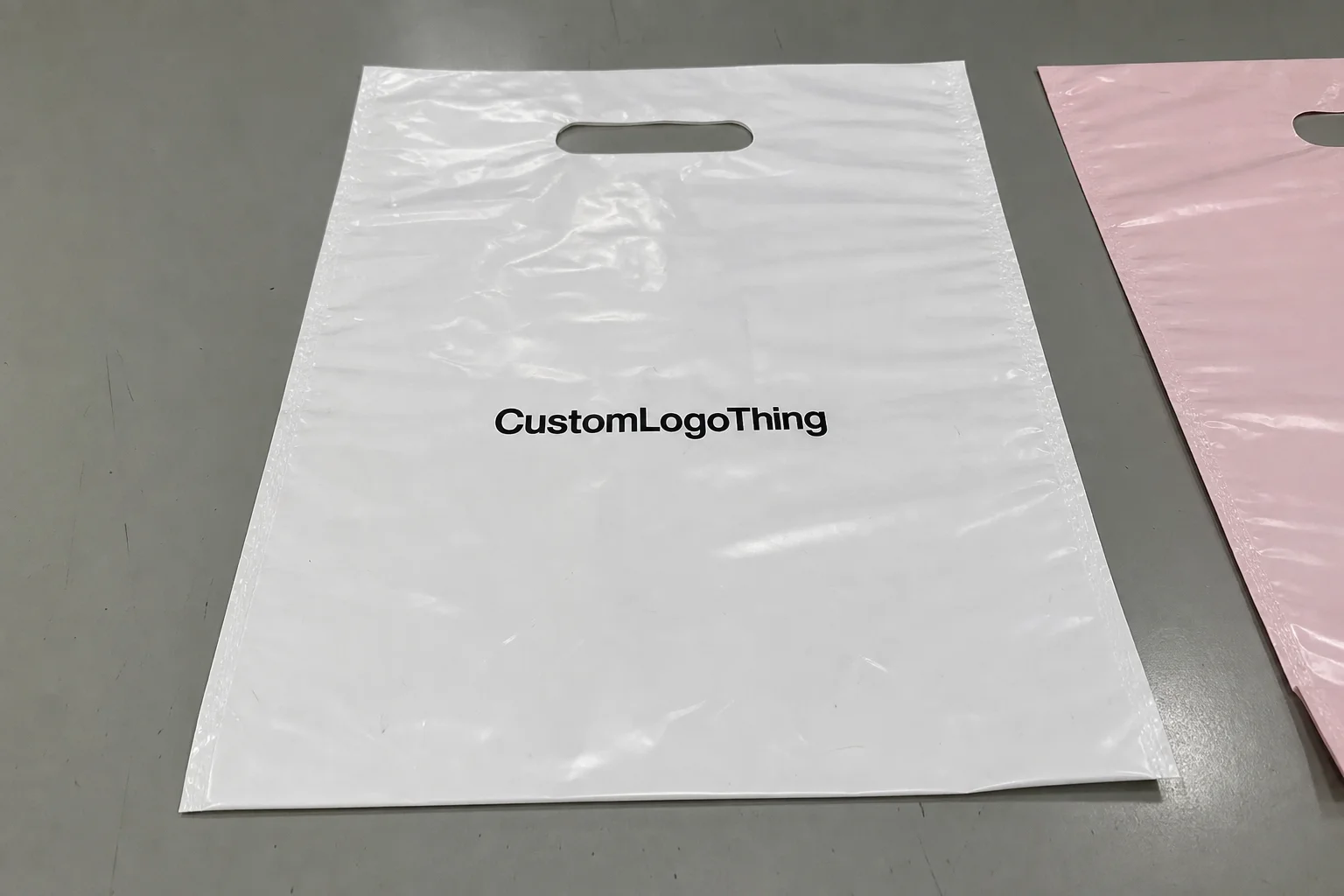
Two plastic bags can look similar in a supplier photo and perform very differently in use. One carries the product cleanly; the other stretches at the handle, scuffs at the logo, or fails at the gusset. That is why a Logo Printed Plastic bags Sample Order Checklist matters.
Most bad orders do not fail because the art file was unusable. They fail because specifications were vague, assumptions were left untested, or an empty sample was approved without a real load test. For retail stores, event teams, food service operators, and boutiques, the sample stage is the cheapest place to catch weak film, poor seals, print issues, and freight surprises before a full run turns into a costly problem.
Logo Printed Plastic Bags Sample Order Checklist: What Buyers Miss First

The first mistake is judging a sample by appearance alone. A bag can look clean on a table and still fail once it carries boxed products, folded apparel, jars, or takeout containers. Empty samples flatter weak construction; loaded samples show the truth.
The second mistake is approving ideas instead of written specs. “Custom retail bag, one-color logo, heavy-duty” is not enough for production. A usable checklist should confirm bag style, material, thickness, finished dimensions, handle type, print method, print area, seal construction, and expected carry weight before approval.
A practical review should answer these questions:
- Does the bag fit the actual product without stressing seams or gussets?
- Is the film appropriate for the brand, price point, and expected use?
- Can the handle survive normal carry use with a margin of safety?
- Does the print resist rubbing, stacking, and light moisture?
- Do the sample specs match the quote, proof, and packing details?
Many sample disputes are predictable: buyers assumed both sides were printed, expected a darker red, or thought patch handles were included. Those are specification failures. If a supplier cannot confirm material, thickness, and handle construction in writing, the approval process is incomplete.
Compliance may also affect the decision. Some regions regulate minimum thickness for reusable bags or restrict certain single-use formats. Environmental claims need care as well: “recyclable” and “contains recycled content” are not the same statement. The U.S. EPA offers baseline recycling guidance at epa.gov, but local rules still control what can be sold or distributed.
How Do You Use a Logo Printed Plastic Bags Sample Order Checklist to Choose the Right Style?
Start with use case, not decoration. The right logo cannot fix the wrong bag style.
Different styles solve different carrying jobs:
- Die-cut handle bags: clean retail appearance for apparel, cosmetics, brochures, and lighter merchandise.
- Patch handle bags: reinforced around the handle area for heavier loads.
- Soft loop handle bags: more upscale presentation for boutiques, trade shows, and higher-ticket retail items.
- Drawstring bags: useful for kits, gifts, and set packaging.
- T-shirt bags: practical and cost-efficient for grocery, food service, and high-volume use.
- Flat merchandise bags: simple counter bags for lightweight goods and small accessories.
Style affects cost, strength, print area, and customer perception at the same time. A soft loop bag may look more premium than a T-shirt bag, but it can also cost substantially more depending on size, thickness, quantity, and print coverage. Patch handles improve strength but change the silhouette and feel. That tradeoff may help one brand and work against another.
Use actual carry weight to narrow the choice. If the bag needs to hold 6 to 12 pounds of boxed products, books, candles, or multiple apparel pieces, buyers usually need thicker film and some handle reinforcement. If the bag is only for one lightweight item or an event handout, slimmer film may be enough and far more economical.
Dimensions also need physical testing. A listed size such as 12 x 15 inches with a 3-inch gusset can still perform badly if corners press into the seals, the opening is awkward, or the handle sits too close to the top edge. Spreadsheet dimensions describe the bag on paper, not how it works in a customer’s hand.
One key question should be asked early: Is this sample built to my final specification, or is it only a reference sample from a previous run? A reference sample is useful for judging general style and film feel, but it does not confirm your final dimensions, logo position, or print quality unless the supplier states that in writing.
If shipping, warehousing, or event handling is part of the project, think beyond checkout. Bags may be stacked, boxed tightly, or exposed to friction and warm storage conditions. Teams that need broader handling guidance can review transit-testing resources at ista.org.
Check Material, Thickness, Handles, and Print Specs Like a Real Buyer
This is where weak approvals usually break down. Buyers need measurements and construction details, not adjectives.
A working checklist should cover these physical specifications first:
- Material: LDPE or HDPE
- Thickness: stated in mil or micron
- Finished size: width, height, and gusset depth
- Expected load: normal carry weight
- Handle construction: die-cut, patch, soft loop, or T-shirt
- Seal quality: side seal and bottom seal consistency
HDPE usually feels crisper and can be cost-effective for high-volume distribution. LDPE tends to feel softer and more substantial in many retail applications. The right choice depends on finish expectations, weight requirements, style, and budget.
Thickness needs to be specified clearly. “Durable” and “heavy-duty” are not buying specs. Lightweight promotional bags may be around 1.25 to 1.5 mil, while stronger retail bags often run around 1.75 to 3.0 mil depending on style, load, and local rules. Some suppliers quote in microns, so confirm units before comparing prices.
Handle construction should be tested physically. On die-cut bags, inspect the cutout area after repeated lifts for stretching or tearing. On patch handle bags, check that the reinforcement patch is even and bonded cleanly. On soft loop bags, inspect the weld area inside the bag, since that is a common failure point.
Seal quality is another frequent blind spot. Side seals should be even, and bottom seals should not distort excessively under load. If the bag will carry angular products, test it with those real shapes. Soft filler items can hide problems that box corners expose immediately.
Then review the print specifications:
- Number of print colors
- Pantone match or accepted color tolerance
- One-side or two-side printing
- Registration accuracy between colors
- Ink rub resistance after handling and stacking
- Logo placement relative to handles, seals, and gussets
Common print traps are avoidable. Oversized artwork can crowd the handle area or sit too close to seams. Color approved in dim office lighting can shift under retail LEDs or daylight. Thin film can photograph well while still feeling noisy, weak, or prone to puncture in use.
A simple scorecard helps keep the review objective. Rate each sample for fit, strength, handle performance, print quality, finish, spec clarity, and quote accuracy. That gives a buying team a better basis for comparing vendors than comments like “looks premium” or “feels decent.”
Pricing, MOQ, and Unit Cost: What a Sample Order Really Tells You
A sample can prove suitability, but it does not prove that the production order is financially sound. Buyers should separate those decisions.
The main cost drivers are bag size, material, thickness, handle style, print colors, print coverage, quantity, and freight origin. Then come the less obvious charges: setup fees, print plates or cylinders, tooling if required, carton packing, duties, and shipping method.
These broad ranges are a useful starting point for standard custom work:
| Bag Type | Typical MOQ | Approx. Unit Cost at 5,000 pcs | Main Cost Tradeoff |
|---|---|---|---|
| Flat merchandise bag | 5,000-10,000 | $0.08-$0.16 | Lowest cost, limited weight capacity |
| T-shirt bag | 5,000-10,000 | $0.06-$0.14 | Budget-friendly, less premium presentation |
| Die-cut handle LDPE bag | 3,000-5,000 | $0.18-$0.32 | Better retail feel, higher film cost |
| Patch handle bag | 3,000-5,000 | $0.22-$0.38 | Reinforcement adds cost |
| Soft loop handle bag | 3,000-5,000 | $0.32-$0.58 | Premium look, more labor and components |
Print coverage changes the math quickly. A one-color logo on one side is very different from a two-side, multi-color design with heavy coverage. Request at least three quantity tiers, such as 3,000, 5,000, and 10,000 pieces, because price breaks are not always where buyers expect them.
MOQ also needs context. Lower minimums can help with small launches or test markets, but they often mean higher unit pricing, fewer size options, or dependence on stock materials. A supplier willing to do 1,000 pieces may still be useful; the mistake is assuming that order will price like a standard 5,000-piece run.
Sample charges should be discussed directly. Stock samples are often free or inexpensive, with freight billed separately. Full custom pre-production samples commonly range from about $75 to $300, sometimes more if multiple colors, special handles, or new tooling are involved.
Quote comparison only works when the specifications are identical. If one vendor quotes 1.5 mil HDPE with one-side print and another quotes 2.25 mil LDPE with patch handles and two-side printing, those are different products, not directly comparable prices.
Before approval, confirm these cost points:
- Sample cost and whether it is credited back
- Plate, cylinder, or tooling charges
- Setup fees
- Freight terms and destination
- Duties or import charges if relevant
- Carton pack count and carton dimensions
- Overrun or underrun policy, often around plus or minus 5% to 10%
Sample Approval Process and Production Timeline Buyers Should Confirm
Lead time problems usually start before production. Vague approvals, incomplete artwork, and changing specifications cause more delay than the presses do.
The typical order flow looks like this:
- Inquiry with specifications and artwork
- Quote review and revisions
- Digital proof
- Stock sample or custom pre-production sample
- Buyer approval
- Production scheduling
- Packing and shipment
Buyers should separate stock sample timing from custom sample timing. Stock samples may ship within 2 to 5 business days. Custom pre-production samples often take 7 to 15 business days after proof approval. Production after final sign-off commonly runs 12 to 25 business days, with transit time added afterward.
Ask for timing by stage, not one broad promise. A useful schedule might break out quote revision, proofing, sample production, manufacturing, and freight separately. That gives purchasing and operations something concrete to plan around.
Revisions can reset the clock. A small logo move may be quick, but a thickness change, handle change, size change, or Pantone revision can mean a new proof, updated pricing, and sometimes another sample.
Artwork quality affects timing more than many buyers expect. Vector files such as AI, EPS, or press-ready PDF are usually preferred. Pantone references should be included if color matters, and print-safe margins near handles and seals should be respected.
Before locking a launch date, confirm:
- Artwork is production-ready
- All specification changes are frozen
- The sample type is defined: stock or custom
- An internal approval owner is assigned
- The freight method is confirmed
- The in-hand date includes buffer for delays
Compare Vendors by Sample Accuracy, Communication, and Order Control
Buyers should trust process more than polish. A reliable vendor documents specs clearly, updates revisions accurately, and answers hard questions without oversimplifying production limits.
Good suppliers usually ask for details such as expected carry weight, whether the logo crosses the handle zone, whether both sides need print, and whether the bag is likely to become a repeat item. Those questions are useful because they surface preventable errors early.
Compare vendors on these points:
- Response quality: complete answers, not just fast replies
- Specification clarity: material, thickness, dimensions, print, and packing documented in writing
- Revision control: proofs and quotes updated correctly after changes
- Sample accuracy: sample construction matches the quoted build
- Order controls: approval records, defect policy, remake terms, and stated production limitations
If the quote says one thing, the proof implies another, and the sample suggests a third, production is unlikely to become more organized later. Strong suppliers usually explain tolerances, likely color variation, and construction limits before buyers discover them the hard way.
Repeat-order consistency matters too. A supplier should be able to explain whether reorders will use the same film, thickness, handle construction, and print setup, or whether substitutions are possible if material availability changes.
Next Steps Before You Place the Sample Order
Before requesting samples, settle the basics internally. Choose the bag style, measure the real product, estimate carry weight honestly, decide whether LDPE or HDPE makes more sense, and confirm print colors and whether one-side or two-side printing is necessary.
Send complete information in one message if possible:
- Target bag size and gusset
- Preferred material and thickness range
- Expected carry weight
- Handle style
- Quantity tiers
- Artwork file
- Pantone codes if color is critical
- Delivery ZIP code or destination country
- Required in-hand date
For larger orders or color-sensitive branding, it can help to request one stock sample for construction review and one custom proof path for print verification. That gives a better read on physical performance and branding accuracy without expecting one sample to answer every question.
Move from sample to production only if these points are true:
- The sample passes a realistic load test
- The print looks correct under actual store, event, or site lighting
- The quoted unit cost fits the margin target
- The lead time fits the launch schedule with buffer built in
- The approved sample matches the written specification exactly
A good checklist is not busywork. It is a filter for the mistakes that create reprint costs, launch delays, customer complaints, and emergency reorders.
FAQ
What should I check on a logo printed plastic bags sample before approving production?
Check the finished size, material, thickness, handle strength, seal quality, print accuracy, logo placement, and whether the sample matches the quoted construction exactly. Review it with the real product inside the bag, not as an empty display piece. The checklist should also cover carton packing, overrun policy, and approval notes.
How much does a logo printed plastic bag sample order usually cost?
Stock samples are often free or low-cost plus freight. Full custom pre-production samples commonly run from about $75 to $300 or more, depending on size, print complexity, and whether new tooling or multiple colors are involved. Buyers should ask whether the sample charge is credited toward the bulk order.
What MOQ is typical for custom logo printed plastic bags?
Many custom runs start around 3,000 to 10,000 pieces, though the exact MOQ depends on bag type, size, print method, and factory setup. Lower minimums are possible in some cases, but they usually increase unit cost or limit customization.
How long is the lead time after I approve a plastic bag sample?
Production after final approval often takes roughly 12 to 25 business days, plus transit time. Custom samples typically add another 7 to 15 business days before that. Ask for timing by stage so you can see where the schedule is tight and where delays are most likely.
Can I use a stock sample to judge my final custom printed plastic bags order?
A stock sample is useful for evaluating general construction, material feel, and approximate thickness. It does not fully confirm final print color, registration, or exact dimensions unless it was made to your approved specification. Treat it as a reference, not final proof of the production run.