Order Custom Number Stickers for Smarter Item Tracking
A warehouse team can lose 20 minutes per shift because two nearly identical bins do not have clear numbers. That sounds small until five workers repeat the same search across 22 working days. Suddenly, a penny-scale sticker decision has become a labor problem.
Custom Number Stickers are built to prevent that kind of quiet waste. They give cartons, kits, permits, sample boxes, equipment, and inventory locations a visible identity. Sometimes the number is read by a person. Sometimes it feeds a barcode scanner, spreadsheet, warehouse system, or warranty record.
At their simplest, they are printed labels carrying sequential, repeated, variable, or grouped numbers. In use, they become small control points. They tell people what something is, where it belongs, whether it matches a record, and whether the item has moved through the right step.
Custom Number Stickers Turn Small Labels Into Control Systems
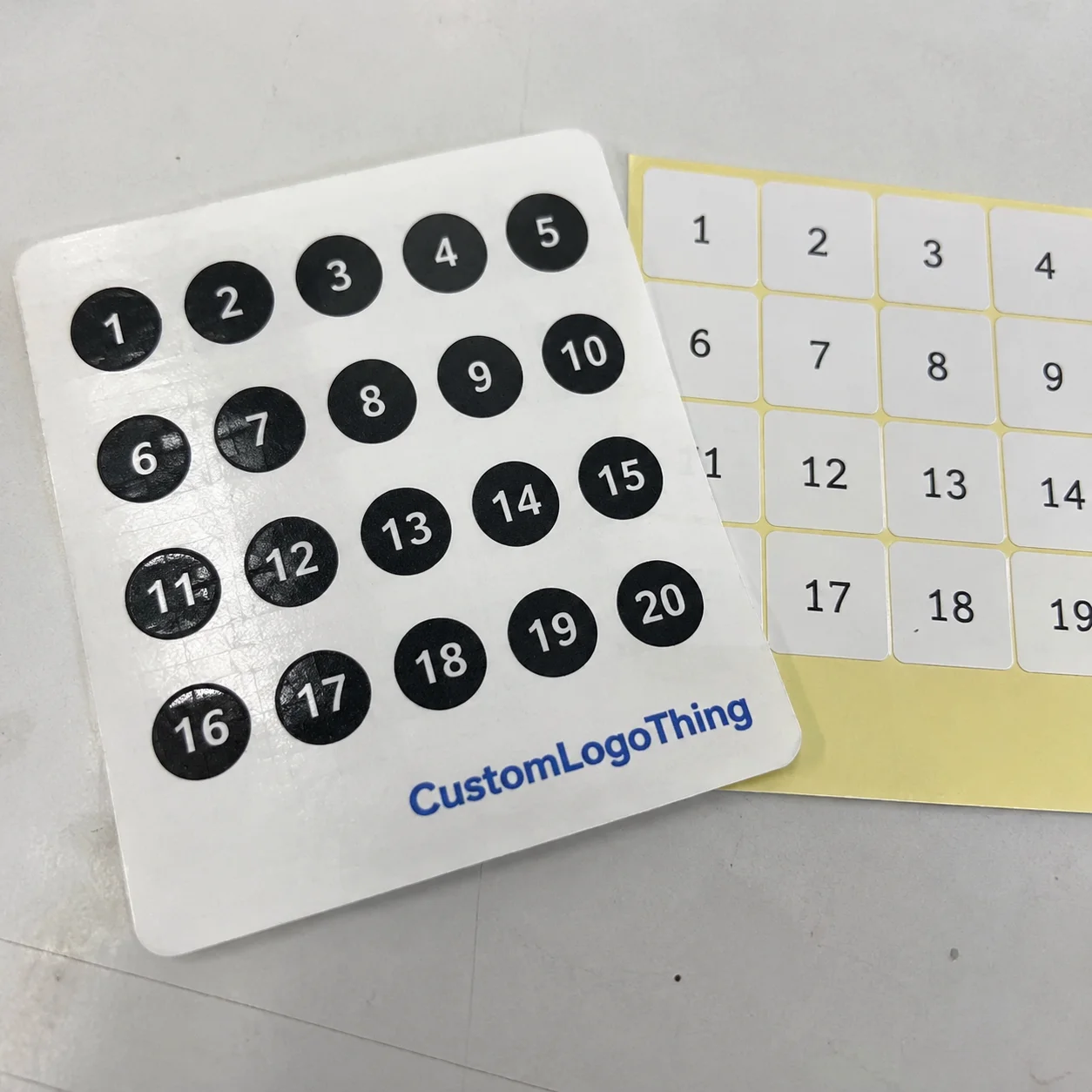
Numbered stickers are not one generic print job. A decorative “No. 25” sticker on a limited-edition box has a different purpose from an operational label used to prevent duplicate asset IDs in a warehouse. One adds character. The other protects a process.
Custom number stickers can support identification, sorting, batching, authentication, warranty tracking, kit assembly, sample management, field service, and customer-facing organization. The common thread is that the printed number follows a rule. Each item may receive one unique number from 0001 to 5000. Every number may appear twice, once on a product and once on a matching record. The sticker may carry an alphanumeric ID, such as A-1047, plus a QR code tied to a database or spreadsheet.
That logic matters more than the artwork. A label with beautiful branding but a duplicated asset number can damage a workflow faster than a plain label with accurate data. Design still matters, especially for retail packaging, sample launches, event credentials, and premium product programs. But numbered labels have to function first.
Common applications include serialized kits, parking permits, event badges, school assets, product sample boxes, raffle tickets, inspection labels, equipment tags, quality-control batches, warehouse bins, and return authorization labels. They also appear in Custom Labels & Tags programs where the same package design needs different tracking data across SKUs, batches, territories, or promotional sets.
Operational rule: if a number controls a decision, treat the sticker as part of the system, not as decoration added at the end of the print order.
The practical decision comes down to six variables: numbering logic, material, adhesive, format, proofing, and timing. Get those right and the labels become boring in the best possible way. They stick, scan, sort, and reorder cleanly.
How Numbered Sticker Printing Works From Data to Finished Rolls
Variable data printing is the engine behind most numbered sticker jobs. The base artwork stays mostly fixed while one field changes from label to label. That changing field may be a simple sequence, a random code, a barcode, a QR code, or several columns pulled from a spreadsheet.
A basic sequence might run from 000001 to 010000 with six digits and leading zeros. A duplicate-set job might print two stickers for each number: one for a product and one for an assembly checklist. A paired-label job may use matching numbers on two different shapes, such as a main equipment tag and a smaller service record label. More complex files can include names, locations, departments, product codes, batch numbers, URLs, or scan values.
Before production, the supplier needs the rules locked down. That means confirming the starting number, ending number, prefix, suffix, font, padding, leading zeros, barcode type, QR destination, and any check digit. For scannable labels, quiet zones are not optional. A barcode needs clear space around it so scanners can separate the code from nearby graphics, borders, text, or die-cut edges.
Format affects both price and handling. Rolls are usually best for fast hand application, label dispensers, and production benches. Sheets work well for office teams applying 25, 50, or 100 labels at a time. Individually cut stickers make sense for kits, event packets, warranty envelopes, sample mailers, and handouts where each piece is handled separately.
Proofing deserves more attention on numbered jobs than on ordinary stickers. A wrong blue tone is annoying. A missing leading zero can break an inventory system. A duplicated range can create two products with the same identity. For custom number stickers, ask for a proof that shows the first few numbers, the last few numbers, the format, and at least one printed barcode or QR code sample if scanning is involved.
Key Specs That Decide Durability, Scanning, and Application Speed
Material selection starts with the environment. Paper labels are economical for indoor, dry, short-term use: office files, classroom assets, event packets, internal folders, and temporary bin labels. White BOPP film is a stronger everyday choice when moisture resistance, cleaner print definition, and better handling are needed. Clear film can look discreet on glass, jars, and premium packaging, though contrast needs careful control. Vinyl is typically chosen for outdoor exposure, abrasion, curved equipment, and rougher service conditions. Tamper-evident or destructible stocks are used when removal should reveal interference.
Adhesive is often the hidden failure point. Cardboard accepts many standard permanent adhesives. Clean glass is usually easier. Powder-coated metal, chilled packaging, low-energy plastics, rough shipping cartons, textured bins, and dusty surfaces are harder. Some plastic totes need a high-tack adhesive. Rented equipment may need removable adhesive to avoid residue. A chilled beverage bottle may need an adhesive that bonds in cold, damp conditions instead of one designed for room-temperature cartons.
Finish affects appearance and function. Matte finishes reduce glare, which can improve barcode readability under warehouse lights. Gloss can make retail packaging look brighter and more polished. Lamination adds a protective layer against abrasion, chemicals, weather, and repeated handling. For harsh-use labels, buyers often compare unlaminated film against laminated film and find that the higher sticker price prevents replacement labor later.
Size is not just a design choice. A 0.75-inch label may save material cost, but if the number must be read from six feet away, the savings disappear in squinting, slow picking, and misreads. For manual reading, larger numerals and plain fonts beat decorative type almost every time. For scanning, test the actual barcode size with the device workers will use, not a phone held perfectly still under office lighting.
Contrast is equally unforgiving. Black on white remains the workhorse because it gives scanners and humans a clear signal. Metallic inks, transparent backgrounds, gray-on-silver layouts, and busy package graphics can look polished but reduce readability. That tradeoff may be acceptable for a collector’s edition label. It is risky for receiving, returns, warranty claims, field service, or quality-control documentation.
For packaging programs that also include cartons, sleeves, pouches, or Custom Printed Boxes, keep the numbered sticker visually related to the wider system without making the data harder to use. A small logo, brand color, or border can work. A patterned background behind the number usually does not.
Cost, Pricing, and MOQ Factors Buyers Should Compare
Pricing for numbered labels is shaped by quantity, size, material, finish, adhesive, format, artwork versions, and variable data complexity. The lowest quote is not always the best value. Buyers should compare the cost of failure as carefully as the cost per label, especially if the labels control inventory, access, warranty records, or regulated samples.
For simple indoor paper sheet labels, small runs may land around $0.08 to $0.18 per label depending on size and quantity. Durable film labels on rolls may sit closer to $0.18 to $0.45 per label for mid-size orders, especially with lamination or specialty adhesive. Very small runs, unusual shapes, security materials, color matching, special unwind requirements, or complex barcode data can push unit pricing higher because setup time does not shrink just because the order is small.
| Use case | Typical build | Common format | Budget signal | Buyer risk to check |
|---|---|---|---|---|
| Office or school assets | Paper or standard white film | Sheets | Lower unit cost on simple sequences | Smearing, curling, or weak adhesive on plastic |
| Warehouse bins | White BOPP or vinyl with strong adhesive | Rolls | Moderate cost, faster application | Poor contrast or label lift on textured totes |
| Outdoor equipment | Laminated vinyl | Rolls or individually cut | Higher cost, longer service life | UV exposure, abrasion, chemicals, and weather |
| Event or kit matching | Paper, film, or paired labels | Sheets or cut singles | Depends on duplicate numbering rules | Skipped numbers, mismatched pairs, slow sorting |
| Security or authentication | Tamper-evident or destructible stock | Rolls | Premium material and setup cost | Residue, removal behavior, and record control |
Unit cost usually drops as quantity rises because setup, proofing, die-cutting, press preparation, and data handling are spread across more labels. A run of 500 labels has to absorb many of the same prepress steps as a run of 5,000. Minimum order quantities are often about production efficiency, not supplier stubbornness.
Quote requests move faster when buyers provide the right details: size, quantity, number range, duplicate rules, roll or sheet preference, material, application surface, indoor or outdoor exposure, barcode requirements, and deadline. If the stickers need to coordinate with Custom Packaging Products, include a photo or dieline of the package so the label does not fight the carton, pouch, jar, or sleeve.
Standards can help frame durability conversations. For distribution packaging, ISTA procedures are often used to evaluate transport performance, while ASTM methods are commonly referenced for adhesive and material testing. If sustainability claims matter, ask whether paper stocks can align with FSC sourcing. These details do not apply to every order, but they create a better specification than “make it durable.”
Process and Timeline: From Number Range to Approved Proof
A clean numbered sticker project usually follows a predictable path: define the numbering logic, submit artwork or request design support, confirm materials, receive a digital proof, approve the sequence, print, finish, inspect, and ship. The weak spot is almost always unclear data.
The buyer controls more of the timeline than many realize. Fast approvals help. Clean spreadsheets help more. If the file has merged cells, hidden rows, mixed formats, or numbers stored as text in one row and integers in another, prepress has to slow down. A missing zero at the front of 0048 can become a different ID entirely if the spreadsheet strips it to 48.
For straightforward roll jobs, production may often take 7 to 12 business days after proof approval. More complex orders can take 12 to 18 business days, especially if specialty materials, custom tooling, lamination, barcode testing, or multiple artwork versions are involved. Shipping adds time, and rush freight can cost more than the labels on small orders.
Roll details matter if labels will run through a dispenser or applicator. Confirm roll direction and unwind orientation before approval. A roll that prints beautifully but unwinds the wrong way can slow an application line or force workers to peel labels by hand. Also confirm core size, outside roll diameter if equipment is involved, and whether the sequence runs ascending or descending on the roll.
Quality checks should look for missing numbers, repeated numbers, print clarity, die-cut position, lamination alignment, adhesive consistency, and barcode readability. For barcode or QR jobs, test the code from a printed sample if possible. A code that scans perfectly on a backlit screen can fail once printed at 0.5 inch wide on a curved bottle with gloss coating.
For custom number stickers, the most useful proof shows dimensions, material, finish, layout, number sequence, and representative codes. Printing may be fast. Approval discipline before production starts is usually the real bottleneck.
Common Mistakes That Break Numbering Jobs After Printing
The most frequent failure is painfully simple: buyers approve attractive artwork but never verify the numbering sequence. They miss the leading zeros. They do not check whether each number appears once or twice. They assume the spreadsheet range is complete. Then 4,000 finished labels arrive with a skipped block or duplicated set.
Wrong adhesive is the next expensive mistake. Labels that lift from plastic totes create scanning gaps. Labels that bond too aggressively to rented equipment can leave residue and trigger fees. Labels placed on premium product packaging can tear coatings or paper fibers if removability was not specified. A good adhesive choice starts with the actual surface, not the broad category name of the item.
Over-designing operational labels is another trap. Tiny fonts, reflective foils, decorative numerals, busy backgrounds, and low-contrast colors may look good on a proof at 200 percent zoom. On a warehouse shelf, they can fail. If a worker must read the number from arm’s length while wearing gloves, the design needs to respect that condition.
Barcode and QR errors deserve their own warning. Codes can be printed too small, placed too close to curved edges, squeezed into layouts without quiet zones, or generated from untested data. If the barcode links to an asset record, the data string must match the receiving system exactly. One extra space can behave like a different value.
Format mistakes are quieter but still damaging. Sheets are fine for low-volume office use. They are slow for a team labeling 3,000 cartons before a shipment cutoff. Rolls support speed, but not if the unwind direction is wrong for the dispenser. Individually cut labels are useful for kits and events, though they cost more to handle and pack.
Keep the reorder trail. Save the final number range, artwork version, material, adhesive, finish, roll layout, and supplier proof. Without that record, the next batch may not match the first. For serialized product packaging or warranty programs, that mismatch can create customer service friction months later.
Next Steps Before You Request a Numbered Sticker Quote
Before asking for a quote, write the use case in one sentence. “We need labels for 1,200 plastic inventory bins used indoors” is more useful than “we need numbered stickers.” The first version gives the supplier a surface, quantity, environment, and likely durability target. The second creates guesswork.
- List the application surface: cardboard, glass, plastic, metal, painted equipment, rough carton board, or textured totes.
- Confirm the conditions: indoor, outdoor, chilled, wet, high-touch, chemical exposure, sunlight, or short-term event use.
- Choose the size and viewing distance: close hand scanning, shelf reading, customer-facing packaging, or field inspection.
- Define the number range: starting number, ending number, prefix, suffix, leading zeros, and duplicate rules.
- Decide the format: rolls, sheets, or individually cut stickers.
- State scanning needs: barcode type, QR destination, scanner model if known, and required quiet space.
Test the workflow on paper first. Print sample numbers at actual size, tape them to the item, and read them from the distance workers or customers will use. If the sticker will be scanned, test the code with the real scanner or phone app. This five-minute check can prevent a full production run of labels that technically match the proof but fail in use.
Photos help too. Send pictures of the bin, box, bottle, equipment plate, shipping carton, or retail package area where the label will sit. A supplier can make a better material and adhesive recommendation after seeing texture, curvature, color, and available space. If the label is part of package branding, share the broader packaging design so the numbered element feels intentional without becoming hard to read.
Ask for a proof that confirms sequence, dimensions, material, finish, format, and barcode readability before approval. Then read it slowly. Check the first number. Check the last number. Check the zeros. Check duplicate rules. Check whether the label layout matches the way people will apply it.
Done well, custom number stickers are not just printed labels. They are a low-cost tracking system that protects inventory, kits, assets, events, and packaging workflows from avoidable mistakes. The sticker is small. The record it protects may not be.
FAQ
What are custom numbered labels used for?
Custom numbered labels are used to identify assets, organize inventory, serialize products, manage event access, label equipment, track kits, support warranty records, and reduce mix-ups during packing or fulfillment. The strongest use cases have a clear numbering rule, such as one unique number per item, matching pairs, batch codes, or scannable IDs tied to a spreadsheet.
Can custom number stickers include barcodes or QR codes?
Yes. Numbered stickers can include barcodes, QR codes, or alphanumeric codes, but the artwork must allow enough size, contrast, and quiet space for reliable scanning. Buyers should test sample codes with the actual scanner or phone app before approving the full production run.
How much do custom serial number stickers cost?
Cost depends on quantity, size, material, adhesive, finish, format, variable data complexity, and whether the job needs special durability or barcode testing. Higher quantities usually lower unit cost, but the cheapest material may not be the lowest-cost choice if labels need to survive moisture, abrasion, sunlight, or frequent handling.
What file do I need for sequential number stickers?
For simple sequences, buyers can usually provide a starting number, ending number, and formatting rules such as leading zeros or prefixes. For complex jobs, provide a clean spreadsheet with one row per sticker and separate columns for numbers, codes, names, locations, or barcode data.
How long does it take to produce numbered stickers?
Turnaround depends on proof approval speed, order size, material availability, finish, variable data complexity, and shipping method. Straightforward jobs often move faster when the buyer confirms the number range, artwork, size, material, roll or sheet format, and scanning requirements before production begins.


