Buyer Fit Snapshot
| Best fit | Order Extra Wide Poly Mailers projects where brand print, material claims, artwork control, MOQ, and repeat-order consistency need to be specified before quoting. |
|---|---|
| Quote inputs | Share finished size, material target, print colors, finish, packing count, annual reorder estimate, ship-to region, and any compliance wording. |
| Proofing check | Approve dieline scale, logo placement, barcode or warning zones, color tolerance, closure strength, and carton packing before bulk production. |
| Main risk | Vague material claims, crowded artwork, missing packing details, or unclear freight terms can make a low unit price expensive after revisions. |
Fast answer: Order Extra Wide Poly Mailers: Specs, Pricing, Lead Times should be specified like a repeatable production item. The safest quote records material, print method, finish, artwork proof, packing count, and reorder notes in one written spec.
Production checks before approval
Compare the actual filled-product size with the drawing, then confirm tolerance on folds, seals, hang holes, label areas, and retail display edges. Reserve space for logos, QR codes, warning copy, and material claims before decorative graphics fill the panel.
Quote comparison points
Review material grade, print process, finish, sampling route, tooling charges, carton quantity, and freight assumptions side by side. A quote is only useful when the supplier can repeat the same color, closure quality, and packing count on the next order.
When clients tell me they want to order extra wide poly mailers, I usually ask one blunt question first: what exactly are you shipping that a standard mailer keeps fighting with? I remember standing on a factory floor in Shenzhen, about 45 minutes from the port, watching a hoodie get forced into a bag that was roughly 20 mm too tight. The result was exactly what you'd expect: ugly, strained, and more expensive than anyone planned. The seal pulled, the seams puckered, and the re-ship cost ate right through the savings from the cheaper bag. If you need to order extra wide poly mailers, fit is the first decision, price is second, and pretending otherwise is how buyers end up paying twice, sometimes with interest, which is rude of packaging, honestly.
I have seen this same mistake in three different product categories, and it never gets less irritating. A subscription box brand in Dongguan tried to squeeze folded sweatshirts into a regular flat mailer and ended up with torn corners on almost 8% of outbound orders across a 4,200-unit run. A beauty client in Guangzhou packed soft goods with rigid insert cards, then wondered why the side seams were splitting in transit after a two-day road move to Shanghai. A wholesale buyer I worked with in Huizhou insisted on the smallest possible bag size, and we spent the next afternoon measuring returned stock because the products had bunched up like a bad suitcase someone overpacked for a weekend trip. That is why I keep pushing brands to order extra wide poly mailers with the actual packed shape in mind, not just the flat product dimensions.
If you ship hoodies, stacked apparel, thick soft goods, subscription kits, or anything with a little air trapped in the package, order extra wide poly mailers instead of guessing. You usually get better labor efficiency, less dimensional weight than a box, and a cleaner unboxing than a bag that looks like it lost a fight with the contents. The math is not romantic. It is practical. A mailer that fits properly can cut packing time by 15 to 30 seconds per unit, and on a 5,000-piece run that becomes real labor money, not marketing fluff someone dreamed up in a conference room in Hangzhou.
There is a second benefit that teams underestimate. A well-sized mailer reduces rework. When the bag is too narrow, packers start forcing folds, re-taping flaps, and checking the same order twice because the contents keep shifting. That slows a line down in a way that is hard to see in a spreadsheet but easy to feel in a warehouse. I am kinda picky about that because the hidden labor gets expensive fast.
Why Order Extra Wide Poly Mailers for Oversized Shipments
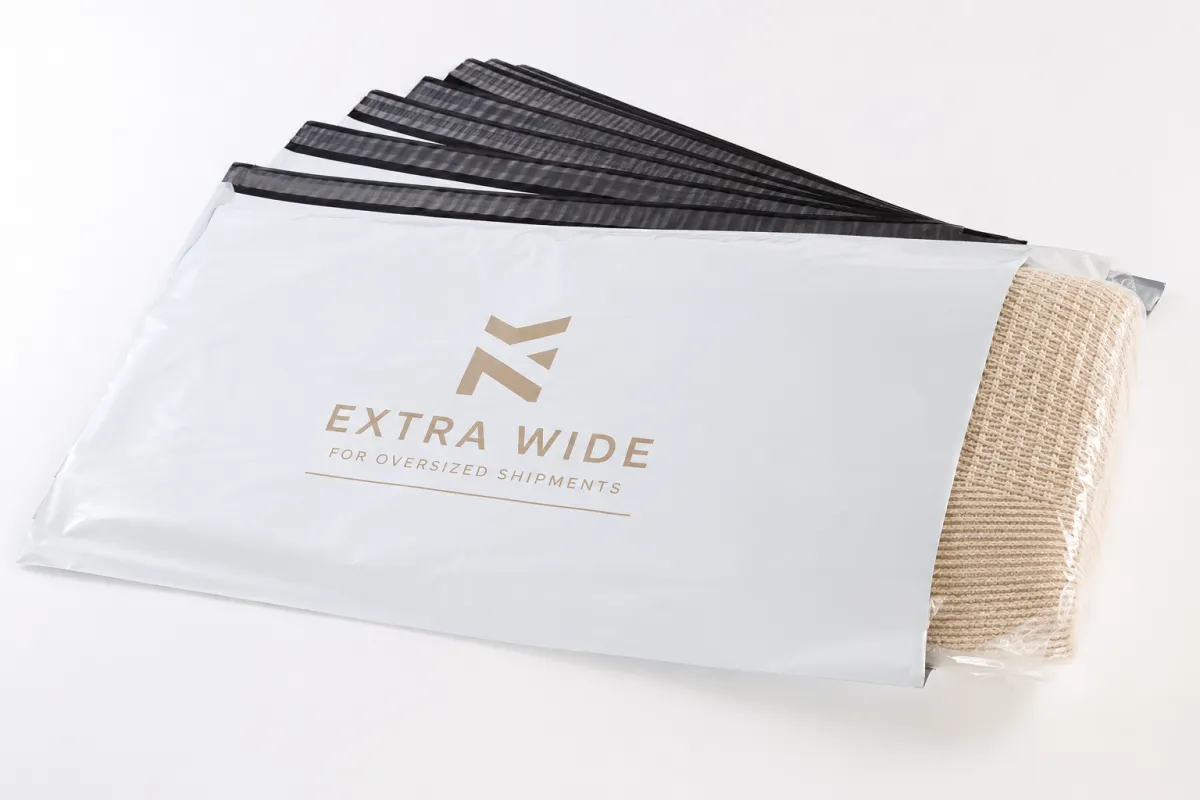
The biggest reason to order extra wide poly mailers is simple: bulky products do not behave like flat products. A sweatshirt may be 12 inches wide when folded, but once the cuffs, hood, and elastic bunch up, the packed width can creep past 14 inches. Add a paper insert, a thank-you card, or a second item, and the seam tension rises fast. I have watched a standard mailer look fine on paper and fail on the conveyor because the contents pushed the adhesive flap into a shallow angle at the last second. That is not theory. That is a factory-floor headache I have paid to fix more than once, and I would happily never see it again.
Extra width matters for more than sweatshirts. Retailers should order extra wide poly mailers for stacked tees, joggers, baby blankets, knitwear, soft accessories, and Subscription Kits That include a rigid card or folded catalog. I have also seen them work well for return shipments, sample packs, and bulk e-commerce orders that do not sit flat. The trick is to match the mailer to the real packed profile. Flat width alone will lie to you every time if the product has height or spring-back, and a 13 x 19 inch bag can still be wrong if the folded garment sits like a brick.
There is also a straight business case. If you order extra wide poly mailers with the right side clearance, you reduce torn seams and crushed corners, which means fewer returns and fewer reships. You also avoid the dimensional weight penalty that kicks in with boxes, especially on light apparel and soft goods. Shipping a 14-ounce hoodie in a box because the mailer was too narrow is like paying restaurant prices for a sandwich you could have made at home. It works, sure. It just wastes money and tests my patience, especially when carrier rates jump by $2.40 to $4.80 per parcel on Zone 7 lanes.
Here is the part buyers often miss: the right width also improves pack speed. A packer does not need to wrestle a product into shape, compress it aggressively, or fight the flap. I have seen a small fulfillment team move from 220 to 260 packs per hour after switching to a better-fit mailer at a warehouse in Suzhou. No magic. Just less friction and fewer muttered comments from the packing table. So if you plan to order extra wide poly mailers, think of it as buying labor relief as much as shipping packaging.
Useful rule of thumb: if the packed item bulges at the sides, creates a hard edge near the seal, or requires more than one compression squeeze to close, the bag is too narrow. That is usually the moment I tell clients to order extra wide poly mailers one size up and compare the total landed cost against their current packaging. A few extra millimeters can save you a lot of annoyance later, which is one of those lessons nobody believes until the carton count starts climbing and the returns report lands on a Monday morning.
For broader packaging planning, our Custom Packaging Products page is a useful starting point, and if you are still comparing formats, our Custom Poly Mailers category shows the range of options we typically supply.
How Do You Choose the Right Size When You Order Extra Wide Poly Mailers?
Start with the packed item, not the product sheet. Measure the garment or kit the way it will actually ship: folded, stacked, tucked, and with any inserts already inside. Then measure the thickest point. That thickest point is the number that matters because it tells you how much width the mailer needs before the adhesive flap starts complaining. If you only measure the flat footprint, you are basically asking the warehouse to guess, and warehouses are already busy enough.
From there, add room for the seal area and a little compression. Not a heroic amount. Just enough that the contents slide in without a wrestling match. If the product carries a hood, cuffs, multiple layers, or a rigid card, compare a standard flat mailer with a wider flat profile and, if needed, a gusseted option. The point is to avoid the ugly middle ground where the bag looks almost right but slows down every packer on the line.
I usually tell clients to compare at least two sizes side by side before they order extra wide poly mailers. One option should fit comfortably, and the second should be the size they think they can get away with. That comparison usually makes the answer obvious. The smaller bag often seems cheaper until you add labor, damage, and the extra time spent re-packing items that never should have been squeezed in the first place.
If the item is soft and compressible, width is usually more important than length. If it is bulky and awkward, both dimensions matter. And if the shipment includes a folded catalog, insert card, or bundle wrap, check the combined thickness, not each piece on its own. That tiny detail trips people up more often than they want to admit.
Order Extra Wide Poly Mailers: What Makes Them Different
To order extra wide poly mailers properly, you need to understand what “extra wide” actually means. It is not a fancy label. It usually means the opening width and usable packing space are larger than a standard flat mailer, which reduces strain on the side seals and gives you room for thicker contents. In practice, that extra width makes the difference between a bag that closes cleanly and a bag that needs to be bullied into submission. And yes, I have seen grown adults in fulfillment argue with a piece of film like it started the fight.
Extra wide mailers are not the same as gusseted mailers, though buyers mix them up all the time. A gusset adds expansion room, often along the sides or bottom, while an extra wide flat mailer increases the opening and internal room without necessarily changing the bag's structure as much. If you order extra wide poly mailers for soft apparel, a wider flat profile may be enough. If your product has serious bulk or odd contours, a gusseted or hybrid option may be smarter. I have had clients insist on a regular flat mailer for boxed sets, and the side seams paid the price. Not ideal. Not cheap either.
Material choice matters too. Most buyers who order extra wide poly mailers will see co-extruded polyethylene as the base option because it balances durability and cost. You can choose matte or glossy finishes, and each one has a different feel in hand. Matte usually reads more premium; glossy tends to be a little more cost-efficient and gives stronger visual contrast for print. Opaque film is the safer move if privacy matters, especially for apparel, supplements, or any category where you do not want the product shape visible in transit. I am personally a little partial to matte because it does not scream for attention the moment it comes off the truck in Newark or Los Angeles.
Closure style is another decision point. If you order extra wide poly mailers with a permanent adhesive strip, you get a fast, one-way closure for standard shipping. If you need returns or multi-use workflows, dual-seal and tamper-evident options make more sense. I once sat in a meeting with a subscription brand that wanted a single-seal bag for a product with a 22% return rate across two fulfillment centers in Dallas and Atlanta. They switched to a return-friendly setup and cut their customer complaints about damaged openings almost immediately. Funny how packaging details suddenly become a big deal the minute customer service starts forwarding screenshots.
The phrase order extra wide poly mailers covers a lot of ground. The right spec depends on your product shape, your shipping method, and whether you care more about appearance, return handling, or unit cost. There is no benefit in buying blind, and there is no award for guessing the right structure on the first try. I would much rather spend an extra 10 minutes on the spec sheet than spend three weeks untangling a warehouse problem, especially when the freight bill from Ningbo to Chicago is already sitting at the edge of the budget.
| Mailer Type | Best For | Typical Strength | Tradeoff |
|---|---|---|---|
| Standard flat poly mailer | Thin apparel, small soft goods | Low to medium | Tight fit on bulky products |
| Extra wide flat poly mailer | Hoodies, stacked shirts, padded inserts | Medium to high | More material than standard sizes |
| Gusseted poly mailer | Bulkier items, boxed sets, layered kits | High | Higher cost and slightly more complex specs |
| Rigid mailer | Documents, flat items needing protection | Medium | Not ideal for soft goods or bulky apparel |
Extra Wide Poly Mailer Specifications That Matter
If you want to order extra wide poly mailers without surprises, start with the dimensions that actually affect packing. I mean the inner usable width, the length, and any gusset or expansion measurement that changes capacity. Buyers love quoting the outer size and then act shocked when the packed item still does not fit. Measure the product at its thickest packed point. That means folded width plus height, not just the flat label dimension. I have seen perfectly good packaging decisions go sideways because someone measured the product before folding it the way the warehouse actually folds it. Tiny mistake, huge hassle.
Thickness is usually listed in mils, and thicker is not automatically better. A 2.5 mil film can be perfectly fine for lightweight apparel, while a 4 mil construction may be better for heavier loads, rough handling, or longer transit lanes. If you order extra wide poly mailers for short domestic routes, overbuilding the film just adds cost. If you ship cross-country or through rougher carrier handling, extra puncture resistance can save money. I have seen 2.75 mil bags hold up beautifully on apparel and 4 mil bags still fail when the contents had sharp zipper pulls from a factory in Yiwu. Film thickness helps, but shape and pack behavior still matter more. Packaging is annoyingly physical like that.
Print specs deserve attention too. When clients order extra wide poly mailers, they often want the logo on both sides, and I ask them to confirm the print area, color count, and whether the artwork wraps across the seam. One-color printing is usually the cleanest and most cost-controlled. Multi-color prints look sharp, but each added color tends to increase setup complexity and unit price. PMS matching is useful if brand color consistency matters, especially for retail programs with strict visual rules. If your brand kit uses a specific shade, do not assume a screen preview is enough. Ask for the exact reference. Screens lie with a straight face, particularly under warehouse LED lights.
Performance specs are where procurement teams should stay awake. If you order extra wide poly mailers, confirm opacity, waterproofing, tear resistance, and seal strength. Opaque film protects privacy and presentation. Waterproofing matters during rain, sorting yards, and last-mile handling. Tear resistance matters when products move through automated or semi-automated fulfillment. Seal strength matters because an adhesive flap that fails at the corner is just a future complaint. On some projects I have requested lab-style checks against ASTM-related packaging test methods and basic drop and handling expectations aligned with ISTA thinking, including a 36-inch corner-drop review for retail apparel cartons. That does not mean every bag needs full certification. It means the buyer should know what level of abuse the mailer must survive and be honest about it.
I also tell clients to check whether the material is compatible with their sustainability claims. If you need recycled content, post-consumer resin, or paper components in a broader packaging system, ask early. For general packaging terminology, the resources at packaging.org offer useful reference material, and ISTA gives solid context for transport testing. If your internal sustainability team wants to talk materials, that conversation should happen before artwork is approved, not after production starts. I have seen that mistake more than once, and it is never a fun email thread, especially when the carton spec has already been locked in at 350gsm C1S artboard for the insert card and nobody remembered to ask whether the whole pack still fits the same mailer.
The companies that order extra wide poly mailers successfully are the ones that compare all of these specs in one sheet. Size, thickness, print area, opacity, seal style, and finish should sit side by side. One of my favorite factory visits was a plant in Zhongshan where the buyer had a one-page spec sheet taped to the inspection table. Clean. No drama. We spent 20 minutes checking dimensions with a steel ruler, compared the film gauge, and signed off. That order shipped on time because nobody was reinventing the wheel or “checking with the team” for the fourth time.
Pricing, MOQ, and What Affects Your Quote
People usually ask what it costs to order extra wide poly mailers, and the honest answer is that the price depends on five things: size, thickness, print coverage, number of colors, and volume. Bigger bags use more film. Thicker film uses more material. More colors mean more setup and more steps. Higher quantity lowers unit cost because the fixed setup gets spread across more pieces. That is not supplier trickery. It is manufacturing math, the kind that refuses to be negotiated with enthusiasm.
For a practical example, a simple unprinted extra wide mailer might land around $0.07 to $0.12 per unit at 5,000 pieces, depending on size and film. Add one-color logo printing and you might see $0.12 to $0.18 per unit at 5,000 pieces. If you move into larger sizes, heavier film, or more complex artwork, the number can climb into the $0.20 to $0.35 per unit range at moderate volume. I have negotiated runs where a small change in dimensions saved more money than a bigger order ever would have. A 15 mm reduction in width on a high-volume SKU is not cosmetic. It is cost control, plain and simple, especially if the order is running through a plant in Dongguan rather than a domestic slitter in Ohio.
MOQ exists because setup is not free. When buyers order extra wide poly mailers with custom dimensions or custom printing, manufacturers usually need enough volume to justify film runs, plate or cylinder preparation, proofing, and inspection. Stock mailers may have lower minimums. Fully custom mailers usually do not. I always tell clients to ask for the lowest viable MOQ first, especially if they are launching a product line or testing a new market. There is no prize for overcommitting to 20,000 pieces before the sell-through data exists. I have seen people do it, and they usually stop smiling after the first inventory count in week six.
There are also the quiet costs. Freight matters. Sample fees matter. Setup charges matter. Packaging configuration matters if you want poly mailers packed in cartons a certain way or labeled with specific SKU counts. I once reviewed a quote that looked low until freight and cartonization were added back in. By the end, the “cheap” supplier was 11% more expensive than the clear quote from a better communicator in Ningbo. That is why I push buyers to compare landed cost, not just factory price, before they order extra wide poly mailers. Clean numbers beat clever numbers every time.
There are smart ways to save without going cheap. A standard bag color usually costs less than a fully custom tint. Limiting artwork to one color instead of three keeps the quote steadier. Ordering a larger run can drop the unit price enough to pay for the added inventory risk, but only if your usage is predictable. I have seen brands overspend by trying to save 2 cents per bag on the wrong spec, then spend $1.50 per order fixing the resulting damage. That is not saving. That is a comedy routine with invoices, and nobody asked for the encore.
How I Explain Quote Variations
When buyers order extra wide poly mailers, I tell them to read the quote like a production document, not a sales flyer. If one supplier is 20% cheaper, ask whether the film gauge is thinner, the print area is smaller, or the adhesive strip is lower grade. Sometimes the bargain is real. Sometimes it is just under-spec'd packaging dressed up in friendly language.
Honest quotes usually mention the finishing details: unit price, setup fee, sample charge, lead time, freight method, and packaging count per carton. I trust that kind of quote more than a suspiciously clean one-line number. Factory people know the real cost is in the details, and Buyers Should Know that too. If a quote looks too neat, I assume something got tucked under the rug, usually the kind of thing that turns into a $480 correction order later.
Order Extra Wide Poly Mailers: Process and Timeline
If you plan to order extra wide poly mailers, the process should be straightforward. First comes the quote request, then measurement confirmation, then material selection, artwork review, digital proof, production, inspection, and shipping. Sounds simple. It usually is, unless someone changes the logo size three times after approval. That is how schedules get torched, and somehow everyone acts surprised when the calendar refuses to absorb chaos.
Here is the practical timing breakdown I give clients. A sample or mockup can take 5 to 10 business days, depending on whether we are using stock film or a custom build. Bulk production commonly runs 12 to 15 business days from proof approval for standard orders, though heavier quantities or more complex print work can stretch that. Sea freight adds its own timeline, often several weeks depending on destination and vessel schedules. Air freight is faster, and also more expensive, which is not exactly a secret. If you need to order extra wide poly mailers for a launch date, build the shipping method into the decision from the start, not as an afterthought stapled onto the end.
I remember one client meeting where the marketing team kept tweaking a slogan while procurement waited for a signed proof. We lost four days to wording changes that nobody on the fulfillment side cared about. Another time, at a factory in Guangdong, I saw a production line sit idle because the buyer had approved the wrong width on the first proof and then tried to correct it after materials were already staged. Expensive mistake. Avoidable too. The fastest orders are the ones where dimensions, artwork, and color are final on the first round, and everyone resists the urge to “just make one more little change” after the proof lands in inboxes from Shanghai to San Francisco.
Inspection should not be an afterthought. When you order extra wide poly mailers, ask how the supplier checks seam quality, print alignment, and size tolerance. I like to see random carton checks with a simple ruler and film review under light. Nothing theatrical. Just disciplined. If the supplier can explain their quality control in plain English, I listen. If they only talk in buzzwords, I get suspicious. That habit has saved me from more than one headache, and probably a few gray hairs too.
"We stopped ordering the smallest bag possible and our returns dropped immediately." That was a line from a retail client after we moved them to a wider mailer with a better adhesive flap and a 3.0 mil film from a plant in Huizhou. No drama. Just better fit and fewer damaged shipments.
If your team uses formal test language, it helps to align expectations with ASTM-style material language and ISTA shipment considerations. That does not mean every order needs laboratory theater. It means your mailer should be fit for the route it travels. I also advise buyers to keep one internal approval sheet with final dimensions, artwork file name, color reference, and packing count. The less guesswork, the better. That is especially true when you order extra wide poly mailers for multiple SKUs, because the little differences are exactly where mistakes sneak in, especially between a 12 x 16 inch folded apparel pack and a 14 x 18 inch bundle with an insert card.
Why Choose Custom Logo Things for Bulk Mailers
Custom Logo Things is built for buyers who want answers, not fluff. If you need to order extra wide poly mailers, we focus on the spec first and the sales pitch second. That means clear dimensions, realistic lead times, and production options that can actually be manufactured consistently. I have spent enough time in packaging plants in Shenzhen, Dongguan, and Wenzhou to know the difference between a nice-looking sample and a repeatable bulk order. The first one is easy. The second one pays the bills, keeps the warehouse moving, and prevents those annoying “why did this change?” phone calls.
I have personally sat through supplier negotiations where the unit price moved because a buyer wanted a wider opening but did not want to pay for the added film usage. Fine, I said. Show me the tradeoff. We compared two widths, adjusted the print coverage, and landed on a spec that held the product without adding unnecessary waste. That is the kind of decision support brands need. Nobody wants to order extra wide poly mailers and discover the “savings” came from cutting the seam allowance too close. I do not care how nice the spreadsheet looked; if the bag fails, the spreadsheet loses.
Our approach is direct. If a client wants a premium finish, we explain the cost. If they want a simpler structure, we explain the tradeoffs. If their brand color needs tight matching, we build the quote around that. If the budget is sensitive, we trim the extras that do not move performance. That is how you keep a packaging program sensible. Not every job needs the most elaborate print. Not every product deserves the cheapest bag either. The right answer is in the middle most of the time, even if that answer is less glamorous than people hoped, especially on runs where a $0.03 finish change matters more than a glossy mockup in a pitch deck.
Procurement teams also care about repeatability. Fair enough. If you order extra wide poly mailers today and reorder in six months, you want the same size tolerance, the same print placement, and the same finish. Consistency is boring until a warehouse supervisor calls about a bag that suddenly packs tighter than the last batch. I have seen that happen after a supplier quietly changed film thickness to save cost. It did not end well. We do not play that game, and I do not pretend it is okay just because the sample looked decent under showroom lighting in a city like Xiamen or Ningbo.
For teams managing multiple packaging lines, our Wholesale Programs can help structure larger runs, and if you need policy or order-flow answers, our FAQ page covers common production and shipping questions. I prefer that buyers ask five practical questions up front rather than chase one vague problem after the freight has already moved. It saves time, sanity, and the occasional mildly dramatic warehouse meeting, which is a real thing in operations teams from Dallas to Dubai.
If you care about compliance and sustainability language, we can keep the discussion grounded. For example, if you need materials that align with recycled-content targets elsewhere in your packaging mix, or you want to understand broader environmental considerations, those requirements should be mapped to the project before production begins. Simple request. Better result. It is much easier to order extra wide poly mailers with the right spec than to explain why the wrong one got approved under pressure. I have been in that room. It is not a fun room, especially when the cartons are already printed and the insert cards are sitting in a Guangzhou bindery at 350gsm C1S artboard.
Honestly, I think the best packaging partners make the buyer look organized. That is the real value. A clean quote, a clear spec sheet, and a delivery that arrives where and when it should. Not fireworks. Not hype. Just competent execution that keeps your warehouse moving and your team from inventing new ways to say “where is the shipment?” on a Tuesday afternoon.
Next Steps to Place Your Order
If you are ready to order extra wide poly mailers, gather four things before you ask for a quote: the packed product dimensions, the target quantity, your logo files, and the shipping deadline that actually matters. “ASAP” is not a deadline. A launch date, warehouse receive window, or retail drop date is a deadline. Be specific. Specific requests get specific answers, and vague requests tend to create vague problems, usually with a tracking number attached.
Ask for at least two size options. I mean it. Compare the version that fits comfortably with the one you think is “probably enough.” The goal is not to buy the biggest bag on the sheet. The goal is to find the size that protects the product, keeps labor low, and avoids dead space. I have watched teams save more by moving one size up than by chasing a lower unit cost on the wrong bag. So yes, order extra wide poly mailers with a comparison in hand, not a guess in a spreadsheet. I like spreadsheets as much as the next person, but they do not fold a hoodie or compress a bulky knit on a line in Newark.
Then approve the sample, confirm the spec sheet, lock the MOQ, and move production forward. Do not let the project bounce back and forth over tiny artwork changes once the core dimensions are settled. Every revision costs time. Some revisions also cost money. That is not me being dramatic. That is just how production works when film, ink, and freight are involved. The packaging plant does not care that someone in marketing had a late-night idea at 11:48 p.m. and wants to move the logo 6 mm to the left.
The clearest takeaway is simple: measure the packed item at its thickest point, compare at least two mailer widths, and choose the one that closes without strain while keeping your shipping cost under control. If you can do that before you order extra wide poly mailers, you will avoid most of the mistakes that turn a straightforward packaging purchase into a mess of returns, rework, and rushed reorders. Fit first. Waste last. Confusion never, if we can help it.
FAQ
How do I know what size to order extra wide poly mailers for my products?
Measure the product at its thickest packed point, not just flat width, because bulk is what causes seal failure. Leave enough room for the adhesive flap and a little compression so the mailer closes cleanly without stretching. If you ship different items, choose the largest common size or request two sizes instead of forcing one mailer to fit everything, especially if one SKU folds to 11 x 14 inches and another lands closer to 13 x 17 inches.
Are extra wide poly mailers cheaper than boxes for shipping?
Usually yes for soft or semi-soft goods, because mailers weigh less and often avoid the extra dimensional weight boxes create. They are not the right call for fragile, hard, or irregular items that need crush protection. The real savings come from reduced packing labor and lower carrier charges, not from the mailer price alone, and a domestic parcel can save $1.20 to $3.90 compared with a corrugated shipper on the same route.
What is the minimum order when I order extra wide poly mailers?
MOQ depends on whether the mailer is stock or fully custom; custom size and custom print usually raise the minimum. Higher color counts, special film, or nonstandard dimensions can increase the required quantity. If you are testing a new product line, ask for the lowest viable MOQ before committing to a large run, because a 3,000-piece test is often easier to absorb than a 15,000-piece commitment.
How long does it take to receive custom extra wide poly mailers?
Sampling and proof approval usually happen first, and delays there affect everything that follows. Production time depends on order size and print complexity, then shipping time depends on whether the freight is air or sea. The fastest orders are the ones where artwork and sizing are final on the first round, and standard bulk production is typically 12 to 15 business days from proof approval before freight even leaves the factory.
Can I print my logo when I order extra wide poly mailers?
Yes, logo printing is standard for most custom runs, including simple one-color branding or larger full-coverage designs. Your artwork file quality matters, because blurry files turn into blurry mailers and nobody wants that. Ask for a proof that shows the logo placement at actual scale before production starts, and confirm whether the print sits 25 mm from the edge or wraps around the flap.