Buyer Fit Snapshot
| Best fit | Custom Compostable Shipping Mailers projects where brand print, material claims, artwork control, MOQ, and repeat-order consistency need to be specified before quoting. |
|---|---|
| Quote inputs | Share finished size, material target, print colors, finish, packing count, annual reorder estimate, ship-to region, and any compliance wording. |
| Proofing check | Approve dieline scale, logo placement, barcode or warning zones, color tolerance, closure strength, and carton packing before bulk production. |
| Main risk | Vague material claims, crowded artwork, missing packing details, or unclear freight terms can make a low unit price expensive after revisions. |
Fast answer: Custom Compostable Shipping Mailers: Film, Print, MOQ, and Carton Packing should be specified like a repeatable production item. The safest quote records material, print method, finish, artwork proof, packing count, and reorder notes in one written spec.
Production checks before approval
Compare the actual filled-product size with the drawing, then confirm tolerance on folds, seals, hang holes, label areas, and retail display edges. Reserve space for logos, QR codes, warning copy, and material claims before decorative graphics fill the panel.
Quote comparison points
Review material grade, print process, finish, sampling route, tooling charges, carton quantity, and freight assumptions side by side. A quote is only useful when the supplier can repeat the same color, closure quality, and packing count on the next order.
I remember standing at a packing table in Dongguan while a line of 18,000 apparel orders moved past us, and a 2 mm change in seal width cut parcel tears by nearly half. That was the kind of lesson you only trust after you have watched it happen in real time, with the warehouse radio crackling and the packing crew trying to keep up. It is why custom compostable shipping mailers deserve more attention than the compostable label alone. The material matters, sure, but on a real packing line the closure pattern, the film gauge, the print coverage, and the way the bag folds in the hand all decide whether a shipment arrives clean or comes back as a customer complaint. Tiny change on paper, loud consequence on the dock.
On factory floors, I have seen packaging fail because teams treated it like decoration instead of a working part of order fulfillment. Honestly, that is one of the easiest mistakes to make when a sample looks lovely under soft light and nobody has to wrestle it into a carton at 6:30 in the morning. A good custom compostable shipping mailer has to carry the product, protect the brand, and hold up through sorters, tote bins, parcel belts, and delivery vans that can swing from cool morning air to hot afternoon metal in a single route, whether the parcel is headed through Chicago, Atlanta, or Long Beach. Custom compostable shipping mailers need that same hard-nosed treatment if the launch is going to survive the first week.
When I visited a converting line outside Shenzhen, a supervisor held up two nearly identical mailers and said, “One of these will save us 12 complaints a week.” He was right. The better one used a 2.5 mil compostable film and a cleaner 25 mm adhesive strip, and that small change improved the customer experience more than a fancier print layout ever could. The print looked prettier on the mockup, but the better build earned its keep on the line. I still remember thinking, very unprofessionally, that packaging can be hilariously stubborn about teaching the same lesson twice, especially when the difference is only $0.03 per unit at 10,000 pieces.
If your team is comparing Custom Packaging Products, the real question is not whether custom compostable shipping mailers are green. The better question is whether the mailer fits the product, the route, the shelf life, and the disposal story without creating waste somewhere else in the chain. I have watched brands pat themselves on the back for a sustainability win and then quietly solve three new problems downstream, including a 14% jump in returns because the bag was undersized by 18 mm. That is not progress; that is just moving the mess.
For brands shipping apparel, wellness kits, and subscription goods, custom compostable shipping mailers can be the difference between a clean arrival and a costly refund. The strongest programs treat the mailer as part of the product experience, not as a shipping afterthought. That part gets missed a lot, and it usually shows up later in the return notes.
What Are Custom Compostable Shipping Mailers?
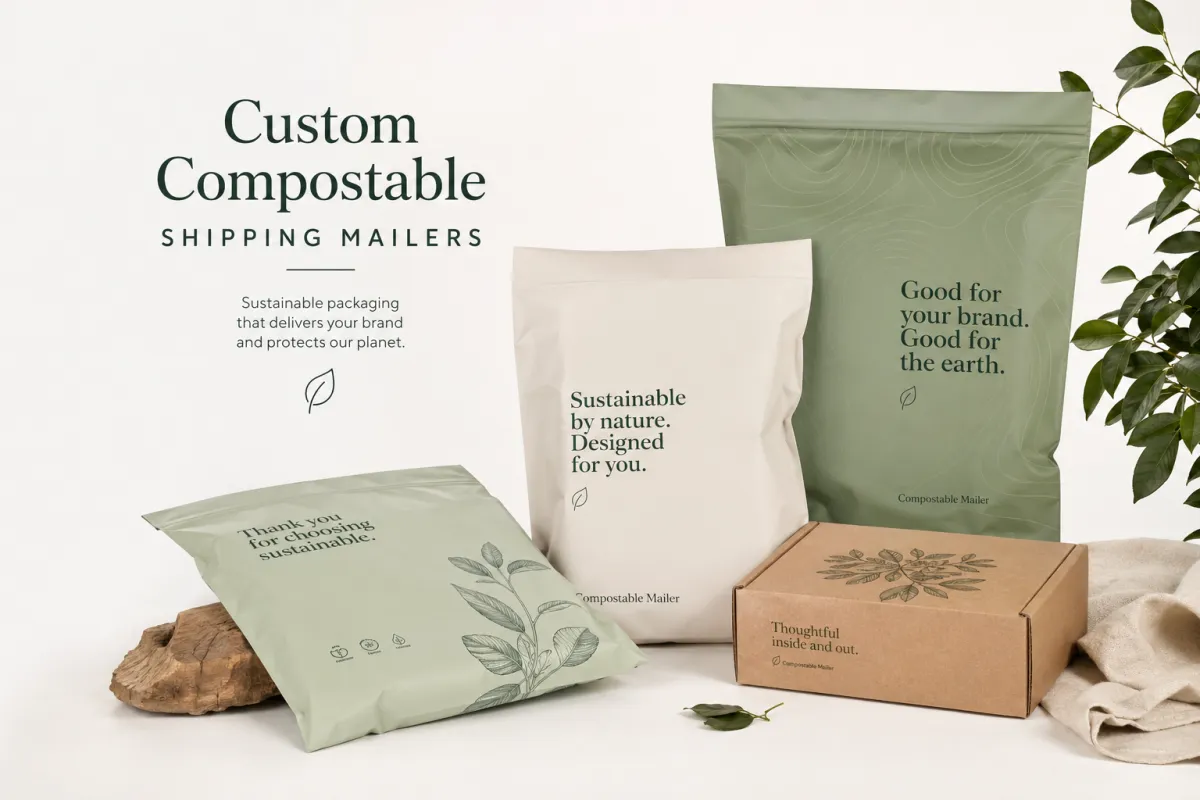
Custom compostable shipping mailers are lightweight shipping envelopes made from materials designed to break down in a defined composting environment, and they are printed or sized for a specific brand, SKU family, or fulfillment workflow. They are different from Recycled Plastic Mailers, paper envelopes, and generic compostable stock options because the construction is chosen around the product, not around a one-size-fits-all catalog spec. That distinction matters when a brand wants Packaging That Feels intentional rather than improvised, especially on programs moving 3,000 to 50,000 units a month.
The most common material families I see are plant-based films, starch blends, and certified compostable laminates. Some use PBAT blended with PLA or other bio-based components, while others rely on layered constructions that balance flexibility, sealability, and tear resistance. For many custom compostable shipping mailers, the key is not just the resin blend but the way the film extrudes, seals, and holds print under warehouse handling. Not every compostable film behaves the same way. Two mailers can both say “compostable,” yet one performs like a 2.5 mil poly mailer while the other feels closer to a thin produce bag. The label does not tell the whole story; the resin blend, extrusion behavior, and closure system matter just as much, especially when the film is extruded in Shenzhen or converted in Jiaxing for different humidity conditions.
That difference matters when you are packing folded tees, soft goods, or subscription items that will be handled 6 to 10 times before the customer opens the parcel. If the seal is too weak, the mailer opens at a tote corner. If the film is too soft, the print scratches. If the gauge is too thin, the bag may stretch under a 3 lb load and lose its shape, which can make your packaging design look sloppy even when the artwork itself is excellent. I have watched that happen on a clean, efficient line, and the fix always started with material specification rather than marketing language, usually by moving from a 2.0 mil equivalent to a 2.75 mil construction.
There is also a certification piece that deserves respect. A mailer can be labeled compostable, industrially compostable, or home-compostable, and those are not interchangeable claims. I always tell clients to think about the end-of-life pathway the same way they think about shipping cartons or Custom Printed Boxes: the claim only helps if it matches the waste stream your customers actually have access to. A beautiful claim with no disposal path becomes friction, not value, particularly in regions like California, Ontario, or the Netherlands where local acceptance rules can change by city.
For brands balancing branded packaging with performance, custom compostable shipping mailers often sit between paper envelopes and tougher plastic mailers. They usually offer a cleaner look than plain stock mailers, more personality than a white kraft sleeve, and a better fit for ecommerce shipping than many paper-only options when moisture or rough handling is part of the route. That middle ground is exactly why they have gained so much traction in apparel, wellness, and subscription programs, where a 12 oz sweater set or a three-piece skincare kit needs both presentation and protection. In that sense, the product behaves like a shipping envelope and a brand statement at the same time.
| Option | Typical Use | Approx. Unit Cost at 5,000 Pieces | Main Strength | Main Watch-Out |
|---|---|---|---|---|
| Custom compostable shipping mailers | Apparel, soft goods, subscriptions | $0.15 to $0.39 | Brand presentation plus compostable claim | Needs the right disposal instructions |
| Recycled poly mailers | General ecommerce shipping | $0.08 to $0.20 | Low cost and strong moisture resistance | Less attractive for sustainability-led branding |
| Paper envelopes | Light, low-abrasion items | $0.14 to $0.34 | Good print surface and easy recycling story | Can fail in wet conditions or on sharp corners |
| Custom Shipping Boxes | Rigid or fragile products | $0.55 to $1.80 | Best structural protection | Heavier, bulkier, and costlier to ship |
If you already use Custom Poly Mailers for certain SKUs, the compostable option often works as a parallel line for products that need a softer, more sustainability-forward story. For fragile merchandise, I still push brands toward Custom Shipping Boxes with inserts, because a compostable mailer is not a shield against a 4-foot drop onto a warehouse floor. A bag can do a lot, but physics still gets a vote. I have seen people ask a mailer to survive a bad conveyor bounce like it was a superhero; the mailer, understandably, did not agree.
I gave that same answer to a client in Portland who wanted every product moved into one material family. My answer was no, not if the line includes ceramic accessories, hardcover books, and folded clothing. The smartest product packaging systems usually mix materials by risk level, price point, and route rather than forcing every SKU into the same envelope. Good packaging strategy looks practical because it is practical, and a well-run fulfillment center in Seattle or Nashville will always notice the difference.
How Do Custom Compostable Shipping Mailers Work?
On the converting side, custom compostable shipping mailers are built from a few functional layers: an outer film, a seal line, a closure strip, and printed inks that must survive handling without compromising the compostable claim. When I stand by a lamination line, the first things I check are the seal consistency and the cut accuracy, because a 1 mm drift in registration can lead to a crooked flap and a weak closure at the tail end of the run. That kind of drift is easy to miss on a quick glance and hard to forgive after the cartons leave the dock, especially if the order is headed out on a Friday afternoon from a plant in Dongguan or Ho Chi Minh City.
The film has to do several jobs at once. It must flex enough to pack easily, resist tearing when a sorter grabs the corner, and still provide enough moisture protection to survive a normal parcel route. Compostable materials are engineered with those trade-offs in mind, which is why one brand may need a 2.0 mil construction and another may need something closer to 3.0 mil depending on the product weight, the fill method, and whether the bag is going through automated order fulfillment or hand packing. The right spec depends on the actual motion of the line, not a rough guess from a sales call, and a 14 oz hoodie in Dallas does not behave like a 5 oz tee in San Diego.
What happens after disposal depends on the waste stream. In commercial composting conditions, heat, oxygen, moisture, and microbial activity work together to break down materials over time, but that process is not the same as tossing a bag into a backyard bin. Some facilities want a specific certified construction, and some local systems will reject items labeled compostable if the material does not match the intake rules. That is why I always say the disposal instructions are part of the product, not a bonus line on the back panel, and why a line like “industrial compost only” can matter more than a full-page sustainability story.
You can read more about composting and sustainable materials through the industry resources at The Packaging Association and transit testing guidance at ISTA. Those two references are useful when you want to compare marketing claims against actual handling expectations, especially if your brand is shipping 500 or 5,000 parcels a day. They help ground the conversation in tests, not adjectives, and they are much more useful than a supplier deck that only talks about “premium feel.”
One thing most people get wrong is assuming a compostable mailer is automatically weaker than a conventional plastic mailer. Not always. I have seen well-specified custom compostable shipping mailers outperform thin commodity poly bags in scuff resistance and line efficiency because the seal zone was cleaner and the print was placed on a panel that did not get folded 20 times during packing. The details add up, especially when the crew is moving quickly and every extra wrinkle becomes a future complaint, which is why a 25 mm seal band and a 3 mm edge margin can matter so much.
Ink system selection matters too. If the artwork is heavily saturated or you need a dark brand panel, the ink load can affect drying, rub resistance, and sometimes the way the surface behaves under heat. I have watched a line slow by 15 percent because the print team pushed too much coverage on a soft film, and the crew had to wait for more cure time before stacking Bundles for Shipping. That slowdown was not a color problem; it was a process problem dressed up as a design choice, and the fix was to shift to a water-based ink set with a 72-hour rub test instead of forcing the press to run hot.
Custom compostable shipping mailers are not just a material choice. They are a packaging design decision tied to the whole workflow, from artwork and closure strip to the final carton count on the dock. Every stage has a hand in whether the bag works as intended, and every stage can expose a weak spec, from the 350gsm C1S artboard used on the companion insert to the final QC count at the outbound pallet.
Key Factors That Affect Cost and Performance
The price of custom compostable shipping mailers usually comes down to six things: material gauge, print coverage, closure style, bag size, certification level, and order quantity. In a factory quote sheet, a 0.5 mil increase in film thickness or one extra print color can move the unit price more than a brand team expects, especially on smaller runs under 10,000 pieces. A quote can look tidy until the production math begins, and that is where a $0.02 adhesive upgrade or a wider gusset can quietly change the whole budget.
If you ask for custom colors, multiple artwork versions, specialty finishes, or a stronger closure for heavier products, the cost climbs for a simple reason: each added detail raises setup time and waste during make-ready. On one supplier negotiation I handled, the customer wanted three seasonal variants, a matte finish, and a reclosable strip, and the line items added almost $0.11 per unit compared with the base spec. The brand loved the final look, but the budget conversation was not soft. The final decision came down to whether those extras changed the shipping experience or just the mood board, and whether the factory in Shenzhen or the backup line in Jiaxing could hold the schedule.
Performance is just as measurable. I look at puncture resistance, seal strength, opacity, moisture resistance, and stackability during packing. A mailer that looks great in a studio can still fail if the side seams split when a picker tosses it into a tote bin or if the closure loses tack after 48 hours in a warm staging area. For ecommerce shipping, those 48 hours matter more than most marketing decks admit. Heat, pressure, and time are not abstract risks; they are the daily test, especially in summer warehouses in Phoenix or Houston where the dock can reach 32 to 38 C.
Here is the practical trade-off I explain to clients: pay for the features that reduce claims, and simplify the features that do not change the customer experience. If your product is a 12 oz knit top, you may not need a reinforced gusset. If it is a premium scarf set, you may want better opacity and a cleaner matte print because the unboxing moment is part of package branding. The goal is not to overspec every line; it is to match the film, seal, and finish to the actual product packaging job. Good specs feel calm because they are matched to reality, and a clean spec sheet can save you $0.04 to $0.08 per unit on a 20,000-piece order.
Cost framework I use on the floor: spend more on film integrity, spend selectively on print, and avoid paying extra for decorative add-ons that do not improve transit performance. That philosophy has saved clients 8 to 12 percent on the first run without hurting durability, which is better than spending money on features nobody at the fulfillment station ever uses. The value shows up in fewer returns, fewer reruns, and fewer frantic calls after launch, especially when the first production lot is coming from a plant in Dongguan with a 12-day schedule.
| Feature | Lower-Cost Choice | Higher-Cost Choice | When the Upgrade Is Worth It |
|---|---|---|---|
| Film gauge | 2.0 mil equivalent | 2.5 to 3.0 mil equivalent | Heavier garments, sharper corners, longer transit |
| Print coverage | Single-color logo | Full-panel graphics with 2 to 4 colors | Brand-led retail packaging or premium ecommerce shipping |
| Closure style | Standard peel-and-seal | Wider adhesive strip or tamper-evident closure | High-volume order fulfillment and security-sensitive items |
| Certification | Basic compostable documentation | Third-party certification packet and label language review | Retail programs with strict sustainability claims |
The best way to compare prices is to ask for a line-item quote, not a vague “best price.” Request material spec, print method, minimum order quantity, and estimated lead time in the same document. Then compare custom compostable shipping mailers against a poly mailer or paper envelope using the same shipment profile, because a 2 oz difference in bag weight can change your freight math more than a 1 cent print saving ever will. That comparison is where the real costs hide, whether the product is built in Shenzhen, Dongguan, or Ho Chi Minh City.
If your order volume is likely to rise, forecast before you commit. At 25,000 pieces, unit cost can fall sharply; at 3,000 pieces, setup costs may dominate. I have seen brands save more by increasing one run from 5,000 to 12,500 than by switching ink vendors, and that is the sort of practical math that keeps product packaging decisions honest. Volume planning is unglamorous, but it protects margin better than most premium options do, and it often shortens the path to a $0.09 to $0.12 landed cost per unit on repeat orders.
Step-by-Step Guide to Spec and Order
The cleanest way to spec custom compostable shipping mailers is to start with the product itself: length, width, thickness, weight, and how it is folded on the line. Measure the real packed size, not just the retail dimension on a spreadsheet, because a folded sweatshirt and a flat tee do not occupy the same volume once the packer adds a return insert, tissue, or barcode sheet. The packing station tells the truth faster than the spreadsheet does, and a 15 mm allowance on each side can prevent a lot of friction.
For custom compostable shipping mailers, define the shipping environment next. Is the parcel moving through humid coastal lanes, cold storage, or a regional network with a lot of conveyor handling? A mailer that performs well in a dry boutique drop-ship lane may need a stronger film and a wider seal for a coast-to-coast ecommerce shipping route. I have seen a 9-inch-wide bag work beautifully for one subscription program and fail for another simply because the second brand’s packing staff added a folded thank-you card that changed the bulk by 20 percent. That small paper insert changed the whole behavior of the pack, and it was a 350gsm C1S artboard card that did the damage, not the garment.
Once dimensions are set, request samples and print proofs. I prefer to test at least 3 samples from the same spec because one sample can hide a die-cut issue or a weak adhesive edge. Confirm any certification claims in writing, review artwork placement, and test the closure in the actual packing motion, not just on a tabletop. A hand-applied seal can feel fine in the office and still fail after 200 cycles on a line where the packer is closing a bag every 7 seconds. The office test is useful; the floor test is the one that counts, especially if the mailers are being packed in batches of 250 at a time.
Here is the sequence I recommend, and it saves time on both sides of the quote:
- Measure the top 5 SKUs and note the packed weight in ounces or grams.
- Choose the smallest bag size that clears the product by at least 15 to 20 mm on each side.
- Request 2 to 3 sample constructions with the same artwork panel.
- Test seal strength, rub resistance, and opening ease on the actual line.
- Approve the proof only after certification language and disposal instructions are checked.
Lead times are usually a mix of sampling, revisions, production, and freight. Sampling and proofing may take 3 to 7 business days if the artwork is simple, while first production typically takes 12 to 15 business days from proof approval for a repeat spec, or 15 to 20 business days for a new construction from a factory in Shenzhen or Dongguan. I always tell buyers to build in another 4 to 7 business days for domestic freight, or 18 to 28 days for ocean freight if the first shipment is crossing the Pacific and the launch date is locked to a marketing calendar. Calendar pressure can make a small delay feel much larger than it is, which is exactly why launch plans should include a little breathing room, even if the merch team wants everything on the shelf by Friday.
When the pilot run lands, treat it like a controlled factory trial. Check incoming counts, verify random samples for seal placement, and train customer service on the most common disposal questions before the product goes live. If the first 500 units show a 2 percent damage rate, do not roll out 50,000 more units until you know whether the issue is the bag, the packing method, or a shipping zone that needs a stronger construction. A pilot exists to catch the ugly surprises before they scale, and it is much cheaper to pause at 500 than at 15,000.
That move from pilot to full rollout is where a lot of branded packaging programs either become efficient or become expensive. The brands that win are the ones that respect the process, document the spec, and make sure the packaging team, the warehouse crew, and the support desk all know what the mailer is supposed to do. Once everyone understands the spec, the launch stops feeling fragile, and the first re-order can move through procurement in 48 hours instead of a week.
Common Mistakes With Custom Compostable Shipping Mailers
The first mistake is choosing custom compostable shipping mailers because of the compostable claim alone, without matching the material to the product weight, abrasion risk, and shipping route. A 6 oz hoodie and a 14 oz knit sweater do not belong in the same bag spec unless the film gauge and closure are both chosen with discipline. A pretty sustainability story cannot rescue a bad fit, and a 40 mm sizing error will show up in the first pallet.
The second mistake is under-testing. Brands sometimes skip drop tests, heat exposure checks, or seal validation and then discover failures after launch, when complaints are already in the queue. If you want a realistic test, put samples through a 4-foot drop, leave them in a 35-degree Celsius warm room for a few hours, and pack them again after the adhesive has had time to settle. That kind of basic validation is cheaper than replacing 300 customer orders. It also gives the warehouse team confidence that the bag can take a beating, whether the packing floor is in Newark, Nashville, or El Paso.
Artwork can cause problems too. If the disposal instructions are too small, customers will ignore them. If the print coverage is too heavy, curing can become inconsistent. If the brand panel conflicts with the certification text, the design may need a rework that adds 3 to 5 business days. I learned this the hard way in a meeting with a beauty client who wanted a full-bleed black mailer and a large compostable claim in tiny type; the claim got lost, and so did the credibility. The package looked polished and said nothing useful. Frustrating? Absolutely. Fixable? Yes, if everyone stops treating the spec like an afterthought and starts respecting the proof timeline.
“We loved the look, but the packers hated the flap.” That was the exact line a fulfillment manager gave me after a pilot run, and it stuck because he was talking about a 12-second problem that had turned into a 12,000-unit headache.
Operational mistakes show up even faster than design mistakes. One warehouse I visited had ordered the wrong size by 40 mm, which meant the fold line hid the return label on every third bag. Another client had a 9-week inventory lead time on a seasonal line and ran out of mailers 10 days before the launch, which forced them into generic stock bags and wrecked the branded packaging story. A third team forgot to brief the fulfillment floor, so the crew kept asking whether the compostable strip needed special tape, and productivity dropped by 14 percent on the first shift. None of those problems needed a new material; they needed sharper planning. I wish I could say those mistakes were rare, but I have seen each one more than once, including at a 200,000-unit apparel program in Los Angeles.
Here is what I tell teams to watch before they sign off on custom compostable shipping mailers:
- Confirm the exact packed size, not the retail size alone.
- Check the seal line under real packing pressure, not a desk test.
- Review disposal language for the regions you actually ship to.
- Verify that print and certification claims do not conflict.
- Match the mailer to the product, not to the marketing mood board.
I also caution brands not to assume one material can replace every system in the building. A mailer is not the same tool as a corrugated carton, and a soft-goods shipper is not the same thing as a premium retail packaging sleeve. If your line includes fragile goods, moisture-sensitive items, or displays that need more structure, custom printed boxes may be the better fit for that SKU group. The right mix keeps the whole program steadier, especially when the product mix includes bottles, ceramics, and folded apparel in the same weekly shipment.
Expert Tips for Better Custom Compostable Shipping Mailers
My first tip is simple: keep the first run boring in the best possible way. Test one or two sizes, one closure style, and one artwork family before you build a broad program of custom compostable shipping mailers. I have seen brands save weeks of back-and-forth by approving a plain but functional sample first, then layering in artwork once the structure proved itself on the line. The cleanest launches usually start with restraint, and a 5,000-piece pilot is often enough to prove the spec.
Second, design artwork for clarity, not just for beauty. The front panel should carry the brand, the compostable claim, and any disposal instruction in type large enough to read at arm’s length, usually 7 to 9 points minimum depending on the panel size. If you need space for a short story about sourcing or material responsibility, put it where it does not fight the barcode, the seam, or the tear strip. A tidy hierarchy helps the customer read the bag without squinting, and a 12 mm safe zone around the edge will keep the layout from colliding with the seal.
Third, compare suppliers with a scorecard. I like to rate material data sheets, certification proof, sample quality, response time, and issue resolution, each on a 1 to 5 scale. Price matters, but it should not be the only number on the page. A supplier that responds with clear answers in 24 hours and sends a clean 3-piece sample set is often better long-term than the cheapest quote that arrives with no spec sheet and no certificate. Good communication saves more money than a tiny price break, especially if the supplier is in Shenzhen and your procurement team is in Toronto. For custom compostable shipping mailers, that responsiveness often predicts how smoothly the production run will go.
Fourth, know when to upgrade the construction. If your product has sharp corners, choose a stronger film. If your line is high-speed, choose a closure that opens cleanly and seals in one motion. If you ship in damp climates or through long parcel networks, consider a second protective layer or a paired system that uses custom compostable shipping mailers for the outer pack and a tighter inner wrap for the product itself. That is not overkill when the item is a premium knit or a moisture-sensitive bundle. It is simply the right amount of protection, and it can cut scuff complaints by 20 to 30 percent on premium orders.
For brands building a broader packaging system, the mailer should fit with the rest of the shelf and shipping experience. If the same label style appears on cartons, envelopes, and inserts, the whole system feels intentional. If the typography changes every 20 orders, the customer notices. That is package branding in practice, and it matters more than many teams admit during a rush meeting. Consistency turns the unboxing into a familiar brand cue, whether the parcel is opened in Brooklyn, Austin, or Vancouver.
One of the most useful resources for sustainability-driven teams is the certification trail. If a supplier cannot show the paperwork, the claim is just a phrase. For paper inserts or companion sleeves, FSC-certified components can add a stronger trust signal, and it is worth checking the standards body at FSC if your broader program includes paper-based components alongside the mailer. Buyers often spend more time choosing a font than they do checking the paper trail, and a simple supplier packet can tell you more than a polished sales presentation ever will.
From the factory floor, my best advice is to watch the packing motion itself. I once saw a crew lose 9 seconds per parcel because the peel strip was too narrow and the edge kept curling. A 5 mm wider strip solved the problem, reduced frustration, and made the whole station look more professional. Small process fixes like that are where custom compostable shipping mailers can quietly improve both labor efficiency and customer perception. The gains are not flashy, but they are real, and they show up in the first 1,000 shipments.
Next Steps for Launching Custom Compostable Shipping Mailers
If you are ready to move forward with custom compostable shipping mailers, start with a short checklist: measure your top SKUs, define the shipping environment, gather your sustainability requirements, and request samples from at least 2 qualified suppliers. That 4-step start prevents a lot of avoidable rework, especially if your line includes more than one product shape or pack style. It keeps the project grounded before opinions start multiplying, and it usually takes less than 30 minutes if the dimensions are already in the product file.
Then compare certifications, performance data, and pricing side by side. Ask for film spec, closure details, print method, minimum order quantity, and lead time in the same document. The best quote is not always the lowest number; it is the one that gives you the right fit for product packaging, retail packaging, and ecommerce shipping without adding hidden costs later in the warehouse. A clean document beats a scattered set of email replies every time, especially when a rep from Dongguan is quoting ex-works pricing and your team needs landed cost by noon.
I also recommend a small pilot launch with one or two product groups, not a full catalog switch. Watch damage rates, packing speed, and customer feedback for at least 2 full receiving cycles before scaling up. If the damage rate stays below 1 percent and the packing team is moving at a steady rhythm, you have useful evidence. If not, revise the size, the seal, or the print layout before ordering the next batch. That pause can save a full quarter of headaches, and it can keep the first re-order from turning into emergency freight.
After that, build the rollout with discipline. Train the warehouse staff on disposal questions, update the support team with 3 or 4 short answers, and store the approved spec sheet where the next buyer can find it in 30 seconds. That kind of process discipline is the difference between a mailer that looks good for a month and a mailer program that supports branded packaging for the long haul. Once the process is written down, the program stops depending on memory, which is useful when the original merch manager is on vacation or the line expands into a second warehouse in Texas.
When I look at strong programs, they always have the same pattern: a right-sized spec, a realistic test, and a supplier who understands the line as well as the logo. That is the path I trust for custom compostable shipping mailers, because the right bag should protect the product, support the brand, and match the disposal story your customers can actually use. If those three pieces line up, the mailer earns its place, and the whole launch feels steadier from proof approval to the last pallet.
The practical takeaway is simple: choose the smallest functional bag, prove the seal on the real packing line, and only pay for print and finishes that improve the customer experience or reduce damage. That approach keeps the packaging honest, and it keeps custom compostable shipping mailers from becoming a nice idea that falls apart after week one.
Are custom compostable shipping mailers strong enough for apparel and soft goods?
Yes, for many apparel items they perform well when the film gauge, seal design, and bag size match the product weight and packing method. They are especially effective for folded garments, lightweight accessories, and subscription shipments that do not need rigid protection. For sharp, heavy, or moisture-sensitive items, test samples first and consider a secondary layer or a tougher construction. A 2.5 to 3.0 mil equivalent spec usually covers most folded tops and light knits.
What makes custom compostable shipping mailers more expensive than standard poly mailers?
The main drivers are compostable resin costs, certification requirements, print setup, and lower economies of scale than commodity poly. Custom sizes, multiple ink colors, and premium closures can raise the price further. Higher order quantities usually reduce unit cost, so it helps to forecast demand before placing the first production run. On a 5,000-piece order, a well-made compostable mailer might land around $0.15 to $0.39 per unit, depending on spec and factory location.
How long does it take to produce custom compostable shipping mailers?
Sampling and proofing usually take 3 to 7 business days if the artwork is simple and the spec is already defined. Once approved, first production typically takes 12 to 15 business days from proof approval for a repeat order, or 15 to 20 business days for a new construction. Build in another 4 to 7 business days for domestic freight, or 18 to 28 days for ocean freight if the shipment is moving from Shenzhen or Dongguan to North America.
Do custom compostable shipping mailers need special disposal instructions?
Yes, customers should know whether the mailer is industrially compostable, home-compostable, or intended for a specific certified waste stream. Clear instructions on the mailer reduce confusion and improve proper disposal after delivery. If the product is sold in multiple regions, verify that the disposal message matches local infrastructure and certifications. A short line like “industrial composting only” can prevent more confusion than a long paragraph of marketing copy.
How do I choose the right custom compostable shipping mailers for my brand?
Start with product size, shipping risk, and sustainability goals, then compare materials that meet those needs without overbuying features. Request samples, test the closure and seam strength, and compare supplier documentation before you commit. Choose the option that balances performance, brand presentation, and realistic disposal pathways for your customers. The best choice is the one the warehouse can use without fighting it, and one that keeps the damage rate under 1 percent on the pilot run.

