Buyers searching for frosted garment bags Lead Time and MOQ usually need practical numbers: how fast the right bag can ship, what minimum order applies, and which specs change cost or delay approval.
That matters because a garment bag affects more than presentation. It can change packing speed, carton cube, barcode readability, and how clean the product looks on a retail rail or in e-commerce delivery. Problems are often small but expensive at scale: dimensions that are too tight at the shoulders, zippers that slow packers down, or film thin enough to split at the side seal.
Frosted garment bags sit between basic clear poly and fully opaque premium packaging. They still allow item recognition, but they hide some of the visual clutter from mixed colors, tags, and folds. For boutiques, uniforms, private-label apparel, bridalwear, and online fulfillment, that can improve presentation without moving into a much heavier packaging format.
Lead time and minimums are not fixed across this category. They move with size, thickness, print method, closure choice, and whether the order uses a stock-supported format or a fully custom build. The sections below focus on the decisions that actually affect specs, cost, MOQ, production timing, decoration, and inspection.
Why frosted garment bags outperform basic clear poly for many apparel programs
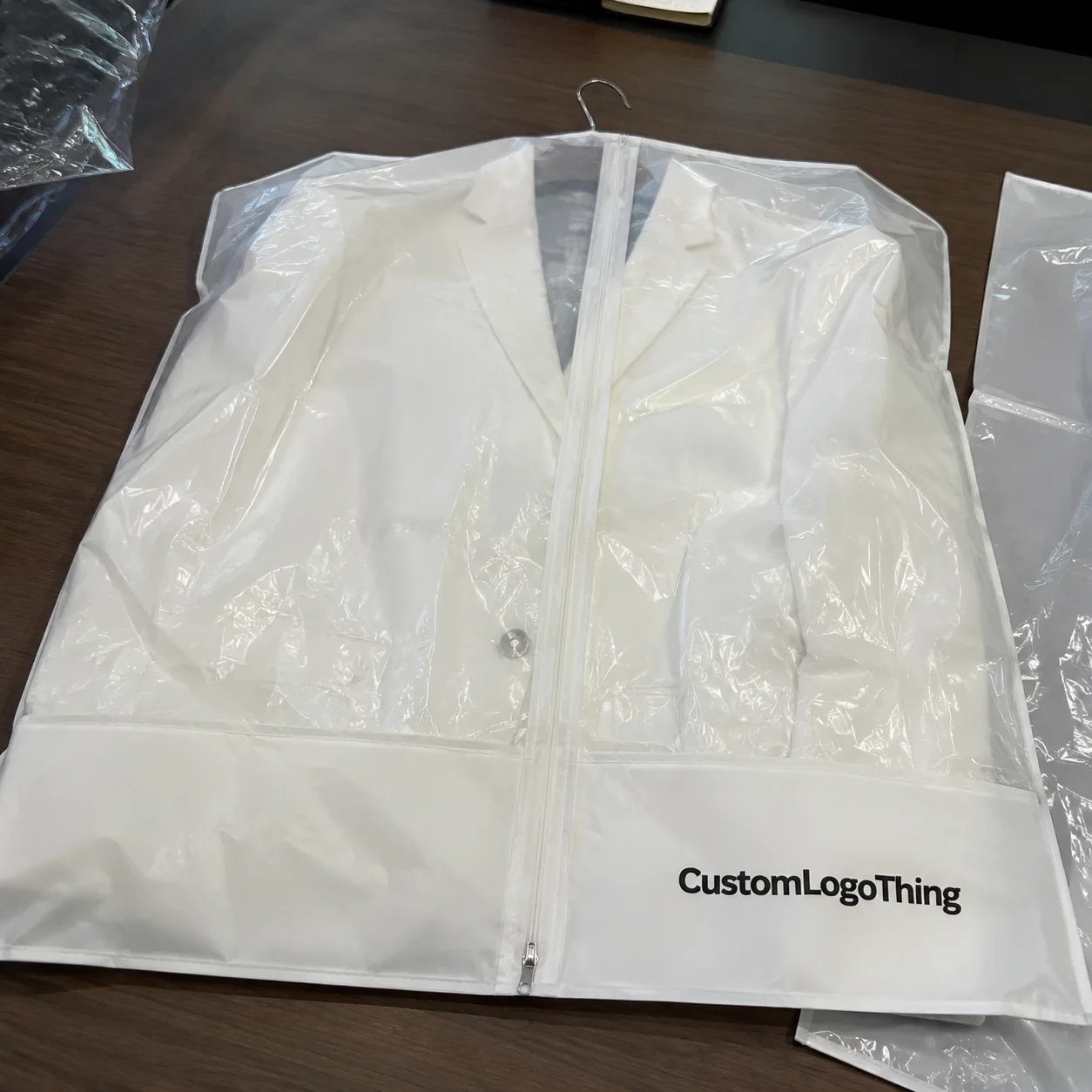
Clear poly has one obvious advantage: full visibility. If the bag is only for short-term protection in a back room, that may be enough.
But for many apparel programs, full visibility creates visual noise. Mixed colors, graphic prints, folded sleeves, spare tags, and size stickers can make inventory look less controlled. Frosted film softens that effect while still allowing staff to identify the item inside.
That difference is most useful on retail rails and during unboxing. A frosted finish can make replenishment stock look more consistent and hide minor scuffs, fold lines, and internal label clutter better than standard clear poly. For dresses, blouses, knitwear, uniforms, and coordinated sets, that is often the main reason buyers upgrade.
There is also an operational benefit when the construction is right. A well-sized frosted bag helps keep garments grouped, reduces dust exposure, and moves more smoothly through packing if the closure, venting, and opening are chosen properly. The gain is usually not dramatic on one unit, but it shows up over a full run in fewer bag swaps, fewer split seals, and less repacking.
Material, finish, and closure details to confirm before sampling
Most frosted garment bags are made from polyethylene, commonly LDPE or an LDPE-based blend. LDPE stays popular because it seals well, feels relatively soft, and flexes without becoming too brittle in normal handling.
Frosted usually means a translucent matte finish, not opaque white. The exact frost level varies by supplier, so it should be approved by sample rather than described loosely. One factory’s “light frost” can look much clearer than another’s.
Thickness is the next major choice because it affects both feel and failure rate:
- 1.5 to 2.0 mil often works for lightweight folded shirts, tees, or short-term dust protection.
- 2.0 to 2.5 mil is common for premium folded apparel and many zip-closure applications.
- 2.5 to 3.0 mil and above is more suitable for heavier garments, repeat opening, long hanging formats, or a more substantial hand feel.
More gauge usually improves puncture resistance and perceived quality, but it also adds resin cost, carton weight, and freight. If the garment is light and the bag is discarded quickly, excess thickness can raise cost without adding much value.
Closure style affects usability, cost, and often MOQ:
- Zip lock works well for repeat access and many folded-apparel programs.
- Slider zipper feels more premium and opens more easily, but adds components and usually higher minimums.
- Self-adhesive flap can be efficient for one-time packing and is often more economical.
- Hanger hole is critical for hanging formats, but its size and position must match the hanger profile.
- Vent holes help with air release and safety; poor placement can interfere with print or garment presentation.
- Bottom gusset helps bulky outerwear, multi-piece sets, or structured garments fit without stressing side seals.
Printing adds another layer. A simple one-color logo on a standard-size bag is usually straightforward. Multi-color graphics, large solid panels, fine lines, and tight registration requirements can require different tooling or longer setup. On frosted film, white ink often looks clean, while darker inks may need opacity review.
Other details worth confirming early include required warning text, barcode contrast on matte film, recycled-content targets, odor limits, and print-placement tolerance. These are easy to overlook but often slow approval later.
Size, thickness, print, and packing specs that change performance and cost
A reliable quote depends on a complete spec. For frosted garment bags, buyers should confirm width, length, thickness, closure type, gusset depth if any, print area, vent configuration, and pieces per carton.
Size selection is where many projects drift off target. Rounding up “to be safe” increases film use, carton cube, and freight. A bag that is much larger than necessary may still work, but it uses more material on every unit and often makes the garment look less tailored in the package.
Typical sizes depend on the product. Folded T-shirts may fit around 10 x 14 inches or 12 x 16 inches. Blouses, sweaters, and dresses often move into 14 x 20 inches or 16 x 22 inches. Hanging garments such as coats, uniforms, formalwear, or bridal items usually need longer formats and sometimes gussets for shoulder bulk.
The practical test is not just whether the garment fits. It is whether it fits without stressing the seal, bunching the zipper line, crushing embellishments, or slowing the packer down. Those issues are common when a sample is approved with one size range but bulk production includes larger sizes or heavier fabrics.
Print limits should also be reviewed early. Large print panels increase ink coverage and make registration variation more visible. Artwork that looks sharp on paper may not reproduce as cleanly on frosted plastic. If branding needs are simple, a smaller one-color mark often gives the best balance of visibility, speed, and cost control.
Packing specs matter too. Ask for pieces per carton, outer-carton dimensions, and gross weight. A carton of 1,000 flap bags behaves very differently from a carton of 250 slider-zip gusseted bags, and that affects storage, receiving efficiency, and warehouse labor.
If the bag specification is detailed but the carton specification is vague, the landed-cost picture is still incomplete.
Frosted garment bags pricing and MOQ: what actually moves the unit cost
The main cost drivers are bag size, film gauge, resin grade, print coverage, color count, closure hardware, and packing format. Each one increases material use, setup work, machine time, or freight exposure.
MOQ follows the same logic. A supplier minimum is usually tied to efficient machine run length, raw-material purchasing, and whether the order needs custom plates, dies, or extra conversion steps. Standard sizes with light customization tend to support lower minimums. Custom dimensions with sliders, gussets, or more demanding print usually require larger runs.
A low MOQ is not automatically the best value. It lowers the initial cash outlay, but setup and tooling are spread across fewer pieces, so unit cost can rise sharply. For small or test programs that may still make sense. For steady replenishment, a larger run often produces better economics if storage is available.
| Order Type | Typical MOQ Range | Main Cost Drivers | Rough Unit Cost Range |
|---|---|---|---|
| Stock-like size, no print | 1,000-3,000 pcs | Film gauge, flap or zipper choice | $0.10-$0.22 |
| Standard size, 1-color custom print | 3,000-5,000 pcs | Print area, setup, carton quantity | $0.14-$0.28 |
| Custom size, 1-2 color print | 5,000-10,000 pcs | Material use, plate cost, seal setup | $0.18-$0.38 |
| Custom size with slider or gusset | 10,000+ pcs | Added components, tooling, freight cube | $0.28-$0.55+ |
These figures are directional. Resin, freight, and destination all move the result. Buyers should also confirm whether they are comparing ex-works, FOB, CIF, or delivered pricing. A quote that looks cheaper at the factory gate may not stay cheaper after freight, duty, and final delivery.
Sample costs can also cause confusion. Stock samples are usually inexpensive, but pre-production samples with custom print, special sizing, or nonstandard closures may involve setup or short-run charges. That is usually cheaper than finding a spec error after bulk production starts.
For clean quote comparisons, line up these details across suppliers:
- Finished dimensions and tolerance
- Film thickness in mil or micron
- Material type and recycled-content requirement
- Closure style, vent holes, and hanger-hole details
- Print method, number of colors, and coverage area
- Pieces per carton, master-carton weight, and shipping terms
What is the typical frosted garment bags lead time and MOQ for custom orders?
Lead time in this category has three parts: pre-production, manufacturing, and transit. Combining them into one number often hides where delays actually happen.
Pre-production includes quote review, dieline confirmation, artwork checks, sample approval if needed, and commercial approval. This can move quickly when buyers provide vector artwork, clear dimensions, quantity tiers, destination, and legal copy at the start. It often slows when thickness, warning text, closure choice, or frost level is still undecided.
After proof approval, standard-size frosted garment bags with simple print often run about 12 to 18 business days in production. Custom formats with gussets, slider zippers, multiple print colors, specialty resin, or new tooling often move into the 20 to 35 business day range.
Transit is separate. Courier is fast for samples. Bulk orders vary more: air freight is quicker but costly for low-value packaging, while ocean freight lowers per-unit transport cost but can add weeks and more scheduling risk.
A typical order flow looks like this:
- Quote request and specification review
- Artwork and dieline confirmation
- Sample review if needed
- Order approval and deposit
- Material allocation and print setup
- Printing and bag conversion
- Inspection and packing
- Freight booking and final delivery
Many delays are approval delays rather than factory failures: missing vector files, late changes to warning copy, unconfirmed carton markings, or frost expectations that were never tied to an approved sample. Holiday congestion, resin availability, customs holds, and warehouse receiving appointments can also affect the final schedule.
As for MOQ, common starting points are often 1,000 to 3,000 pieces for stock-like constructions without print, 3,000 to 5,000 pieces for standard sizes with simple custom print, and 5,000 pieces and up for more customized builds. Sliders, gussets, and complex graphics usually push the minimum higher.
If timing is tight, it helps to request two options: a faster standard-size route with simplified print and a fully custom route with the preferred construction. That makes the tradeoff between speed, branding, and cost visible early.
Quality-control points that prevent claims and packing-line delays
Quality control here is functional, not cosmetic trivia. It affects labor efficiency, damage risk, and whether a packaging run creates rework downstream.
The checks worth asking about are film-thickness consistency, dimensional accuracy, seal strength, print registration, ink adhesion, zipper function, vent and die-cut cleanliness, and carton count accuracy. If any of these drift, the problem often shows up first as slower packing, more bag failures, or extra repacking.
Weak side seals can split in normal handling. Bags cut too narrow can compress collars or shoulders. Poor zipper alignment wastes time on every pack. Ink rub can make the item look mishandled before the customer even sees the garment itself.
Not every variation is equally serious. Minor frost variation may be acceptable if it stays within the approved visual range. Failed seals, missing vents, unreadable barcode zones, or zipper mismatch are functional defects and should be treated differently.
Buyers do not need to control every inspection step, but they should ask how quality is checked during production and before packing. A supplier that can explain material checks, inline inspection, measurement frequency, and final sampling gives a clearer risk picture than one offering only general assurances.
Good packaging quality control protects schedule and labor just as much as appearance.
What to send for a faster quote and cleaner approval process
The fastest quotes usually come from complete briefs. Send finished dimensions, garment type, thickness target, closure style, print color count, quantity tiers, destination, and required in-hands date at the start.
A reference sample helps even more. If the goal is to match an existing bag’s frost level, zipper feel, softness, or hanger-hole placement, a physical sample is more reliable than descriptive language.
State early whether a stock-supported size is acceptable for speed or whether the program requires a custom build. That decision affects MOQ, tooling, and lead time immediately. If cost comparisons are needed, ask for quantity breaks and at least one alternate thickness to see the tradeoff clearly.
Artwork should be supplied in editable vector format such as AI, EPS, or print-ready PDF. Include warning copy, barcode requirements, carton-marking instructions, and any pallet or receiving constraints before production starts.
A concise quote request should include:
- Finished bag dimensions and tolerance if critical
- Target thickness and acceptable backup thickness
- Closure type, vent holes, hanger hole, and gusset details
- Artwork files and number of print colors
- Quantity breaks such as 3,000 / 5,000 / 10,000 pieces
- Ship-to country or ZIP code and required in-hands date
FAQ
What is the typical frosted garment bags lead time and MOQ for a custom order?
Most standard-size custom-printed orders fall around 3,000 to 5,000 pieces, while more customized constructions often start higher. Simpler jobs may run about 12 to 18 business days after proof approval, while more complex builds often take 20 to 35 business days before transit.
How do bag size and thickness affect frosted garment bags MOQ and pricing?
Larger bags and heavier gauges use more resin, increase carton cube, and raise freight exposure. Custom sizes can also require more setup, which may increase MOQ. Even small size changes can affect total packaging spend across a large run.
Can I get samples before placing a full frosted garment bags order?
Usually yes. Stock samples are commonly used to review material feel, frost level, and closure style. Custom pre-production samples may require extra time and setup cost, especially when custom print, tooling, or nonstandard dimensions are involved.
What information speeds up a quote for frosted garment bags lead time and MOQ?
Send finished dimensions, target thickness, closure details, artwork, print color count, quantity tiers, ship-to location, and your in-hands date. A current sample or reference photo also helps reduce confusion around finish and fit.
Are lower-MOQ frosted garment bags always the best option for small brands?
No. Lower minimums can help cash flow, but they often increase unit price because setup and material costs are spread across fewer pieces. For small brands, a standard size with simple print often gives the best balance of speed, cost, and presentation.