A single crooked, faded, or thick-edged decal can make a careful brick build look unfinished. The bricks may be aligned perfectly. The model may be clever. But the eye goes straight to the sticker.
That is why lego custom stickers matter for restorations, branded displays, MOCs, educational kits, miniature signage, and product mockups built from bricks. At this scale, graphics are not decorative afterthoughts. They carry information, imply quality, and either disappear into the build or call attention to every production flaw.
For clarity, LEGO is a trademark of the LEGO Group. The custom sticker work discussed here refers to graphics sized for LEGO-style bricks and compatible building elements, not official LEGO replacement parts unless sourced through official channels. From a packaging production point of view, these small decals behave like miniature Custom Labels & Tags: material, adhesive, print resolution, finish, and cutting tolerance all show up fast on the finished piece.
What lego custom stickers are and when they make sense
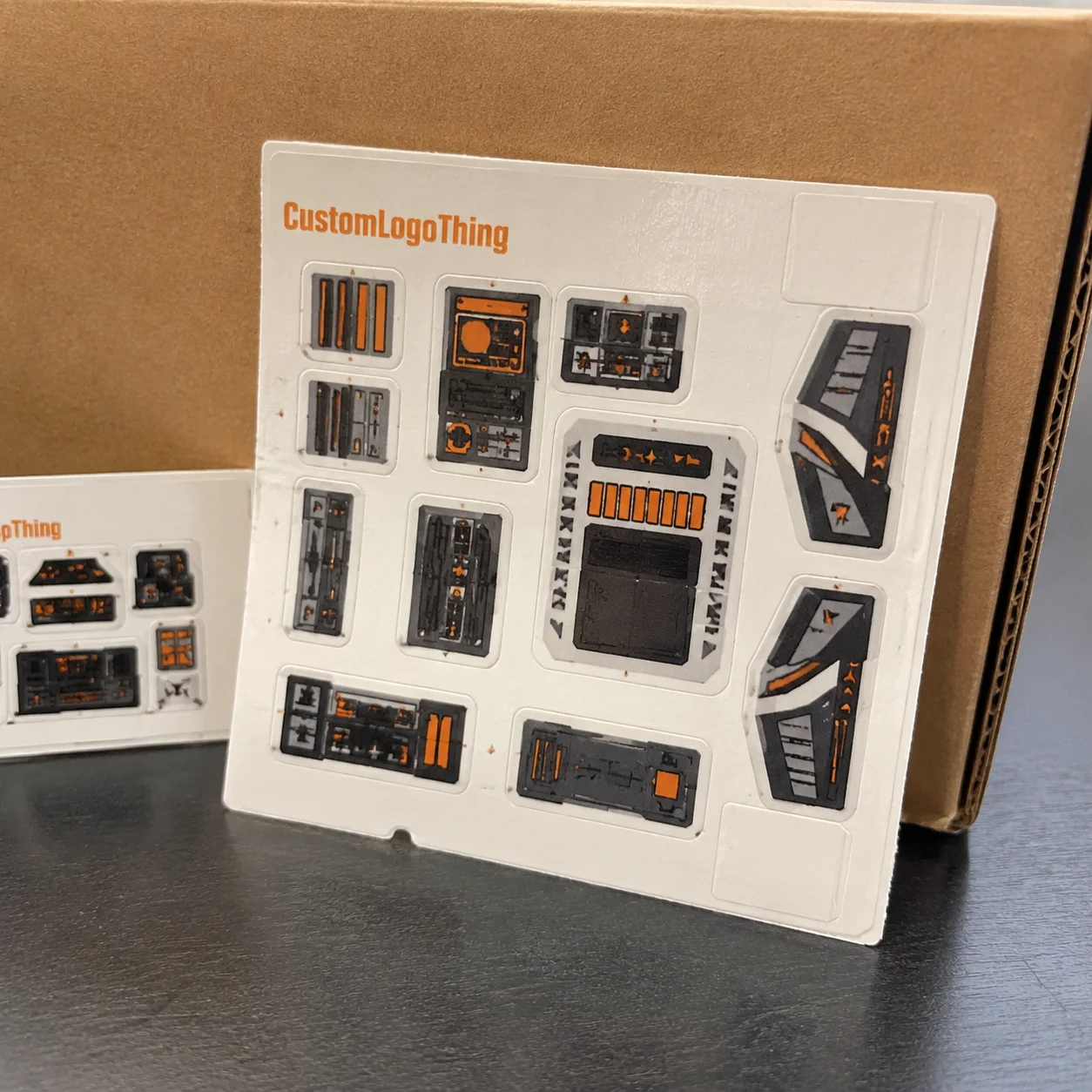
Lego custom stickers are small-format adhesive graphics made to fit tiles, slopes, panels, minifigure accessories, vehicle sides, shop signs, control panels, display walls, and other miniature build surfaces. The tolerances are tight. On a 1x2 tile, a border that is only 0.3 mm too wide can start crowding the bevel and make the print look off-center, even if the artwork itself is sharp.
Different projects need different sticker behavior. Replacement stickers try to recreate a missing or damaged graphic from an older set. Original MOC graphics add maps, warning labels, uniforms, dashboards, storefronts, or instrument panels to a new build. Event and retail display stickers may carry a logo or campaign graphic on a tabletop model. Educational labels might identify body parts, machine components, city zones, or lab equipment. Collector-grade restoration pieces usually need the strictest control over size, finish, and color because the goal is visual consistency, not just decoration.
Ordinary craft labels rarely hold up well here. Brick stickers need clean edge cutting, accurate sizing, controlled adhesive strength, and print that remains readable at miniature scale. Household sticker paper can look bulky on a small tile, and inkjet prints may smear under damp fingers. A professional label film, even at only a few mils thick, usually sits flatter and cuts cleaner.
Stickers make the most sense when you need detail, flexibility, and lower setup cost than direct printing. Pad printing can be better for permanent, mass-produced elements, especially when thousands of identical parts will be handled heavily. For short runs, varied designs, restorations, classroom kits, branded packaging displays, and prototype models, stickers are usually the more practical route.
How custom brick decals work from artwork to adhesive
The production path sounds simple: measure the usable brick face, prepare the artwork, print on a suitable film, laminate if needed, cut to shape, weed or separate the pieces, and pack the finished sheet so each sticker can be lifted without tearing or curling. The work is close to small label production, just scaled down to pieces that may be smaller than a postage stamp.
Common materials include white vinyl, clear film, matte polyester, gloss laminated vinyl, and removable adhesive stocks. White vinyl is the safe general-purpose option because it gives opaque color and readable graphics, even on dark bricks. Clear film is useful when the brick color should show through unprinted areas, though pale artwork may need a white ink layer underneath to avoid looking dull over red, black, blue, or dark gray plastic. Polyester tends to be dimensionally stable and crisp. Gloss laminate brightens color and adds scuff resistance. Matte laminate reduces glare and often looks closer to factory toy stickers.
Scale is the quiet troublemaker. A 5 pt label that looks acceptable on a monitor can become a gray smudge on a 1x1 tile. Hairline borders below roughly 0.25 mm may break up during printing or disappear after cutting. Low-contrast color pairs, such as dark red on black or pale gray on white, lose legibility quickly on curved panels and minifigure parts.
Adhesive behavior matters as much as print quality. Initial tack is the grab you feel as soon as the sticker touches the brick. Repositionability gives a little forgiveness during placement. Long-term bond determines whether corners stay down after handling. Smooth ABS plastic usually accepts pressure-sensitive adhesive well, but oils from fingers, dust, old sticker residue, and mold-release residue can weaken the bond. Permanent adhesives may hold better. Removable adhesives reduce residue risk, but they can lift sooner on edges and curves.
Finish should match the build. Matte looks calm and toy-like. Gloss gives stronger color for retail displays, vehicles, and bold signage. Clear film works well for windows, panels, and colored tiles where unprinted areas should visually disappear, provided opacity is planned before printing.
Key specs that decide fit, color, and durability
Sizing accuracy is the first spec to lock down. A sticker can be beautifully printed and still look wrong if it overlaps a stud edge, sits unevenly on a tile, or crowds the bevel around a sloped brick. For flat tiles and panels, measure the usable print area, not the full plastic part. If the brick face is 15.8 mm wide but the comfortable flat area is closer to 14.8 mm, that missing millimeter is not waste. It is the margin that keeps the decal from looking forced.
File quality comes next. Vector artwork is preferred because lines, logos, and text can scale cleanly without pixelation. Adobe Illustrator, editable PDF, EPS, and SVG files are commonly useful when fonts are embedded or outlined. High-resolution raster files can work, often around 300 to 600 ppi at final size, but screenshots, phone photos, and compressed web images usually need cleanup before printing. Tiny decals expose every fuzzy edge.
Color matching has limits. Printed inks sit on top of film; molded brick color is solid plastic. Those two surfaces reflect light differently. Dark reds, bright yellows, metallic silvers, transparent bricks, and pearl finishes are especially difficult to match exactly. If color is critical, ask for a printed sample or at least a proof with written color notes. For broader color and material responsibility questions, packaging teams may also look at supplier drawdowns, print process standards, and paper-based backing considerations; groups such as the Forest Stewardship Council are relevant when sticker sheets are part of a larger paper packaging program.
Cut style changes the final result. A square cut is clean and efficient for tiles, signs, and panels. A kiss cut leaves each sticker on a backing sheet so the user can peel it away easily. A contour cut follows the artwork shape, which looks polished but adds setup and cutting time. Rounded corners help prevent lifting on handled pieces. Grouped sticker sheets are usually easier to pack, count, and apply than loose individual decals.
Durability depends on use. Display models inside a case may not need laminate. Classroom kits, event builds, trade show models, and children’s play builds deal with finger oils, UV exposure, repeated handling, and occasional wipe-downs. A thin clear laminate can improve scuff and moisture resistance, though it adds slight thickness. On very small stickers or curved surfaces, added thickness can make edge lift more likely, so the best construction depends on the part.
Practical callout: if the model will be handled often, test one sticker on a spare brick for at least 24 hours. Adhesive can feel fine at first touch and still reveal edge lift after pressure, temperature change, or repeated handling.
Safety is basic but real. Very small stickers are easy to misplace and difficult to align. Adult application is usually best for collector builds, classroom sets, or any project where the finished model needs consistent placement across dozens of identical parts.
Pricing, MOQ, and unit cost for small sticker runs
Pricing for lego custom stickers is driven less by the square inches of film and more by setup time, artwork prep, print method, cutting complexity, sheet layout, and order quantity. The material on one sheet may be cheap. The labor behind clean miniature production is not.
Typical quote variables include the number of unique designs, finished sticker size, total sheet count, material, matte or gloss finish, laminate, contour cutting, color requirements, white ink needs, proofing, and packaging format. A sheet with 60 small rectangles may be easier to produce than a sheet with 60 different contour shapes, even if both use the same amount of film.
Many buyers are surprised that tiny stickers can cost more than expected. Each shape still needs a cut path. Each sticker needs enough spacing around it so a fingernail or tweezers can lift it without damaging the neighbor. The layout also needs practical organization: torso stickers in one zone, control panels in another, signs grouped together, and duplicates counted clearly.
| Sticker sheet option | Typical use | Common cost range | Best fit |
|---|---|---|---|
| Small white vinyl sheet, square cuts | Tiles, signs, basic MOC labels | $35-$95 setup plus $2-$6 per sheet in small runs | Simple graphics and fast proofing |
| Clear film with white ink layer | Windows, dark bricks, transparent effects | $60-$150 setup plus $3-$8 per sheet | Designs where brick color remains visible |
| Contour-cut laminated sheet | Collector restorations, branded displays | $75-$200 setup plus $4-$10 per sheet | Handled builds and polished presentation |
| Organized multi-design sheet | Classroom kits, retail packaging builds | Varies by count, often lower per design | Many related graphics in one order |
Minimum order quantity can be flexible, but very small batches carry a higher unit cost because prepress and setup are spread across fewer sheets. A five-sheet restoration run may feel expensive per sheet. Fifty or 100 sheets of the same layout can bring the per-sheet price down noticeably. That is normal in label production.
Ask for a proof or sample if the build is valuable, color-sensitive, or brand-facing. Collector restorations, retail displays, and package branding projects deserve that checkpoint. One prevented rerun usually saves more money than rushing production before the artwork is ready.
To reduce cost, combine related designs on one sheet, standardize sizes where possible, avoid unnecessary contour cuts, and approve final artwork before production begins. If the brick display is part of a larger branded packaging or Custom Printed Boxes program, share those colors and logo files early so the sticker sheet does not become a late-stage mismatch.
Process and timeline: what happens after you request a quote
The ordering sequence is usually straightforward. Share brick measurements or reference photos, send artwork, confirm material and finish, receive a digital proof, approve production, and apply the finished sheets once they arrive. Clean inputs make the quote more accurate and the proof easier to trust.
Prepress is where the supplier checks the quiet details: bleed, safe zones, line thickness, font legibility, color mode, cut paths, and whether the artwork actually matches the intended brick surface. A 0.5 mm bleed may be enough for many tiny stickers, but the supplier may ask for more or less depending on the cut method. Safe zones matter because text that sits too close to the edge can look clipped even when the cut is technically accurate.
The proofing stage deserves careful review. Check size, orientation, spelling, mirrored graphics, color notes, and sheet layout. If a dashboard graphic needs to face left on one vehicle and right on another, say so before approval. If a logo must stay upright after a slope is installed, include a photo of that part in position. A digital proof is not a formality; it is the last low-cost chance to catch errors.
Turnaround depends on artwork cleanup, proof revisions, material availability, quantity, finishing steps, and shipping distance. A simple sheet with print-ready vector art may move through proofing and production in several business days after approval when standard materials are available. Complex contour-cut sheets, white ink on clear film, color-critical restorations, or dozens of unique designs need more review time. Rushing those jobs usually shows.
For commercial teams that use brick models inside retail packaging displays, trade show kits, or product packaging presentations, it helps to align sticker proofing with the broader packaging design schedule. The same logo file, color build, and finish notes used across Custom Packaging Products can guide the miniature decals too. For transit and display planning, standards groups such as ISTA are useful references when a finished display or kit also needs to survive shipping.
The cleanest projects usually come from three habits: clear millimeter measurements, organized files, and prompt proof approval. Label each file by part or placement, such as “1x4 shop sign front” or “minifigure torso blue uniform.” Small naming details prevent large misunderstandings.
Common mistakes that make brick stickers look homemade
The most common mistake is measuring the full brick instead of the usable sticker area. Studs, bevels, curves, seams, clips, and raised edges all reduce the flat space available for a clean label. If the artwork runs too close to those features, the sticker may wrinkle, lift, or look squeezed into place.
Overcomplicated artwork is another problem. Tiny paragraphs, thin outlines, gradients, distressed textures, and photo details can print poorly at miniature scale. A control panel does not need twenty microscopic buttons if six readable shapes tell the story better. Strong contrast and simplified forms usually look more professional on small decals.
Clear film needs planning. Light-colored artwork on clear film over a dark brick can nearly disappear unless white ink is printed beneath it. Metallic effects are also tricky because standard CMYK ink cannot truly reproduce chrome or foil. If the design depends on metallic shine, discuss specialty materials or accept a printed approximation.
Skipping test placement can spoil an otherwise good sheet. Direction matters. A sticker designed for the left side of a vehicle may not work on the right side unless mirrored. A minifigure torso graphic may look centered on a flat proof but sit high once the arms are installed. Print a paper mockup at actual size, cut it loosely, and place it on the brick before final approval.
Household sticker paper often disappoints for lego custom stickers because it can leave rough edges, absorb too much ink, smear under handling, feel bulky, or lose tack on smooth ABS. It may be fine for a quick prototype, but it rarely gives the thin, durable look expected for restorations or display pieces.
Application errors matter too. Avoid touching the adhesive. Clean dusty plastic with a dry microfiber cloth or a mild method that will not damage the brick. Do not stretch thin film during placement. Once pressure-sensitive adhesive starts to grab, repeated lifting can weaken the bond or curl the edge. Tweezers, a toothpick, or the tip of a hobby knife can help position very small pieces, but heavy pressure can dent film or scratch the brick.
Next steps before you order a custom sticker sheet
Before requesting a quote, prepare the basics: the brick or surface, usable print measurements, finish preference, quantity, and grouped artwork. If you need 12 shop signs, 12 window decals, 24 menu boards, and 40 tiny product labels, state those counts clearly instead of sending a mixed folder with no quantities.
- Measure in millimeters: include width, height, and any corner radius or curved area notes.
- Photograph the part straight on: place a ruler nearby for scale, especially on slopes, curved panels, windscreens, and accessories.
- Send vector artwork when possible: outline fonts and include linked images if the file uses them.
- Choose the finish early: matte for a softer factory-style look, gloss for brighter color, clear film when brick color should show.
- Order extras: practice pieces help with collector restorations, classroom kits, events, and any design that must be applied many times.
If exact brick dimensions are uncertain, straight-on photos with a ruler are better than a guess. Slopes and curved panels can be deceptive because the visible face is not always the same as the flat adhesive area. Windscreens, helmets, shields, and minifigure accessories need extra caution because the sticker may need to conform around a curve.
Vector artwork gives the cleanest result, but imperfect files should not stop early quoting. Send the best available image with notes about desired size, color, and final placement. A good prepress check can separate minor cleanup from artwork that needs to be rebuilt before printing.
Always request a digital proof, then review it at actual size on screen or print it on plain paper. Check spelling. Check left and right orientation. Check whether the sheet layout includes the right count of each design. If the sticker supports retail packaging, product packaging, or package branding, compare the logo and color notes against the main brand files before approval.
Before ordering lego custom stickers, gather measurements, artwork, quantity, finish preference, and photos showing where each piece will sit. With those details ready, the quote is clearer, the proof is more useful, and the finished sticker sheet has a much better chance of fitting the bricks the first time.
FAQ
What material is best for custom LEGO sticker sheets?
White vinyl is a strong general-purpose choice for bright, opaque graphics, especially on dark or saturated bricks. Clear film works best when the brick color should show through unprinted areas, but pale artwork may need a white ink layer for opacity. Matte finishes tend to look closer to toy-style factory stickers, while gloss finishes make colors stronger and more reflective. For handled builds, a thin protective laminate can help resist scuffs, fingerprints, and light moisture.
Can lego custom stickers be removed without damaging bricks?
Many sticker films can be removed from smooth ABS plastic, especially when they use a removable or moderate-tack adhesive. Removal is easiest when the sticker is lifted slowly from one corner rather than scraped aggressively. Older stickers, heat, sunlight, and strong permanent adhesives can increase residue risk, so test first on a spare brick if the piece is valuable.
How do I measure bricks for custom LEGO decals?
Measure the flat usable area where the sticker will sit, not the full brick dimension from edge to edge. Avoid studs, bevels, seams, curves, and raised details unless the sticker is intentionally designed around them. For best results, provide measurements in millimeters and include a straight-on photo of the brick surface with a ruler nearby.
Are custom brick stickers better than pad printing?
Stickers are usually better for small batches, detailed MOCs, restoration work, short-run displays, and projects with many unique designs. Pad printing is more permanent and can look more like a molded toy part, but it typically requires more setup and is less flexible for tiny runs. The right choice depends on quantity, budget, durability needs, and whether the design may change later.
How much do custom LEGO-style stickers cost?
Cost depends on artwork prep, number of designs, sheet size, material, finish, cut complexity, quantity, and whether proofing or samples are needed. Small orders usually have a higher unit cost because setup and file preparation are spread across fewer sheets. Combining multiple graphics on one organized sheet is one of the easiest ways to improve value.


