What Personalised Pillow Boxes Actually Do for a Product
A small soap, jewelry piece, gift card, candle sample, or pair of socks can look painfully forgettable in a plain mailer. Put that same item into personalised pillow boxes, and it suddenly feels retail-ready instead of “someone packed this during lunch.”
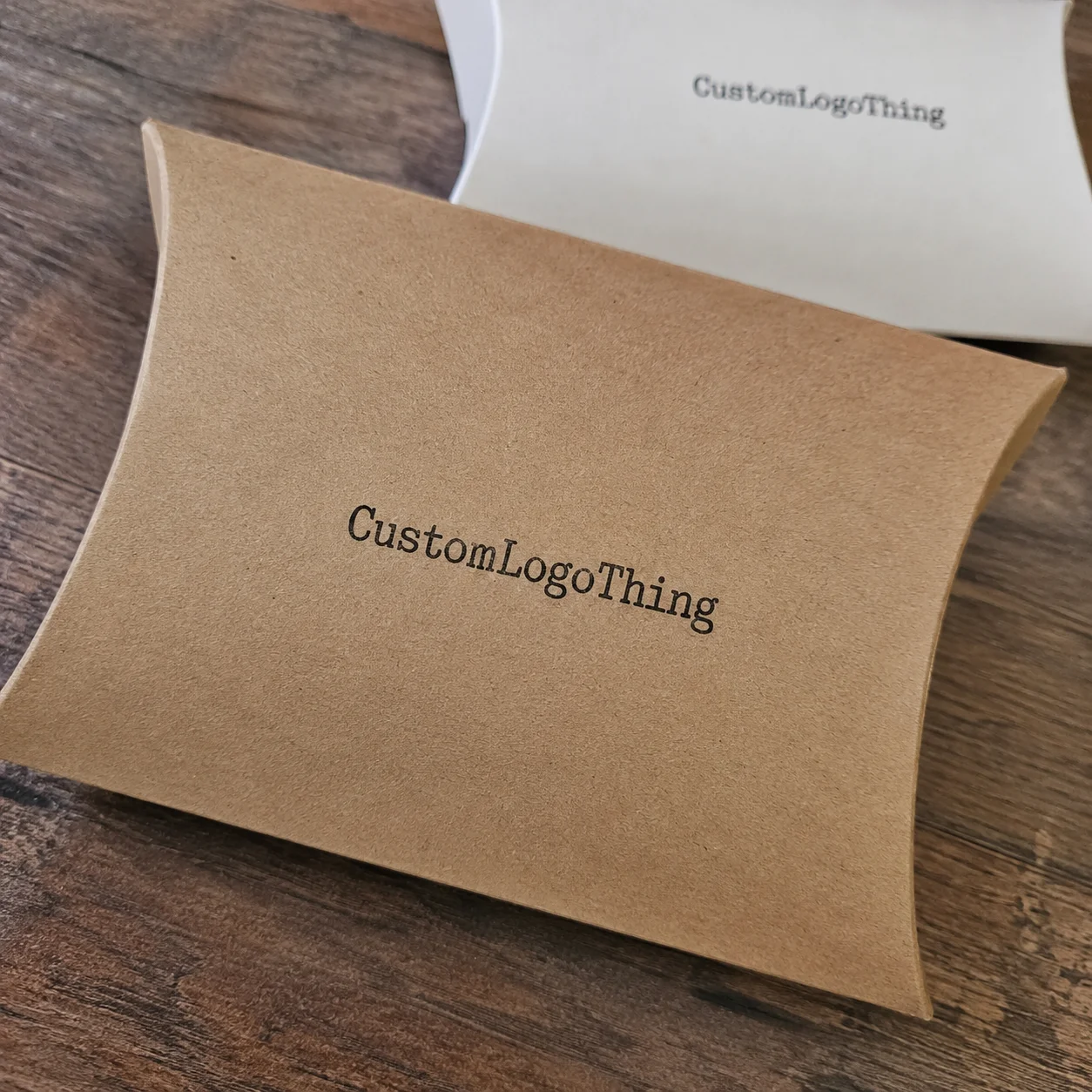
These boxes are lightweight folding cartons made from die-cut paperboard, scored fold lines, and curved tuck ends. The structure creates a rounded, belly-like shape that gives small products more presence without the storage bulk or unit cost of rigid packaging.
The build is economical for a reason. One flat board sheet is printed, cut to shape, creased, and closed with curved side flaps. No separate lid. No rigid base. No glued shoulder. That is why pillow boxes remain popular for Custom Retail Packaging, boutique gifts, apparel accessories, cosmetics, promotional kits, party favors, event giveaways, and product samples.
They work best for lightweight or moderately light products, often in the 30g to 300g range depending on box size, board weight, packout, and shipping method. A 250gsm kraft board may be fine for a soap sample or favor. A 350gsm SBS board with lamination makes more sense for a premium cosmetic set, jewelry accessory, or small apparel item that needs cleaner structure.
The limitation is less photogenic: pillow boxes are charming, not protective armor. Heavy, sharp, fragile, oily, or liquid-filled products usually need inserts, sleeves, padding, or a different carton style. A glass dropper bottle rolling around inside a curved paperboard carton is not a packaging strategy. It is wishful thinking with a logo on it.
Buyer rule: choose the box around product fit, presentation, shipping method, and order quantity. Print matters, but structure fails first.
If the product is being handed out at an event, the board can often be lighter. If it ships through parcel networks, test the full packout: pillow box, product, mailer or shipper, void fill, and any inserts. For shipping performance, standards from ISTA are useful because they focus on how packaging behaves during drops, compression, and vibration. Not glamorous. Very useful.
How the Pillow Box Structure Works Before Printing Starts
The folding mechanics are simple on paper. The carton is printed, cut, creased, shipped flat, and popped open by hand during packing. That flat shipping format saves freight and storage compared with rigid boxes, especially for orders in the 2,000 to 20,000 unit range where warehouse space starts pretending to be infinite.
Material choice drives stiffness, color, texture, and print quality. SBS paperboard gives a clean white surface and sharp print, commonly in the 300gsm to 400gsm range for small retail boxes. Kraft board gives a natural look, but bright colors look duller unless white ink is printed underneath. Recycled board can support sustainability targets, though surface smoothness, shade, and fiber consistency vary. Art paper or C1S board can work well for coated designs with heavier ink coverage.
Curved ends need accurate scoring. Poor scores create cracked ink, uneven flaps, fuzzy fold lines, and boxes that fight back during assembly. Very glamorous, obviously. On dark full-bleed artwork, cracking across a fold can look especially cheap, so grain direction, coating, scoring pressure, and prepress review matter more than many first-time buyers expect.
Sizing is not just length and width. You need length, width, depth, and usable inner space after the board curves inward. Measure the product at its widest, thickest, and most awkward point. Add room for tissue, hang tags, wrappers, inserts, cords, caps, and anything else packed with the item. Soft products like socks compress. Hard products do not care about your optimism.
- Length: the longest internal span available for the product.
- Width: the flat panel width before the curved sides close.
- Depth: the usable bulge created when the box pops open.
- Clearance: often 3mm to 8mm for small items, more for bulky, wrapped, or irregular products.
Add-ons are available, but each one changes cost and handling. Common options include hang tabs, ribbon holes, clear windows, foil stamping, spot UV, embossing, debossing, matte lamination, gloss lamination, and soft-touch finishes. For a broader look at printed formats beyond pillow packaging, review Custom Packaging Products before locking the structure.
Key Design Factors That Decide Whether the Box Looks Premium or Cheap
Good design starts with hierarchy. Your logo, product name, short benefit, compliance text, barcode, website, social handle, ingredients, and recycling mark should not all scream at the same volume. If everything is bold, nothing is bold. Retail shoppers scan quickly, so the front panel needs one clear job.
For most personalised pillow boxes, the front curved panel should carry the brand mark and product identity. Secondary details can sit on the back or side areas. Tiny text on curved surfaces is a common mistake because the curve reduces readability, especially under store lighting or in product photography.
Print coverage has tradeoffs. Full-bleed artwork looks rich, particularly with dark backgrounds, gradients, or illustrated patterns. It also increases the chance of visible fold cracking if the board, coating, grain direction, and scoring are not handled correctly. A lighter design with a border or unprinted fold zones can be more forgiving, though it may feel less dramatic.
CMYK is standard for most Custom Printed Pillow boxes. Pantone spot colors help when brand matching is tight, especially for corporate gifts, franchise programs, or retail assortments. Kraft board changes color behavior because brown paper absorbs and mutes ink. White ink underneath can help bright colors pop, but it adds another print pass and cost.
Finishes deserve buyer logic, not finish addiction. Matte lamination softens glare and gives a modern look. Gloss boosts color saturation and works well for bold graphics. Soft-touch lamination feels expensive but scuffs more easily in handling. Foil stamping adds a tactile cue and metallic contrast, but it requires a die and setup. Spot UV can highlight a logo or pattern; overuse turns clean packaging into a shiny argument.
| Option | Best Use | Typical Tradeoff |
|---|---|---|
| 300gsm SBS board | Light retail items, samples, cosmetics | Clean print, moderate stiffness |
| 350gsm to 400gsm SBS board | Premium gifts, jewelry, heavier accessories | Better structure, higher unit cost |
| Kraft board | Natural, handmade, eco-style brands | Muted color unless white ink is added |
| Foil stamping | Luxury logos, limited editions | Extra die cost and production pass |
| Clear window | Products shoppers need to see | Less print area and more recycling complexity |
Windows can build trust. A shopper buying soap, candy, socks, or a handmade accessory may want visual proof before purchase. The downside is reduced print area and a mixed-material structure if the window uses plastic film. If recyclability matters, review guidance from the EPA recycling resources and ask your supplier about window-free designs, cutouts without film, or removable window patches.
Dielines matter more than mockups. Build artwork around the actual template with bleed, safe zones, fold areas, glue areas if any, and barcode quiet zones. Do not stretch a square label design onto a pillow box at the last minute and call it branding. That is how logos land on folds and legal copy disappears into curves.
Cost, Pricing, and MOQ Factors to Check Before You Quote
Pricing depends on box size, board thickness, print coverage, number of colors, coatings, specialty finishes, window patches, inserts, quantity, packing method, and shipping destination. Anyone giving a single universal price without those details is guessing. Cute, but not useful.
Small custom runs have higher unit costs because setup time, dieline preparation, printing plates or digital setup, die cutting, finishing, and proofing are spread over fewer boxes. A 250-piece test run may cost several times more per unit than a 5,000-piece run. That does not automatically mean the supplier is overcharging. It means setup math exists.
As a practical range, a simple printed pillow box in a moderate size may land around $0.35 to $0.90 per unit at a few thousand pieces, depending on specs and freight. Larger boxes, low quantities, foil, soft-touch lamination, windows, or inserts can push that higher. Very small runs can exceed $1.50 to $3.00 per unit because the setup cost has nowhere to hide.
MOQ tradeoffs are real. A low MOQ is useful for testing a new product, subscription box insert, seasonal gift, or limited campaign. The per-box price often drops noticeably once production moves into more efficient quantities such as 1,000, 2,500, 5,000, or 10,000 units. Ask for quantity breaks instead of staring at one quote and hoping procurement magic appears.
Special finishes add cost because they require extra tooling, materials, or production passes. Foil stamping may need a metal die. Embossing and debossing need male and female dies. Spot UV requires a registered coating pass. Soft-touch lamination adds film and handling cost. Windows add film, patching, waste control, and sometimes slower production.
Do not compare quotes on unit cost alone. A cheaper quote may use thinner board, weaker coating, looser color control, no proofing, slower freight, or vague tolerances. If one supplier quotes 350gsm SBS with matte lamination and another quotes 300gsm recycled board with no coating, those are not the same box. Comparing them is decorative nonsense.
- Test run: 250 to 1,000 units for market checks, samples, or photography.
- Standard run: 2,500 to 5,000 units for active retail or ecommerce use.
- Bulk run: 10,000+ units when demand is predictable and storage is available.
For personalised pillow boxes, request at least two or three quantity breaks with the same specification. That shows where the price curve improves and whether ordering more actually saves meaningful money after storage, cash flow, and possible design changes are considered.
Process and Timeline: From Dieline to Delivered Boxes
The ordering process usually follows a clean sequence: share product dimensions, choose material and finish, receive the dieline, prepare artwork, approve a digital proof, approve a sample if needed, then move into production. Skip one of those steps and the risk simply moves downstream. It never disappears.
Custom packaging timelines depend on proofing speed as much as production speed. A buyer who takes five days to approve a dieline just donated five days to the calendar. Suppliers can only move after approvals are clear, especially if die cutting, foil, window patching, or sampling is involved.
A simple repeat order can often move through production in 7 to 12 business days after proof approval, plus freight. A first-time custom run with sampling may need 15 to 25 business days before shipping. Add foil, embossing, windows, unusual sizes, peak-season capacity, or overseas freight, and the schedule can stretch further. Not always, but often enough to plan around.
Typical stages include structural setup, artwork prepress, digital proofing, physical sampling if requested, print production, die cutting, finishing, folding or gluing if required, quality control, packing, and freight. Each stage has its own failure points. A barcode too close to a curve can fail scanning. A logo placed over a crease can crack. A window patch can shift if tolerances are loose.
Quality control should be specific, not ceremonial. Check color against the approved proof or swatch, confirm board weight and finish, inspect fold cracking, test closure strength, scan barcodes on finished boxes, and pack the real product into the carton. Pull samples from the start, middle, and end of the run when possible. Defects often arrive in clusters, not politely spaced one per carton.
Shipping choices change the calendar and the cost. Air freight is faster and pricier, often used for launches, events, or emergency replenishment. Sea freight is cheaper for bulk but slower and better suited for predictable reorder programs. Domestic warehousing can help if you reorder branded pillow packaging regularly and want shorter replenishment windows.
Order before seasonal peaks, product launches, weddings, holidays, trade shows, and subscription box deadlines. Packaging emergencies get expensive because physics remains rude. Ink still needs drying time. Dies still need setup. Freight still takes space on a truck, plane, or vessel.
Common Mistakes That Make Custom Pillow Packaging Disappointing
The biggest mistake is measuring only product length and forgetting depth, flex, accessories, inserts, or how the item behaves inside the box. A bracelet pouch, soap bar, charger cable, or cosmetic tube may measure neatly on a desk and still pack badly once tissue, labels, and hang tags are added.
Overloading a pillow box causes bulging flaps, weak closure, crushed edges, and a sad little package nobody wants on a retail shelf. If the side flaps are under constant tension, they will open, crease, or deform during handling. For heavier products, use a thicker board, internal sleeve, belly band, or a different carton style.
Another mistake is choosing board stock only by thickness. GSM matters, but stiffness, grain direction, coating, caliper, moisture content, and fold performance matter too. A 350gsm board that cracks badly at the curved ends may perform worse than a 320gsm board with better fiber structure and scoring behavior.
Artwork mistakes are easy to avoid and weirdly common. Tiny text on curved panels. Logos placed across fold lines. No bleed. Low-resolution images. Rich black builds that look muddy. Barcodes too small or distorted. If your artwork file is 72 dpi because someone pulled it from a website, do not expect crisp retail print. Printers are skilled, not magical.
Finish overload is another trap. Foil plus spot UV plus embossing plus a window can look premium, or it can look like the box lost a fight with a craft store aisle. Pick one hero finish and let the structure breathe. A clean logo foil on matte white board often looks better than five effects competing for attention.
Assembly time also matters. A beautiful box that takes 45 seconds to fold can quietly wreck packing labor costs. If your team packs 1,000 units, that is 12.5 labor hours just folding boxes at 45 seconds each. At 12 seconds each, it is 3.3 hours. The box did not get cheaper if labor ate the savings.
For ecommerce, test the complete shipper. Personalised pillow boxes can act as primary presentation packaging, but they may still need a mailer, corrugated shipper, void fill, or protective insert. A retail-ready box arriving crushed inside a thin poly mailer is not a branding moment. It is a return request warming up.
Ordering Boxes That Fit, Print, and Ship Properly
Start with the product, not the artwork. Measure the item, decide the packing method, confirm the sales channel, choose the material, pick the finish level, and define the order quantity. That sequence prevents the classic mistake of designing a beautiful package for a product that does not fit.
Prepare brand assets before requesting a quote. Send vector logo files, color codes, final copy, barcode, compliance marks, product photos, and retailer requirements if the item goes into stores. If you sell cosmetics, food-adjacent products, candles, or children’s items, confirm labeling rules before artwork approval. Redesigning after proofing is a tidy way to burn time and money.
Send practical details: internal product dimensions, target outer size if known, quantity range, board preference, finish preferences, delivery location, deadline, and reference photos. If you already use other formats from Custom Packaging Products, share those specs so the new box aligns with your current packaging system.
Request a dieline before final artwork. For unusually shaped, premium-priced, fragile, or retail-bound products, request a physical sample. A digital proof checks print placement. A physical sample checks fit, folding behavior, closure strength, hand feel, and whether the carton looks good under real light.
- Measure the product at its longest, widest, and thickest points.
- Add clearance for wrappers, inserts, tissue, tags, and accessories.
- Choose board weight, usually 300gsm to 400gsm for many small retail uses.
- Pick one or two finish upgrades only if they support the brand.
- Ask for quantity breaks with identical specs and shipping terms.
- Approve the dieline, proof, and sample before full production.
Compare quotes by specification, not vibes: same board, same size, same finish, same quantity, same proofing level, same shipping terms. If one quote includes air freight and another excludes freight entirely, the cheaper quote is not cheaper. It is incomplete.
The best personalised pillow boxes do not win because they are the fanciest. They win because the product fits, the folds stay clean, the print lands where it should, the packing team can assemble them quickly, and the final package survives the sales channel it was built for. Check those details together, and the curved little carton does its job. Ignore them, and it becomes an expensive print problem with two tuck flaps.
FAQ
What products fit best in personalised pillow boxes?
They work best for lightweight or moderately light items such as jewelry, soaps, small cosmetics, socks, gift cards, candles, party favors, samples, and promotional gifts. Avoid using them alone for heavy, sharp, glass, or leak-prone products unless you add inserts, padding, sleeves, or a stronger outer shipping carton.
How do I measure my product for custom pillow boxes?
Measure the product at its longest, widest, and thickest points, then include extra room for wrappers, inserts, tissue, hang tags, or any accessory packed with it. Send the actual product or a 3D reference to the supplier when the shape is curved, soft, bulky, or inconsistent.
Are custom pillow boxes expensive compared with regular folding cartons?
They can be cost-effective because they ship flat and use relatively simple paperboard construction, but custom size, specialty finishes, windows, and low quantities raise the unit cost. Ask for multiple quantity breaks so you can see whether ordering more meaningfully lowers the price instead of guessing.
What is the usual lead time for printed pillow boxes?
Lead time depends on artwork readiness, sample approval, production complexity, order size, and shipping method. Simple repeat orders may take 7 to 12 business days after proof approval, while first-time orders with sampling, foil, embossing, windows, or overseas freight need more planning time.
Can personalised pillow packaging be recyclable?
Paperboard pillow boxes can often be recyclable when they use standard inks and coatings, but plastic windows, heavy lamination, foil, and mixed materials may complicate recycling. If sustainability matters, ask for recycled board, water-based coatings, soy-based inks, minimal lamination, and window-free designs where possible.