A 2-ounce bracelet, handmade soap bar, gift card, or lip balm set can look premium or forgettable because of a few square inches of paperboard. That is the appeal of custom printed pillow boxes: they give small products a finished retail shape without the cost, bulk, or storage problems of rigid packaging.
The format is simple. A pillow box is a folding carton with a bowed front and back, curved side flaps, and tuck-in ends. Most ship flat, assemble by hand, and require no glue during packing. For small brands, that storage math can matter as much as the artwork. Five hundred flat cartons fit where a few cases of pre-formed boxes would quickly crowd a stockroom.
The design looks soft. The buying process is not. Size, board grade, print method, finish, tolerance, and timeline all decide whether the final box feels polished or becomes a slow, expensive packing problem.
Custom Printed Pillow Boxes: What They Are and When They Work Best
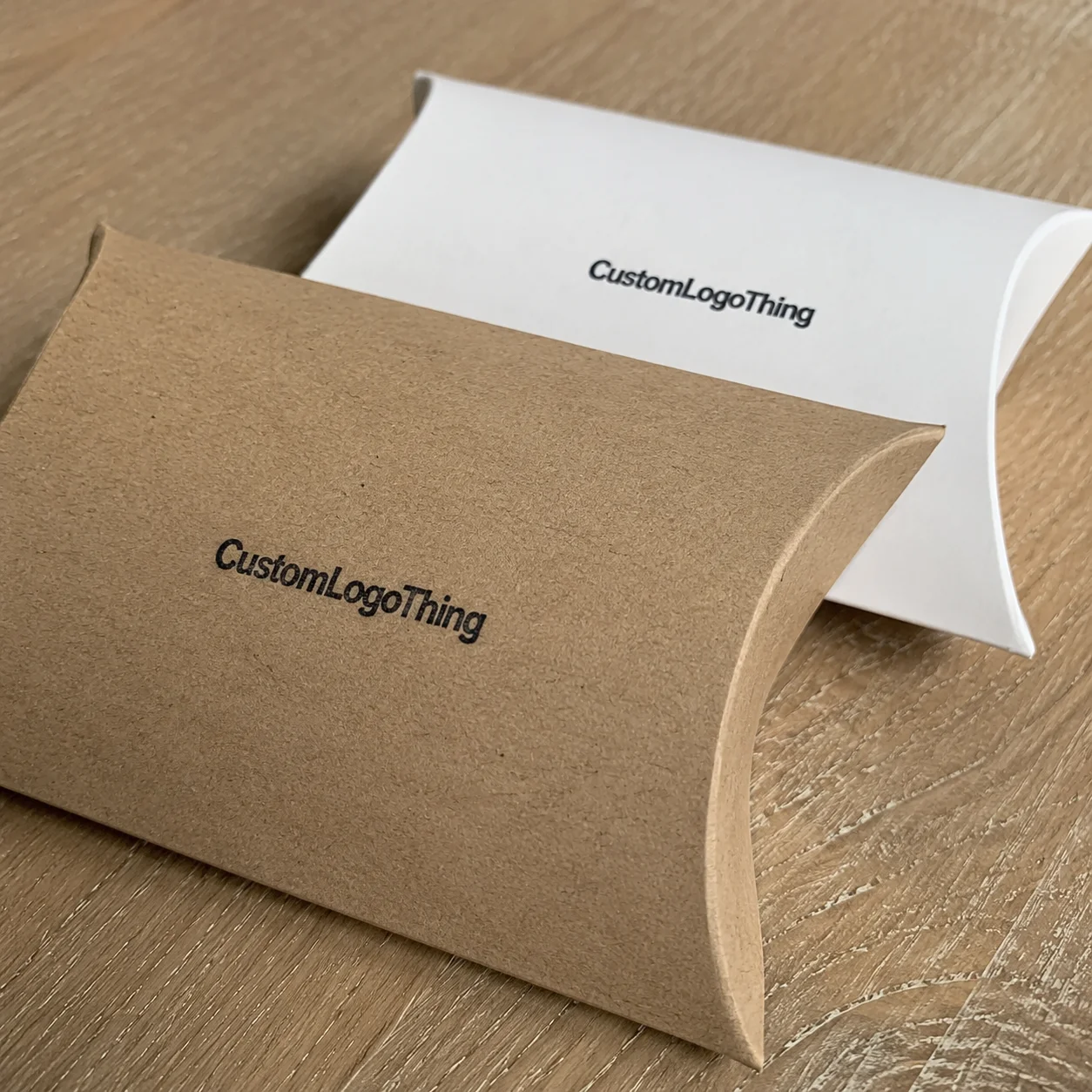
Custom printed pillow boxes are a style of folding carton, not just a decorative gift box. Their curved structure creates more dimension than an envelope or product card while using less material than many two-piece cartons. That makes the format useful for brands that need visibility, color, and logo placement but do not need a heavy protective box.
The shape works especially well for jewelry, soaps, cosmetics, candles, small apparel accessories, party favors, subscription inserts, promotional products, and gift cards. A lip balm set in 300gsm to 350gsm SBS paperboard can feel clean and retail-ready. A pair of earrings in kraft stock with one-color ink can feel handmade without looking unfinished. Same structure. Different signal.
There are limits, and they matter. Pillow cartons are usually not the best first choice for heavy, fragile, liquid, sharp-edged, or irregular products unless the design includes an insert, sleeve, pouch, wrap, or outer shipper. A glass vial rolling inside a loose pillow box is not premium packaging. It is a damage claim with nicer graphics.
Packaging buyer reality check: the strongest order is not the prettiest mockup. It is the one where product size, board grade, print method, quantity, and timeline agree before production starts.
Small folding cartons punish guesswork. A box can look excellent on screen and still fail in packing if the tuck ends fight the product, the barcode curves too far around the panel, or the board is too thin for the product weight. Good branded packaging starts with structure. Artwork comes next.
How Pillow Box Structure, Materials, and Printing Actually Work
The dieline is the map. It usually shows the front panel, back panel, curved side flaps, tuck ends, cut lines, fold lines, bleed, and safe zones. Some larger pillow boxes also use a glue seam or pre-glued sleeve construction to speed assembly. If a logo, QR code, barcode, or compliance line crosses a crease, the press may print it correctly and the folded box may still read poorly.
Material choice changes both appearance and performance. SBS paperboard is common for crisp retail packaging because its smooth white surface supports strong color coverage. Kraft board gives a natural look but mutes bright inks. Recycled board can support lower-virgin-fiber goals, though color and surface consistency may vary from batch to batch. Coated stock helps full-bleed artwork look sharper, especially on designs with dense color or gradients.
Thickness is often listed as points, gsm, or caliper. A small jewelry, soap, or cosmetic carton may use 300gsm to 350gsm board. Slightly heavier accessories may need 400gsm or a higher-caliper grade, depending on the carton size and folding stress. Thicker is not automatically better. If the stock is too stiff, curved flaps can crack, resist closure, or spring open after packing.
Printing method follows quantity, artwork complexity, and color expectations. Digital printing is practical for short runs, multiple SKUs, market tests, and seasonal packaging. Offset printing usually offers tighter color control and stronger unit economics as volume rises, often once the order reaches a few thousand units. Flexographic printing can be efficient for simpler high-volume work, especially when the artwork does not depend on fine photographic detail.
Finishes add cost, feel, and risk. Matte lamination reduces glare. Gloss coating increases shine and color pop. Soft-touch coating can feel expensive, but dark soft-touch surfaces may show scuffs quickly. Spot UV, foil stamping, and embossing draw attention to logos or patterns, although each adds setup work and production time. Aqueous coating is often a sensible middle ground for light protection without complicating recycling claims as much as some film laminations can.
Curved panels distort perception. Centered logos, thin borders, tiny type, and symmetrical patterns need more conservative placement than they would on a rectangular folding carton. A 3 mm safe zone may be acceptable on a flat panel, but pillow boxes often benefit from 5 mm or more around folds and curved ends. Borders are especially unforgiving because normal die-cutting movement can make a perfect file look off-center in real life.
Key Specs That Decide Whether the Box Fits, Folds, and Sells
Start with the product, not the catalog size. Measure the finished item at its longest, widest, and deepest points. Then measure it again with any wrap, card, pouch, tissue, insert, or protective sleeve included. A quarter inch can decide whether packers move quickly or fight every tuck end for an entire shift.
Internal dimensions describe the usable product space. External dimensions affect fulfillment bins, shelf trays, master cartons, and freight cost. Buyers often focus on the inside because fit feels urgent. Operations teams care about the outside because 500 or 5,000 cartons that miss a shipper configuration can raise shipping costs or reduce pallet efficiency.
Movement inside the carton deserves attention. Too tight, and the product crushes corners, bends the bowed panels, or slows assembly. Too loose, and it rattles, which weakens the unboxing experience. For small product packaging, a modest tolerance is usually better than a compression fit. The correct allowance depends on product shape, board thickness, insert design, and whether the item should slide out easily or stay snug during retail handling.
Artwork priorities should be ranked before design begins. Decide what needs to be seen first: logo, product name, scent, shade, size, ingredient copy, barcode, opening instruction, recycling mark, social handle, or retailer-required symbol. A small curved carton does not have unlimited real estate. If every element becomes primary, the package starts shouting.
Color management is where small assumptions become expensive. Pantone references can help protect brand color, but the final result still depends on paperboard, coating, ink density, and print method. CMYK conversion may shift saturated tones. Kraft board will mute bright colors. Coated SBS usually keeps them cleaner. If the pillow box will sit beside other Custom Packaging Products, ask whether the same color system, stock family, and finish can be used across formats.
Barcodes need a flat, quiet zone. Place them on the flattest practical panel, away from tight curvature, folds, foil, heavy texture, and high-gloss effects that can interfere with scanning. For retail use, test a printed sample with the scanner type used by the store, warehouse, or fulfillment partner whenever possible. A beautiful box that fails scan tests is not finished packaging. It is a delay with good art direction.
Small specification errors travel through the whole supply chain. A slightly oversized carton may require a larger shipping case. A weak board may increase dents. A poor fold can slow packing speed from hundreds of units per hour to a manual workaround. The cost rarely appears on the first quote, but it shows up later in labor, freight, rework, and damaged inventory.
Cost, Pricing, and MOQ Factors Buyers Should Compare
The unit cost of custom printed pillow boxes is driven by quantity, size, board grade, print coverage, number of colors, finishing, tooling, proofing, packing method, and delivery location. A quote is not just “box price.” It bundles setup, materials, press time, die cutting, finishing, labor, waste allowance, packing, and freight.
MOQ means minimum order quantity. Suppliers set minimums because setup exists whether the order is 250 units or 25,000 units. A press still needs calibration. A die still needs to cut cleanly. A proof still needs review. Cartons still need to be counted, packed, and shipped. That fixed work is painful at very low quantities, which is why short-run pricing can look surprisingly high.
| Order Scenario | Typical Best Fit | Cost Pattern | Watch For |
|---|---|---|---|
| 250 to 500 units | Digital print, simple finish | Higher unit cost, lower entry spend | Limited finishes, fewer stock choices, sample cost |
| 1,000 to 2,500 units | Digital or offset, depending on artwork | Better setup absorption | Color consistency between reorders |
| 5,000 units and above | Offset or flexographic production | Lower unit cost if setup is justified | Freight, storage, forecast accuracy |
| Premium gift run | Foil, embossing, soft-touch, thicker board | Higher unit and tooling cost | Longer approvals and slower finishing |
For a small printed run, pricing may feel high at 500 units because setup is spread across too few boxes. At 5,000 units, the unit price may drop sharply if the design is stable and freight is efficient. For a compact pillow carton, a realistic quote might range from roughly $0.18 to $0.75 per unit depending on size, coverage, finish, quantity, and shipping. That range is broad for a reason. A one-color kraft box and a foil-stamped soft-touch carton are not the same product.
Ask for tiered pricing at 500, 1,000, 2,500, and 5,000 units. Volume breakpoints reveal more than a single quote. Sometimes 1,000 units is the awkward middle ground and 2,500 units is only modestly more expensive overall. Other times, limited storage or uncertain demand makes the smaller run smarter even at a higher unit cost.
Check hidden variables line by line. Dieline creation, physical samples, rush fees, foil dies, embossing dies, specialty coatings, freight, duties, warehousing, and reorder storage can all change landed cost. The cheapest quote may use thinner board, exclude delivery, skip physical proofing, or require extra labor on the packing line. That is where many “savings” quietly disappear.
If you are comparing several styles of Custom Packaging Products, normalize the quotes. Ask each supplier to price the same material, quantity, print coverage, finish, delivery location, proofing route, and packing method. Otherwise, you are comparing assumptions rather than suppliers.
Process and Timeline: From Dieline to Delivered Boxes
A typical workflow starts with product measurement, then moves to dieline creation, artwork placement, digital proof, optional physical sample, production approval, printing, die cutting, finishing, packing, and delivery. The sequence looks tidy on paper. Real delays usually come from missing inputs, late artwork changes, material substitutions, or approvals sitting untouched for several days.
Buyers control more of the timeline than they may realize. Send final product dimensions, product weight, vector logos, barcode files, Pantone references, final copy, retailer rules, and shipping requirements early. If a supplier has to chase a missing QR destination, updated warning statement, or revised scent name after proofing, the schedule stretches.
Digital proofs check layout, content, dieline placement, and general color expectation. They do not prove material feel, folding behavior, or real product fit. A physical sample does. For a first run of custom printed pillow boxes, sampling is often worth the extra time, especially if the product is oddly shaped, the artwork includes tight borders, or the finish is central to the brand experience.
Many standard jobs take about 10 to 20 business days after proof approval, though that window can lengthen for foil stamping, embossing, custom dies, special board, complex coatings, or peak seasonal capacity. Freight adds its own clock: a few days for many domestic shipments, much longer for overseas production and ocean shipping. Treat every estimate as conditional until artwork, materials, quantity, proofing route, and delivery method are locked.
Build internal approval time into the schedule. Legal, compliance, retail buyers, finance, founders, and design teams all look for different risks. One group may care about warning copy. Another may care about color. Another may care about case pack. If the packaging supports a launch, event, subscription drop, or retail reset, work backward from the in-hand date rather than the ship date.
Quality control should not wait until cartons arrive. Ask how the supplier checks color, die-cut registration, fold accuracy, glue seam strength if applicable, coating consistency, and carton count per case. For a live job, sensible checkpoints include approved proof, first-article review for complex work, and inspection before shipment. Even basic photos of packed cartons, case labels, and finished boxes can catch avoidable mistakes.
For transit testing, standards from ISTA can help frame how the packed system should perform. A pillow carton alone is rarely the full protection plan; it usually sits inside a shipper, tray, or master case. ASTM paper and paperboard test methods are also commonly referenced in packaging development, especially for strength, stiffness, and material behavior.
Common Ordering Mistakes That Create Waste, Delays, or Reprints
The most expensive mistake is approving artwork before confirming the final product size, insert plan, or bundle configuration. It happens often. The product team adds a card. Marketing adds tissue. Retail asks for a warning label. Suddenly the carton that looked perfect is tight, distorted, or legally incomplete.
Grain direction and fold behavior also matter. Paperboard folds more cleanly in one direction than another. Ignore that, and curved pillow ends may crack, warp, or refuse to close neatly. Dark ink across fold lines can make cracking more visible. Soft-touch finishes can highlight scuffing. None of these details sound dramatic until thousands of units arrive with stressed edges.
Tiny text is another trap. Ingredient copy, compliance language, and recycling marks must remain readable after printing, folding, and handling. Thin borders can look misaligned because die cutting has normal movement tolerances, often around 1 mm to 2 mm depending on equipment and job conditions. On a curved box, that tiny shift can become obvious.
Over-design can damage the result as much as under-design. Foil plus embossing plus spot UV plus heavy ink plus specialty coating may make a small carton feel busy rather than premium. Each finish should earn its place. If a foil logo improves shelf impact, use it. If three finishes only decorate a weak hierarchy, fix the design hierarchy first.
Sustainability claims need precision. Recycled, recyclable, compostable, and FSC-certified mean different things. A box made with recycled board may not be recyclable in every local system if it uses incompatible coatings, films, adhesives, or metallic decoration. FSC certification requires chain-of-custody documentation, not just a tree icon. The Forest Stewardship Council explains certification requirements for brands that need documented sourcing claims.
Fulfillment mistakes are less glamorous and often more expensive. A box can look good individually and still slow packers, fail barcode scans, waste master-carton space, or stack poorly in retail trays. Ask how many assembled boxes fit in a shipper. Ask how long assembly takes. Ask whether the tuck ends stay closed after repeated handling. Those questions decide whether the design works outside the photo set.
Next Steps Before You Request a Sample or Place an Order
Before requesting a quote for custom printed pillow boxes, gather the practical facts. Suppliers can price faster and more accurately when they are not guessing. At minimum, prepare product dimensions, product weight, target quantity, material preference, print coverage, finish ideas, delivery zip code, and required in-hand date.
- Product details: finished length, width, depth, weight, inserts, wraps, and tolerance needs.
- Brand assets: vector logo, outlined fonts, Pantone colors, barcode, QR destination, and final copy.
- Order assumptions: quantity tiers, launch date, delivery location, storage limits, and reorder expectations.
- Design direction: preferred board, ink coverage, finish, opening style, and required compliance marks.
- Retail needs: scanner placement, shelf orientation, case pack, and buyer packaging rules.
Choose one primary goal before design begins. Lower unit cost, stronger shelf impact, faster packing, lower material use, and a more premium gift feel are all valid goals. They are not always compatible. A low-cost kraft carton with one-color ink is a different decision than a coated SBS box with foil and embossing. Both can work. They solve different problems.
Ask the manufacturer for the dieline, proofing route, production lead time, quote tiers, shipping estimate, and reorder expectations in one conversation. If you are comparing pillow cartons against sleeves, mailer inserts, or other custom printed boxes, review all formats together under Custom Packaging Products so the brand system stays consistent.
Measure the product. Choose the use case. Compare quote tiers. Approve the proof. Then order only after the structure and artwork have both been checked against the real item. That extra discipline is not bureaucracy; it is how small cartons become reliable retail packaging instead of attractive waste.
FAQs
What products fit best in custom pillow box packaging?
Lightweight, compact products work best, including jewelry, soaps, cosmetics, gift cards, small apparel accessories, favors, and promotional items. Heavy, breakable, liquid, or sharply shaped products may need an insert, inner wrap, or a different box style for protection.
How do I measure products for custom printed pillow packaging?
Measure the finished product at its widest, longest, and deepest points, then include any wrap, pouch, insert, or product card that will go inside. Share product weight and explain whether the item must sit snugly, slide out easily, or have extra room for tissue or marketing inserts.
What affects the price of printed pillow boxes the most?
Quantity, box size, paperboard grade, print method, ink coverage, coatings, foil, embossing, sampling, tooling, and shipping all affect pricing. Ask for tiered quotes because the best unit cost often appears at a higher quantity once setup costs are spread across more boxes.
How long does it take to produce custom pillow boxes?
Timeline depends on artwork readiness, proof approvals, material availability, finishing complexity, production capacity, and shipping method. Build extra time for physical samples, color matching, foil or embossing dies, retailer approvals, and seasonal demand spikes.
Can custom printed pillow boxes be eco-friendly?
Yes, options may include recycled board, kraft paperboard, FSC-certified stock, aqueous coatings, soy-based inks, and right-sized construction to reduce material use. Avoid vague sustainability claims; confirm recyclability, coating compatibility, certification needs, and local disposal realities before printing claims on the box.