Personalized Baking Boxes: Buy Smarter for Custom Treats
Personalized baking boxes do more than hold a brownie, a cookie assortment, or a mini loaf. They tell the customer how to read the product before the first bite. A plain carton says the item is being transported. A well-built printed box says the product has been considered, presented, and priced with intention.
Buyers sometimes focus too hard on unit cost and not enough on what the package does at the counter, in a delivery bag, or under store lighting. Packaging changes how fresh, premium, and gift-ready a product appears, and that effect can be just as real as the recipe itself. For bakeries that sell in retail, at markets, or through local delivery, the box is part of the margin. It affects perceived value, breakage, and repeat purchase behavior in ways that show up quickly.
There is also a practical side that tends to get overlooked. A box that closes well, stacks cleanly, and survives grease or steam is easier for staff to use, easier for customers to carry, and less likely to cause complaints. The best packaging is rarely flashy for its own sake. It feels appropriate to the product and reliable in the hand.
Why personalized bakery packaging changes the customer experience
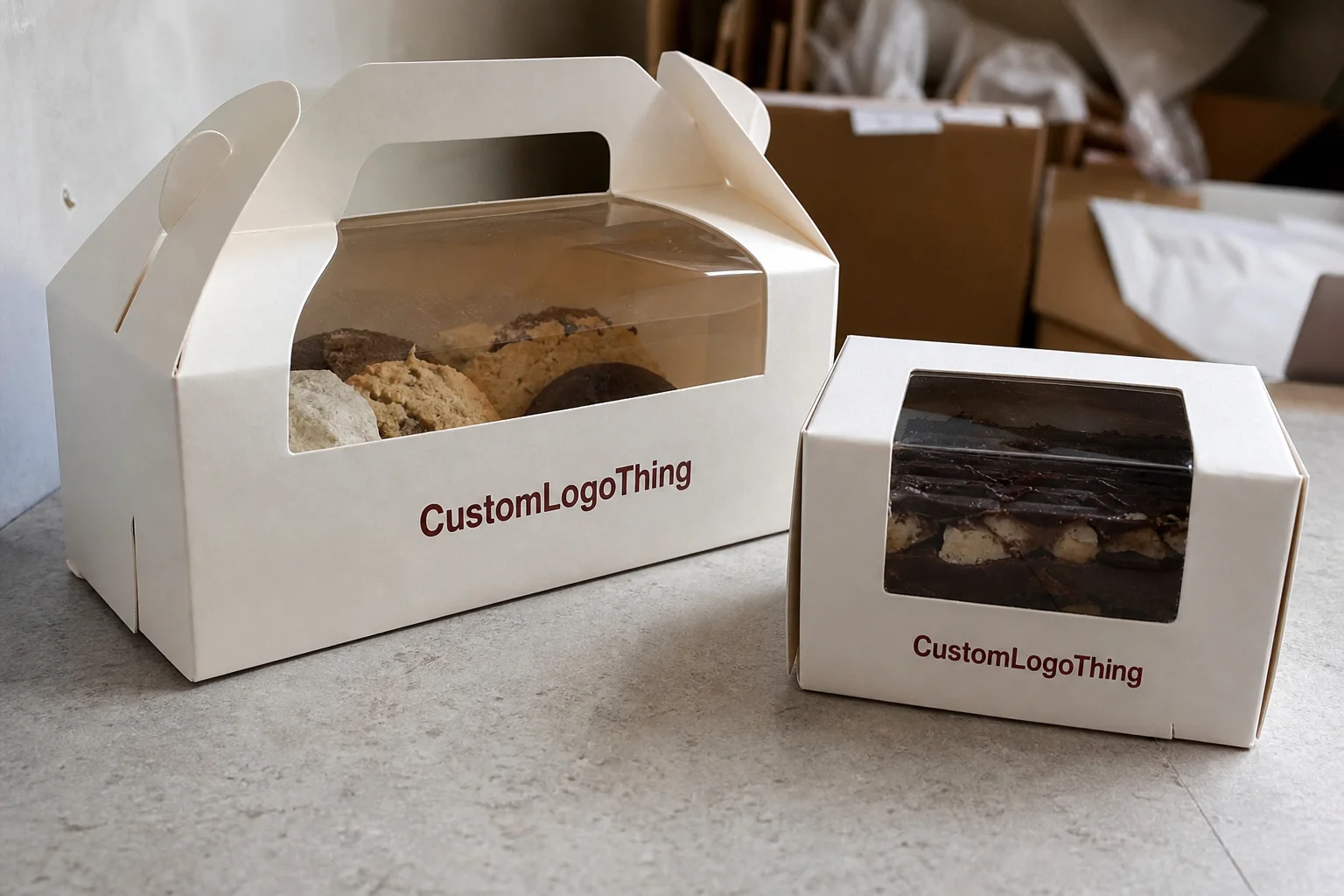
Packaging is part of the product experience, not an accessory. When someone receives cookies or pastry in personalized baking boxes, they are making quick judgments about quality, freshness, and price fairness. Those judgments happen before the lid opens, which is why surface finish, print clarity, and structure matter more than many new buyers expect.
A bakery box has to do several jobs at once. It needs to protect the item, present the brand, and make handling feel easy rather than awkward. Those goals can conflict. A heavy rigid box may look impressive, but if the product is a simple counter sale, the added freight and storage costs may not make sense. A lightweight folding carton may be efficient, but if the print is muddy or the top flaps do not close squarely, the brand loses polish.
For cookies, brownies, cupcakes, and small pastries, shelf appeal often comes down to small details. Straight edges, accurate color, a logo placed where the eye lands first, and an insert that keeps products from leaning all signal care. That matters on social media too, though the bigger point is more basic: people trust food that looks handled with precision.
In many bakeries, better packaging supports a higher menu price without feeling forced. That is especially true for seasonal assortments and gift items, where the customer is buying presentation as much as flavor. A box that looks designed rather than generic can make the product easier to sell at a premium, even when the ingredients themselves are unchanged.
“If the box looks rushed, the product feels rushed. Customers rarely separate the two.”
How the customization process works from artwork to delivery
The ordering process is usually straightforward, but the details matter. It starts with the box style, then moves to dimensions, board selection, print coverage, and closure type. Only after that should the artwork be finalized. Skipping those steps tends to create reproofs, fit issues, or packaging that looks nice on screen and fails in pack-out.
Good suppliers will ask for product dimensions, finished weight, how many pieces go into each box, and whether the item is oily, frosted, warm, or fragile. Those questions are not paperwork. They determine whether the box needs a grease-resistant coating, a stronger board, a divider, a window, or a more secure lock. A cookie box and a macaron box may both be “bakery packaging,” but they are not the same job.
The artwork phase should happen with a usable dieline in hand. Send vector logo files, approved brand colors, and any required text such as allergen information, ingredients, or handling notes. If the box will touch food directly, the supplier also needs to confirm food-safe construction or an internal barrier. That is the point where many projects slow down, because buyers assume the print file is enough. It usually is not.
Proofing should include both visual review and structural review. A digital proof confirms layout, typography, and panel placement. A physical sample confirms whether the product actually fits and whether the box opens, closes, and stacks the way the team expects. Those are different checks. A package can look clean in PDF form and still be awkward in a real store setting if the lid resists closure or the insert shifts by a few millimeters.
For buyers comparing packaging styles across product lines, the Custom Packaging Products catalog is a useful place to review different structures, board types, and finishing options before narrowing the spec.
Materials, finishes, and inserts that affect performance
Material choice affects print quality, crush resistance, grease handling, and shipping performance. For lighter bakery items, SBS paperboard or coated food-grade paperboard is common because it prints sharply and folds cleanly. For heavier products, multi-pack assortments, or shipped orders, corrugated board offers better compression strength. Kraft board can work well for rustic branding, but buyers should expect some color shift because the brown surface changes how ink reads.
The right board depends on the product, not the branding mood board. A warm pastry with butter on the surface needs different protection than a dry cookie. If the box will be carried in a paper bag for ten minutes, that is one thing. If it will move through parcel shipping, refrigerated storage, or a long pickup line, that is another. Heat, moisture, and stack pressure all matter more than the logo treatment.
Finishes shape how the box feels and how long it keeps looking clean. Matte coating gives a calmer, more bakery-forward look. Gloss can make colors pop and is often easier to wipe. Soft-touch lamination feels upscale, but it adds cost and can complicate recyclability depending on the build. Foil stamping and embossing are strong tools when used with restraint. They work best as accents, not as a blanket solution across every panel.
Windows are useful when the product itself is part of the selling point. Decorated cookies, frosted pastries, and colorful assortments benefit from visibility. The tradeoff is protection. A window opens the box visually, but it also introduces questions about dust, condensation, and whether the pack still feels neat after handling. If the dessert is delicate or highly decorated, the safer choice may be a closed box with strong print rather than a large window cutout.
Inserts often determine whether the customer receives a pristine product or a damaged one. A simple divider or molded insert can keep cupcakes from leaning, keep macarons from sliding, and stop tartlets from colliding in transit. Many box failures are not outer-box failures at all. They are pack-out failures. The carton survives, but the decoration inside does not.
Sustainability claims should be handled carefully. Paper-based packaging is often recyclable, but mixed materials, heavy lamination, foil-heavy finishes, and plastic windows can complicate disposal. FSC-certified paperboard is worth asking for if responsible sourcing matters to your brand, and certification should be traceable rather than assumed. For transport testing, packaging teams often look to FSC standards for fiber claims and ISTA test standards when evaluating how a box handles drops, vibration, stacking, and parcel movement.
Personalized baking boxes cost, MOQ, and quote factors
Pricing can be misleading if the quote is not fully specified. Two boxes with similar-looking artwork may have very different costs once the structure, coating, insert, and freight are accounted for. The main drivers are size, board thickness, print coverage, number of colors, finishing complexity, and quantity. Order quantity often matters more than buyers expect, because setup costs get spread across fewer or more units.
For simple paperboard builds, short-to-mid runs may fall around $0.18 to $0.28 per box at roughly 5,000 pieces, though the number can move up fast if the design uses specialty coatings, more complex structures, or inserts. Smaller runs generally cost more per unit because press setup, die cutting, and proofing do not shrink proportionally. That is normal, not a sign that the quote is inflated.
The minimum order quantity, or MOQ, shapes the entire buying decision. A higher MOQ often lowers the unit price, but it also increases inventory risk and storage needs. For a bakery that refreshes packaging often or runs seasonal designs, a smaller run with a slightly higher unit price may be the better operational choice. A cheap box that sits in storage for a year is not cheap.
Buyers should also look for hidden costs. Tooling, plates, samples, inserts, freight, special coatings, and rush fees may not appear in the first number handed over. If the quote seems unusually low, check whether it includes the same board, same finish, same print coverage, and same box style you actually need. A window box is not comparable to a closed carton, and a flat printed sleeve is not the same as a fully converted folding box.
| Option | Typical use | Cost pressure | Strength | Notes |
|---|---|---|---|---|
| Plain bakery carton | Basic counter sales | Low | Simple and efficient | Limited branding impact |
| Printed paperboard box | Retail, gifting, pickup orders | Moderate | Strong visual branding | Best balance for most bakeries |
| Rigid gift box | Premium assortments, seasonal gifts | High | High-end presentation | Higher freight and storage needs |
| Box with insert | Cupcakes, macarons, fragile items | Moderate to high | Better product protection | Worth it when breakage is a real risk |
Comparing quotes line by line is the only reliable method. Same dimensions. Same board. Same finish. Same print coverage. If one supplier is quoting a lower price on a structurally lighter box, the difference may disappear once product damage or rework is considered. Packaging costs should be evaluated on landed cost and performance, not just the printed unit number.
Production steps and turnaround: what to expect after you approve the proof
After proof approval, production usually moves through file setup, printing, converting, finishing, inspection, and packing. If the order includes foil, embossing, or specialty coatings, each of those steps adds complexity. The process is not mysterious, but it is sequential, and one delayed step can push everything behind it.
Lead time depends on order size, material availability, and plant load. Many Custom Bakery Box projects finish in about 12 to 15 business days from proof approval before freight, though that can stretch during peak seasons. Holiday orders, spring launches, and event-driven runs all compete for the same production windows. When stock boards are tight, suppliers may have to offer substitutions or longer timelines. That is worth clarifying early.
Rush work exists, but it narrows the room for correction. Faster schedules can mean fewer finish options, tighter approval windows, and higher freight costs. They also leave less margin for artwork mistakes. If the box is meant to support a product launch or a holiday promotion, a modest buffer is usually the safer operational choice.
Shipping and packing are part of the final cost, not an afterthought. A box that is inexpensive to make can still be expensive to move if it is bulky, rigid, or poorly nested. Ask how many cartons fit per case, how the boxes are packed flat or assembled, and whether pallet configuration changes the freight class. Those details affect warehouse planning as much as they affect the invoice.
A step-by-step ordering checklist for bakery owners
Start with the product, not the design. Measure the finished item, record its weight, and note whether it is fragile, greasy, warm, or meant for shipping. A bakery box is sized around the real item, not a rough estimate. If the box holds multiple pieces, count them in the final configuration, because spacing and inserts change the internal dimensions.
Then select the structure that fits the use case. Tuck-top boxes are practical for many bakery items. Sleeves can work well over trays or wraps. Gable boxes are strong for grab-and-go gifting. Two-piece boxes suit a more premium presentation. Window boxes help when the product is visually strong enough to carry itself. The right structure depends on how the item is sold, stored, and handed over to the customer.
Artwork should be prepared with production realities in mind. Confirm bleed, safe zones, image resolution, and whether the print will be full color, spot color, or a more restrained treatment. If your brand colors are specific, send Pantone references. Just keep in mind that coating, substrate, and finish all affect the final appearance. A color that looks exact on a monitor can shift once printed on kraft or coated board.
A disciplined checklist helps prevent rework:
- Confirm dimensions, weight, and product count per box.
- Select the structure and board type.
- Decide on finish level and any insert requirement.
- Prepare print files and brand references.
- Request a sample or prototype.
- Test pack-out behavior with actual product.
- Approve the final proof only after checking fit and readability.
That sequence saves time because it catches problems before they become inventory. With personalized baking boxes, the right order is product first, packaging second, and graphics third. If the box fits well and protects the item, the design has a better surface to work with.
Common mistakes that raise costs or hurt shelf appeal
The most common mistake is choosing a box because it looks attractive in a mockup. Mockups do not show crush performance, grease resistance, or closure behavior. If the box sags, pops open, or stains too easily, the visual win disappears fast. Damage and returns cost more than most buyers budget for.
Another frequent problem is overdesign. A crowded layout, too many typefaces, or excessive foil can make the box feel less refined rather than more premium. Often, a cleaner front panel and a controlled color palette do more to support the product. The packaging should help the baked item feel considered, not compete with it for attention.
Storage is easy to underestimate too. Large custom runs take space, especially if the boxes are rigid or packed in bulk cartons that do not nest efficiently. If you store packaging on-site, ask for case count, carton dimensions, and pallet configuration before placing the order. Otherwise the packaging can quietly become a storage problem.
Artwork errors create another avoidable source of delay. Missing font outlines, low-resolution images, unclear color references, or copy changes late in the schedule can force a reproof. That does not only slow production. It can also push freight into a more expensive window if the launch date is fixed.
“The cheapest quote is not cheap if the box fails the product.”
Practical next steps to order personalized baking boxes
The best place to start is with a short specification sheet. Include dimensions, finished product weight, grease or moisture concerns, desired quantity, print finish, and budget range. That gives suppliers enough detail to quote something meaningful instead of guessing at the structure.
After that, decide which three requirements are non-negotiable. For most bakery buyers, those are protection, print quality, and delivery timing. If one of those falls short, the box will underperform even if the price looks attractive. Packaging is a working part of the product line, not a decorative extra.
A simple comparison sheet helps keep decisions clean. List the supplier, box style, board type, MOQ, unit price, tooling or setup charges, sample policy, and turnaround time. The differences become much easier to see when the details are side by side. That approach also prevents false comparisons between two quotes that describe very different builds.
For most bakery businesses, the smartest path is to sample first, refine the artwork, verify the fit, and then approve production. It is not the fastest route on paper, but it is usually the least expensive one in the end. The box should support the product’s sale price, protect the item during handling, and reflect the brand without creating unnecessary cost. If those pieces are aligned, personalized baking boxes earn their place quickly.
What size should personalized baking boxes be for cookies or brownies?
Measure the finished product, not the recipe pan, and allow a little clearance for loading. If the box holds multiple pieces, include room for dividers or inserts so the items do not shift during transport.
Are personalized baking boxes expensive compared with plain bakery boxes?
They usually cost more at the start because of printing and setup, but the difference shrinks as quantity increases. The stronger branding and better presentation often make the added cost easier to justify for retail and gifting.
How long does custom bakery box production usually take?
Lead time varies with proof approval, material availability, and order size. A common range is about 12 to 15 business days before freight, though peak-season demand can extend that.
What artwork files do I need for personalized baking boxes?
Vector files are preferred for logos and text, while high-resolution artwork is needed for images or detailed graphics. Bleed, safe zones, and color references should be confirmed before the final proof.
Can personalized baking boxes be food-safe and recyclable?
Yes, many paper-based options are designed for food use and can be recyclable, depending on coating, finish, and window or insert choices. The exact answer depends on the construction and the local recycling stream.

