personalized round labels do a specific kind of work that is easy to underestimate until you are packing hundreds or thousands of units. They close a folded tee, finish a gift box, hold a tissue wrap in place, or give a mailer a cleaner first impression. The shape matters because a circle reads quickly, frames a logo without harsh corners, and keeps small packaging from feeling visually cluttered. For apparel brands, that often means the label is not just decoration. It is part of the product presentation, and customers notice the difference before they ever touch the garment.
What personalized round labels do for clothing brands
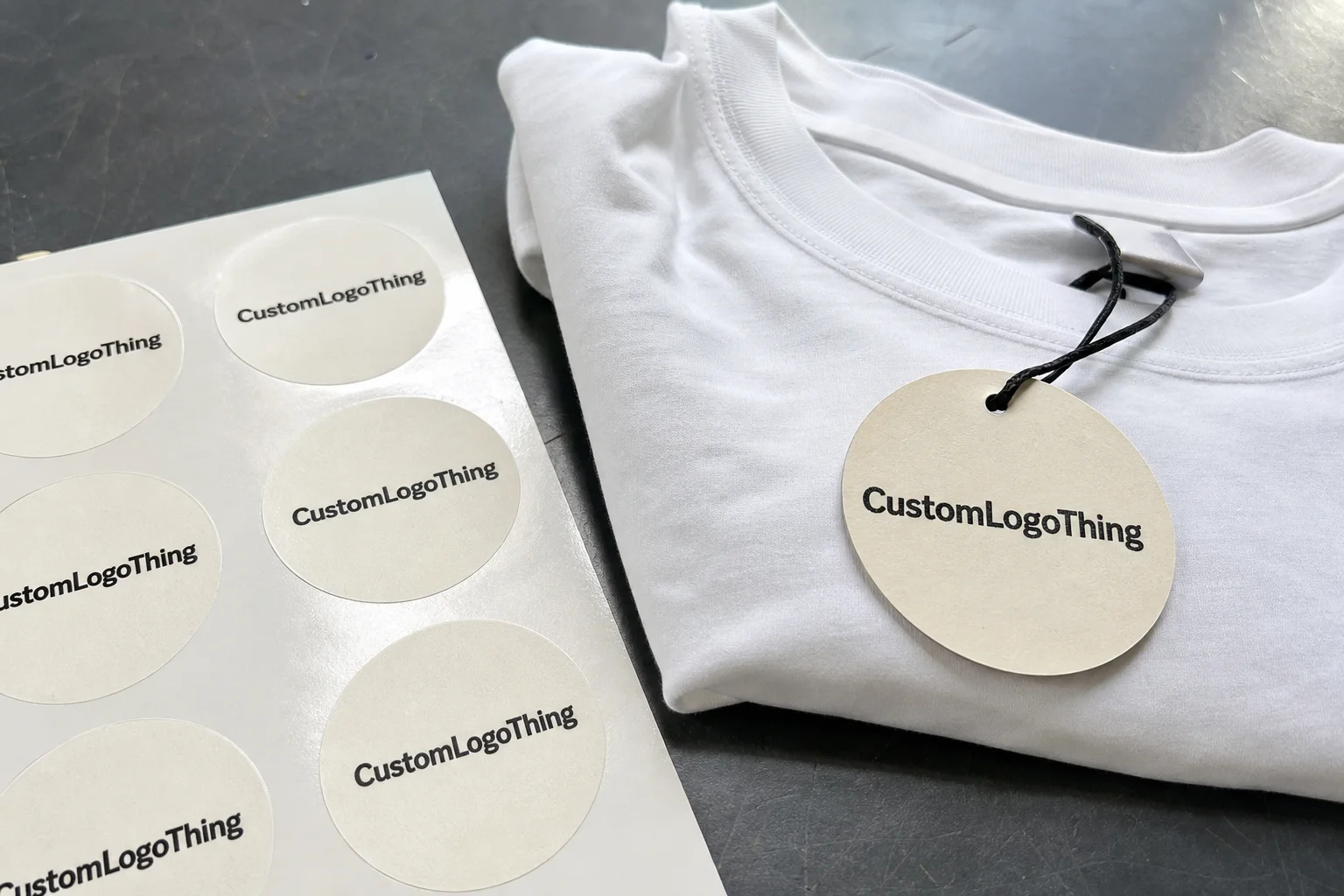
From a packaging buyer’s point of view, the job is simple: make the item feel complete and intentional. personalized round labels are custom circular labels used on apparel, inserts, packaging, and retail presentation pieces. They can carry a logo, a collection name, a size note, a care reminder, or a short internal code. In smaller formats, the circle is especially useful because it gives the eye a clean boundary and avoids the cramped feeling that can happen with a rectangle.
That is why this shape shows up on folded apparel, tissue wraps, subscription kits, box closures, and hang-tag alternatives. One label may be doing brand recognition only. Another may be doing a little operational work too, like identifying a seasonal run or a product group during packing. A third may be acting as a closure seal on a mailer or bag. The format is simple, but the use case changes how the label should be specified.
“A round label does not need to explain everything. It needs to carry the right message clearly, at the size it will actually be seen.”
A common mistake is trying to fit a full marketing message into a small circle. That usually creates a label that feels busy, thin, or hard to read once it is printed and trimmed. A better approach is to decide whether the label is there for branding, sealing, identification, or all three in a limited way. If the packaging system includes multiple label types, it helps to compare the options alongside Custom Labels & Tags before locking the final spec. A circle is not the best answer for every packaging problem, but it is strong when the message is short and the presentation needs to stay clean.
How the production flow works from file to finished labels
The production path starts with the artwork and the end use. Before anyone prints a sample or sets up a run, the buyer should know the diameter, the bleed, the safe area, the finish, and whether the label will be handled by hand or by machine. That distinction matters more than many first-time buyers expect. A label that is easy to dispense in a production room may not be the best choice for a hand-applied retail pack. A label that looks good on a flat mockup may not behave the same on a curved or textured surface.
Proofing comes next. A digital proof confirms placement, crop line, copy, and general layout. It catches most mistakes early, but it does not replace a physical sample when color accuracy or surface feel matters. If a label needs to match an existing carton, tissue wrap, or box finish, a sample is worth the extra time. The print may be correct on screen and still shift slightly in tone on press, especially if the stock is uncoated, coated, or synthetic.
After approval, the job moves through print, cut, inspection, and shipment. Some orders are printed and die-cut in one pass. Others are printed on sheets and trimmed later. Variable data, serial numbers, or mixed artwork add another layer because the production team has to keep registration tight and the sequence correct. Clean files shorten the process. Poorly prepared files usually create avoidable back-and-forth before the order reaches the press.
Material documentation can matter as well. If a brand is asking for recycled paper or certified fiber, that should be visible before the order is placed, not added as an afterthought. Buyers who care about paper sourcing often want more than broad sustainability language. They want a clear paper spec and a credible chain-of-custody framework. That level of detail is especially useful on premium apparel packaging, where the label sits close to the customer’s first physical impression.
Key factors that change look and durability
Material choice drives most of the visible difference. Paper stock gives a straightforward packaging feel and works well for short-term application, retail presentation, and tissue wrap closure. Coated paper usually gives stronger contrast and sharper edges for logos with fine detail. Synthetic films cost more, but they handle moisture, friction, and repeated touching better, which makes them useful for shipping flows and warehouse handling.
Adhesive choice matters just as much. Permanent adhesive is the default for labels that need to stay in place. Removable adhesive is better when the label is temporary, such as a closure seal or a short-life promotional sticker. Specialty adhesives are worth discussing when the surface is textured, coated with a low-energy finish, or unusually soft. Some mailers and cartons accept standard adhesive without issue. Others need a more deliberate match. The proof may look fine while the real surface refuses to hold the label properly.
Finish changes both appearance and handling. Matte reduces glare and usually feels more restrained. Gloss makes color look richer, though it can reflect overhead light in a way that hides detail. Soft-touch creates a premium tactile effect, but it increases cost and is not always the right choice for labels that need to be written on, scanned, or packed in high volume. If the line relies on barcodes or very small type, the finish should be tested before the order is approved rather than assumed from the mockup.
Size and legibility need to be treated as one decision. A 1.5-inch circle can hold a monogram or short emblem comfortably. A 3-inch circle can carry more copy, but it still does not have the linear breathing room of a rectangle. That means hierarchy becomes important. Put the brand mark first. Keep supporting copy short. Leave white space where the eye needs it. Circular labels reward restraint, and the strongest examples usually feel calm rather than crowded.
| Material or finish | Best use case | Typical tradeoff |
|---|---|---|
| Uncoated paper | Folded apparel, tissue wraps, low-handling presentation | Lower moisture resistance; best for short-term display |
| Coated paper | Retail packaging, sharper logo detail, richer color blocks | More glare than matte stock; surface can show fingerprints |
| Synthetic film | Shipping packs, durability needs, handling-heavy orders | Higher cost; not always necessary for indoor presentation |
| Soft-touch finish | Premium apparel lines and gift sets | Can increase price and reduce suitability for writing or scanning |
Step-by-step guide to choosing specs without guesswork
Start with the application, not the look. Ask where the label will live: apparel, tissue, outer packaging, or an insert card. That answer determines the adhesive, the stock, and whether the label should be packed on a roll, on sheets, or in another format suited to the packing line. A circle used as a bag seal has different requirements from a circle used as a product identifier, even if the art is the same.
Then choose the diameter by viewing distance, not by preference alone. Buyers often approve a size because it looks balanced on screen, then discover the mark feels too tight once it is applied to a folded shirt or a carton flap. Print a few paper mockups, place them on the real packaging, and step back. If the design looks crowded, simplify the copy or increase the diameter. If it overwhelms the package, reduce the secondary text before shrinking the logo.
After that, decide what belongs on the label and what should move elsewhere. A round layout usually works best with one primary message and one supporting element. That may be a logo plus a short website line, or a collection name plus a size note. It usually does not work well when the design tries to carry a slogan, a barcode, care text, and a social handle all at once. If the label needs that much information, the format is doing too much.
Finally, lock the operational details before the proof is approved. Quantity, finish, color expectations, and pack format should all be clear in the brief. That prevents the order from drifting later when someone realizes the label needs to run on a different line or match another packaging component. If you are comparing options, pricing, and minimums across the rest of the line, it helps to review them alongside our Custom Labels & Tags range. The closer the spec sits to the actual workflow, the fewer surprises show up after approval.
- Confirm the application surface and how long the label needs to stay in place.
- Choose the diameter based on real viewing distance and logo complexity.
- Trim the copy until the circle has enough white space to read cleanly.
- Lock the quantity, finish, and pack format before the proof is approved.
Production steps and turnaround: what happens after approval
Once the proof is approved, the order usually moves through file finalization, print setup, production, finishing, inspection, and shipment. The exact sequence depends on the job, but the logic stays the same: the cleaner the file, the less time the team spends correcting it. Standard production often runs around 12 to 15 business days from proof approval, though quantity, material, and finishing requirements can shift that range. Rush orders can compress the timeline, but they also compress the room for correction.
Late changes are what usually cause the schedule to slip. Changing the diameter after proof approval means recalculating the cut line and rechecking the layout. Changing the material can affect color and adhesive behavior. Changing quantity can move the order into a different production queue. None of those changes is unusual on its own. Combined, they can push the job beyond the original ship date.
Rush work also leaves less room for the checks that prevent reprints. There may be no time for a second proof. There may be less margin for color correction or registration adjustments. If the order depends on tight application, especially on premium clothing packaging, it is smarter to build a small calendar buffer rather than assume every stage will move perfectly. Shipping time should be treated separately from production time too. A label can finish on schedule and still miss a launch if freight is not planned with enough margin.
For brands with recurring drops, consistency usually matters more than speed. Keeping the same stock, finish, and diameter across runs reduces re-approval work and preserves a stable presentation from one collection to the next. That consistency also helps when the label is part of a larger packaging system that includes boxes, tissue, and inserts.
Cost, pricing, and MOQ: what actually changes the quote
Pricing comes down to a few repeatable variables: material, finish, size, quantity, and any special print or cutting requirements. A simple one-color label on paper stock is usually less expensive than a soft-touch synthetic piece with tight registration and custom cut geometry. Bigger labels also cost more because they consume more material and can require more careful finishing. If the label includes variable data or multiple versions, setup labor may rise as well.
MOQ matters because setup costs have to be spread across the run. A small order can make sense for a new drop, a limited capsule, or a product test, but the unit cost will usually be higher. Larger runs often improve value once the design is proven. The common mistake is not choosing a small quantity. The mistake is choosing one without knowing the real usage volume, then reordering under time pressure when the first batch runs out sooner than expected.
| Order profile | Indicative unit cost | What drives the price | Best for |
|---|---|---|---|
| 1,000 labels, paper stock, simple print | $0.14-$0.28 each | Setup spread across fewer units | Testing a new collection or market |
| 5,000 labels, coated paper, standard finish | $0.08-$0.16 each | Better scale on print and cutting | Recurring packaging demand |
| 10,000 labels, synthetic stock, specialty finish | $0.06-$0.13 each | Higher material cost, but stronger scale | High-touch retail or handling-heavy orders |
Those numbers are directional, not fixed. Foil accents, lamination, custom cores, unusual die shapes, and color-critical work can all move the quote. A buyer who can simplify the spec usually saves more than the difference between two vendors. The clearest route is to define the real usage volume first, then compare quote tiers against the same specification. Otherwise, the cheapest line item on paper can turn into the most expensive order once reprints, delays, or extra setup are added in.
Common mistakes that cause reprints or delays
Artwork errors are the easiest problem to predict. Low-resolution logos blur at print scale. Missing bleed leaves the edge too tight. Tiny text becomes unreadable after trimming. Color values without clear references lead to a proof that looks close enough on screen and wrong in print. If the brand has Pantone targets, include them. If not, provide a vector file and a clean reference image. Guessing at color is expensive.
Spec mismatches create the next layer of trouble. The adhesive may be too weak for a coated carton or too aggressive for a delicate finish. The stock may curl after cutting. The label may look polished on the proof and still fail on the real surface because the substrate was different from what was assumed. These are ordinary production issues, not rare failures, and they are usually preventable with a better brief.
Planning mistakes are just as costly. Ordering too few labels means the brand pays for another setup. Ignoring lead time can push the launch past the marketing window. Approving a proof without checking the final use case is how a label ends up too large for a fold or too small for a box flap. A short checklist before sign-off is far cheaper than a reprint after the order is already moving.
Before final approval, it is worth checking four points: artwork resolution, actual diameter, adhesive suitability, and whether the label is meant to be permanent or temporary. That list is short because it needs to be used in the room, not filed away in a brand deck.
- Confirm the file is vector or high-resolution and that the logo edges are crisp.
- Check that the circle leaves enough white space around the mark.
- Match the adhesive to the real surface, not the mockup surface.
- Review the proof in the same orientation the customer will see it.
Expert tips and what to prepare before you request a quote
The fastest quote usually comes from the cleanest brief. Prepare a small brand kit with logo files, color values, target size, quantity range, and one or two reference photos of the intended packaging. That gives the supplier enough information to price the job without guessing at the expensive details. If the line has more than one SKU, say so early. If the label has to match an existing box, tissue wrap, or mailer, include the dimensions. Specificity saves time on both sides.
If the design feels busy, simplify it before production. Circular labels reward restraint because the eye reads them as a single object, not as a miniature brochure. One strong icon or wordmark usually performs better than three layers of information. If the brand needs more data than the circle can hold, move the extra content to a secondary package element and keep the label focused on recognition.
For premium apparel, sample review is worth the time whenever finish is likely to affect how the customer reads quality. A soft-touch label and a matte paper label can look similar in a mockup and feel very different in hand. That difference can change the perceived value of the product line. The label is small, but it sits close to the purchase decision, which gives it more influence than its size suggests.
The best orders are the ones that do not need rescue. Confirm the use case, the quantity, the material, and the finish before committing, then let the production team build the spec around that reality. With that approach, personalized round labels become a dependable part of the packaging system instead of a recurring source of corrections. For clothing brands, that is the practical standard: a Label That Fits the workflow, looks finished on the shelf, and prints cleanly every time the order is repeated.
FAQ
Are personalized round labels better than square labels for clothing packaging?
Round labels usually feel softer and more premium on folded apparel, tissue, and gift packaging. Square labels are better when the design needs more text, a stronger grid, or multiple elements that would feel cramped inside a circle.
What size works best for custom round labels on apparel boxes?
Choose the diameter based on viewing distance and logo complexity rather than preference alone. Smaller boxes usually need a simpler mark and a tighter message so the label stays readable once it is applied.
How do I choose the right material for personalized round labels?
Use paper or coated stock for standard packaging and short-term use. Choose a synthetic or specialty stock if the label needs more durability, moisture resistance, or handling strength during packing and shipping.
What affects the turnaround time for round clothing labels?
Clean artwork, confirmed specs, and prompt proof approval shorten the timeline. Special finishes, custom cutting, and late revisions usually add time because they introduce extra production checks.
Can personalized round labels be ordered in small quantities?
Yes, but lower quantities usually raise the per-label cost because setup is spread across fewer units. If you are testing a new brand or seasonal line, start with the minimum that covers realistic demand.
For buyers comparing options across a packaging line, the most useful inputs are the application surface, quantity, material, finish, and diameter. That combination produces a quote that reflects the real job rather than a general estimate.