Personalized Soda Bottle Labels: What Actually Matters Before You Print
A plain soda bottle becomes more useful when the label looks intentional. Personalized soda bottle labels do that fast, but only if the stock, adhesive, and bottle dimensions match the actual container instead of a mockup built for a perfect cylinder.
That is where many orders go wrong. Artwork matters, but the bottle gets handled, chilled, stacked, photographed, and sometimes dropped into ice for hours. If the label curls, clouds, or peels after 20 minutes in condensation, the design stops helping the product and starts advertising the mistake.
Why personalized soda bottle labels get noticed immediately
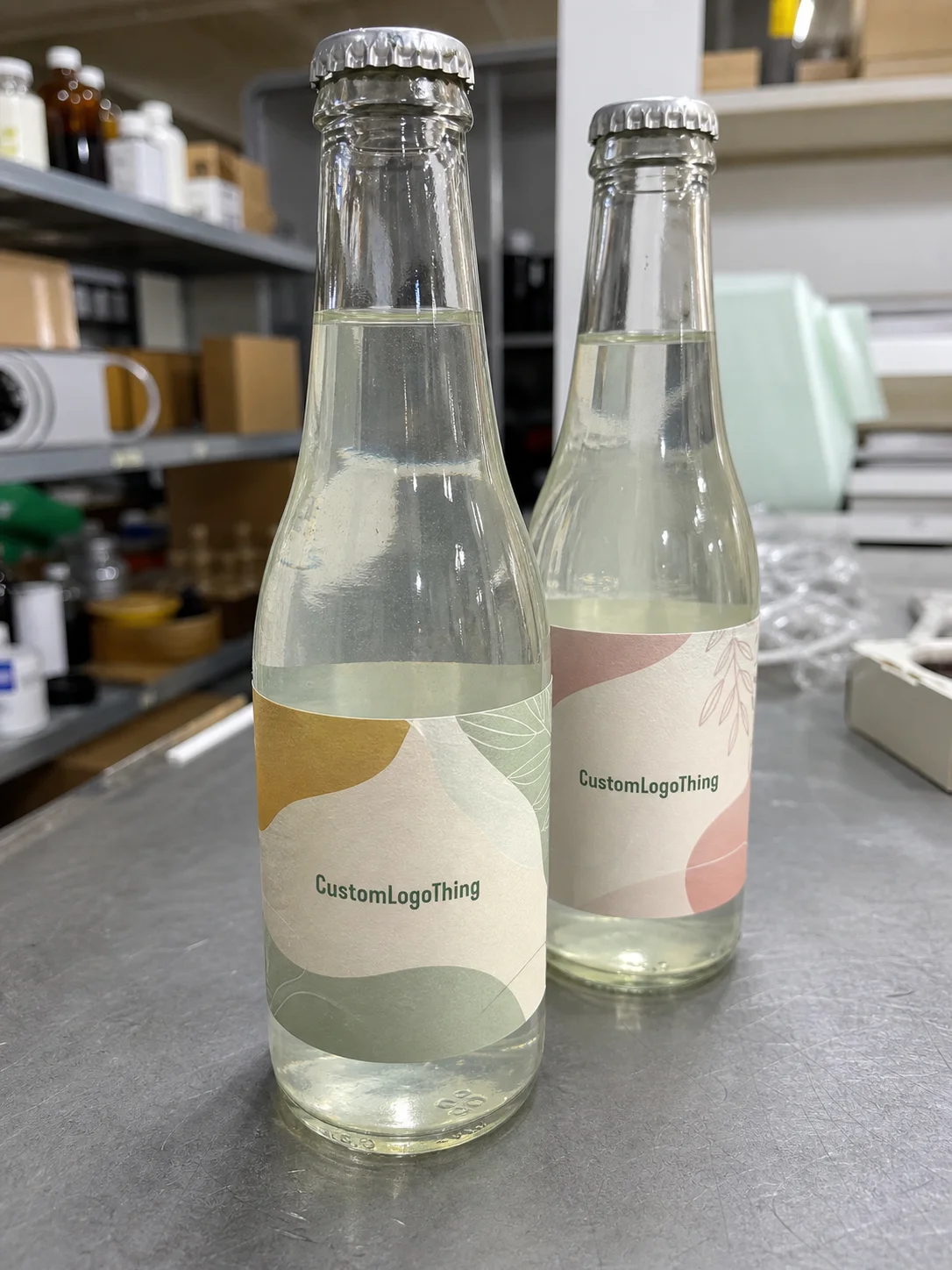
People notice these labels for the same reason they notice a clean menu or a sharp table card. The surface is small, so every choice reads louder. A good label can turn a basic bottle into a wedding favor, a tasting sample, a table marker, or a branded giveaway without changing the beverage itself.
That matters because the bottle is usually part of a larger presentation. A label can carry names, dates, flavor notes, sponsor logos, event hashtags, or QR codes. It can also make a low-cost bottle feel retail-ready. In that sense, the packaging is doing visual labor, not just decoration.
For promotions, the label helps the sample look like a product. For events, it helps the setup feel deliberate. For photo-heavy settings, it gives the bottle a clean front so the image does not collapse into a generic prop.
A proof that looks fine on a screen can still fail on an iced bottle. Moisture exposes weak adhesive, thin stock, fuzzy type, poor edge cuts, and labels that were designed too close to the trim line.
The finish changes the read faster than most people expect. Matte feels softer and more controlled. Gloss pushes contrast and catches light from a distance. Clear film can almost disappear when the artwork is built for it, which is useful when the bottle color should stay visible.
Because the bottle is a hand-held object, people touch it, turn it, set it down, and pick it back up. If the label is proportioned well, it stays legible through all of that. If it is not, the package looks rushed.
How the label production process works
The workflow is straightforward: artwork comes in, the file gets checked, a proof goes back, the buyer approves it, and production moves into print, finishing, cutting, and packing. The hard part happens before the press starts. Most delays come from incomplete specs or artwork that was never built for the bottle shape.
For short runs and variable names, digital print is usually the practical choice. It keeps setup costs manageable and handles version changes without a tooling conversation. Flexographic printing works better for large repeat runs, but the setup makes less sense for a few dozen or a few thousand personalized pieces unless the order will be repeated often.
What the printer needs is not complicated, but it needs to be accurate:
- Bottle measurements, especially circumference and visible label height
- Label width and height, or a dieline if one already exists
- Quantity, finish, and material preference
- Variable text such as names, dates, flavors, or batch numbers
- Notes on storage, chilling, display, and handling
A common mistake is assuming a label can stretch to fit anything. It cannot. Curved bottles, tapered shoulders, and narrow necks change the usable panel. If the file is built for a flat rectangle and the bottle is not flat, the label will look off even if the art is strong.
File quality matters too. Low-resolution logos, RGB-only files, missing bleed, and text sitting too close to the trim all create avoidable cleanup. A printer can correct some of that. No printer can make a weak file behave like a strong one.
For a broader starting point, the Custom Labels & Tags page is useful if you need a clean reference for structure, construction, and common label formats.
Materials, finishes, and sizing choices that change the result
This is where performance is won or lost. The artwork can be excellent and still fail if the substrate is wrong. For cold drinks, pressure-sensitive BOPP is usually the safer pick because it handles moisture better than standard paper. White BOPP is the workhorse. Clear BOPP works when the bottle color or contents should stay visible. Paper can work for dry applications, but it is not the smart choice for ice buckets or condensation-heavy setups.
If sustainability is part of the brief, paper stocks with FSC certification are worth considering for dry service or short shelf displays. The tradeoff is straightforward: paper can look refined, but film performs better around water. For certification background, the FSC site is useful: FSC. For broader waste and recycling context, the EPA’s packaging guidance is also helpful: EPA recycling resources.
Finish changes the feel of the label more than people think. Matte lowers glare and reads more restrained. Gloss increases contrast and makes color pop under event lighting. Soft-touch can feel premium, but it is not the first choice for wet handling unless the full construction supports it.
Size matters just as much as stock. A wraparound label should be built from the real circumference, not a guessed standard. Leave a small seam gap so the ends do not overlap awkwardly or peel at the edge. On tapered bottles, the visible panel can shrink toward the shoulder or base, which means a layout that looked balanced on paper can feel cramped on the actual bottle.
Use these sizing rules as a starting point:
- Measure the bottle circumference at the exact label height, not at the widest point
- Leave about 1/8 inch to 1/4 inch for a seam gap on wrap labels
- Keep critical text at least 1/8 inch inside the trim and safe zone
- Test the layout on one physical bottle before approving the full run
Legibility is non-negotiable. Tiny type, low contrast, and decorative fonts may look clever on a screen, but they blur once the bottle curves or the surface gets wet. A label has to read at arm’s length, under glare, and often through condensation.
If the project is part of a larger kit, the same Custom Labels & Tags format can also work for seal labels, favor tags, or matching inserts so the whole package feels intentional instead of pieced together.
Cost and pricing: what changes the quote
The quote usually moves for six reasons: quantity, size, stock, finish, print method, and whether the order includes variable names or unusual shapes. That is the real list. Everything else is usually a variation of one of those factors.
Small runs cost more per label because the setup cost gets spread across fewer pieces. Larger quantities lower the unit price even if the total invoice is higher. That is normal printing economics, and it is why a 250-piece order can look expensive beside a 2,500-piece run.
| Order Type | Typical Unit Price Range | Best For | Tradeoff |
|---|---|---|---|
| Short digital run, paper stock | $0.30-$0.70 each | Dry displays, short events, low quantity | Lower moisture resistance |
| Short digital run, BOPP film | $0.40-$0.90 each | Ice buckets, coolers, events with condensation | Slightly higher cost |
| Mid-size run, standard shape | $0.14-$0.32 each | Brand activations, weddings, recurring use | Needs accurate specs to hold the price |
| Large run with variable data | $0.10-$0.25 each | Names, batch numbers, or promotional versions | Proofing takes more time |
Setup costs can show up in places buyers forget to ask about. Proofing, Custom Die Cutting, file cleanup, and rush handling can all change the quote. If the bottle shape is unusual, expect more back-and-forth before production starts.
When comparing quotes, ask what is included. Does the price cover the proof, the cut, packing, and freight? Are reorders billed against the same setup? Is shipping separate? Those questions save money because the lowest sticker price is often missing one or two items you still need.
For personalized soda bottle labels, the cheapest run is not always the least expensive outcome. A label that peels in the cooler costs more than the one that used the right stock the first time.
Step-by-step timeline from proof to delivery
The timeline is usually more predictable than the price. If the files are ready and the specs are clear, the process moves in a clean sequence: submit the request, receive a proof, approve the layout, print the labels, finish and cut them, then pack and ship. The part that slows everything down is almost always the proof loop.
Typical turnaround depends on quantity and artwork readiness. A straightforward digital order can move through production in roughly 5-10 business days after approval. More complex runs often land closer to 12-15 business days. Rush jobs are possible, but only when production capacity is available and the file is already print-ready.
Here is how buyers shorten lead time without cutting corners:
- Send exact bottle dimensions, not a guess.
- Upload print-ready artwork with bleed and safe zones in place.
- Choose stock and finish before requesting the quote.
- Provide all variable names or versions in one clean list.
- Get internal approval before the proof comes back so response time does not stall the order.
There is also a hidden delay most buyers underestimate: decision churn. Someone wants the logo larger. Someone else wants a different shade of blue. Another person notices the date and changes the text. Each edit costs time.
If the labels are going into kits that will be shipped rather than handed out locally, it helps to think about parcel handling too. The ISTA test procedures are a useful reference for distribution stress, especially when bottles and labels are packed together and stacked in transit.
For repeat orders, save the approved dieline and final art files. People lose them constantly. The next reorder should not require rebuilding the whole setup from scratch.
Common mistakes that make soda bottle labels fail
The biggest miss is designing for a flat bottle when the real bottle is curved, tapered, or built with a shoulder that eats into the usable space. A flat mockup can hide a lot of issues. The actual bottle does not.
Weak adhesive is another common failure point. If the bottle is going into an ice bucket, cooler, or humid event space, ordinary paper stock with ordinary adhesive is asking for trouble. The corner lifts first. Then the edge gets fuzzy. Then the label looks tired before the event is halfway done.
File mistakes cause expensive rework:
- RGB artwork sent instead of print-ready CMYK
- Low-resolution logos that blur on press
- Tiny text that disappears once the bottle curves
- No bleed, or bleed that is too tight
- Safe zones ignored because the proof looked roomy on a monitor
Operational mistakes are just as annoying. Ordering the wrong quantity is common, especially when people forget a few bottles need to be held back for breakage or last-minute additions. Skipping the proof is worse. A proof is the checkpoint where bad measurements and bad assumptions get exposed before they cost money.
Testing one sample on the actual bottle is cheap insurance. Put it in ice if that is how it will be used. Handle it with damp hands. Leave it overnight. If the label survives the exact use case, the full order has a real chance of doing the same.
Expert tips and next steps for a cleaner order
Start with the bottle, not the artwork. Measure circumference, label height, shoulder curve, and any flat panel area with a tape measure. Then build the layout around the actual container. That one step eliminates a surprising number of problems.
Request a proof on the exact stock and finish you plan to use. Color shifts happen when ink meets a different substrate, and contrast changes more than most people expect. A label that looks sharp on matte paper can read differently on gloss film.
If your order needs names, batch numbers, or event-specific versions, organize the variable data early. Do not send it in scattered emails. Put it in one clean file with a consistent naming system.
Before you approve the job, confirm these items:
- Quantity
- Stock and finish
- Label dimensions and seam gap
- Proof approval status
- Delivery date and shipping method
Most print problems are not mysterious. They are the result of one missing number, one assumption about moisture, or one person approving a file without touching the bottle first.
For weddings, promotions, fundraisers, and tasting events, the best result usually comes from choosing the right material first and the flashiest art second. If the label handles the bottle well, the design gets to do its job.
What size should personalized soda bottle labels be for standard bottles?
Measure the bottle circumference and visible label panel first, because standard sizes vary by brand and bottle shape. Leave a small seam gap on wraparound labels so the ends do not overlap awkwardly or peel at the edge.
Are personalized soda bottle labels waterproof for ice buckets and coolers?
Use moisture-resistant stocks like BOPP or another film label, not basic paper, if the bottles will sit in ice or condensation. Ask whether the adhesive is rated for cold, wet surfaces before you approve the final quote.
How long does it take to get personalized soda bottle labels printed?
Timing depends on proof approval, quantity, and whether the artwork is print-ready when submitted. Simple digital orders often finish in 5-10 business days after approval, while more complex runs usually take longer.
What is the cheapest way to order personalized soda bottle labels?
The lowest unit cost usually comes from larger quantities, simpler shapes, and standard stock with a basic finish. You save more by preparing clean artwork and accurate bottle specs than by chasing the absolute lowest quote.
Can I use personalized soda bottle labels for weddings, events, or promotions?
Yes. They work well for favors, table service, tasting events, storefront giveaways, and branded beverage samples. Choose the material based on how the bottles will be stored, served, and handled, not just on how they look in a mockup.