Personalized Vinyl Labels: Buyer's Guide to Ordering
Personalized vinyl labels do more than sit on a garment. They shape the first impression long before anyone checks the fabric weight, stitching, or fit. A clean label makes a plain tee feel deliberate. A sloppy one makes the whole item look rushed. That is the kind of small detail buyers ignore right up until it costs them a reorder.
These labels show up on tees, hoodies, uniforms, kidswear, private-label basics, and short-run merch that needs a tighter brand read than a hangtag can give. They are popular because they are low-profile, legible, and easy to place where a customer will actually see them. If you are comparing label systems, the broader Custom Labels & Tags range helps frame the choice between vinyl, woven, printed, and sewn-in formats.
The real decision is practical. You are balancing durability, hand feel, placement, and the job the label is meant to do. Branding only? Care details too? One garment family or three different fabrics? Those questions matter more than a polished mockup, because a label that looks fine in design software can fail once heat, pressure, and wash cycles enter the picture.
Personalized vinyl labels and the first impression problem
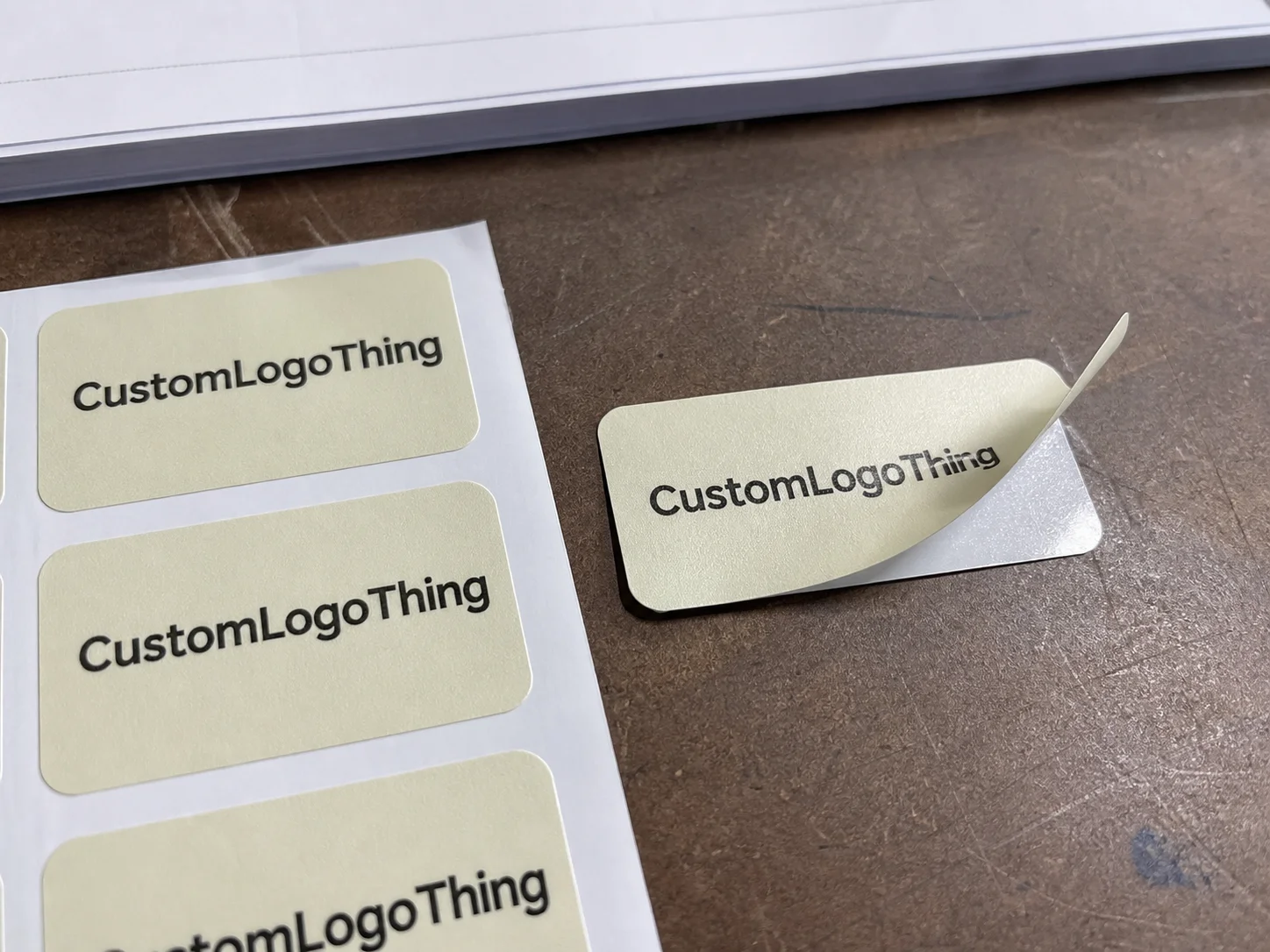
People treat labels like finishing touches. In reality, they are one of the first physical cues a customer uses to judge quality. That judgment happens fast. Before they inspect the seam allowance or ask about construction, they have already decided whether the product feels retail-ready.
On uniforms, a label helps the team look consistent. On kidswear, it can signal brand trust in one glance. On private-label basics, it separates a blank garment from a product that feels ready for shelf display. For limited drops, the label often carries the brand identity more directly than the garment itself.
That is why personalized vinyl labels are attractive to buyers who want a crisp, low-bulk look. A thick patch can fight with the fabric. A sewn-in tag can be functional, but it is not always the cleanest visual answer. Vinyl occupies a narrow lane and does it well: it reads clearly, stays out of the way, and avoids adding much weight.
A label rarely gets a second chance. If it looks dull, oversized, or hard to read under retail lighting, the garment starts from a weaker position no matter how good the fabric feels.
The best briefs ask three questions at the start. Does the label need to survive repeated laundering? Does it need to move with the fabric? Does it need to carry branding only, or branding plus information? The answers shape the rest of the order. If you skip them, you end up designing around the quote instead of the product.
There is also a practical reality buyers learn the hard way: a label that looks strong on a sample card can behave very differently once it lands on rib knit, fleece, or stretch polyester. The garment surface decides a lot. Not the mockup.
How the artwork-to-label process works
The process usually starts with a logo file, not a finished label. A supplier will clean up vector art, confirm the dimensions, and flag details that may not survive production. Thin strokes, tiny text, and crowded spacing are the common problem areas. If the thinnest line is below about 0.25 mm, or the smallest text falls under 5 pt, the odds of a clean result drop fast. That is especially true on textured fabrics.
Proofing matters because it is the point where design meets manufacturing limits. A useful proof should show scale, color limits, and any simplification needed for production. If the artwork depends on gradients, hairline outlines, or ultra-fine registration, ask for a production-minded version rather than a pretty rendering. A proof is a planning tool. It is not a guarantee that every detail will survive heat and handling.
There is also a difference between a sample and a prototype. A sample may confirm appearance on a generic swatch. A prototype checks the actual garment, finish, and placement area you plan to use. That second step matters more than most buyers admit, because cotton jersey, fleece, polyester blends, and stretch knits do not respond the same way under pressure.
Testing should happen on the real garment. If the application method uses heat, ask for the recommended temperature, dwell time, and pressure range. A common starting point is medium pressure at roughly 300-325F for 8-15 seconds, but that changes with the film, adhesive, and garment surface. The point is repeatability. If the supplier cannot tell you how they test, they are asking you to gamble with the order.
For brands that care about shipping and handling, the broader packaging environment matters too. Industry references such as packaging.org and ISTA are useful reminders that compression, transit, and storage can affect how a product arrives. A label that looks fine at the bench can still be damaged in packing or freight if the spec is weak.
Cost, pricing, and MOQ tradeoffs that change your quote
Pricing is usually a stack of small variables, not one big number. Quantity matters most, then label size, number of colors, finish, backing type, and whether the order needs a rush schedule. Setup and revision charges also matter more than first-time buyers expect, especially on smaller runs.
For a practical benchmark, lower-volume orders often land around $0.60-$1.10 per unit, while mid-volume runs of about 1,000 to 5,000 pieces often fall closer to $0.18-$0.35 per unit depending on print coverage and complexity. Larger volume can push pricing lower, sometimes into the $0.10-$0.22 range, but that only helps if the spec is stable and the inventory will move.
| Order profile | Typical unit price | Best for | Main tradeoff |
|---|---|---|---|
| 300-500 labels | $0.60-$1.10 | Samples, micro-drops, small seasonal tests | Higher setup share and less room for price breaks |
| 1,000-5,000 labels | $0.18-$0.35 | Core SKUs, small brand launches, uniform programs | Good efficiency, but revisions still move the cost |
| 10,000+ labels | $0.10-$0.22 | Repeat programs, national retail, stable size runs | More cash tied up in inventory and storage |
MOQ is the lever that catches people off guard. A lower MOQ makes entry easier, but the unit cost usually climbs because setup is spread over fewer labels. A higher MOQ improves unit economics, yet it increases the risk of overbuying if the design changes or the SKU does not perform. The cheapest quote is not always the smartest one. It just looks tidy in an email.
Compare quotes on a like-for-like basis. Check the number of usable labels, not just the headline number. Confirm whether sample fees are credited back, whether revisions are included, and whether shipping is treated as a separate line. A quote that is $40 lower but excludes proof changes, replacement pieces, and freight can cost more once the order is real.
For launch programs, a slightly higher quote can be the better business decision if it reduces waste, application failures, or reorder pressure later. The cheapest unit price means very little if it creates a late delivery or a pile of scrap.
Material, finish, and adhesion choices that affect wear
Fabric choice changes how personalized vinyl labels behave. Cotton usually gives a friendlier surface. Polyester can be slicker. Blends sit in the middle. Fleece adds texture. Stretch materials create the hardest test because the fabric moves after application, and the label has to keep up. If it cannot, edge lift and cracking show up sooner than anyone wants.
Finish changes both appearance and perceived quality. Matte reads softer and often hides scuffs better. Gloss looks sharper under bright retail lighting, though it can show wear more easily. In practice, the finish should fit the garment category. A premium hoodie does not need the same treatment as a performance tee, and pretending otherwise usually creates a worse result.
Adhesion and durability depend on heat, pressure, wash frequency, and dryer exposure. A label that survives a cold home wash may behave differently in a hot cycle or a commercial laundry setting. That is why suppliers should explain how they test. If they can point to repeatable wash tests, abrasion checks, or recognized methods such as ASTM or ISO references, that carries more weight than vague durability claims.
Legibility is another common trap. A logo with too much internal detail may look fine at proof stage and then disappear in production. Keep contrast strong. Keep icon shapes simple enough to survive laundering. If the label includes text, do not use a font weight so light that it vanishes after a few washes. Clean typography beats decorative complexity almost every time.
For buyers who care about sustainability, the bigger waste issue is usually not the substrate itself. It is the reorders, misprints, and overproduction that come from weak specs. The cleaner the approval process, the less waste ends up built into the program.
Ordering process and timeline from proof to delivery
The cleanest ordering process is straightforward: request, proof, revision, sample approval, production, packing, and shipment. Each step should have an owner. If the supplier is waiting on artwork, or the buyer is waiting on a fit sample, lead time stretches. The schedule usually fails in the handoff, not in the manufacturing step itself.
Typical lead times often fall in the 12-15 business day range after proof approval, though that shifts with artwork changes, peak-season congestion, and sample requirements. A custom sample can add several days before production starts. If the garment line includes multiple fabrics or size families, the test matrix gets longer and the schedule gets less predictable.
Backward planning is the safest approach. Start from the launch date, then subtract shipping, packing, production, sample sign-off, and proof time. If the label is on the critical path, the whole launch is exposed. That is why experienced buyers lock the spec early and push creative changes before production starts.
Rush orders are not automatically bad. They make sense when the artwork is final, the fabric is known, and the quantity is stable. If any of those variables are still moving, a rush order can hide a spec problem rather than solve it. Faster is not better if the first batch is wrong.
For buyers comparing label families before they request a quote, the custom label formats page is a practical way to narrow the material, finish, and application method before the order gets locked.
One habit saves grief later: ask for a shipment window, not just a production window. Goods can be finished on time and still arrive late because packing, customs, or freight booking was ignored. That detail matters more on repeat programs than most teams expect.
Common mistakes that lead to peeling, errors, or reorders
The most expensive mistake is approving artwork before confirming garment size, placement area, and fabric type. A label that looks centered on a mockup can sit too high on a toddler tee or too close to the seam on a hoodie. One wrong assumption at the start becomes wasted inventory later.
Typography is another easy way to create problems. Tiny text, low contrast, and complicated graphics often fail once the label is applied at scale. If a design depends on visual tricks to work, it probably needs simplification. Saving 20 minutes on artwork review can cost weeks in production correction. Not a great trade.
Application errors are just as costly. Misaligned placement, skipped wash testing, and ignoring supplier instructions on heat or pressure all raise the risk of peeling. Some failures show up right away. Others appear after the first few washes, which is worse because the run is already in circulation.
- Do not skip sample testing on the actual garment.
- Do not approve artwork before confirming garment dimensions.
- Do not assume one fabric test covers every SKU.
- Do not ignore pressure, temperature, or dwell-time instructions.
- Do not order so tightly that defects leave you empty-handed.
Inventory planning is the mistake many teams undercount. A supplier may hit the full order count and still leave you short if you did not allow for defects, application rejects, or replacement pieces. A small overage can be the difference between a clean launch and an emergency reorder.
The best buyers are usually not the ones chasing the lowest unit cost. They are the ones who understand where failure happens and budget for it early. That mindset matters with personalized vinyl labels because the label is small, but the branding consequence is not.
What to prepare before you request samples or a quote
If you want a fast, accurate quote, send the supplier the information they actually need: logo file, label dimensions, garment fabric, placement location, quantity, and target delivery date. Add finish preference, color count, and whether a sample is required. The more complete the brief, the less time you spend fixing avoidable errors.
A simple test plan helps too. Ask for the sample on the exact fabric blend you plan to use, not just a generic swatch. Check edge lift, stretch recovery, print clarity, hand feel, and wash response. If possible, run a few controlled washes before approving the full order. One sample on one swatch does not prove a production run.
Use an apples-to-apples quote structure. Separate unit price, setup, sampling, shipping, and revision costs so you can compare suppliers cleanly. If one quote bundles everything and another does not, the lower headline number may be misleading. That kind of comparison sounds basic, but it is where many first orders go wrong.
Before you place the order, check whether the supplier can support repeats without retooling the whole job. That matters for size runs, reorders, and new colorways. It also matters if you plan to scale beyond the first launch. The right setup should make the next buy easier, not harder.
For teams comparing vinyl against other branded options, review the broader Custom Labels & Tags selection before locking the spec. Then narrow the brief, test the sample, approve only what will survive production, and scale personalized vinyl labels with fewer surprises.
Are vinyl clothing labels a good option for stretchy garments?
Yes, but only if the label system is compatible with stretch fabrics and the application method is tested on the actual garment. Ask for a sample on the exact material blend you plan to use, because performance can change on ribbed knits, spandex mixes, and lightweight tees.
What affects the price of custom vinyl clothing labels the most?
Quantity is usually the biggest driver, followed by size, number of colors, finish, and whether the order needs a rush turnaround. Setup, sample, and shipping costs can make a low-price quote look expensive if you are only comparing the unit number.
How long do vinyl labels typically last on apparel?
Durability depends on fabric type, wash temperature, dryer exposure, and whether the label was applied with the right heat and pressure. A proper sample test is the safest way to judge lifespan, because a label that looks fine on day one can fail after repeated laundering.
Can custom vinyl labels work on cotton, polyester, and blends?
They can, but adhesion and finish quality may differ by fabric, so compatibility testing matters more than the base material name alone. If you use multiple garment types, ask for fabric-specific testing so your branding stays consistent across the line.
What should I send before asking for a quote on vinyl garment labels?
Send the logo file, label dimensions, garment fabric, placement location, order quantity, and target delivery date. If you want a fast quote, also include finish preference, color count, and whether you need a sample first.


