Buyer Fit Snapshot
| Best fit | Poly Mailers Premium Quality projects where brand print, material claims, artwork control, MOQ, and repeat-order consistency need to be specified before quoting. |
|---|---|
| Quote inputs | Share finished size, material target, print colors, finish, packing count, annual reorder estimate, ship-to region, and any compliance wording. |
| Proofing check | Approve dieline scale, logo placement, barcode or warning zones, color tolerance, closure strength, and carton packing before bulk production. |
| Main risk | Vague material claims, crowded artwork, missing packing details, or unclear freight terms can make a low unit price expensive after revisions. |
Fast answer: Poly Mailers Premium Quality: Material, Print, Proofing, and Reorder Risk should be specified like a repeatable production item. The safest quote records material, print method, finish, artwork proof, packing count, and reorder notes in one written spec.
Production checks before approval
Compare the actual filled-product size with the drawing, then confirm tolerance on folds, seals, hang holes, label areas, and retail display edges. Reserve space for logos, QR codes, warning copy, and material claims before decorative graphics fill the panel.
Quote comparison points
Review material grade, print process, finish, sampling route, tooling charges, carton quantity, and freight assumptions side by side. A quote is only useful when the supplier can repeat the same color, closure quality, and packing count on the next order.
I still remember standing on a packing line in Dongguan, Guangdong, at 7:40 a.m., watching two bags that looked almost identical on a sample table behave very differently once we loaded them with 2 pairs of jeans, 3 folded T-shirts, and a little too much warehouse pressure. That is the moment Poly Mailers Premium quality stops sounding like a marketing phrase and starts acting like a business variable with a measurable cost per shipment. For brands that ship every day, poly mailers premium quality is not about looking expensive. It is about surviving real handling, real compression, and real transit.
The cheaper bag had the same glossy face, the same black logo, and even the same quoted thickness on paper. Transit exposed the weak points fast: a soft side seal, an adhesive strip that gave up under compression after 48 hours in a stacked carton, and a film blend that stretched just enough to tear at the corners. The buyer thought they had saved $0.02 per unit on a 5,000-piece run. They had actually bought a pile of avoidable problems, plus a second freight bill that landed two weeks later. I still get a little irritated thinking about that one, because the fix was obvious in hindsight. It is one of those moments that makes poly mailers premium quality feel less like a preference and more like insurance.
That gap is the point of this piece. I have seen premium-looking mailers fail inside a distribution center in Shenzhen and plain-looking ones survive rough handling from Shenzhen to Chicago without a single complaint over 1,200 miles of transit. With poly mailers premium quality, the real story lives in the film blend, seal integrity, print consistency, and the way the bag behaves when a sorter drops it on a conveyor edge at 1.2 meters per second. Buyers for brands, fulfillment teams, and private-label stores notice the difference long before the artwork starts looking impressive on a quote sheet. In practice, the Best Poly Mailers premium quality products usually win on consistency, not cosmetics.
What Makes Poly Mailers Premium Quality?
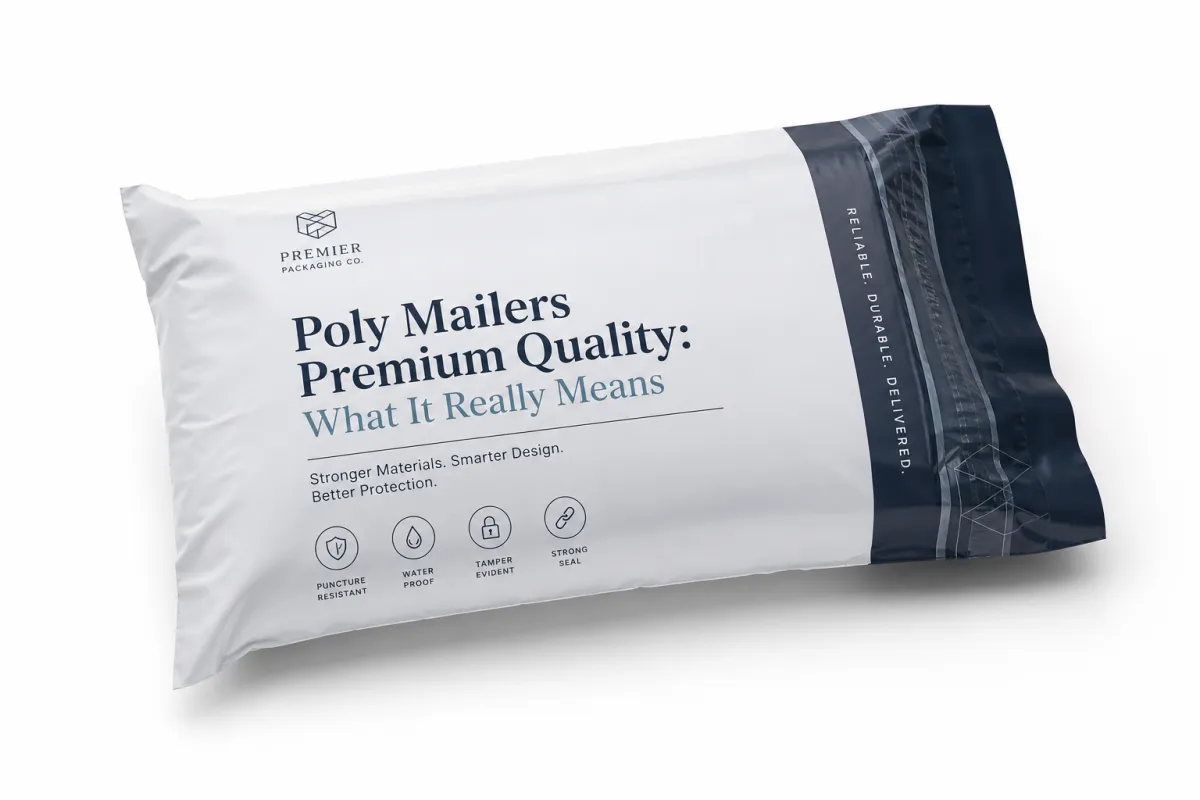
Poly mailers premium quality means a mailer that performs consistently, batch after batch, without turning every shipment into a small inspection project. The number printed next to thickness matters, but it does not tell the whole story. Better polymer blends, cleaner extrusion, stronger heat seals, and print that still looks sharp after a 6-hour truck ride all matter more than a single micron figure listed in isolation. A 2.5 mil bag from a disciplined factory in Jiangsu can outlast a sloppier 3.0 mil run if the resin mix and seal temperature are tuned correctly. That is why buyers who compare only the mil count often miss the real difference in poly mailers premium quality.
On a visit to a supplier in Suzhou, Jiangsu, a sales manager laid out three mailers that all claimed the same thickness and the same 10 x 13 inch size. One felt stiff and brittle, one felt soft and stretchy, and one had the right balance of flex and tear resistance after 20 hand pulls. The third one cost $0.04 more per unit on a 10,000-piece quote, which sounded irritating until we tested them with a 4-pound apparel order and a 2-inch stack of folded knitwear. The brittle bag split at the corner seam, the stretchy one wrinkled badly, and the balanced one passed without drama. Quiet differences like that rarely show up in product photos, which is half the problem. Quiet differences are also what separate ordinary mailers from poly mailers premium quality.
Thickness alone can mislead. I have seen 3.0 mil bags lose to a well-built 2.25 mil co-extruded mailer because the lower-thickness option had better seal strength and better control over tear direction. A serious supplier will talk about puncture resistance, seal integrity, opacity, and print holdout, not just toss a mil count into a quote and hope nobody asks follow-up questions. On a 2024 order in Ningbo, one supplier even listed the seal width at 8 mm and the outer film at 60 microns, which told me more than a polished brochure ever could. Honestly, I think that kind of lazy quoting is where a lot of procurement pain starts. It is also where a lot of supposedly premium mailer bags quietly fail.
If you need a wider view of what a packaging partner can supply beyond mailers, I often point buyers to Custom Packaging Products if they are comparing mailers with boxes, inserts, and branded shipping accessories. A brand shipping 3,000 orders a month from Dallas or Phoenix may save more by improving the whole outbound pack than by trimming 1 cent off a bag. Sometimes the smarter move is a better shipping system, plus fewer surprises for the packing team, who are usually the first people to spot a bad spec anyway. That is especially true when poly mailers premium quality has to fit into a broader ecommerce packaging workflow.
"A mailer can look expensive and still be junk. I learned that after one factory in Foshan spent $800 on beautiful print plates and then ignored a weak seal bar setting that ruined a whole carton of 500 bags."
That is the heart of poly mailers premium quality: not flashy, not fake premium, just dependable performance with enough margin in the material to survive real shipping abuse from a warehouse floor in Columbus to a porch in Atlanta. It is the kind of quality you only appreciate after the first bad batch has already cost you time, money, and a few hard conversations.
How Poly Mailers Premium Quality Performs in Shipping
A poly mailer has four jobs. It protects the product surface, resists tears, keeps out moisture, and stays closed until the customer opens it. Miss any one of those, and the package starts burning money through refunds, replacements, and customer service time. That is why poly mailers premium quality has to be judged in motion, not only on a desk under fluorescent light in an office that smells like cardboard and toner. In shipping, poly mailers premium quality is really a test of material engineering under pressure.
Picture the abuse a shipment takes. It gets compressed under cartons, rubbed against pallet wrap, shoved into a chute, and sometimes crushed by a heavier box that should have been taped better in the first place. Premium film handles that stress with controlled stretch, usually in the 12% to 18% range before failure, while cheap film stretches too fast, then snaps back unevenly or splits at the seam. The failure is rarely theatrical. The invoice that follows usually is, especially after a 300-unit return wave. That is why strong mailer bags matter so much in ecommerce fulfillment.
Working with an apparel brand shipping 8,000 units a month out of a warehouse in Nashville, I tracked damage by failure type for six weeks. The weak point was not the face film. It was the bottom seal. After we moved from a single-pass heat seal to a tighter, cleaner double-pass seal with a better adhesive strip, returns tied to open bags dropped from 1.7% to 0.4%, and the change paid for itself in roughly 11 days. That kind of operational win is not glamorous, but it is the sort finance teams actually notice. It is also a good reminder that poly mailers premium quality often pays back faster than buyers expect.
Premium performance also shows up in the packing room. Fulfillment teams notice when a bag opens cleanly, seals without a fight, and stays flat enough to stack 25 high on a cart. If line workers start muttering every time they pack 500 units, morale is not the only issue. Labor efficiency is bleeding out of the building. I have watched supervisors in Indianapolis switch to a higher-priced supplier because the team could pack 12% faster with fewer rewraps. That is not glamorous, but neither is watching a pallet of returns come back because the closure gave up halfway to Dallas. A smooth pack-out process is one of the clearest signs of poly mailers premium quality.
What Better Closure Systems Do
The adhesive strip matters more than most buyers expect. A weak closure can pop open under compression, especially when the mailer is overfilled by 1/2 inch or more or when the carton is kept at 90 degrees Fahrenheit in a warm trailer. A wider tack area with stronger adhesive closes more confidently and reduces the chance of a package opening in transit. In one negotiation in Xiamen, a supplier offered to shave $0.015 per unit by switching adhesive grades from 18 gsm to 14 gsm. I passed. That tiny saving was cheaper than one returned order and a lot cheaper than losing a customer’s trust. Better closure design is one of the quiet advantages of poly mailers premium quality.
If you are ordering custom printed mailers, start with Custom Poly Mailers and ask for sample grades that differ in film structure, closure style, and print coverage. A good sample pack tells you more than a polished sales deck ever could. I usually ask for the one that looks nicest, the one that costs least, and the one the factory would rather not send because it has the rawest edge cases. That last one is often the most useful, especially if you are trying to verify poly mailers premium quality before a bulk run.
That image is the real test. Not the mockup. Not the white-background carton shot. The actual bag in a warehouse, under 30 pounds of stacked cartons, with a seal that either holds or embarrasses you in front of the shipping manager. If the bag survives that moment, you are probably looking at poly mailers premium quality.
Key Factors That Define Poly Mailers Premium Quality
If I had to judge poly mailers premium quality in under five minutes, I would check five things: film structure, seal strength, print quality, dimensional consistency, and proof of claims. Thickness matters, but it is one piece of a much larger puzzle. A supplier in Vietnam may quote 2.3 mil, but if the seal bar is off by 15 degrees and the artwork bleeds at the edges, the number on the quote sheet does very little. The same goes for Mailer Bags That look impressive but cannot handle an ordinary ship-out.
Film Structure and Blend
Good film is usually a better blend, not just a thicker sheet. A co-extruded structure can combine outer-layer toughness with inner-layer flexibility, which is why some 2.5 mil mailers outperform clumsy 3.0 mil options. The better construction resists corner punctures and does not turn brittle in cooler shipping lanes. I have seen a sample pass in a warm showroom in Guangzhou and fail in a cold warehouse in Minneapolis after two hours at 41 degrees Fahrenheit. Temperature changes matter more than most product sheets admit, and I have never met a buyer who enjoyed learning that the hard way. That is why poly mailers premium quality starts with the film, not the print.
Seal Strength and Tear Behavior
Seal performance should be checked with actual pull tests and a basic field tear test. If a bag opens too easily at the seal, it is not premium. If it refuses to tear cleanly when the customer opens it, that is annoying but less dangerous. The dangerous part is a seal that looks fine and then splits under modest compression, like 8 pounds of stacked product in a carton. I ask suppliers for seal test data, not just a polished promise. If they only send me a brochure with smiling models and zero numbers, I already know the meeting is going to be longer than it should be. Good seal data is one of the cleanest signals of poly mailers premium quality.
Print Quality and Surface Finish
Print is a quality signal. Crisp edges, accurate Pantone matching, and no ink rub-off all matter because the package is the first physical brand touchpoint. On a branded shipment, blurry logos and color drift make the whole order feel cheaper even if the product inside is excellent. A soft-touch finish may look rich, but if it scuffs easily after 15 cart transfers, it stops feeling premium the moment it hits a sorter belt. I have literally seen a beautiful black mailer arrive looking like it fought a raccoon and lost. For that reason, poly mailers premium quality needs a print standard that survives handling, not just photography.
For environmental and compliance questions, I tell buyers to verify claims rather than trust a sales sheet. If a supplier says a material contains recycled content or supports sustainability claims, check the documentation and compare it with a credible source like the U.S. EPA’s recycled materials guidance at epa.gov. If you want to understand transport testing, the standards used by serious shippers often point to ista.org. Standards do not make a weak bag strong, but they do keep everyone honest. That alone saves a lot of wishful thinking, and it helps separate real poly mailers premium quality from label-deep claims.
Size Consistency and Tolerance
This one gets ignored all the time. A supplier might quote 10 x 13 inches, but if the tolerance swings too much, your packing line wastes time and material. Bags that come 1/4 inch short create overstuffed closures. Bags that come 1/2 inch oversized create sloppy presentation and wasted freight volume. For high-volume programs, I want tolerances written on the spec sheet, not whispered later like a favor. A good range might be +/- 2 mm on width and +/- 3 mm on length, depending on the factory. Tight tolerances are part of poly mailers premium quality because they keep the workflow predictable.
I once had a client reject a shipment because the usable width drifted by nearly 0.3 inch across cartons from the same production lot in Taicang. The mailers were technically usable. They were also a pain in the neck. In a 20,000-unit order, a small size problem becomes a loud operations problem, the sort of loud problem that wakes up accounting and the warehouse manager at the same time, which nobody wants. That sort of drift is exactly what premium mailer bags are supposed to prevent.
Proof of Claims and Paperwork
Ask for test reports, material descriptions, and if needed, recycled-content evidence. Do not accept "factory standard" as documentation. That phrase is basically packaging for "trust me, bro." If the supplier cannot prove the film blend, the seal method, or the print process, then you are buying on hope. Hope is not a procurement strategy, especially not for a 12,000-piece order headed to a fulfillment center in New Jersey. Real poly mailers premium quality should come with paper trails, not just promises.
In my experience, the best poly mailers premium quality suppliers answer boring questions quickly: what is the film layer count, what is the adhesive coat weight, what is the size tolerance, and what is the carton pack count? A serious factory in Dongguan might answer within 4 business hours, while a weaker one takes 3 days and sends half the details missing. That level of specificity saves time later. It also tends to separate the factories that run on discipline from the ones that run on optimistic guessing. If the answers are crisp, your odds of receiving true premium mailers improve fast.
Poly Mailers Premium Quality Cost and Pricing
Pricing for poly mailers premium quality comes from several places: resin cost, film construction, print setup, adhesive upgrades, custom sizing, carton packing, and order volume. A quote that looks unusually cheap does not make me happy. It makes me look for the hidden tradeoffs, because a bag that costs $0.11 today and fails in transit can become a $9 replacement shipment tomorrow. That is the hidden math behind a lot of poly mailers premium quality decisions.
One real-world example sticks with me. A Shenzhen factory quoted $0.15 per unit for 5,000 pieces of Custom Printed Mailers with a two-color logo, a better adhesive strip, and 2.25 mil film. The same supplier then added $120 for plates, $65 for sampling, and $210 for freight to the forwarder in Long Beach. The bag price itself was honest enough. The total project price was the number that mattered, especially after the buyer compared it with a plain stock option at $0.09 per unit. The more premium the build, the more carefully you need to read the full quote.
That is the trap. Buyers compare unit price and ignore the rest. Then tooling, freight, paperwork, and minimums appear in the quote like a bad joke with a long setup. I have seen "cheap" mailers become the most expensive option after one damaged shipment and a second urgent reorder. Nobody enjoys explaining that one to a finance team in March after the holiday shipping rush. I certainly do not miss those emails. Poly mailers premium quality is where total landed cost starts to matter more than headline price.
| Grade | Typical Build | Indicative Price | Best For | Risk Profile |
|---|---|---|---|---|
| Budget | 1.5-1.8 mil, basic seal, simple print | $0.08-$0.12/unit at 10,000 pieces | Light apparel, low-risk items | Higher tear and seal failure risk |
| Mid-Grade | 2.0-2.5 mil, improved adhesive, better opacity | $0.12-$0.18/unit at 5,000-10,000 pieces | Most ecommerce shipments | Balanced cost and performance |
| Premium | 2.5-3.0 mil co-extruded film, stronger seal, crisp print | $0.18-$0.32/unit at 3,000-10,000 pieces | Branded programs, sharper products, heavier items | Lowest damage risk, higher upfront spend |
Those numbers shift with resin markets, print colors, and factory location. A quote from Yiwu can look very different from one out of Ho Chi Minh City or coastal China once you add freight, carton packing, and customs handling. Resin prices dip, then jump, and everyone suddenly becomes lyrical about "market volatility." That phrase usually means somebody is trying to explain why last month’s quote vanished into thin air. It also explains why poly mailers premium quality needs a pricing check that includes landed cost.
When you compare suppliers, ask for five line items: unit price, setup or plate cost, sample charge, freight terms, and minimum order quantity. If you only ask for the unit price, confusion is guaranteed. I also tell buyers to request landed cost for a real order size, not a theoretical quote that only works if they buy 50,000 pieces and ship by a route that leaves on Tuesday. A good comparison might show $0.16 landed from Shenzhen versus $0.19 landed from Ningbo, which is the comparison that actually matters. That is the level at which poly mailers premium quality becomes a useful procurement decision.
The best way to think about poly mailers premium quality is simple: if a better bag saves you one damaged shipment per few hundred orders, the economics shift quickly. Returns, re-pack labor, customer complaints, and reshipments add up in a way most spreadsheet models forget. A bag that costs $0.05 more and prevents 2% damage can easily win, especially on a 20,000-order month. In other words, the right mailer bag can be cheaper than the cheap one.
Price also changes based on branding. A single-color logo is cheaper than full coverage print. A matte finish, spot gloss, or metallic ink adds cost. Larger runs bring the per-piece price down, but only if the factory is set up correctly and the file is clean. I have watched a buyer save $300 on price and lose two weeks because the artwork arrived in the wrong format, then had to be rebuilt in AI and PDF files. That sort of delay is a special kind of annoying because the money you "saved" never actually shows up in your hands. For poly mailers premium quality, the cheapest quote is often the slowest route to a real result.
Step-by-Step Process and Timeline for Ordering
Ordering poly mailers premium quality should follow a structured process, not a guessing game. The cleanest orders I have handled all moved through the same sequence: specs, quote, sample, approval, production, packing, inspection, and shipment. Skip one step, and the schedule starts to wobble fast, especially if the destination is split between a West Coast port and a Midwest fulfillment center. A good process is the difference between a smooth launch and a very avoidable backlog.
- Gather specs. Size, thickness, print coverage, closure type, quantity, destination, and whether you need custom branding or plain stock.
- Request quotes. Ask for unit price, setup fees, sample fees, freight terms, and lead time in writing.
- Review samples. Test the bag with your actual product, not just paper or some random office desk object.
- Approve artwork. Check Pantone colors, logo placement, bleed, and readability on the chosen film finish.
- Run production. Ask for a pre-production sample if the order is large or the print is complex.
- Inspect and ship. Confirm carton counts, outer pack labels, and whether the shipment is going by air or ocean.
For timing, a realistic sample window is 3 to 10 business days if the artwork is ready and the film spec does not change. Production for a custom run often takes 12 to 18 business days after approval, with 12 to 15 business days being common for a straightforward order approved on Monday. Add 5 to 7 days for air freight or 20 to 35 days for ocean freight, depending on route and customs. That is the boring truth, and boring truth is what keeps launches from slipping. It is also the rhythm that usually supports poly mailers premium quality without late-stage surprises.
I have sat through too many meetings where the buyer wanted sample approval "by tomorrow" but had not even confirmed bag size, print side, or quantity split. That delay is self-inflicted. Faster results come from exact dimensions, clear print coverage, and a target quantity that the supplier can actually plan around. Vague briefs create vague output. Then everyone acts surprised when the factory ships a quote-shaped mistake. Good poly mailers premium quality projects usually begin with precise specs.
"Our packing room stopped rework almost overnight once the spec sheet included usable width, seal width, and carton count. Before that, every pallet had a surprise, usually on the bottom row."
For a broader look at packaging formats before locking in one, it helps to review Custom Packaging Products alongside your mailing bag quote so you can choose the right mix of bags, inserts, and shipping materials for a 90-day forecast instead of just one rush order. That wider view often makes poly mailers premium quality easier to justify.
My practical timeline looks like this: day 1 for specs and quote, days 2-5 for sample review, days 6-8 for artwork confirmation, days 9-24 for production, and then transit. If a supplier says they can do everything in five days, ask how many corners they are cutting and whether they are skipping the proof stage. Usually, the answer is "enough." A legitimate poly mailers premium quality order rarely needs fantasy scheduling.
Common Mistakes That Quietly Kill Quality
The biggest mistake is judging the bag by appearance alone. I have seen gorgeous glossy mailers fail harder than plain ones because the seal was weak and the film was brittle after a 2-mile forklift ride and a hot afternoon in a loading dock. Pretty is not proof. Poly mailers premium quality has to survive pressure, friction, and stacking, not just a photoshoot in front of a white cyclorama. If the bag only looks premium, it is not premium.
The second mistake is buying on thickness alone. Microns or mils matter, but they do not tell you enough. A 3.0 mil mailer with poor seal control can be worse than a 2.25 mil mailer with stronger structure. If the supplier cannot explain the film layers and seal process, the real point is getting missed, and usually the missing detail is the one that costs the money later. Real poly mailers premium quality depends on how the materials work together.
The third mistake is ignoring size fit. An overstuffed bag stresses the adhesive and makes the seams work too hard. A bag that is too large wastes material and looks sloppy. I once helped a cosmetics client in Los Angeles fix a problem caused by ordering a bag that was 1 inch short on usable length. The product fit. The seal did not. That is not a small mistake when an entire shipment depends on it, especially if 6,000 units are already printed. Proper fit is a basic feature of poly mailers premium quality.
The fourth mistake is skipping samples, or worse, accepting one perfect sample as proof of stable production. I have seen factories hand-build a flawless sample in 24 hours and then run a loose production batch two weeks later. Sample approval helps, but it is not a substitute for quality control. If real money is on the line, ask for a production sample or a pre-shipment inspection on the first 1,000 units. That step protects poly mailers premium quality from one-off showroom tricks.
The fifth mistake is chasing the lowest quote from a supplier you have never vetted. Price matters. Of course it does. Yet communication, QC process, and the ability to repeat a spec matter more over time. One supplier in Ningbo quoted me $0.03 less per piece, then missed two color matches and a carton label spec in the same order, which turned into a 3-day rework. Cheap becomes expensive fast when the factory is improvising. In packaging, improvised is just another word for risky.
One more thing: do not accept recycled-content or eco claims without proof. If a supplier says the bag is made with recycled material, ask for documentation and test reports. I care more about honest sustainability claims than a green label slapped onto weak packaging. Pretending is easy. Proving it costs more. And if that sounds a little cynical, well, it is because I have seen too many shiny claims fall apart the minute someone asked for paperwork. True poly mailers premium quality should stand up to both performance tests and documentation checks.
Expert Tips for Poly Mailers Premium Quality
If you are ready to buy, start with a short audit. Pull the last three months of damage claims, late deliveries, and packing complaints. If the numbers show a recurring issue, your current mailer is telling you something. The bag is not being dramatic. It is being accurate, and a 1.8% damage rate is usually more useful than a dozen opinions in a conference room. That sort of data is the fastest path toward poly mailers premium quality that actually matters.
Request two or three sample grades: one budget version, one mid-grade, and one true premium option. Test them with your actual product weights, not a random office sample. If you ship hoodies, load a hoodie. If you ship cosmetics, pack the worst-case shape, not the nicest one. Poly mailers premium quality shows up when the package meets the real item, not the specimen that sits politely on a conference table. The test should resemble shipping, not a showroom demonstration.
My Basic In-House Test Plan
- Seal check: Pack 20 units, close them, and press each one for 10 seconds across the seal line.
- Drop test: Drop a packed mailer from waist height, then inspect the corners and closure strip.
- Scuff test: Rub the printed surface against another mailer 25 times and see if the logo loses clarity.
- Puncture test: Place the product with its sharpest edge facing the inside corner and verify the film holds.
- Line-speed test: Have a packer process 50 units and note where the bag slows the workflow.
Keep one approved sample on file. Label it with the order number, the supplier, the material spec, and the date. I cannot count the number of arguments that disappear once someone can physically compare a new shipment to the signed-off sample. A photo helps. A real sample settles disputes. I once watched a warehouse lead in Richmond win a debate in 30 seconds because he walked over with the approved bag in his hand. No speech. No spreadsheet. Just reality. That is the practical side of poly mailers premium quality.
I also recommend a supplier scorecard. Give each vendor a score from 1 to 5 on price, communication, consistency, on-time delivery, and problem-solving. Add landed cost, not just unit cost. The supplier that looks cheapest on paper can lose once freight, delays, and QC rework get counted. I learned that the hard way after a low quote from a regional factory came with two missed ship dates and a carton spec that required hand relabeling across 18 pallets. That was the sort of week that makes coffee look like a strategic resource. A scorecard keeps poly mailers premium quality grounded in facts instead of optimism.
My blunt advice: do not overpay for shiny nonsense, but do not cheap out on a bag that protects your brand 100,000 times a year. The right poly mailers premium quality order should make packing faster, returns lower, and product presentation stronger. That is a real business result, not marketing fluff, and it is measurable in fewer damaged cartons, fewer support tickets, and fewer refunds. If the bag does all that, it has earned its place.
Before placing the bulk run, compare the specs, test the samples, and ask for a clear landed cost. Then compare them again against the items that will actually ship inside the bag. That is how I decide whether a mailer is truly poly mailers premium quality or just dressed up to look that way. The bag should earn its premium through performance, not through adjectives.
Frequently Asked Questions
How do I know if poly mailers premium quality are actually worth it?
Compare damage rates, return rates, and packing speed against your current mailers instead of looking only at unit price. If the better bag reduces failures on a 5,000-unit month, the savings usually show up in fewer replacements and less customer support cleanup. Ask for samples and test them with your heaviest and sharpest products before deciding on poly mailers premium quality. I usually want a little abuse in the test, because shipping is not gentle and pretending otherwise is how people end up chasing refunds.
What thickness is best for poly mailers premium quality?
Thickness alone should not decide it; the film blend and seal quality matter just as much. I usually prefer a 2.25 to 2.75 mil construction for apparel, but heavier or sharper items may need more. Ask the supplier for real performance specs, not just a number on the quote, because poly mailers premium quality is about behavior, not bragging rights. A 2.5 mil co-extruded bag from Suzhou can outperform a generic 3.0 mil bag if the resin mix is cleaner.
Are poly mailers premium quality expensive to customize?
Customization usually adds cost through print setup, color matching, and sometimes minimum order quantities. A simple one-color logo might add $0.01 to $0.03 per unit, while more complex art can climb higher. The per-piece price drops as volume rises, so small runs look expensive and larger runs usually make more sense for poly mailers premium quality. If a vendor promises full custom work for pennies, I start looking for the catch before they finish the sentence.
How long does it take to produce custom poly mailers premium quality?
Sample approval can take 3 to 10 business days depending on artwork and material changes. Production and packing often take 12 to 18 business days after approval, and a straightforward run can land in the 12 to 15 business day range once the proof is approved. Then shipping time depends on whether you choose air or ocean freight. The fastest orders come from clear specs, quick sample feedback, and a supplier that is actually organized about poly mailers premium quality.
What should I test before ordering poly mailers premium quality in bulk?
Test seal strength, puncture resistance, scuffing, and how the mailer holds up when packed with your real product. Check whether the adhesive stays closed after handling, compression, and a basic drop test from waist height. Confirm the color, opacity, and size tolerance match your brand and packing workflow before you commit to poly mailers premium quality. If you can, watch someone on the line use the sample too; the look on their face tells you a surprising amount.

