Buyer Fit Snapshot
| Best fit | Order Custom Printed Mailers No Minimum for Brands projects where brand print, material claims, artwork control, MOQ, and repeat-order consistency need to be specified before quoting. |
|---|---|
| Quote inputs | Share finished size, material target, print colors, finish, packing count, annual reorder estimate, ship-to region, and any compliance wording. |
| Proofing check | Approve dieline scale, logo placement, barcode or warning zones, color tolerance, closure strength, and carton packing before bulk production. |
| Main risk | Vague material claims, crowded artwork, missing packing details, or unclear freight terms can make a low unit price expensive after revisions. |
Fast answer: Order Custom Printed Mailers No Minimum for Brands should be specified like a repeatable production item. The safest quote records material, print method, finish, artwork proof, packing count, and reorder notes in one written spec.
Production checks before approval
Compare the actual filled-product size with the drawing, then confirm tolerance on folds, seals, hang holes, label areas, and retail display edges. Reserve space for logos, QR codes, warning copy, and material claims before decorative graphics fill the panel.
Quote comparison points
Review material grade, print process, finish, sampling route, tooling charges, carton quantity, and freight assumptions side by side. A quote is only useful when the supplier can repeat the same color, closure quality, and packing count on the next order.
Order Custom Printed Mailers No Minimum for Brands - I remember a founder in Atlanta sliding a dented carton across a folding table and saying, with the kind of calm that only comes from panic, "I need to Order Custom Printed mailers no minimum before Friday." The problem was not vanity packaging. It was cash flow, a 3 p.m. fulfillment cutoff, and whether the business could ship 240 orders from a 1,400-square-foot warehouse without tying up another $2,000 in inventory. For startups, DTC labels, subscription boxes, and seasonal drops, no-minimum branded packaging removes one very real obstacle between idea and launch.
Why Brands Order Custom Printed Mailers No Minimum
I have watched this same decision surface in three very different places: a garage startup in Austin shipping 48 orders a week, a beauty brand in Miami preparing for a 300-unit pop-up, and an apparel founder in Brooklyn who refused to let 8,000 plain mailers sit in a storeroom for half a year like some expensive monument to optimism. The first question was never about taste. It was about whether they could order Custom Printed Mailers no minimum and keep the launch alive without locking money into cartons they might never use.
The math explains the hesitation. Buy 5,000 poly mailers at $0.22 each and you have $1,100 tied up before a customer even sees the package; buy 10,000 at $0.15 per unit and the sticker price improves, but the storage risk gets heavier, not lighter. Change the palette, rename the SKU, or shift the art direction and that stack of inventory starts looking like a very expensive reminder of what not to do. Ordering Custom Printed Mailers no minimum keeps money moving, which matters when your monthly ad spend is $4,500 and your inventory budget is already under pressure.
I still remember a supplier meeting in Los Angeles where a founder wanted to test two bundle sizes in the same month: a one-item launch kit and a three-item gift set. The packaging spec changed twice in eight days, from 9 x 12 inches to 10 x 13 inches after the final product sample arrived from San Diego. A bulk run would have locked them into the wrong dimensions, which is exactly the sort of thing that makes you want to stare at the ceiling for ten minutes. Instead, they chose to order custom printed mailers no minimum, printed the logo once, and used the same branded shell across both campaigns.
The value goes beyond budget math. Custom mailers create visual consistency, and repetition creates memory. A customer who sees the same mark, same color field, and same layout on every shipment starts linking the parcel to the brand, just as a shopper remembers a retailer by the shape of its carrier bag or the weight of its tissue paper. That connection matters whether you ship leggings, skincare samples, protein bars, or light accessories under 1.5 pounds. It also explains why order custom printed mailers no minimum has become a practical starting point for companies that are not ready for custom printed boxes but still want Packaging That Feels deliberate.
Many brands delay packaging because they mistake "small run" for "small effect." Those two ideas are not related. A 500-piece launch can leave a stronger impression than a warehouse full of generic supplies if the print, size, and presentation are right. I have watched buyers reverse course after seeing one strong proof from a factory in Shenzhen, Guangdong: a matte white mailer with a 1-color black logo, a 0.5-inch border, and a clean self-seal strip that made a $6 T-shirt look like a $26 purchase. They stop thinking like commodity shoppers and start thinking like packaging builders, comparing retail packaging and product packaging with a little more nerve.
The real question is not whether the mailer should be branded. The real question is how much risk you want to carry before demand is proven. That is why many teams choose to order custom printed mailers no minimum for test drops, influencer sends, and location-specific campaigns where every SKU decision still feels provisional. A 200-piece pilot in Chicago can tell you more than a spreadsheet with 12 months of optimistic forecasts.
Product Details: What Comes with Custom Printed Poly Mailers
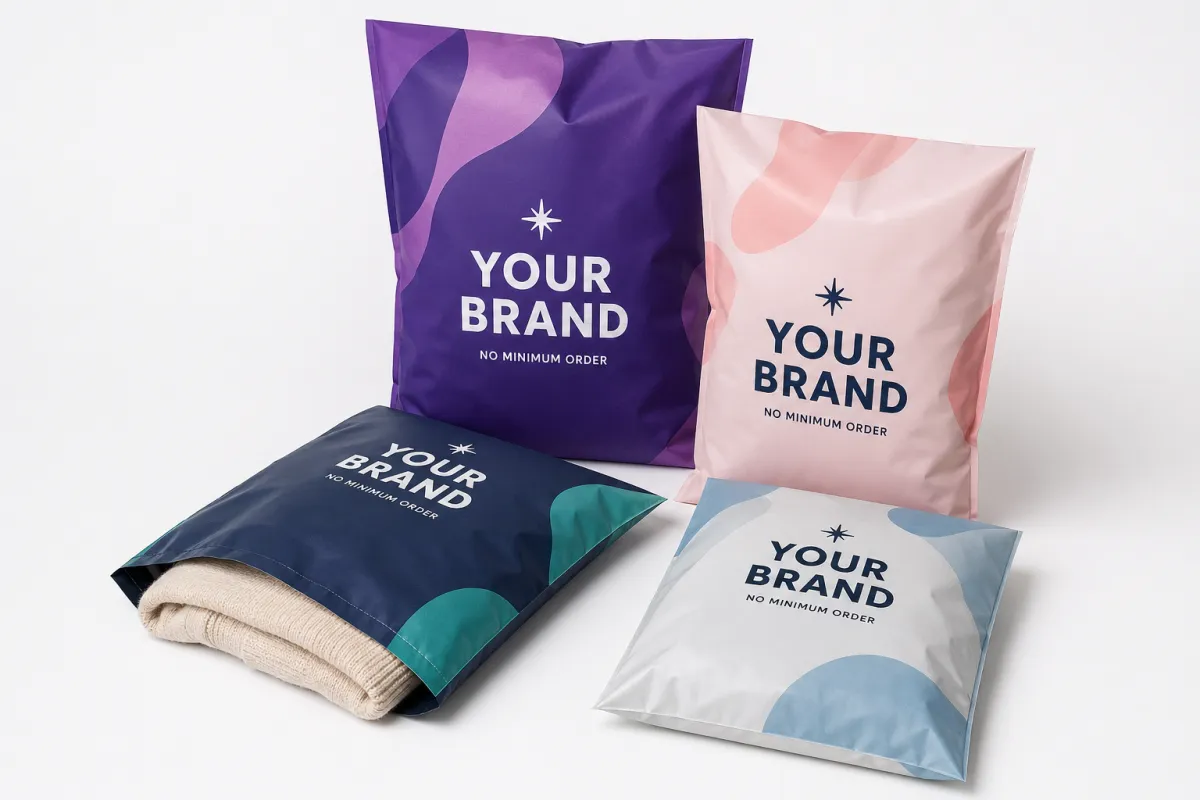
Buyers usually want three things from custom printed mailers: a size that fits, a print that looks crisp, and a closure that survives transit. Our custom Printed Poly Mailers are made from lightweight polyethylene film, usually in the 2.5 mil to 3 mil range for standard apparel and accessory shipments, with 100% virgin LDPE available for brands that want a cleaner, more uniform print surface. That thickness gives a solid balance of flexibility, moisture resistance, and shipping efficiency, especially for products that do not need a rigid carton or a 350gsm C1S artboard insert to stay presentable.
Most brands use them for apparel, socks, cosmetics, small soft goods, and lightweight consumables. They fit e-commerce orders well because they can lower dimensional weight compared with boxes, which can change postage in ways people only notice after the first invoice lands. A 10 x 13 mailer for folded tees is not the same as a 14.5 x 19 mailer for hoodies, and that size choice should be made before you order custom printed mailers no minimum. Too small, and the seam strains at the fold line; too large, and you pay to ship air while the package loses visual discipline.
Customization usually includes logo placement, one-color or full-color printing, and outside printing on a white, kraft, or tinted surface. Some buyers ask about inside printing, but the better question is what actually creates value. A strong front-facing logo and a disciplined color field often do more for package branding than trying to decorate every panel with gradients and taglines. That is especially true when you order custom printed mailers no minimum, because a simpler layout usually moves faster and is easier to proof in a 15-minute review call.
The structure matters as much as the appearance. A self-seal adhesive strip, opaque film, and tear resistance are not cosmetic extras; they are the features that protect product packaging in motion. I have seen brands obsess over a logo shade and then forget to ask whether the adhesive is tamper-evident or whether the film is opaque enough for privacy in a city like New York, where deliveries often sit in lobbies for 20 to 40 minutes before pickup. That tension is common: polished branded packaging has to survive a parcel network that does not care about your palette or your mood board.
"The mailer has one job before it has a brand job: get the product there intact. If it looks good too, that is the bonus."
That is also why I keep telling first-time buyers to compare custom printed mailers with custom printed boxes instead of treating them as rivals. Boxes are better for fragile, premium, or mixed-product shipments, especially if the contents need a 350gsm C1S artboard insert or a rigid interior tray. Poly mailers are better for low-bulk, lightweight orders that need speed and efficiency. Both can support retail packaging and product packaging, but they answer different problems. If your order mix is still changing, it often makes sense to order custom printed mailers no minimum first and move to a box program later.
For brands that want a broader view of packaging options, our Custom Packaging Products page is a useful starting point, and the category page for Custom Poly Mailers shows how the format behaves at different sizes and print layouts. If you are still mapping the buying process, our FAQ page answers common questions about artwork, proofing, reordering, and freight from production hubs in Shenzhen and Dongguan.
Specifications to Check Before You Order Custom Printed Mailers No Minimum
The quickest way to waste money is to skip the spec sheet. Before you order custom printed mailers no minimum, check dimensions, thickness, material type, print area, adhesive style, and color options. Those six details determine whether the mailer fits the product, prints clearly, and holds up after the carrier scan, the sortation line, and the last-mile handoff from a depot in Dallas or a sorting center in Frankfurt.
Start with size. A mailer that is 9 x 12 inches may be right for folded T-shirts, while a 12 x 15.5 or 14.5 x 19 inch format may fit hoodies, layered apparel, or boxed inserts. Oversized mailers do not just look loose; they can raise postage by $0.60 to $1.40 per parcel depending on the carrier and zone. Undersized mailers can crease printed inserts or strain the seam. When you order custom printed mailers no minimum, a 1-inch difference can matter more than a 10% discount.
Thickness is the next lever. In practical terms, lighter goods can do well in 2.5 mil film, while heavier garments or rougher shipping routes may need 3 mil or more. I visited a converting floor in Dongguan where an operator pointed to a run that failed because the spec was too thin for the product weight. The artwork was not the issue. The film was. That kind of mistake usually appears only after boxes are sealed and labels are printed, which is why order custom printed mailers no minimum should begin with the product profile, not the art file.
Then comes print setup. Most brands will need a vector logo file, usually AI, EPS, or print-ready PDF, with a 0.125 inch bleed and a safe zone that keeps key elements away from the seal and edges. If your brand uses exact Pantone references, say so early; if CMYK approximations are acceptable, document that too. Clear files shorten proofing. That matters even more when you order custom printed mailers no minimum because small runs often move quickly, and nobody wants to lose a day to missing fonts, low-resolution screenshots, or a logo exported at 72 dpi.
There are also practical limits that can speed production. Many no-minimum programs offer a narrower stock color range, fewer finishing choices, and simplified print zones. Some buyers see that as a drawback. I see it as a trade: fewer choices, fewer delays, fewer chances for the job to stall. If you need metallic ink, interior printing, or a complicated multi-panel layout, a larger run may fit better. If you just need brand presence and clean execution, order custom printed mailers no minimum is often the sharper path.
For buyers who like a checklist, I recommend this order of review:
- Dimensions: match the product plus any insert, tissue, or filler, such as a 9 x 12 shirt fit or a 14.5 x 19 hoodie fit.
- Thickness: confirm the film can handle product weight and transit stress, usually 2.5 mil or 3 mil.
- Print area: verify logo size, safe zones, and edge clearances, especially if the seal sits within 0.75 inches of the top.
- Seal style: choose a self-seal adhesive that closes cleanly under pressure and resists re-open attempts in transit.
- Artwork files: send vector logos, fonts outlined, and color notes with Pantone references if the brand requires exact matching.
- Quantity: set a run that supports your current sales window, whether that is 250 pieces for a pop-up or 5,000 pieces for a quarter.
I also tell clients to think in terms of shipment behavior, not just appearance. If the mailers are moving through humid hubs in Houston or Manila, moisture resistance matters. If the product is going to subscription customers, repeat presentation matters. If the order supports a launch, the proof cycle matters even more. To validate transit expectations, I often point teams toward ISTA testing guidance, because the packaging standard should be measured against the journey, not the mood board. For brands comparing material choices and waste goals, the EPA's materials management resources at EPA are useful context too.
Pricing and MOQ When You Order Custom Printed Mailers No Minimum
Pricing follows a simple pattern, even if the quote sheet looks complicated. Size, print complexity, material choice, and quantity drive the number. A one-color logo on one side usually costs less than a full-wrap design on both sides. A 500-piece run almost always carries a higher unit price than a 5,000-piece run. That is ordinary. What matters is total cash outlay, storage exposure, and how confidently you can forecast use. That is why many buyers still choose to order custom printed mailers no minimum even when the unit price is higher.
Here is the comparison I walk clients through in real meetings. A small business might spend $420 for 1,000 branded mailers at $0.42 each, plus $65 to $180 in freight depending on destination. A larger bulk order might land at $1,950 for 10,000 mailers at $0.195 each. The larger order looks cheaper on paper, yet it also ties up more than four times the capital and creates a storage problem if sales slow or artwork changes. If the design is still evolving, that inventory risk may be acceptable. If the SKU mix is still changing, order custom printed mailers no minimum gives you cleaner financial control.
For planning, this is the kind of pricing structure I see most often. These are illustrative ranges, not a quote, but they show how the economics move across a 90-day buying window:
| Scenario | Example Quantity | Illustrative Unit Cost | Estimated Total | Best Fit |
|---|---|---|---|---|
| Test Run | 250 to 500 | $0.68 to $1.10 | $170 to $550 | Prototype packaging, pop-ups, first launch |
| Launch Batch | 1,000 to 2,500 | $0.34 to $0.52 | $340 to $1,300 | DTC drops, influencer sends, seasonal kits |
| Recurring Run | 5,000 to 10,000 | $0.15 to $0.28 | $750 to $2,800 | Established product lines, repeat replenishment |
Those figures leave out a few extra costs that smart buyers ask about early. First is artwork adjustment, which can be minimal if the logo is print-ready but can reach $35 to $120 if the file needs cleanup, font outlining, or color correction. Second is proofing, where a prompt approval can save two or three business days. Third is freight, which changes with volume and destination. A 300-unit box of mailers can move very differently from a 6,000-unit pallet. If you want the full landed cost, ask for the freight line before you approve the job. That is the point where many first-time teams realize why order custom printed mailers no minimum is not just a packaging decision; it is a working-capital decision.
I once sat with a buyer negotiating a seasonal launch out of Portland. He wanted two designs, three sizes, and a rush freight option from the West Coast to a warehouse in Indianapolis. The total looked messy until we compared it with the cost of sitting on 12,000 generic mailers that would not fit next quarter's assortment. Once freight, storage, and write-off risk were added back in, the no-minimum route won by a wide margin. The lesson was plain: the cheapest unit cost is not always the cheapest program. The spreadsheet is often the loudest liar in the room.
It also helps to compare mailers with other product packaging paths. Custom printed boxes often make sense above a certain weight or fragility threshold, but they add carton cost, cube, and usually more labor. A rigid mailer with 350gsm C1S artboard insert cards can feel premium for cosmetics or stationery, but that is a different build from a soft poly mailer used for tees. Poly mailers are faster to pack and cheaper to ship for the right products. For brands in a testing stage, order custom printed mailers no minimum can be the sharper financial tool because it keeps the total commitment small while still upgrading package branding.
Process and Timeline: From Artwork to Delivery
The ordering flow should be straightforward, and if it is not, somebody is hiding friction under polite language. The process is usually: request a quote, confirm dimensions and quantity, submit artwork, review the proof, approve production, and ship. That is the clean version. In practice, the thing that slows the job down is usually the same one thing: incomplete files. A logo sent as a screenshot, a font not outlined, or a missing Pantone reference can add a day or two. When you order custom printed mailers no minimum, the schedule rewards preparation.
I have seen a 48-hour delay caused by a single color note. The client said "navy" and the proof team needed more than that. Was it a deep ink navy, a cool blue-black, or the brand's exact Pantone 2965 C? That difference changes the screen and the output. If you want the proof to move quickly, send the logo file, color codes, exact dimensions, and placement notes together. A clean reference package saves more time than a follow-up email ever will, especially when the production team is split between Shenzhen and a domestic check station in California.
Simple artwork usually moves faster than multi-color layouts, and that stays true whether you order 500 units or 5,000. A one-color front print on a stock mailer can move in a tight window if the proof is approved promptly. More complex layouts, especially if they include both sides or multiple logo zones, take longer because the print area and registration need more checking. I have watched a factory floor in Shenzhen stop a job for 20 minutes because the logo sat 2 mm too close to the edge. That pause saved the brand from a visible defect, but it also proved the larger point: small runs leave less room to hide mistakes.
As a planning rule, I usually tell clients to allow 12 to 15 business days from proof approval to delivery for standard runs, though the exact timeline changes with quantity, shipping lane, and seasonality. If the job is a no-minimum order with a simple one-color logo, you may be able to move faster. If the job includes multiple sizes, special inks, or custom freight, the clock stretches. That is the trade: order custom printed mailers no minimum and you gain speed at the front end, but the proof still has to be right or you spend the savings later.
Rush orders are possible in some cases, but rush orders rarely erase bad preparation. They simply compress the consequences. I have seen brands pay extra freight to make a launch date after discovering a typo in the web address printed on the mailer. That is an expensive lesson, and one that a three-minute proof review would have prevented. If your campaign depends on an event date, confirm your artwork, size, and quantity before you even ask for a rush quote. The easier the information exchange, the more likely you can order custom printed mailers no minimum and still meet the calendar.
One last detail: always confirm packaging during transit, not just production. A mailer that prints beautifully and tears in a humid warehouse still fails. A mailer that seals properly but loses opacity when stacked against light also fails. The timeline matters because every stage of the process reveals a different risk, and the point of custom printed mailers is to reduce friction, not invent a new kind of it.
How Do You Order Custom Printed Mailers No Minimum?
The shortest answer is this: send the size, artwork, quantity, and shipping destination, then approve the proof quickly. If you want to order custom printed mailers no minimum without wasting a week, treat the request like a production brief rather than a casual inquiry. The cleaner the brief, the cleaner the quote.
In practice, the process looks like four steps. First, choose the mailer size based on the product, not the box you happen to have left in storage. Second, upload a vector logo or print-ready PDF with your color references. Third, confirm whether you want one-color, full-color, or outside-only printing. Fourth, review the proof for spacing, Pantone matching, and seal placement. A buyer who does those four things can usually move from quote to production much faster than a buyer who sends "need mailers, pls advise."
If you are trying to order custom printed mailers no minimum for a test drop, I usually recommend a conservative quantity and a simple design. Small runs punish indecision less than they punish complexity. Think of it like a chef's knife rather than a whole block of tools: one clean cut, fewer chances to nick the counter. The same logic applies to branded packaging. A strong logo, correct size, and durable material do more for the unboxing moment than a crowded design that has to be explained.
For many brands, the smartest path is to order custom printed mailers no minimum first, measure how the packaging performs for one or two cycles, then scale into a larger run once the SKU mix stabilizes. That is not hesitation. It is field research with a shipping label attached.
Why Choose Custom Logo Things for Brands That Order Custom Printed Mailers No Minimum
Custom Logo Things exists for the exact buyer who needs branded packaging without carrying unnecessary inventory. If your team wants to order custom printed mailers no minimum, the value is not just that the minimum stays low. The value is the ability to test, adjust, and reorder without rebuilding your packaging strategy every time the SKU mix changes.
That matters because packaging is rarely static for long. A DTC brand might add a new colorway, a subscription company might resize inserts, and a seasonal business might shift from soft goods to bundled kits by the next quarter. In each case, no-minimum branded mailers reduce the cost of change. You can ship a clean, consistent parcel today and still keep room to revise tomorrow.
We also focus on the practical side of production: clear proofs, readable size guidance, and artwork checks that catch problems before they become freight problems. A lot of suppliers can print a logo. Fewer can help a buyer think through the relationship between mailer size, material thickness, and shipping behavior. That is the difference between custom printed mailers that look fine on screen and custom printed mailers that perform in the real world.
For brands comparing packaging formats, we can also help evaluate whether custom printed boxes, rigid mailers, or poly mailers are the better fit. Sometimes the answer is obvious; sometimes it is not. A 6-ounce accessory shipped across town does not need the same package as a curated gift set shipping across the country. We help teams decide where to keep things simple and where to spend more.
- Low minimums for test runs and first launches
- Mailer size guidance based on product fit and shipping cost
- Artwork review support for cleaner proofs and fewer delays
- Branded packaging options that balance appearance with transit durability
- Support for e-commerce packaging, launch kits, and repeat replenishment
If your team wants to order custom printed mailers no minimum and keep the process focused, our job is to make that feel less like a procurement puzzle and more like a packaging decision with a clear endpoint.
Next Steps to Order Custom Printed Mailers No Minimum
If your launch date is close, the next move is simple: decide the product size, prepare the artwork, and request a quote. That first step usually reveals more than a long planning document ever could. Once you know the mailer dimensions and print requirements, you can compare pricing across quantity tiers and decide whether to order custom printed mailers no minimum for the test phase or move into a larger run.
I suggest starting with one SKU and one mailer size if your assortment is still shifting. A focused test tells you whether the packaging fits the product, how the seal behaves under packing pressure, and how the branded shell reads in photos, on doorsteps, and in the hands of customers. That information is worth more than a stack of speculative inventory. It is the difference between guessing and knowing.
If you already know the size and design direction, send the logo file, Pantone references, and approximate quantity in one message. That usually shortens the proof cycle and keeps the order moving. If you are still deciding between poly mailers and custom printed boxes, ask for a comparison based on your actual products rather than a generic packaging recommendation. Real fit beats theoretical fit every time.
For brands that want to order custom printed mailers no minimum with a clear path from quote to delivery, the best next step is usually the simplest one: start with the shipment you are preparing right now, then build from there.
FAQ
Can I order custom printed mailers no minimum for a very small launch?
Yes. That is exactly where no-minimum packaging helps most. A small launch can use custom printed mailers without forcing you into a large inventory commitment, which matters when you are testing demand, collecting customer feedback, or shipping a limited drop. Many brands order custom printed mailers no minimum for 250, 500, or 1,000 units because those quantities match the early sales window more closely than a bulk order does.
What file do I need to send?
Vector artwork is best. AI, EPS, or print-ready PDF files usually produce the cleanest result for custom printed mailers. If you can, include outlined fonts, Pantone references, and a note on print placement. That makes it easier to order custom printed mailers no minimum without slowing the proof stage.
Are custom printed mailers better than custom printed boxes?
Neither is better in every case. Poly mailers are usually the better choice for lightweight apparel, soft goods, and lower-bulk e-commerce orders. Custom printed boxes make more sense for fragile products, premium presentation, or mixed-product shipments. If your assortment is still changing, many teams order custom printed mailers no minimum first and move to boxes later if the need appears.
How long does production usually take?
For standard no-minimum runs, a typical window is 12 to 15 business days from proof approval to delivery, though size, quantity, and shipping route can change that. Faster timelines are possible if the artwork is clean and the print layout is simple. The more complete your brief, the easier it is to order custom printed mailers no minimum on a tight schedule.
Do custom printed mailers help with branding?
Yes, and often more than people expect. Repetition matters. A clean logo, consistent color field, and the same mailer size across shipments create recognition in the same way a carrier bag or tissue wrap can. That is why many brands order custom printed mailers no minimum even before they are ready for a larger packaging program.
If you are ready to order custom printed mailers no minimum, start with the size, send the artwork, and choose the quantity that matches your next sales cycle. The cleanest packaging decisions usually come from the most ordinary question: what do you actually need to ship this month?