Buyer Fit Snapshot
| Best fit | Printed Kraft Mailers with Logo projects where brand print, material claims, artwork control, MOQ, and repeat-order consistency need to be specified before quoting. |
|---|---|
| Quote inputs | Share finished size, material target, print colors, finish, packing count, annual reorder estimate, ship-to region, and any compliance wording. |
| Proofing check | Approve dieline scale, logo placement, barcode or warning zones, color tolerance, closure strength, and carton packing before bulk production. |
| Main risk | Vague material claims, crowded artwork, missing packing details, or unclear freight terms can make a low unit price expensive after revisions. |
Fast answer: Printed Kraft Mailers with Logo: Film, Print, MOQ, and Carton Packing should be specified like a repeatable production item. The safest quote records material, print method, finish, artwork proof, packing count, and reorder notes in one written spec.
Production checks before approval
Compare the actual filled-product size with the drawing, then confirm tolerance on folds, seals, hang holes, label areas, and retail display edges. Reserve space for logos, QR codes, warning copy, and material claims before decorative graphics fill the panel.
Quote comparison points
Review material grade, print process, finish, sampling route, tooling charges, carton quantity, and freight assumptions side by side. A quote is only useful when the supplier can repeat the same color, closure quality, and packing count on the next order.
Printed Kraft Mailers With Logo: Shipping That Carries the Brand
Printed Kraft Mailers with logo can look almost plain in a spec sheet. Then they move through a warehouse, get stacked on a cart, pass through a label printer, and end up in a customer’s hands. That is where the real job begins. The package stops being just packaging and starts acting like a first impression, a reminder, and sometimes the only physical brand touchpoint a customer gets before opening the order.
I have watched fulfillment teams handle thousands of these mailers, and the same pattern keeps showing up: the brands that treat packaging as an afterthought usually pay for it later in rework, damage, or a muddled presentation. The brands that get it right think about fit, closure, print durability, and the unboxing path all at once. Printed kraft mailers with logo are not fancy for the sake of being fancy. They are a practical way to make a shipment feel finished without adding a pile of extra material.
That is why printed kraft mailers with logo show up in ecommerce, subscription programs, retail replenishment, document delivery, and seasonal launch kits. They are paper-based shipping mailers customized with a company logo, pattern, short message, or repeat artwork. The appeal is straightforward: less secondary packaging, cleaner presentation, and a package that signals care before the customer even opens the flap. The harder part is deciding whether the mailer will survive the route, fit the packed product, and stay inside budget at the volumes a business actually orders.
Packaging teams usually balance four things at once: appearance, closure strength, transit durability, and lead time. A mailer can look excellent in a mockup and still fail on the line if the adhesive gives way, the paper scuffs too easily, or the size forces awkward packing steps. Printed kraft mailers with logo only earn their keep when branding and shipping performance work together. The sections below break down how these branded shipping mailers are made, what pushes the price up or down, and where the common mistakes tend to hide.
What Printed Kraft Mailers With Logo Are
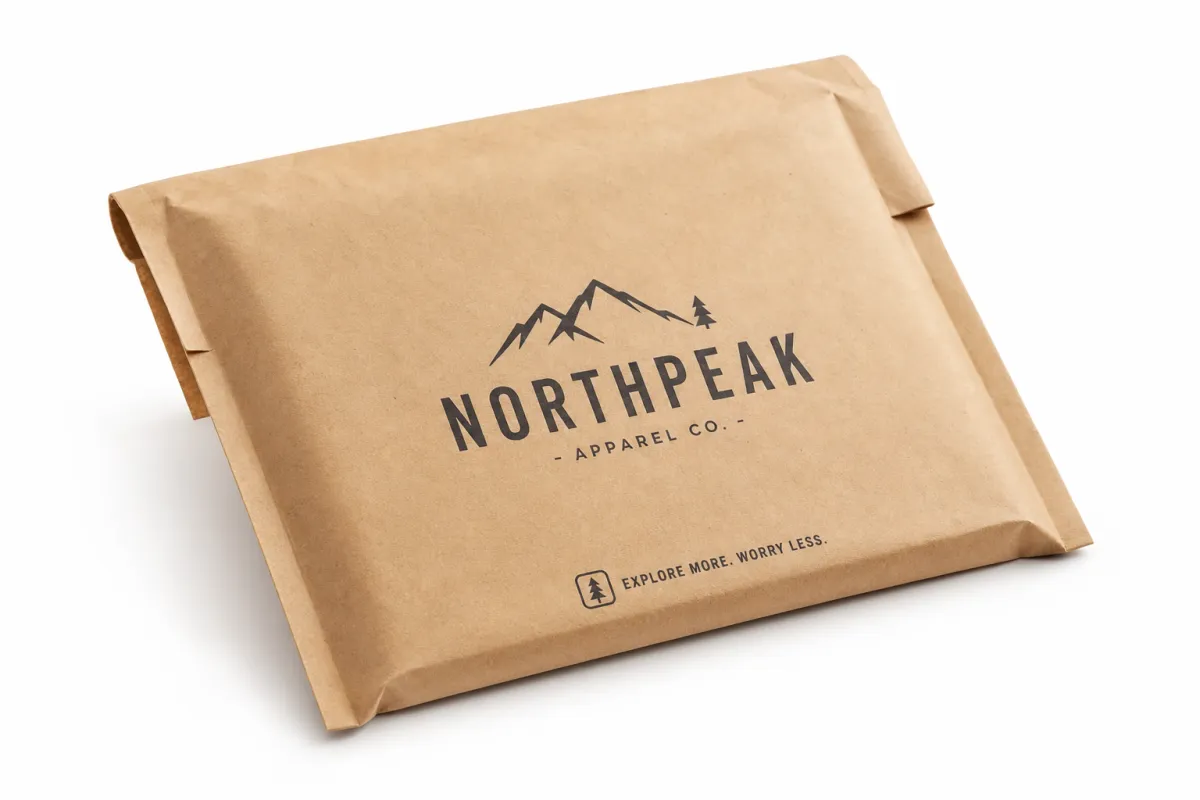
Printed kraft mailers with logo are shipping mailers built from kraft paper or kraft-faced structures, then customized with branding that might be as restrained as a one-color mark or as bold as a full-panel pattern. They sit in a useful middle ground. Plain enough to pack quickly. Custom enough to carry the brand identity the moment the parcel enters the customer experience. That balance is why they appear in so many industries.
The format changes more than many buyers expect. Some printed kraft mailers with logo are simple paper envelopes for documents, flat goods, or ultra-light accessories. Others use reinforced paper walls, adhesive closures, and tear-resistant seams. Some include cushioning from paper fiber or molded paper interiors. Others stay unpadded and rely on structure alone for apparel, books, and flat merchandise. The important part is not decoration. It is the union of print and function in one shipping format.
That functional side matters because shipping is rough on surfaces. In a fulfillment center, a mailer gets stacked, shoved, labeled, slid across tables, and rubbed against other parcels. Ink that looks crisp on a proof can wear down fast once it meets tape rolls, tote walls, and conveyor friction. Good printed kraft mailers with logo are designed so the branding remains legible after real handling, not just under studio lights.
For a brand, the value reaches beyond appearance. Printed kraft mailers with logo can reduce the need for separate branded stickers, extra sleeves, or another layer of presentation packaging. They also help the customer experience feel coherent. Product page, confirmation email, packing slip, and outer mailer all speak the same visual language. Customers rarely stop to analyze that consistency, but they notice when it is missing.
There is a logistics benefit too. A branded mailer is easier to identify on a packing table or in a tote, which can speed up sorting during busy periods. Internal teams often use visual differences to separate product lines, regions, or subscription tiers. In that setting, printed kraft mailers with logo are not just branding. They are part of the operating system.
Decoration and performance are not the same thing. A decorative mailer can photograph well and still fail under ordinary shipping conditions. A functional shipping mailer has to do all of these jobs at once:
- Protect the product during transit and normal handling
- Seal firmly without peeling open
- Accept print cleanly without smudging or cracking
- Resist abrasion, light moisture, and stacking pressure
- Support the brand without adding weight or slowing packing
That combination is the real strength of printed kraft mailers with logo. They are simple enough to control on cost, yet flexible enough to feel custom. Buyers comparing formats often place them alongside other packaging categories in Custom Packaging Products and compare the shipping feel against alternatives such as Custom Poly Mailers. The right choice depends on the product, the packing method, and how much visual presentation matters at the door.
For brands that want an eco-friendly packaging story without drifting into vague claims, kraft paper mailers often make sense as a starting point. They can support recycled content, paper-based construction, and a lighter presentation than multi-layer systems, though the details still depend on the exact build. Printed kraft mailers with logo are most persuasive when the material choice and the shipping job line up.
One more practical detail: in some operations, a well-labeled kraft mailer cuts a few seconds from every pack because staff can spot the correct size faster. That sounds small. It is not. Multiply a few seconds by a few thousand orders and you are suddenly talking about hours. Packaging rarely wins attention for being glamorous. It wins by shaving friction where nobody expected it.
How Printed Kraft Mailers With Logo Are Produced
The construction behind printed kraft mailers with logo is usually direct, but the details change the result quickly. Most versions begin with kraft paper outer layers, then add whatever structure the design needs: reinforced panels, a paper or fiber cushion layer, a seal strip, and a print-ready surface that accepts ink without too much feathering. If the mailer is meant for rough handling, seam strength and closure quality matter as much as the artwork on the front.
Print method is one of the first choices. Flexographic printing tends to fit larger runs because the setup cost gets spread across more units and the process works efficiently for repeat jobs. Digital printing is useful for smaller orders, launch programs, and artwork that changes more often. One-color branding still appears often in printed kraft mailers with logo because kraft paper naturally supports a restrained, earthy look. A single strong mark can feel more premium than a crowded design.
Artwork preparation decides a lot about the final quality. A vector logo is best when it is available. Clean outlines, correct spacing, and accurate color data make a real difference once the file hits production. Bleed still matters on a mailer because the art needs room around folds, seals, and cut lines. Placement matters too. Put the logo too close to a flap and it can disappear after sealing. Put it too low and a shipping label or rubbing against other parcels can hide it. Good printed kraft mailers with logo account for those realities before the first piece is printed.
Color matching deserves caution. Kraft is not white, and the substrate shifts how color reads. Deep black, earth tones, and restrained brand colors usually hold up better than pale gradients or delicate pastels. If exact color matters, ask for a proof on the actual paper stock rather than trusting a screen preview. That advice matters even more for printed kraft mailers with logo that rely on typography and small marks instead of a large icon.
Surface texture changes how artwork behaves. Kraft has tooth, which can soften thin strokes and tiny copy. Fine-line logos, narrow taglines, and hairline registration marks often look weaker on kraft than on coated stock. Bolder layouts tend to survive the material better. In packaging terms, printed kraft mailers with logo usually reward direct graphics more than crowded compositions.
Transit conditions should enter the production discussion from day one. Abrasion in totes, scuffing against other cartons, and occasional moisture exposure can all affect how the logo ages. A print that looks perfect on a sample but rubs off under pressure is not a good shipping solution. For brands that want to verify durability, the transit testing guidance from ISTA is a useful reference, especially for parcels that move through repeated handling.
Printed kraft mailers with logo should be judged the way a warehouse team judges any package: by how it survives packing, stacking, and delivery, not just by how it photographs on a desk.
That practical view is why many buyers ask for a sample before approving the full run. A sample shows more than the logo. It reveals the closure, the seal line, the stiffness of the paper, and the way the mailer feels in the hand. When the mailer will support recurring fulfillment, a sample is cheap insurance. The gap between a polished proof and a package that actually works can surface only after a few hundred units move through the building.
If sustainability claims are part of the brief, the material structure deserves a close look. Kraft does not automatically equal recyclable in every configuration, and not every adhesive or coating behaves the same way in local recycling systems. Buyers who want to verify fiber sourcing can review standards through FSC and compare those claims with local guidance for end-of-life sorting. Printed kraft mailers with logo can be a strong paper-based option, though the construction still determines the final result.
For teams comparing custom shipping mailers across multiple product lines, this stage is also where the long view starts to matter. A mailer that works for one launch but slows every repeat order is a hidden cost. Printed kraft mailers with logo are strongest when the production method supports both brand consistency and warehouse speed. That is the whole trick, really: a packaging choice that looks simple because it was specified carefully.
Key Factors That Affect Performance and Branding
The best printed kraft mailers with logo usually feel unremarkable in the right way. They fit, seal, and carry the brand without slowing down the packing line. Size comes first. A mailer should fit the packed product, not the bare item. Tissue, inserts, small boxes, return cards, and seal clearance all affect the final dimensions. Too tight, and the seams work harder than they should. Too loose, and the package slides around and looks careless.
Paper weight and structure matter almost as much as dimensions. A lightweight document mailer can work for flat inserts or very thin accessories, but apparel, books, and products with corners or weight need heavier paper or a reinforced format. Printed kraft mailers with logo should be matched to the shape and mass of the shipment, not chosen only because the front panel looks good. A mailer that feels sturdy in the hand but splits at the edge in transit creates a problem the warehouse will notice quickly.
Closure type is a detail buyers often underestimate. A good adhesive strip is not just convenient. It keeps the package shut through handling, temperature swings, and the pressure changes that happen in transit. Some mailers use peel-and-seal closures. Others rely on fold-over pressure-sensitive systems. For printed kraft mailers with logo, the closure should be tested the same way the warehouse packs orders, because a neat seal means nothing if it slows down the line or opens in the carrier stream.
Brand placement changes how the package feels. A front-panel logo reads as direct and confident. A repeated pattern can feel more fashion-led or premium. A mark on the flap creates a small reveal during opening, which works well for subscription brands and curated bundles. Printed kraft mailers with logo do not need to shout to be effective. A restrained logo on clean kraft can look more expensive than a heavy, overworked surface.
Consistency is where brand impact starts to compound. One custom run can look nice. A steady system is more powerful. Printed kraft mailers with logo become more useful when the same artwork, paper tone, and closure style repeat across the shipping program. Customers notice the consistency even when they do not describe it that way. They simply register a brand that handles details with care.
Sustainability needs a careful reading rather than a slogan. Kraft paper can be a good choice because it often uses fiber-based materials and can support recycled content or FSC-certified sourcing, but the full structure still matters. Adhesives, coatings, windows, and interior layers can change how the package is handled after use. A well-built mailer does not need extra decoration to feel responsible. In many cases, printed kraft mailers with logo help a brand reduce unnecessary layers and keep the shipper lean.
Order type matters too. Folded apparel, flat documents, small boxed items, and accessories do not all ask for the same print coverage or stiffness. A product with sharp edges or heavier weight may need another structure entirely. The point is not to push every shipment into printed kraft mailers with logo. The point is to use them where they fit the job best.
In practice, the strongest performers usually share three traits: the dimensions are right, the branding is controlled, and the structure suits the shipment. Fancy graphics do not rescue a poor fit. If the mailer works in the warehouse and looks clean at delivery, printed kraft mailers with logo are doing the job they were built for.
| Option | Typical Use | Approx. Unit Price at 5,000 pcs | Notes |
|---|---|---|---|
| Stock kraft mailer with one-color logo | Light apparel, flat goods, simple fulfillment | $0.18-$0.32 | Best for clean branding and lower setup complexity |
| Reinforced printed kraft mailers with logo | Heavier apparel, books, accessories, mixed orders | $0.24-$0.45 | Better seam strength and a more durable feel |
| Digital short-run custom mailer | Launches, test programs, seasonal packs | $0.45-$0.85 | Good for smaller quantities and variable artwork |
| Higher coverage custom print | Premium branding, repeating patterns, retail presentation | $0.30-$0.65 | Price depends heavily on colors, coverage, and size |
What Printed Kraft Mailers With Logo Cost
Pricing for printed kraft mailers with logo comes from a small set of variables, but those variables overlap in ways that make every quote slightly different. Quantity usually drives the largest swing. Higher volumes lower the per-unit cost because setup, plate creation, and proofing get spread across more pieces. A small order can seem expensive even when the material is ordinary, simply because the preparation does not shrink much.
Print method changes the math too. Flexographic printing tends to fit larger runs with simple graphics and steady artwork. Digital printing often fits smaller batches, pilot programs, or fast-turn jobs where plate setup would not pay off. For printed kraft mailers with logo, one-color logos usually sit at the lower end of the range, while multiple colors or full-coverage graphics push the number upward. Paper weight, reinforcement, and closure style add another layer of variation.
A useful way to read the spend is to ask what the mailer replaces. If printed kraft mailers with logo remove the need for branded stickers, a belly band, a sleeve, or extra tissue, the net packaging cost may be more reasonable than it first appears. If the mailer adds branding but does not improve shipping speed or product protection, the value is mostly perceptual, and that should be part of the decision.
Some costs stay hidden until the project is underway. Artwork cleanup can take time if the logo file is low resolution or if the brand lacks production-ready color data. Proofing may involve a digital mockup, a physical sample, or both. Freight can matter because mailers are bulky even when they are light. Special finishes, custom dimensions, or unusual paper stock can move the total upward. Printed kraft mailers with logo are not just a unit price; they are a project price.
Here is a cleaner way to think about the range:
- Low-complexity jobs: single-color logo, stock size, standard kraft paper, simple closure
- Mid-range jobs: reinforced structure, two-color branding, better seam performance, moderate volume
- High-presentation jobs: full-coverage art, custom sizing, premium finish, shorter runs
The cheapest option is not always the best option. If a mailer fails and returns rise, or if the shipment needs a second outer carton because the mailer is too light, the savings vanish quickly. In logistics terms, the best printed kraft mailers with logo are the ones that reduce rework and keep the fulfillment line moving.
Inventory planning also deserves attention. Underordering can trigger rush freight costs, emergency reprints, and a break in brand presentation right when the business wants to look polished. Overordering can trap cash in a format that may need size or artwork changes later. A sensible planning range usually starts with monthly volume, seasonal spikes, and whether the mailer is used for best sellers or for the full catalog. Printed kraft mailers with logo should be budgeted like a production input, not treated as a one-time creative flourish.
When you compare quotes, ask for the same details each time: size, paper weight, print colors, finish, quantity, proof type, and lead time. That makes the numbers easier to compare and reduces the chance that one quote looks cheaper only because it leaves something out. With printed kraft mailers with logo, a detailed quote is usually the better sign.
Step-by-Step Ordering Timeline
The ordering process for printed kraft mailers with logo works better when it is treated like a small production project instead of a quick checkout. Start by defining the product and the packed format. Is the item shipping flat, folded, boxed, padded, or with inserts? The packed size should drive the mailer size, because a mailer chosen around the naked product usually turns out too small once the actual order is assembled. Printed kraft mailers with logo need room for the real shipment, not the showroom version.
Once the size is clear, decide how visible the branding should be. Some brands want a bold front-panel logo. Others want a quiet mark and a refined kraft surface. That choice affects artwork layout, print method, and cost. The more coverage and color complexity you add, the more the job starts to behave like a custom print project. For printed kraft mailers with logo, a simple spec sheet often keeps the process moving.
The artwork and proof stage deserves patience. Good production teams ask for vector files, color references, and placement guidance. They may also flag issues with line thickness, edge distance, or tiny type. A digital proof helps, but a physical sample is better when color, texture, or closure feel matter. If the mailer will be used again and again, a sample of printed kraft mailers with logo is worth the time because it exposes practical problems a screen cannot show.
Production timing depends on stock availability, print method, and quantity. Some jobs move quickly if the mailer style is standard and the artwork is clean. Others take longer because of a custom size, a special finish, or a multi-step proof cycle. The safer plan is to reserve time for proofing, then production, then freight. A lead time that looks fine in a spreadsheet can shrink fast if a launch date is fixed or a subscription cycle is waiting.
Receiving and fulfillment belong in the timeline too. Bulk mailers take space, and a warehouse needs a place to stage them without crushing edges or exposing them to moisture. If the packing team has to change label placement or reconfigure a table, that needs to be scheduled. Printed kraft mailers with logo work best when the receiving flow has already been thought through.
A realistic timeline often looks like this:
- Confirm product dimensions and packed configuration
- Choose the mailer style and size
- Approve artwork placement and print method
- Review digital proof or sample
- Move into production after approval
- Receive freight and inspect the first cartons
- Run a packing test before full deployment
That sequence may sound basic, yet it prevents a lot of avoidable churn. Printed kraft mailers with logo are easier to manage when everyone knows the final packed size, the branding goal, and the delivery window before the order is placed. A little patience at the front end usually saves a lot of correction later.
Common Mistakes When Ordering Printed Kraft Mailers With Logo
One common mistake is sizing the mailer around the product alone instead of the product plus everything that actually ships with it. A T-shirt in a polybag is not the same as a T-shirt with tissue, a thank-you card, and a return insert. A book with a corner protector is not the same as a bare book. Printed kraft mailers with logo need enough room for the packed set, or the seams end up carrying more stress than they should.
Artwork errors create another set of problems. Low-resolution files can make the logo look fuzzy. Wrong color assumptions can turn a carefully chosen brand color into a muddy brown against kraft. Small text can disappear into the paper texture. If the logo sits too close to a fold, seal, or label zone, part of it may vanish in normal use. Printed kraft mailers with logo work best with clean, bold artwork that respects the shape of the mailer.
Some brands underorder because they want to limit inventory risk, then pay more later through rush freight or split shipments. That gets painful fast during seasonal rollouts and ongoing fulfillment cycles. If the packaging runs out halfway through a campaign, the team may have to mix formats, and the brand impression weakens. Printed kraft mailers with logo should be ordered with a realistic buffer based on actual sell-through, not just the current week.
It is easy to focus on appearance and ignore transit performance. A mailer that looks elegant but cannot handle heavier or sharper-edged products will create damage, returns, or customer service noise. For some categories, a stronger paper mailer works. For others, a different structure is smarter. If the use case is uncertain, compare it against the protection offered by Custom Poly Mailers or other options in Custom Packaging Products. Printed kraft mailers with logo are excellent for many shipments, but not every shipment.
Skipping samples often costs more later. A sample lets you see the paper tone, check the seal, test the size, and feel how the mailer behaves during packing. It also gives the fulfillment team a chance to flag issues before a full run is committed. That test becomes especially useful if printed kraft mailers with logo will be packed by different people or moved through multiple shifts.
Here are a few mistakes worth avoiding:
- Ordering before packed dimensions are confirmed
- Using artwork files that are not production-ready
- Assuming kraft color will behave like white paper
- Choosing branding that blocks shipping labels or barcodes
- Ignoring the difference between visual appeal and transit strength
Most of those problems are easy to prevent with a clear spec sheet and one sample review. A good supplier usually asks the right questions, but the buyer still needs to know what product is being shipped and what the package must survive. Printed kraft mailers with logo can look effortless when the process is disciplined. They look frustrating when the process is rushed.
Expert Tips and Next Steps for Printed Kraft Mailers With Logo
The easiest place to start with printed kraft mailers with logo is not a full shipping overhaul. Pick one or two order types, such as best-selling apparel or a recurring subscription shipment, and test the mailer there first. That gives the brand real data from actual packing conditions before the design expands across the catalog. Printed kraft mailers with logo are easier to improve when the first test case is specific.
A short proof run or sample order is worth requesting whenever the artwork, closure, or size is new. The sample should be checked in the same setting that will use the production version: on the packing table, with real inserts, real labels, and real hands moving at normal speed. The goal is not only to admire the print. It is to confirm that printed kraft mailers with logo pack smoothly, seal correctly, and keep their appearance after handling.
It also helps to create a simple spec sheet before requesting quotes. Keep it plain and factual: product type, packed dimensions, mailer dimensions, paper weight, print colors, artwork placement, quantity, desired lead time, and any sustainability requirement such as recycled content or FSC sourcing. The clearer the brief, the easier the bids are to compare. Printed kraft mailers with logo can vary a lot in cost, and a complete spec reduces the chance that a quote hides an assumption.
Warehouse testing should be part of the sign-off. Have the packing team use the sample in a real workflow and note whether it slows them down, wrinkles too easily, or causes label-placement conflicts. If a mailer looks good but jams the line, it is the wrong mailer. If it speeds up packing and still looks polished at delivery, the decision is heading the right way. That is the point of printed kraft Mailers With Logo: they should support operations, not complicate them.
For sustainability claims, stay specific. If the material is paper-based and the fiber source is certified, say that plainly. If the structure includes coatings or mixed materials, do not assume every local recycling program will treat it the same way. Buyers who want a wider view of packaging choices can compare materials against industry guidance from groups like PMMI and product testing resources from ISTA. Printed kraft mailers with logo should be positioned with facts, not vague green language.
Before the order is placed, think through the launch plan. Do you need warehouse buffer stock? Will seasonal demand spike? Should the brand look identical across mailers, labels, and inserts? Those answers shape the final choice more than any single mockup. A good mailer is not just a print decision. It is part of the shipping system.
Honestly, the strongest results usually come from keeping the design clean, the dimensions honest, and the timing realistic. When those three things line up, printed kraft mailers with logo do a lot of work for relatively little complexity. They protect the product, support the brand, and make the package feel considered from the first glance to the final opening. If you are planning a packaging refresh, printed kraft mailers with logo are a smart place to start.
How Do Printed Kraft Mailers With Logo Perform In Real Shipping?
They perform well when size, paper weight, closure strength, and artwork placement are matched to the packed product. In plain terms, printed kraft mailers with logo are best for flat goods, apparel, books, and light accessories that need a clean presentation without extra layers. They are less suitable for sharp, bulky, or moisture-sensitive items unless the structure is reinforced and tested first.
That is the real comparison point. A mailer can look elegant on a proof and still struggle in the carrier stream if the build is wrong. Printed kraft mailers with logo earn their place when they survive handling, keep the seal closed, and arrive looking intentional instead of tired. The packaging may be quiet, but the result is not.
I have seen brands move from generic mailers to printed kraft mailers with logo and reduce packing hesitation almost immediately. Not because the staff got prettier packaging to look at, but because the new mailer had a clearer size, a better seal, and fewer mispacks. Sometimes the branding benefit is real, and sometimes the operational benefit is bigger. Usually, it is both.
How much do printed kraft mailers with logo usually cost per unit?
Pricing usually depends on quantity, print method, size, and how many colors are used. Larger orders typically lower the unit cost because setup expenses are spread across more mailers, while small runs can cost more per piece if they need extra artwork prep or proofing. For printed kraft mailers with logo, the best quote is usually the one that spells out every production detail instead of hiding behind a single number.
Are printed kraft mailers with logo strong enough for shipping?
Yes, if the mailer is matched to the product weight, shape, and transit conditions. Look for the right paper weight, reinforced seams, and a closure that stays sealed during handling. For heavier or sharper items, test a sample before placing a full order. Printed kraft mailers with logo are strong enough for many ecommerce shipments, but not every product needs the same structure.
What size should I choose for printed kraft mailers with logo?
Choose the size based on the product plus any inserts, protection, or extra space needed for sealing. A mailer that is too tight can stress the seams, while one that is too large can look sloppy and ship inefficiently. Measure the most common packed order first, not just the bare product, and then match the mailer dimensions to that real packed size. Printed kraft mailers with logo work best when they fit the packed order, not the prototype.
How long does it take to produce printed kraft mailers with logo?
Timeline depends on whether the mailer is stock-based or fully custom, plus the print method and quantity. Proof approval can add time, especially if artwork needs adjustments or color matching. Plan ahead for seasonal demand so production and shipping delays do not interrupt fulfillment. For printed kraft mailers with logo, a little lead-time padding is far safer than trying to rush a custom run at the last minute.
Can printed kraft mailers with logo be recycled?
Many kraft mailers can be recycled if the material and printing method are compatible with local recycling rules. Adhesives, coatings, liners, or mixed materials can change how they should be handled after use, so check the construction details rather than assuming every kraft mailer has the same end-of-life path. If recycling claims matter for your brand, printed kraft mailers with logo should be reviewed as a complete structure, not just as a paper surface.
Printed kraft mailers with logo work best when they are treated as a practical shipping tool first and a branding surface second, because that is how they earn their keep in the warehouse and at the customer door. If you match the size, structure, artwork, and timeline to the actual shipment, printed kraft mailers with logo can give you a cleaner presentation, fewer packaging extras, and a more consistent unboxing experience without making fulfillment harder. The most useful next step is simple: lock the packed dimensions, approve one physical sample on the packing table, and only then place the production order.


