Printed pillow boxes can change the way a small product is read before anyone touches it. The shape does part of the selling. Rounded sides soften the look, the flat faces leave room for branding, and the whole format carries a quiet gift-box feel without demanding the cost or rigidity of a premium rigid carton.
That is why printed pillow boxes show up so often in cosmetics, jewelry, accessories, event giveaways, sample kits, and seasonal retail programs. They sit in an awkwardly useful middle ground. More presentable than a plain folding sleeve, less expensive and less storage-heavy than a rigid box. For a buyer, that balance is the point. You get shelf signal, quick assembly, and flat-packed efficiency in one format.
There is a catch, and it matters. Pillow packaging is presentation-first. It is not a shipping carton, and it will not forgive poor fit or overstuffed contents. If the product is too heavy, too sharp-edged, or too loose inside, the package starts working against itself. Good results depend on choosing the right board, the right finish, and a size that respects the product rather than merely containing it.
From a procurement perspective, that makes this format easier to overestimate than to specify. The box looks simple, but the quote hides a chain of decisions: stock weight, print coverage, coating, dieline accuracy, closure style, and freight. Miss one and the landed cost shifts. Miss two and the box may still assemble, but it will not feel finished.
Printed Pillow Boxes: the small pack with a big shelf signal
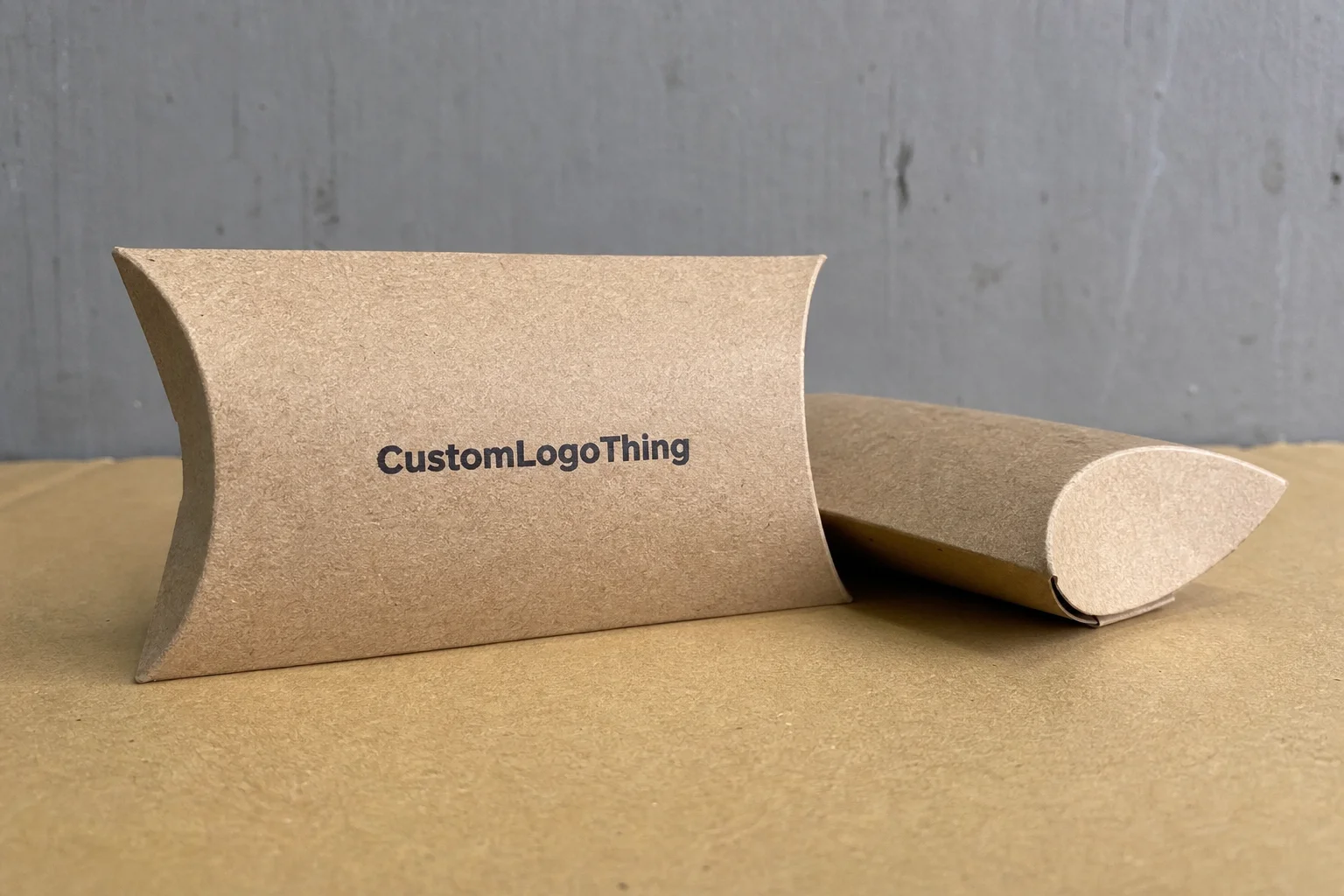
A pillow box is a flat-shipping carton with curved sides that folds into a soft, arched shape. It usually uses scored folds and a tuck or lock-style closure. The form is modest, but it has a strong visual effect. Square cartons tend to read as functional. Pillow boxes read as curated. That difference is small on paper and obvious on shelf.
In retail, those differences compound. A low-ticket item can feel more giftable simply because the package looks considered. A trial-size cosmetic, a bracelet, a gift card, or a small promotional kit suddenly has a stronger display presence. The box does not need a lot of ink to achieve that. Often, a restrained design prints better than a dense one, because the shape itself is doing the work.
The format also solves a practical storage problem. Because the cartons ship flat, they take up much less warehouse space than pre-formed packaging. That matters for short runs, seasonal drops, and launches where inventory is uncertain. A buyer can order a few thousand units, stage them flat, and assemble them only when needed. Compared with rigid packaging, the handling burden drops quickly.
A sensible way to describe pillow packaging is this: small enough to manage, distinctive enough to remember. That combination is rare. It is also why the format keeps showing up in categories that depend on impulse and presentation.
Still, the format has limits. It is not meant for heavy contents or products that need substantial crush resistance. If the item shifts inside the box, the curved sides can start to look strained rather than elegant. That is why the best uses are lightweight products with a clear retail or gifting role. The structure should reinforce the product story, not fight it.
For brands building a broader packaging system, pillow boxes usually work best as secondary packaging alongside other custom cartons and retail formats from Custom Packaging Products. The fit has to match the channel. A box that is perfect for a boutique counter display may be the wrong decision for e-commerce fulfillment.
How the structure and print layout work together
With pillow boxes, structure and artwork are tied together more tightly than many buyers expect. The curved profile changes how logos read. The score lines alter where the eye lands. Even the closure edge can interfere with a headline if the layout is not planned against the dieline.
The front and back panels usually do the heavy lifting. Those surfaces are where logos, product names, short claims, and QR codes tend to work best. Side panels are narrower and curve harder near the folds, so they are better for pattern, legal text, or small supporting details. When the design is overcrowded, the format loses its appeal. Small packaging rewards restraint.
Prepress checks are not optional. Bleed, safe area, panel alignment, and score placement need to be confirmed before proof approval, because once the carton folds, alignment shifts become visible very quickly. Heavy solids, metallic finishes, and thin type near the edges are all less forgiving on this type of packaging. A layout that looks balanced on screen can come out slightly off once the stock is scored and assembled.
There is a simple reason for that. The shape is not a flat billboard. It behaves more like a wrapped object. Curves pull attention toward the center and away from the edges, which means a design that depends on edge detail can lose impact. For that reason, the strongest layouts usually keep one focal point, one short message, and enough empty space to let the form breathe.
The box’s shallow profile also imposes a design constraint. If the product is bulky or irregular, the package can look overworked. In those cases, a paper insert, tray, or tissue wrap can improve stability and reduce movement without changing the outer format. That is often the cheaper fix. Rebuilding the whole structure usually is not.
For buyers who are still deciding how much branding to add, a useful comparison is between a sparse layout and a crowded one. A sparse layout often prints cleaner, reads faster, and tolerates small production variation better. A crowded layout may look impressive on a proof sheet, then lose clarity once folded. That is a packaging problem, not a design style problem.
Stock, finish, and sizing choices that change results
Material choice changes the entire experience. A lighter board lowers cost and folds easily, but it may feel too soft in the hand. A heavier stock improves rigidity, keeps the curve cleaner, and gives the package a more deliberate feel when a customer picks it up. For printed pillow boxes, buyers are commonly choosing paperboard in the rough range of 250gsm to 400gsm, depending on product weight and the level of structural feel they want.
That range is useful, but not universal. A 250gsm board can be perfectly adequate for a lightweight sample or card. A 400gsm stock can feel noticeably stronger, though it may also resist folding more and add cost. What matters is not maximum thickness. It is the balance between stiffness, foldability, and the way the finished box holds shape after assembly.
Finish matters just as much. Matte creates a quieter, more modern look. Gloss boosts color contrast and can make graphics look sharper under retail lighting. Soft-touch coating adds tactility and gives the box a more premium feel, but it also raises price and can show handling wear differently from standard coatings. Foil and spot UV can be effective on small packaging because they create a concentrated visual hit. They also increase proofing sensitivity. Registration errors stand out quickly on a small surface.
Size is where many packaging projects drift off course. A box that is too large allows the product to move, which makes the package feel loose and less controlled. A box that is too tight can stress corners, distort score lines, or make closure awkward. Neither outcome is acceptable if the box is supposed to feel premium. Fit is not only a structural question. It changes how the brand is perceived.
Artwork density is another practical issue. Full coverage, small typography, and multiple special effects can look fine in digital mockups but become harder to control in print. If color accuracy matters, ask how the printer handles proofing and what tolerances are realistic for the run. On small formats, small deviations are visible. A slightly misregistered line or inconsistent solid area is easier to spot on a compact box than on a large carton.
| Option | Typical use | Price impact | Buyer takeaway |
|---|---|---|---|
| Standard paperboard, one-color print | Samples, cards, lightweight accessories | Lower | Best starting point if you want clear branding without extra finishing |
| Heavier board with matte or gloss coating | Retail kits, cosmetics, gift items | Moderate | Better rigidity and a more finished feel |
| Soft-touch with foil or spot UV | Premium launches, holiday sets | Higher | Stronger shelf signal, but proofing and registration need closer control |
| Custom size with complex artwork | Specialty products or tight-fit kits | Highest | Useful when fit matters, but only if the extra spec improves the product story |
For most buyers, the best spec is not the most expensive one. It is the one that gives the product enough structure, enough print quality, and enough visual clarity without paying for features the customer will not notice. That is a procurement rule as much as a design rule.
Cost, pricing, and MOQ factors buyers should compare
Quantity usually drives unit price more than any other variable. Setup work, file checks, changeover time, and finishing setup are spread across more units as volume rises. A small order is flexible, but it rarely gives the best price per box. That is not a mystery; it is simply how print manufacturing behaves.
For budgeting, a simple printed pillow box might land around $0.18 to $0.35 per unit at larger volumes. More elaborate specs can move into the $0.40 to $0.80 range or higher, depending on stock, print coverage, finish, and delivery terms. Those numbers are only a working range. They are useful for comparison, not as a promise from any supplier.
MOQ deserves attention because it affects both risk and flexibility. Lower minimums are helpful for launches, market tests, and seasonal promotions. Higher minimums often reduce unit price, but they also lock up cash and warehouse space. For a first run, many buyers are better off accepting a slightly higher unit cost than overcommitting to an untested spec.
The quote itself is only part of the picture. Proofing, inserts, tooling if required, freight, packaging labor, and rush charges all affect landed cost. A quote that looks attractive before freight can become the expensive option once transport and rework are added. Buyers often underestimate this because the packaging line item looks smaller than it really is in the full budget.
A useful comparison method is to ask for at least three quotes: a baseline spec, an upgraded finish, and a more demanding version with heavier board or custom sizing. That makes the trade-offs visible. Without that comparison, people tend to debate packaging in abstract terms, which is usually unproductive.
If sustainability is part of the decision, ask what the board is made from and whether it carries FSC certification. Third-party standards are more credible than vague claims. The FSC and the EPA are useful references for material sourcing and waste context, but the practical question is still the same: what stock is being used, and how much of it is actually necessary?
One more practical observation: cheaper packaging is not automatically cheaper packaging. If the board is too light, the closure fails more often. If the finish marks easily, the reject rate rises. If the box is too large, fillers and inserts creep into the design. Once those costs are counted, the cheaper quote can disappear fast.
Production process and turnaround: from file to shipment
The production sequence is straightforward, but every step depends on the previous one. It starts with the brief and dieline review, moves to artwork placement and proof approval, then proceeds through printing, finishing, cutting, packing, and shipment. If the file is not ready, the schedule slips before production begins. That part rarely gets enough attention.
Missing fonts, low-resolution images, incorrect bleed, and last-minute artwork changes are common delay points. They are also preventable. A lot of packaging delays are not machine problems. They are file problems or communication problems. Once those enter the workflow, everyone loses time.
For standard printed pillow boxes, production often takes about 12 to 15 business days after proof approval. That window can stretch with quantity, coating complexity, custom inserts, or tight color matching. Shipping time sits on top of that, and it should be treated separately from production rather than blended into a single vague estimate.
Seasonal demand can lengthen the schedule. Holiday packaging, retail resets, and event-driven promotions all compress capacity. If the launch date is fixed, build in buffer time. Speed is expensive when it becomes a rescue plan. Planning is cheaper.
Practical quality control starts early. Ask for a digital proof that reflects actual panel size, or a physical sample if the product sits close to the walls of the box. Check how the closure behaves with the real item inside, not just an empty carton. That is where many projects reveal their weakness. A box that folds well on a bench can still open too easily once loaded.
For distribution-heavy programs, it may also be useful to ask about transit expectations. ISTA profiles are more relevant for some packages than others, but the point stands: if the box will be handled repeatedly, compressed, or packed with inserts, test the assumptions before production. The ISTA site is a useful reference for that kind of discussion.
One plain rule saves a lot of money: do not approve a production run until the fit, closure, and print placement make sense at actual size. A proof is cheaper than a reprint. That is not dramatic. It is just the economics of packaging.
Common mistakes that weaken the package or waste budget
The first mistake is sizing from the product alone. That sounds efficient, but it usually fails once tissue, inserts, wrap, or loading clearance are added. The box needs room to open and close cleanly. If the dimensions are too optimistic, the first production run exposes the problem immediately.
The second mistake is overdesigning the artwork. Small packaging does not have much space, and it punishes clutter. Tiny text, low-contrast color combinations, and dense graphics tend to disappear once the box is folded and viewed at arm’s length. A stronger hierarchy usually works better than trying to say everything at once.
Closure testing gets skipped too often. A tuck or lock-style pillow box should be checked with the actual product weight inside, not just as an empty sample. If the board buckles near the score or the closure loosens under load, the package stops feeling premium. That is enough to change how the product is judged.
Another recurring budget error is comparing unit price without comparing the full spec. Freight, proofing, rush fees, tooling, rework, and waste from a poor fit can wipe out a lower unit price very quickly. Packaging procurement only works if the whole run is considered, not just the line item on the first quote.
There is also a sustainability mistake worth naming. Paper-based does not automatically mean responsible. Stock origin, coating choice, over-ordering, and wasted inventory all matter. If the goal is to reduce impact, the spec has to be built around that goal from the start. Otherwise the claim is mostly decorative.
The best packaging decisions are usually the least dramatic ones. Correct dimensions. Clear hierarchy. A finish that suits the product instead of trying to overwhelm it. A quote that reflects real landed cost. Printed pillow boxes perform well when the spec is disciplined. They perform badly when people try to force them into doing too much.
Expert checks and next steps before you place the order
Before placing an order, confirm six basics: dimensions, product weight, print coverage, finish, quantity, and delivery date. If one of those is fuzzy, the quote is less reliable than it looks. Packaging quotes are only as strong as the specification underneath them.
If the design is new, request a sample or a proof that shows the layout at actual size. That is especially useful when the product sits close to the walls of the box or when the closure has to hold a specific shape. The goal is not to admire the proof. It is to catch structural issues before they become production problems.
Ask for at least two spec options if you are still deciding. One should be the functional baseline. The other can test a stronger finish, heavier board, or tighter fit. Then compare them on three criteria: brand impact, production speed, and acceptable unit cost. That keeps the decision tied to business needs rather than preference alone.
A clean approval workflow usually looks like this:
- Gather the dieline, artwork, and final dimensions.
- Confirm the product weight and any insert requirements.
- Request pricing at two or three volume levels.
- Review proof timing before committing to the launch date.
- Lock the spec only after the fit and closure are confirmed.
That process is not sophisticated, but it is effective. The more precise the input, the fewer surprises later. With printed pillow boxes, small errors show up quickly because the format is compact and visually exposed. There is nowhere for a mistake to hide.
For buyers who care about consistency and procurement discipline, packaging should be treated as a production decision rather than a decorative afterthought. Stock, finish, and size all affect the final result. Once those are aligned, the box does its work quietly and predictably.
The strongest printed pillow boxes are the ones that fit the product, the channel, and the budget without trying to solve every packaging problem at once. That is how you end up with a package that feels polished, ships efficiently, and still makes sense on the quote sheet.
What products are best suited for printed pillow boxes?
They work best for lightweight items such as cosmetics, jewelry, gift cards, accessories, samples, and small apparel pieces. They are not a strong fit for heavy or rigid products unless you add inserts or another support layer. The format is strongest when presentation matters more than structural protection.
How do I choose the right size for printed pillow boxes?
Measure the product plus any insert, tissue, or protective wrap. Leave enough room for easy loading without letting the item move around inside. If fit is important, prototype the closure before approving the full run.
What affects printed pillow box pricing the most?
Order quantity usually has the biggest effect on unit cost. Custom sizes, special finishes, and higher print complexity increase the price. Shipping, proofing, and rush production can also change the final landed cost.
How long does the production process usually take?
Timeline depends on proof approval, quantity, and finish complexity. Physical samples and artwork revisions can add time before production starts. Build in extra days if your launch date is fixed or the design is new.
Can printed pillow boxes be shipped flat and assembled quickly?
Yes, most pillow boxes are designed to ship flat and fold into shape when needed. Assembly is fast, but the closure should be tested with the actual product weight. Flat shipping also helps reduce storage space and handling costs.


