The hidden cost of late mailers: why printed courier bags lead time and MOQ matter on day one
A launch can be perfectly timed and still look underprepared if the mailers arrive late. That is the real issue behind Printed Courier Bags lead time and moq. A low unit price can quickly be cancelled out by plain substitute bags, split shipments, or expensive air freight when production slips.
MOQ is the quieter risk. A larger run usually lowers the unit cost, but it also ties up cash and increases the chance of dead stock if branding, product lines, or returns messaging changes. Buyers should assess Lead Time and MOQ together: speed versus commitment, and lower piece price versus inventory exposure.
The best packaging order is rarely the one with the lowest headline price. It is the one that lands on time, matches spec, and does not leave you writing off stock three months later.
Where branded courier bags add measurable value in eCommerce, retail returns, and shipping operations
Courier bags are widely used for apparel, soft goods, documents, subscription packs, and returns. Small specification changes can affect print quality, packing speed, freight cost, and damage risk more than many first-time buyers expect.
Branded courier bags do more than carry a logo. They improve recognition at delivery, can include returns instructions or handling text, and shape the first physical impression. Operationally, opaque film protects privacy, permanent adhesive discourages tampering, and a second adhesive strip can simplify returns.
Design still has to work on the packing bench. A clear label area helps barcode scanning and packing speed; full-surface artwork often causes labels to cover branding or reduce contrast. For garments and other non-breakables, courier bags are often the practical middle ground: lighter and more space-efficient than cartons, and usually faster to pack than padded mailers.
Core specifications buyers should confirm before requesting a quote
Accurate pricing starts with the basics: width, length, flap, film thickness, material, print colors, closure style, quantity, and delivery destination. Miss one, and the quote often has to be revised later.
LDPE is common because it is flexible, durable enough for mailing, and prints reliably. Co-extruded films can improve opacity and puncture resistance. Recycled-content films can support sustainability targets, but buyers should expect more natural variation in surface appearance and color tone, which makes proofs more important.
Thickness is usually specified in microns. Light apparel mailers may sit around 50-60 microns, while heavier garments or rougher shipping conditions often need 70-90 microns or more. Too thin and puncture complaints rise; too heavy and material, freight, and storage costs increase unnecessarily.
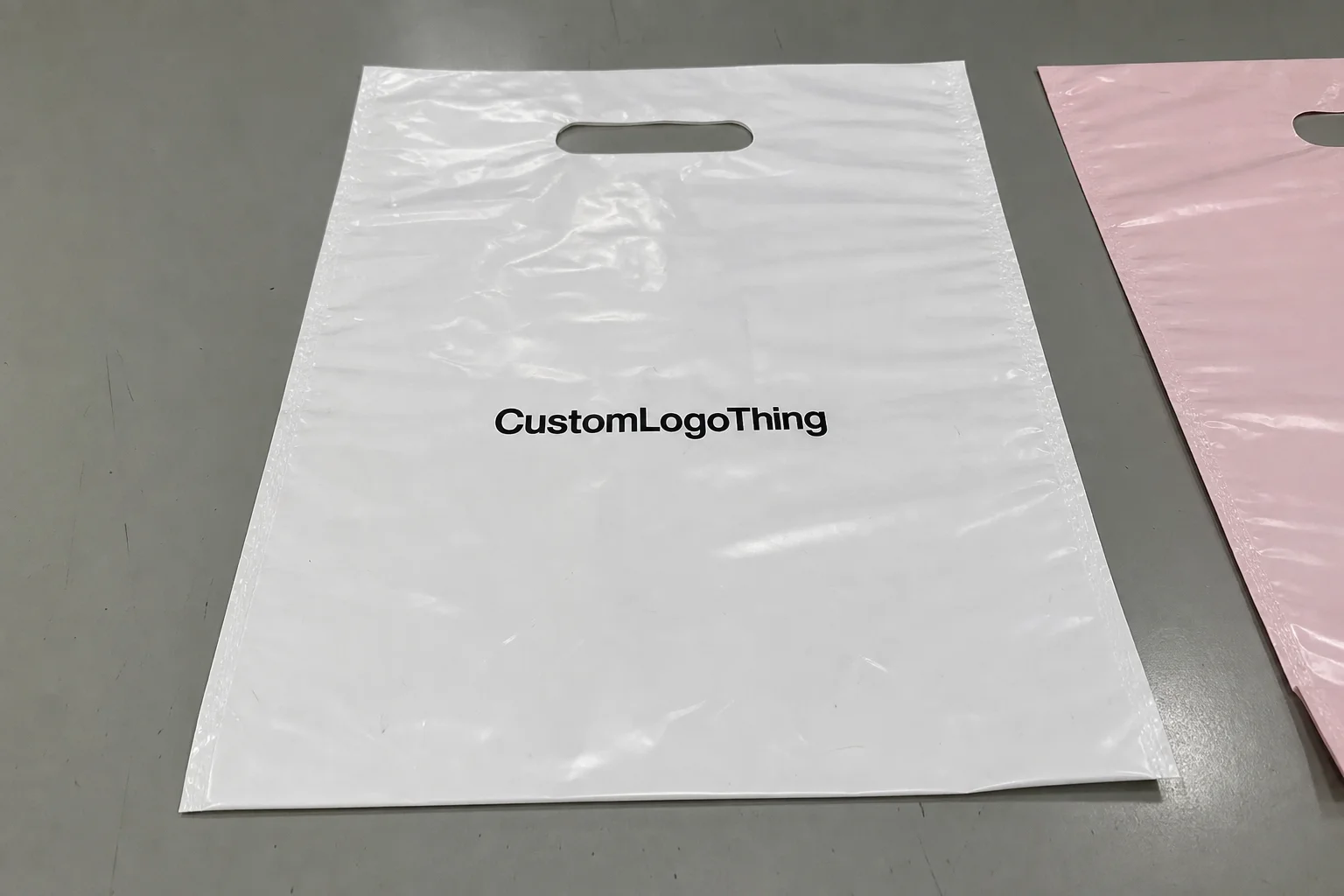
Print complexity changes both cost and manufacturability. A one-color design on a standard white or grey bag is straightforward. Multiple colors, dense flood coverage, or double-sided print increase setup demands and make proof approval more critical.
Details that commonly change price, MOQ, or lead time
- Film thickness: matched to product weight and puncture risk.
- Material structure: virgin LDPE, co-extruded film, or recycled-content blend.
- Closure style: single adhesive strip, dual-seal return strip, or tamper-evident format.
- Bag format: flat or gusseted, depending on packed product volume.
- Print layout: one side or two, plus color count and coverage.
- Label area: reserved space for shipping labels, barcodes, or warehouse stickers.
Artwork causes more delays than machines do. Fine reverse text, low-resolution logos, thin lines, and barcode zones placed over dark backgrounds should be checked before approval. If compliance text is required, confirm it early. Some markets require suffocation warnings or exact recycled-content wording. For broader packaging references, see FSC and the EPA recycling resources.
A strong quote request is concise: exact dimensions, packed item, thickness, print colors, quantity, delivery country, and required in-hand date. That gives suppliers enough to price the real job rather than a placeholder.
Pricing and MOQ: what really changes your unit cost
Custom courier bag pricing usually includes raw film, print setup, conversion, packing, quality control, and freight. There may also be fixed setup costs such as plates or cylinders. Those fixed costs are why small custom runs can look disproportionately expensive.
MOQ exists for practical reasons. Presses need setting up, film must be loaded, and waste allowances are built into the run. When order quantity is too low, the cost per piece rises quickly because setup is being spread over too few bags.
The price curve usually drops sharply at first, then flattens. Moving from a trial quantity to a workable production run can lower unit cost noticeably. Moving from an already efficient run to a much larger order may save less than expected and only makes sense if demand is stable enough to justify the extra inventory.
| Order band | Typical cost behavior | MOQ pressure | Best use case |
|---|---|---|---|
| Small trial run | Highest unit cost because setup is spread thinly | High | Launches, design tests, uncertain demand |
| Core production run | Lower cost per bag and more balanced economics | Moderate | Repeat SKUs with predictable usage |
| Higher-volume run | Best pricing if storage and cash flow can absorb it | Lower relative impact | Fast-moving programs and stable branding |
Buyers still have useful levers. Standard sizes are usually cheaper than custom dimensions. Fewer print colors reduce setup and registration demands. Single-seal bags cost less than dual-return formats. Repeat orders are simpler because artwork, tooling references, and QC expectations are already established.
Do not compare ex-works price alone. Freight, duties, palletization, local delivery, and storage can change the economics quickly. If one supplier looks dramatically cheaper, first confirm that the specifications being quoted are actually identical.
Production timeline and lead time: from artwork approval to delivered bags
Lead time is easier to manage when split into stages: pre-production, manufacturing, and transit. Many delays come from treating them as one vague number.
A typical sequence is specification review, quotation, artwork check, proof approval, production scheduling, printing, bag conversion, quality control, packing, and shipping. In practice, artwork revisions, missing dimensions, or unclear label placement often delay a job longer than the print run itself.
For many custom orders, production after proof approval is roughly 12 to 15 business days. That is a baseline, not a guarantee. More colors, unusual sizes, recycled-content film availability, peak-season congestion, or extra inspection steps can extend it. Transit comes after that, and the difference between air and sea freight can be substantial.
Repeat orders are often faster because the specification is already locked. Buyers who maintain clean records and reorder before stock becomes critical usually see fewer surprises. A practical rule is to build the schedule backward from the date the bags must be in your warehouse, allowing buffer for customs, carrier delays, and internal approvals.
If shipment conditions are rough or seal failure is a concern, transport testing may matter. ISTA standards are a useful benchmark when puncture resistance or seal integrity has been an issue.
How to compare suppliers on speed, consistency, and order risk
Fast turnaround claims are common; useful quoting discipline is less so. One of the best signs of a capable supplier is the quality of the questions asked before pricing. If they ask about thickness, packed product, print coverage, seal type, label area, and destination, they are more likely to quote accurately.
That matters because assumptions become delays. Good suppliers will flag low-resolution artwork, poor barcode contrast, thin reverse text, or dimensions that look fine flat but fail once the product is packed. These checks are cheaper than a rerun.
Consistency matters as much as speed. Ask about film gauge tolerance, print registration control, adhesive performance, and carton packing standards. Suppliers with batch traceability and retained production records are easier to work with on repeat orders when something drifts.
If you are comparing sources for printed courier bags lead time and moq, focus on four questions:
- Response accuracy: does the quote match the real specification?
- Proofing discipline: are artwork and barcode risks identified before production?
- Lead time transparency: are manufacturing and transit shown separately?
- Repeat order control: can the supplier reproduce a locked spec consistently?
What is the typical printed courier bags lead time and MOQ?
For a first custom order, lead time and MOQ depend mainly on bag specification, print complexity, and shipping method. Many suppliers quote production at around 12 to 15 business days after final proof approval. Delivered timing is longer once freight is added.
MOQ is driven by process efficiency. Standard sizes with simple print usually support lower minimums than unusual dimensions, heavy ink coverage, or dual-seal return bags. Rather than asking for one universal MOQ, buyers should compare three figures from each supplier: Minimum Order Quantity, production lead time after proof approval, and delivered lead time to the warehouse.
Next steps to order the right bags faster and avoid preventable delays
Start with the packed item, not the flat product photo. Bag size depends on the product after folding, including thickness, any inner wrap, and space for the shipping label. Then confirm film gauge, print colors, return strip requirements, barcode zone, and any compliance text.
The first inquiry should include quantity, expected usage, artwork files, delivery country or postcode, and the required in-hand date. It also helps to say whether the order is a trial or a repeat, because that can change the sensible MOQ and production route.
Ask for two or three quantity breaks rather than one price. That shows where unit cost improves, where inventory commitment becomes uncomfortable, and which order size fits actual consumption.
- Confirm packed product size and shipping conditions.
- Choose material, thickness, opacity, and closure style.
- Submit print-ready artwork with any compliance wording.
- Review the proof carefully, including label space and barcode visibility.
- Set a reorder trigger based on usage, production time, and transit buffer.
That last step matters. Reorder too late and every discussion becomes urgent. Reorder from a defined consumption trigger and both lead time and MOQ become easier to manage.
FAQ
What is the typical printed courier bags lead time and MOQ for a first order?
First orders usually take longer than repeat runs because artwork, dimensions, and construction details still need checking. A common production baseline is around 12 to 15 business days after proof approval, with freight added on top. MOQ depends on size, print complexity, film type, and bag construction, because the factory needs enough volume to justify setup and conversion waste.
How can I reduce printed courier bag MOQ without driving the price too high?
Use a standard size, limit the number of print colors, and avoid extra features unless they solve a real operational problem. Ask for multiple quantity breaks so you can see where the cost curve starts to improve. Shared designs across several SKUs, with variable labels added later, can also reduce the need for separate custom runs.
What information do suppliers need to quote printed courier bags accurately?
Provide finished bag dimensions, flap style, film thickness, material preference, print colors, print sides, quantity, delivery location, and required in-hand date. Include artwork files and explain the end use, especially if the bag needs return strips, barcode space, privacy opacity, or compliance text.
Do recycled-content courier bags affect lead time or MOQ?
They can. Material availability may be tighter, and print appearance can vary slightly compared with virgin film. That makes proof approval more important. Buyers should also confirm whether any recycled-content claim needs supporting documents or exact wording on the bag.
Is it better to choose a lower MOQ or a shorter lead time for custom courier bags?
That depends on demand certainty, storage space, and the cost of a stockout. Stable, high-volume programs often benefit from a higher MOQ if it lowers unit cost and simplifies replenishment. New launches, seasonal ranges, and uncertain forecasts usually benefit from lower commitment, even if the piece price is less attractive.