Buyer Fit Snapshot
| Best fit | Recycled Paper Hang Tags Manufacturer projects where brand print, material claims, artwork control, MOQ, and repeat-order consistency need to be specified before quoting. |
|---|---|
| Quote inputs | Share finished size, material target, print colors, finish, packing count, annual reorder estimate, ship-to region, and any compliance wording. |
| Proofing check | Approve dieline scale, logo placement, barcode or warning zones, color tolerance, closure strength, and carton packing before bulk production. |
| Main risk | Vague material claims, crowded artwork, missing packing details, or unclear freight terms can make a low unit price expensive after revisions. |
Fast answer: Recycled Paper Hang Tags Manufacturer: Material, Adhesive, Artwork, and MOQ should be specified like a repeatable production item. The safest quote records material, print method, finish, artwork proof, packing count, and reorder notes in one written spec.
Production checks before approval
Compare the actual filled-product size with the drawing, then confirm tolerance on folds, seals, hang holes, label areas, and retail display edges. Reserve space for logos, QR codes, warning copy, and material claims before decorative graphics fill the panel.
Quote comparison points
Review material grade, print process, finish, sampling route, tooling charges, carton quantity, and freight assumptions side by side. A quote is only useful when the supplier can repeat the same color, closure quality, and packing count on the next order.
A recycled Paper Hang Tags manufacturer is not just a printer with an eco label slapped onto the front of the job. The gap between a tag that feels refined and one that feels thin or tired usually comes down to fiber selection, sheet formation, and the care taken during finishing. Brands that want shoppers to notice sustainability without giving up shelf appeal need a stock choice that supports the artwork instead of fighting it.
That matters most in apparel, gift, and accessory lines, where the tag is often the first physical piece a shopper touches. A recycled Paper Hang Tags manufacturer can source recycled fiber, convert it into tag stock, print the brand message, add a hole or stringing, and finish the piece for retail use. The real decision sits in the details: which paper grade belongs on the product, whether a coating helps or hurts, and which print method fits the budget and the look.
For brands comparing suppliers, the technical details are not academic. A recycled paper hang tags manufacturer that understands pulp quality, print registration, and attachment strength can prevent costly rework later in the project. If you are also sorting through broader branding options, Custom Labels & Tags is a helpful place to compare construction styles, while About Custom Logo Things gives a clearer view of the company behind the service.
What a recycled paper hang tags manufacturer actually does
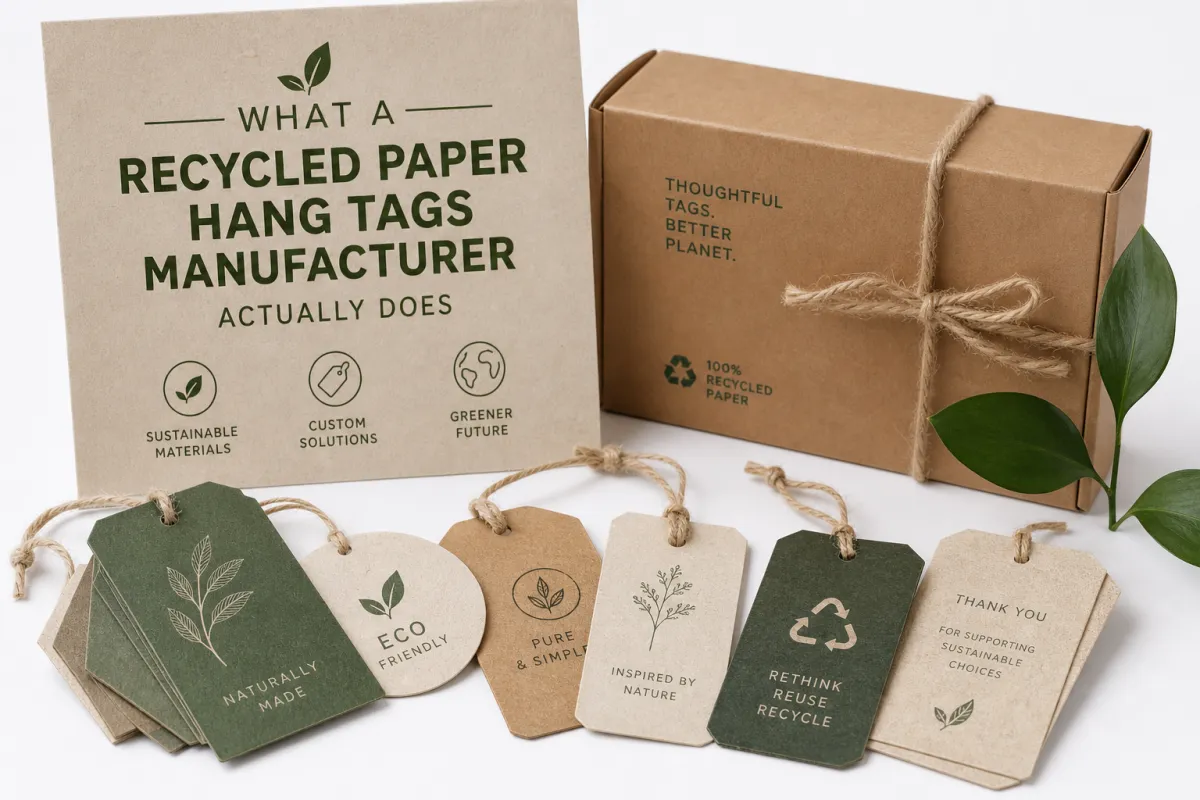
At its core, a recycled paper hang tags manufacturer turns recovered fiber into a retail-ready tag that carries a brand story, pricing, sizing, and care details. That sounds simple until you look at the decisions behind it. Recycled paper is not one fixed material. It can be made from post-consumer fiber, pre-consumer scrap, or a blend of both, and each choice affects stiffness, color, print clarity, and cost in a different way.
From a buyer's point of view, the best recycled paper hang tags manufacturer acts like a material converter, a print shop, and a production planner all at once. The supplier has to source the sheet, check whether it can hold ink cleanly, decide if the surface should stay uncoated or receive a light treatment, and then cut it into a shape that will not split around the hole. That chain is longer than many teams expect when they first start quoting a project.
The word "recycled" gets used too casually, and that creates confusion. Some people hear it and picture a rough, gray, uneven tag that will never look premium. That assumption is often wrong. A good recycled paper hang tags manufacturer can still deliver crisp typography, strong color coverage, and a tactile feel that suits a higher-end product, especially on a well-chosen 300gsm to 400gsm stock. Weak results usually come from poor material selection or loose production control, not from recycled fiber itself.
There is also a branding reason to care about the build. Hang tags are small, but they sit among the first touchpoints shoppers handle. A recycled paper hang tags manufacturer is helping create proof of sustainability in a format people can see and feel immediately. A recycled claim that never reaches the customer's hand stays buried in a spec sheet, where it does little for the brand story.
Most buyers are chasing three goals at once: a clean look, enough durability to survive transport and retail handling, and a price that does not crush the margin on a lower-ticket item. A recycled paper hang tags manufacturer can balance those goals, but only when the brief is clear. Size, paper grade, hole style, string type, and print coverage all influence the final result, sometimes more than the artwork itself.
One misconception deserves a direct answer. Recycled does not automatically mean weak. The right recycled paper hang tags manufacturer can supply a sheet that is stiff enough for garment racks, smooth enough for detailed logo work, and clean enough to die-cut without ragged edges. The trick is matching the paper to the use case instead of treating every tag like a generic promo card.
How a recycled paper hang tags manufacturer turns fiber into tags
The production path starts long before printing. A recycled paper hang tags manufacturer begins with recovered paper that is sorted, pulped, screened, and cleaned so contaminants like staples, tape residue, and heavy inks do not damage sheet consistency. After that, the fiber is formed into a web, dried, and calendared to reach the texture and thickness needed for tags. Every step changes how the final piece behaves in print and in hand.
That is why fiber quality matters so much. Contamination in the recycled stream can lead to specks, uneven tone, or weak sheet edges. A recycled paper hang tags manufacturer that controls those variables can deliver better consistency from one run to the next, especially for brands that need the same tag across several product lines. When the stock shifts too much, color matching becomes harder and the brand starts to look careless.
Post-consumer and pre-consumer content
Buyers should ask direct questions about recycled content instead of settling for vague eco language. Post-consumer fiber comes from paper that has already been used by consumers and recovered after disposal. Pre-consumer fiber comes from manufacturing waste before it reaches the market. A recycled paper hang tags manufacturer should be able to explain which blend is used, what percentage sits in the sheet, and whether any certification or chain-of-custody document supports the claim.
That distinction matters because it shapes both the environmental story and the look of the material. A high post-consumer blend can show more natural variation, which some brands welcome and others do not. A recycled paper hang tags manufacturer may recommend a cleaner blend for luxury goods, or a more visibly recycled surface for a sustainability-forward collection. Neither choice is inherently better. The right one depends on the brand voice and the retail setting.
After the sheet is formed, the paper is printed, cut, and finished. A recycled paper hang tags manufacturer may use offset, digital, or screen printing, depending on the quantity and the amount of ink coverage. Then come die-cutting, corner shaping, hole punching, scoring, and attachment options such as string, cotton cord, elastic, or paper twine. The more custom the shape, the tighter the registration needs to be.
Finishing choices can strengthen the result or work against it. Matte or uncoated stock usually keeps the recycled look honest and improves writability, while spot UV, foil alternatives, and embossing can create contrast without overwhelming the substrate. A recycled paper hang tags manufacturer should also warn buyers if a finish starts to work against the sustainability story. Heavy coatings may look polished, but they can reduce recyclability and make the tag harder to process after use.
The best answer is often the simplest one that still performs. A recycled paper hang tags manufacturer does not need to cover everything in special effects. If the logo is strong, the typography is clear, and the edge quality is sharp, the tag can do its job without extra decoration. That is especially true for garments and accessories, where texture often carries more authority than gloss.
Not every project needs the same structure. A fashion label may want a textured recycled stock with a subtle blind emboss. A home goods brand may want a smoother surface for barcode clarity. A recycled paper hang tags manufacturer that understands those tradeoffs can help brands avoid the mistake of over-specifying features that add cost but not value. I have seen more than one project get bloated by nice-sounding extras that looked clever in a deck and awkward in the hand.
The result is a production chain that looks small from the outside and turns technical as soon as you step through it. Recycled fiber choice affects the sheet. Sheet quality affects the print. Print quality affects brand perception. That is the chain a recycled paper hang tags manufacturer manages every day.
Cost and pricing: what changes the quote from a recycled paper hang tags manufacturer
Price is where buyers usually get surprised. A recycled paper hang tags manufacturer is not quoting just paper and ink. The quote reflects paper grade, recycled content percentage, size, shape complexity, print method, finishing, attachment style, packaging, and shipping. Two tags that look similar from a distance can have very different production costs once the specs are broken down.
Paper grade is usually the first driver. Heavier stock costs more, and some recycled sheets need more careful handling to print cleanly. A recycled paper hang tags manufacturer may also price differently depending on whether the sheet is naturally textured, coated, or made with a higher post-consumer content percentage. The more unusual the material, the more likely the price moves upward.
Shape complexity matters more than many buyers expect. A basic rectangle with rounded corners is faster to produce than a custom die-cut shape with a notch, a hang hole, and special alignment marks. A recycled paper hang tags manufacturer will often spread setup cost across the run, so the impact of custom tooling is much heavier on small batches than on larger runs.
Ink coverage is another lever. One-color black text on a natural recycled sheet is less expensive than a full-bleed, four-color design that needs tight registration and stronger press control. A recycled paper hang tags manufacturer may also charge for specialty finishing such as embossing, foil alternatives, or spot UV. Those details can be useful, but they should earn their place on the tag.
For a practical pricing lens, ask for a line-item quote. That makes it easier to see whether the cost sits in paper, printing, cutting, or attachment. A recycled paper hang tags manufacturer that gives a clean breakdown is easier to compare than one offering only a single number. Without that detail, the lowest quote can hide thinner stock or less finishing than you expected.
| Tag style | Typical unit cost at 5,000 pieces | Common setup factors | Best fit |
|---|---|---|---|
| Simple rectangular tag, 1-color print, uncoated recycled stock | $0.10-$0.16 | Basic die-cut, standard hole, minimal prepress work | Volume apparel, basic branding, fast reorder cycles |
| Custom size, 2-color print, recycled textured stock | $0.14-$0.24 | More press passes, tighter registration, added proofing | Retail products that need stronger shelf presence |
| Special shape, 4-color print, reinforced hole | $0.22-$0.36 | Custom tooling, more inspection, stronger finishing control | Premium collections and launch campaigns |
| Textured recycled stock with embossing or foil alternative | $0.30-$0.55 | Extra finishing steps, higher scrap risk, more handling time | Luxury goods and presentation-led packaging |
Volume changes everything. Small runs under 1,000 pieces usually feel expensive because setup costs are spread across fewer tags. A recycled paper hang tags manufacturer may give a lower per-unit price at 10,000 pieces than at 2,500, even if the total order value looks much higher. That is normal. The real question is whether the inventory risk makes sense for the launch plan.
Timing also affects price. Rush work tends to cost more because it interrupts a planned production schedule. A recycled paper hang tags manufacturer may also charge extra if the artwork changes after proofing or if the buyer needs multiple revisions to the dieline. Those fees are easy to avoid when the brief is complete before quoting starts.
If you are comparing suppliers, compare more than the final number. Ask what stock is being used, whether stringing or hole reinforcement is included, whether samples are part of the price, and how the supplier handles changes. A recycled paper hang tags manufacturer with a slightly higher quote can still be the better buy if the run arrives on time and requires no rework.
Process and timeline: from brief to shipment
A realistic order moves through a sequence, not a single step. A recycled paper hang tags manufacturer usually starts with discovery, where the buyer shares the brand style, quantity, size, color targets, attachment preferences, and sustainability goals. Then comes material recommendation, artwork prep, proofing, sampling if needed, production, quality check, packing, and shipment. Each handoff adds clarity, and each handoff can add delay if the information is incomplete.
The biggest timeline surprise is usually artwork. A recycled paper hang tags manufacturer can only move as quickly as the file allows. Missing dielines, low-resolution logos, unclear cut paths, or color references that do not match the production method all slow the process. If the design team changes the tag size after proofing, the schedule can slip again because the die or digital file has to be rebuilt.
Stock sourcing matters too. A recycled paper hang tags manufacturer may need to confirm paper availability before confirming the delivery window, especially for a recycled blend with a specific color, texture, or thickness. If the chosen paper is out of stock, the supplier may need to recommend a close alternative. That is not a failure; it is ordinary supply chain work.
Sample timing and production timing are not the same thing. A prototype or digital proof can often be turned around quickly, sometimes within a few business days, while a full manufacturing run takes longer because drying, cutting, inspection, and packing all happen in sequence. A recycled paper hang tags manufacturer should explain that difference clearly so nobody assumes a proof approval means goods ship the next day.
As a rule of thumb, the more custom the tag shape and finish, the more buffer time should be built into the plan. A simple recycled tag with standard dimensions may move in roughly 7-12 business days after proof approval. A more detailed run with specialty finish or complex attachment may need 12-18 business days, and that is before freight time. A recycled paper hang tags manufacturer that promises every order in the same window is usually smoothing over real variables.
Where delays happen
Delays often show up in places buyers do not see. A revised recycled content spec can require a new material check. A late decision about cord color can trigger another sample. A recycled paper hang tags manufacturer also needs time for quality inspection, especially if the run includes multiple SKUs or mixed language variants. Coordination becomes even more important if the tags must land with garments, labels, boxes, or inserts.
A tag can be made from recycled paper and still fail the retail test if the hole tears on the first hanger or the print smears during transit. Sustainability is only credible when the product survives real handling.
That is why launch planning matters. If the tags need to arrive with a clothing shipment or a retail kit, the manufacturer needs the full schedule up front. A recycled paper hang tags manufacturer can usually work with tight deadlines, but only when the buyer gives enough runway for proofing, sampling, and freight. The more moving parts in the launch, the more valuable a detailed timeline becomes.
How to judge quality, durability, and sustainability claims
Good recycled tag stock should feel deliberate in the hand. It should have enough stiffness to hang straight, clean cut edges, and print sharpness that does not blur at the edges of fine type. A recycled paper hang tags manufacturer should also be able to explain how the sheet resists scuffing during transport and how the hole behaves after repeated handling. Small details decide whether the tag feels premium or merely recycled.
Durability is not only about thickness. A 350gsm sheet with poor fiber bonding can fail faster than a well-made 300gsm sheet. A recycled paper hang tags manufacturer should be able to discuss tear strength around the punched hole, curl behavior in humid conditions, and whether the surface will mark easily when boxes rub against it. If the supplier cannot speak to those practical concerns, the buyer is left guessing.
For sustainability claims, documentation matters. Ask for the exact recycled-content percentage, whether the blend is post-consumer or pre-consumer, and what supporting documents are available. If certification language is used, it should match the claim. For broader paper sourcing standards, the FSC site is a useful reference point. For shipping durability and pack-out behavior, the testing framework published by the ISTA is worth understanding because retail damage is often a logistics problem rather than a design problem.
A recycled paper hang tags manufacturer should also help buyers avoid greenwashing by accident. A tag printed on recycled paper but wrapped in a heavy laminate, unnecessary plastic tie, and excess embellishment may look eco-friendly at first glance, yet it creates a more complicated end-of-life story. Simplicity can be an advantage. A plain recycled tag with a clean print finish may communicate more honesty than a busy one loaded with coatings.
Appearance and performance are related, but they are not identical. A tag can look premium without being glossy. Some of the strongest recycled designs use texture, contrast, and disciplined typography instead of shine. A recycled paper hang tags manufacturer that understands this can guide brands toward a better result without adding unnecessary finish costs.
Sample comparison helps a lot. Recycled papers can vary more than many buyers expect, even when the specifications look similar on paper. Put two or three sample tags side by side and check the tone, the edge quality, and the hole strength. A recycled paper hang tags manufacturer that welcomes that comparison is usually more confident in the material they are supplying.
Common mistakes when ordering recycled paper hang tags
The biggest mistake is choosing a supplier on price alone. The cheapest recycled stock can bring print issues, weak holes, or inconsistent color across the run. A recycled paper hang tags manufacturer that cuts corners on material control may still deliver something that looks acceptable in a photo, but the real test is how the tag behaves on a rack, in transit, and under store lighting.
Vague specs create another problem. If the size, thickness, print method, and attachment are not defined, quotes become hard to compare. A recycled paper hang tags manufacturer may assume one paper grade while another supplier assumes a different one, and the buyer ends up comparing mismatched numbers. Clear specs are not bureaucracy. They are the only way to get a useful quote.
Over-design is a sneaky issue. A sustainability piece can lose credibility if it becomes overloaded with coatings, foils, laminates, and decorative extras that do not help the brand message. A recycled paper hang tags manufacturer should be willing to say that a simpler structure will look better and cost less. That kind of honesty saves money and usually improves the end result.
Skipping sample approval is risky. Many buyers approve artwork on a screen, then discover the tag is too light, too glossy, too small, or too dense once it reaches production. A recycled paper hang tags manufacturer can only make the sample reflect reality if the sample is reviewed carefully. Even a small adjustment to hole placement or string length can change how the tag hangs on the product.
Late-stage artwork changes are another familiar trap. They add cost, but they also create pressure on the schedule and raise the chance of a mistake. A recycled paper hang tags manufacturer may need to rerun the proof, remake the die, or redo the plates. That is manageable when everyone knows it is happening. It is expensive when it appears two days before the planned press slot.
One more mistake gets overlooked often: failing to think about the full product system. If a brand also needs labels, inserts, or boxes, the tag should fit the broader visual language. A recycled paper hang tags manufacturer can help keep that system consistent, but only if the buyer shares the whole picture early. Otherwise the tag becomes a standalone item that looks disconnected from the rest of the package.
Expert tips for choosing the right recycled paper hang tags manufacturer
Start with a scorecard, not a gut feeling. A strong recycled paper hang tags manufacturer should be able to explain material options, show samples, define proofing steps, give realistic lead times, and talk about tradeoffs in plain language. If the supplier hides behind vague promises, that is a warning sign. Better to learn that before the order is placed.
Ask for samples from projects that resemble your own. If you are planning a textured retail tag, you need to see how the recycled fiber feels in hand and how the print lands on that surface. If the project is more technical, ask for a sample with a similar size, hole style, and attachment. A recycled paper hang tags manufacturer that can produce comparable samples is easier to trust because you are judging the same kind of work you plan to buy.
Build a brief that carries the right information. Include quantity tiers, target retail price, brand voice, preferred recycled-content range, artwork files, and any attachment preference. A recycled paper hang tags manufacturer can quote far more accurately when the buyer is specific. That also makes it easier to identify where a cheaper option trims quality or finish.
Use the supplier as a packaging advisor, not just a print vendor. A good recycled paper hang tags manufacturer can recommend a lighter sheet, a simpler cut, or a smarter attachment that reduces waste without hurting presentation. That advice matters because the tag is not an isolated object. It sits inside a larger packaging system that has to look consistent, arrive on time, and survive handling.
If you are comparing partners, look for the one that explains the hard parts without drama. The best recycled paper hang tags manufacturer will tell you when a finish is too much, when a paper grade is not ideal for the press method, or when the timeline needs a buffer. That honesty is worth more than a polished sales pitch.
For brands still mapping out how tags fit into a larger packaging program, the product mix at Custom Labels & Tags helps narrow the decision, and the background at About Custom Logo Things makes the service model easier to evaluate. A recycled paper hang tags manufacturer that documents recycled content, sends clean proofs, and keeps the order moving is usually the partner that creates fewer problems later. For a brand that wants practical sustainability rather than marketing fluff, that is the standard worth protecting.
What should I ask a recycled paper hang tags manufacturer before ordering?
Ask for recycled-content details, paper grade options, proofing steps, and whether the quote includes printing, die-cutting, and stringing. A recycled paper hang tags manufacturer should also be able to share sample photos or physical samples from similar runs so you can judge the finish before production starts.
How much do recycled paper hang tags usually cost?
Pricing depends on size, paper thickness, recycled content, print colors, finishing, and order quantity. Small custom runs usually cost more per tag because setup and tooling are spread across fewer pieces, while larger orders lower the unit price more quickly.
How long does a recycled paper hang tags order take to produce?
Simple orders can move quickly once artwork is approved, while custom shapes and finishes add time. Build extra time for proofs, sample reviews, stock sourcing, and shipping if the tags must match a product launch or a coordinated packaging rollout.
What recycled content percentage should I look for?
Ask for the exact percentage and whether it is post-consumer, pre-consumer, or a blend. A recycled paper hang tags manufacturer should help you choose the level that fits your sustainability goals while still giving the tag the stiffness and print quality you need.
How can I avoid quality problems with custom recycled hang tags?
Approve a sample, confirm artwork specs, and make sure the supplier understands your attachment, finish, and durability needs. A recycled paper hang tags manufacturer that gives line-item quotes and clear documentation is easier to evaluate, and the final tag is less likely to surprise you in the warehouse or on the shelf.
If you are preparing a new run, the most useful next step is a tight one-page brief: size, quantity, recycled-content target, print method, attachment style, and the date the tags need to land in hand. That gives a recycled paper hang tags manufacturer enough room to recommend the right stock and surface finish, and it keeps the conversation focused on the details that actually affect how the tag looks, hangs, and holds up once it reaches retail.