Buyers researching Woven Labels Unit Cost for chocolate brands usually want the unvarnished number first: is this small piece of trim worth paying for, or is it just a prettier way to spend packaging money? On a $9 chocolate bar, a $0.20 label can feel steep. On a $24 to $60 gift box, the same label may be the detail that pushes the pack from “nice” to “finished.” The answer sits in the specs: size, weave, thread count, fold, backing, application method, and order volume.
That sounds clinical because cost is clinical. Perceived value is not. Chocolate is sold through texture before anyone tastes it: paper tooth, box weight, ribbon tension, foil shine, the clean snap of a seal. A woven label adds another signal, but only if the rest of the package can support it.
Your Chocolate Wrapper Is Not the Premium Part
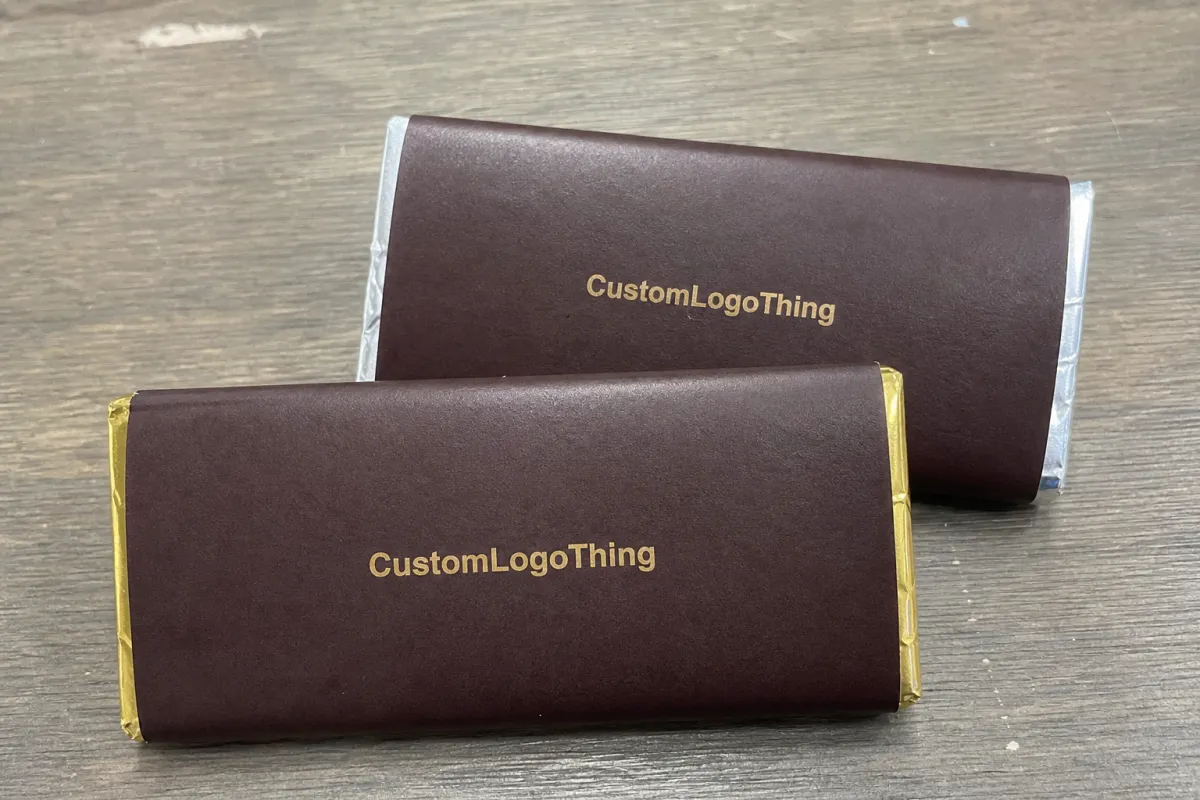
Chocolate brands often assume the product is doing all the work. It is not. A strong bar inside a flat, careless wrapper still reads cheaper than it should. Customers make quick comparisons: one box feels like a gift, another feels like inventory. Texture changes that judgment.
A woven label adds raised detail, edge definition, and a tactile cue that printed paper usually cannot fake. It catches light differently. It keeps its shape. From arm’s length, which is where most retail decisions begin, it can make a small package look more deliberate.
That is why chocolate brands borrow a trim format that started in apparel. Woven labels work as box seals, belly-band accents, pouch tags, ribbon markers, gift-set badges, and seasonal identifiers. They can also become a repeating brand element across collections, letting a company update flavors or paper graphics without rebuilding the whole visual system every season.
The tradeoff is blunt. Woven labels are not the cheapest labeling option. If the job is barcode compliance, ingredient copy, or a quick promotional sticker, paper will do it faster and cheaper. If the job is giftability, shelf texture, or a small premium signal, the extra cost can make sense.
The strongest fits are usually bean-to-bar makers, hotel amenity chocolates, wedding favors, holiday assortments, corporate gifts, boutique bars, and subscription boxes where the unboxing moment matters. The weakest fits are low-margin impulse bars, high-speed retail wrappers, and packs that need to remain perfectly flat for automated handling.
One detail gets missed: the woven label is not the hero. The package is. A woven patch on a flimsy carton can make the carton look worse, not better, because the contradiction becomes visible. Premium trim needs a compatible base: decent board, clean folds, controlled print color, and a placement area that does not fight the label.
For brands still deciding how labels, tags, sleeves, and ribbons should work together, Custom Labels & Tags is the logical starting point before locking in a woven format. For broader packaging structure references, the examples in our Case Studies show how small finishing details affect the final read.
Where Woven Labels Fit on Chocolate Packaging
The best chocolate applications are almost never direct food-contact use. Put woven labels on the outer box, sleeve, pouch, ribbon, outer wrap, or sealed presentation layer. Keep thread fibers away from ganache, truffles, fillings, and primary food surfaces.
Common uses are simple. A small logo tab can sit on a ribbon closure. A flat patch can sit on the front of a rigid box. A woven seal can bridge a tuck flap. Side tags work well on kraft pouches. Limited-edition sets often use a woven badge to identify flavor groups, seasonal collections, or corporate branding without reprinting the full carton.
Compared with stickers, hang tags, and printed sleeves, woven labels occupy a narrow but useful lane:
- Stickers are cheaper and faster, though they usually look flatter and can scuff.
- Hang tags allow more information, but they swing, bend, and complicate packing.
- Printed sleeves look clean at volume, yet revisions can be expensive once stock is printed.
- Woven labels add texture and permanence in a small footprint.
Application speed matters. A hand-applied woven label may be fine for 500 wedding favor boxes. It becomes a labor problem at 20,000 units unless the placement, adhesive, and packing flow are engineered early. A label that looks charming in a sample photo can slow a line if staff have to align it by eye on every box flap.
Attachment also affects pack behavior. A label on a rigid box front is mostly decorative. A label used as a seal must survive opening pressure, storage, and transit vibration. A label on ribbon has to flex without twisting. A pouch tag may face abrasion in shipping cartons. Those are different jobs, and they should not be quoted as if they were identical.
For brands shipping through rougher channels, test the outer pack as a system. Transit vibration, drop stress, compression, and scuffing show weaknesses quickly once a label is attached to a real carton. ISTA test methods provide useful context for distribution testing. If the carton, insert, or paper component needs responsible sourcing claims, FSC certification may also be part of the packaging discussion.
Woven Label Specs That Change the Quote
Most quote swings come from a small set of choices. Damask woven labels usually provide the sharpest detail and are common for logos, borders, and small type. Satin woven labels feel smoother and can look more polished on premium gift packs. Taffeta is more basic, often less expensive, and better suited to simpler marks.
Then come the finishing choices: straight cut, hot cut, merrowed edge, center fold, end fold, loop fold, adhesive backing, heat-seal backing, iron-on backing, or plain sew-on construction. Each one changes material use, setup, and labor. A straight-cut damask label with two colors is not in the same cost family as a folded, adhesive-backed label with a special edge.
Size moves the price more than buyers expect. A small tab might be 0.5 x 1 inch or 1 x 2 inches. A front patch for a rigid chocolate box might be closer to 1.5 x 2 inches or 2 x 3 inches. Larger labels use more yarn and more loom time. They may also need tighter cutting control because small alignment errors become more visible at larger sizes.
Thread color count is another lever. Two to four colors are usually efficient. Five to eight colors can work, but costs climb and fine detail becomes harder to hold. Metallic thread can look attractive on holiday and corporate gifting, but it often adds cost, stiffness, and sampling risk.
Artwork complexity deserves more respect than it gets. Woven labels are strong at logos, crests, borders, monograms, simple icons, and short text. They are weak at nutrition panels, tiny legal copy, delicate serif type, micro-patterns, gradients, and QR codes unless tested at final size. A digital proof can make details look clean that the loom cannot render cleanly.
Attachment choice has to match chocolate packaging conditions. Pressure-sensitive adhesive is common for boxes, sleeves, and some pouch fronts. Heat seal only works if the packaging material tolerates heat and pressure without warping, gloss shift, or adhesive bleed. Stitching makes sense for fabric pouches or reusable gift bags. Ribbon integration can be effective for premium assortments because the label feels like part of the gift, not a separate decoration added late.
Storage conditions add another layer. Chocolate packaging may pass through cool rooms, humid retail counters, hand packing, insulated shippers, and warm receiving docks. Condensation, hand oils, waxed surfaces, kraft fibers, and coated board all affect adhesion. Secondary packaging is the correct place for woven labels, but the backing still has to suit the substrate.
| Spec profile | Typical MOQ | Cost per piece | Best fit |
|---|---|---|---|
| Small damask logo tab, 2 colors, straight cut | 500-1,000 | $0.08-$0.18 | Seasonal boutique bars, simple box seals |
| Folded label with adhesive backing | 1,000-3,000 | $0.18-$0.35 | Rigid boxes, sleeves, premium pouch fronts |
| Multi-color woven patch, special edge, proofing required | 3,000-5,000+ | $0.25-$0.55 | Gift sets, corporate chocolate, branded collections |
| Larger premium label with specialty backing | 5,000+ | $0.45-$0.90+ | Core SKU packaging, higher-end presentation packs |
Woven Labels Unit Cost for Chocolate Brands: Real Quote Math
Woven Labels Unit Cost for chocolate brands usually lands in a wide range because the label is not one product. It is a set of production decisions. Simpler runs at workable volume may fall around $0.08 to $0.35 per piece. Larger, folded, adhesive-backed, multi-color, metallic, specialty-edge, or low-volume labels can move into the $0.25 to $0.90+ range.
The main cost drivers are size, weave type, thread colors, edge finish, fold type, backing, artwork cleanup, sampling, packing method, shipping speed, and quantity. Setup charges matter too. Even a small order requires loom file preparation, color planning, proofing, machine setup, cutting, and packing. On low quantities, that fixed effort has fewer pieces to absorb it.
Small MOQ protects cash. Large MOQ protects margin. The right answer is usually the one that matches the launch calendar, not the one that sounds bold in a meeting.
Compare the label cost to the selling price and purpose of the pack. On a $24 to $60 chocolate gift box, a $0.18 to $0.45 label can be reasonable if it improves perceived value and supports the brand position. On a $3.99 grocery bar, the math usually breaks. Premium trim belongs on packs with enough margin to carry it.
Freight can distort the piece price. A quote that looks lower before shipping may not be lower after cartons, courier fees, import charges, or rush handling are included. Ask whether the unit cost includes packing method, proofing, and delivery, or whether those appear as separate line items. Buyers get surprised less often when they compare landed cost rather than factory piece price.
A clean quote request should include the final logo file, exact dimensions, fold or edge preference, backing choice, quantity tiers, packaging material, placement photo or dieline, and target delivery date. If the label goes over a box seam, around a ribbon, onto textured paper, or across a flap, say so before pricing. Vague specs often produce padded quotes because the supplier has to protect against unknowns.
Ask for 1,000, 3,000, 5,000, and 10,000 piece breaks in the same quote if the product may repeat. The pattern matters more than one number. Sometimes the jump from 1,000 to 3,000 pieces changes the economics dramatically; sometimes it does not. That depends on setup, material width, loom efficiency, and finishing labor.
MOQ Tradeoffs: Small Test Run or Better Piece Price
MOQ is not a punishment. It is a tradeoff between cash control and unit economics. Lower quantity lets a chocolate brand test a new pack without committing to cartons of obsolete trim. Higher quantity usually lowers the piece price and makes reordering easier because setup effort is spread across more labels.
The practical ranges are familiar. A 500-piece run can make sense for a seasonal market test, wedding favor batch, influencer mailing, or small gift set. A 1,000 to 2,000-piece order fits a boutique retail launch. A 5,000-piece run starts to align with corporate gifting, wholesale packaging, and stronger repeat demand. At 10,000 pieces and above, the label is probably part of a core SKU or recurring program.
Ordering too little creates quiet costs: repeated freight, repeated setup, rush replenishment, and inconsistent lots if the next run is produced under pressure. Ordering too much creates a different risk: dead inventory after a logo update, flavor change, carton revision, compliance edit, or seasonal concept that does not repeat.
Evergreen artwork reduces that risk. Brand marks, crests, patterns, short collection names, and simple icons age better than flavor-specific claims or year-stamped messages. Keep ingredients, allergens, net weight, nutrition facts, certifications, and promotional copy on printed components that can be updated more easily. A woven label should carry the durable identity, not volatile information.
Color planning helps too. If the brand changes seasonal palettes often, a neutral woven base with a stable logo may travel across more collections than a highly specific holiday colorway. It is less exciting on the spec sheet. It is often smarter in inventory.
The best buying move is to request multiple tiers before committing: a small test run, a balanced production run, and a best-price bulk run. That gives marketing, operations, and finance something concrete to compare. Nobody has to debate whether a label “feels premium” while ignoring the invoice.
Process and Timeline From Artwork to Finished Labels
The production path is predictable when the buyer sends clean inputs: artwork review, quote confirmation, weave file setup, digital proof, physical sample if needed, approval, bulk weaving, cutting or folding, backing or adhesive application, quality check, packing, and shipping. Delays appear when one of those steps is uncertain.
For timing, a realistic range is 1 to 2 business days for quoting when specs are clear, 2 to 4 business days for proofing, about 5 to 10 business days for sampling if a physical sample is needed, and roughly 10 to 20 business days for bulk production after approval. Larger orders, complex folds, metallic threads, specialty backings, and holiday peaks can stretch that schedule.
Three things slow projects quickly: repeated artwork revisions, unclear placement, and late attachment decisions. Adhesive testing can also add time because a label that holds on coated board may lift on textured kraft, and a label that behaves on a flat box front may curl near a flap or seam.
Send vector artwork. Confirm exact dimensions. Choose the attachment method early. Provide the packaging surface if adhesion matters. Approve color references before sampling. These steps do more for schedule control than long email threads.
Physical samples are not always necessary for a simple repeat order, but they are sensible for premium gift boxes, new substrates, adhesive-backed labels, metallic threads, unusually small text, or high-visibility launches. A sample costs time. A failed bulk run costs more.
Seasonal chocolate calendars need buffer. Valentine’s Day, Easter, weddings, corporate gifting, and year-end assortments compress production and freight schedules. If the pack also needs photography, retailer approval, or kitting, build the woven label timeline into the full launch plan rather than treating it as a last decoration.
Quality Checks Before You Put Labels on Chocolate Boxes
Quality control for woven labels is not complicated, but it has to be specific. Check edge consistency, color accuracy, logo readability, adhesive hold, fold alignment, thread density, label flatness, cut accuracy, and loose yarns. Those are the visible issues customers notice. The rest is noise.
Test the label on the actual packaging material, not a random sample board. Rigid boxes, kraft pouches, fabric bags, coated sleeves, textured papers, and ribbons all behave differently. Adhesive that holds on smooth board may fail on rough stock. A folded label that sits cleanly on ribbon may look bulky on a narrow box flap.
Storage and shipping matter. Chocolate packaging may sit in cool rooms, face condensation, absorb hand oils during packing, or vibrate in transit. The label should not lift, fray, stain, curl, or snag under expected handling. If the finished product is going through retail distribution or a gift fulfillment center, test the journey it will actually take.
Artwork proofing is where many brands get trapped. Thin lines disappear. Tiny serif text turns soft. Gradients do not translate into weave the way they appear on a screen. Low-contrast tone-on-tone colors may look elegant in a mockup and unreadable under store lighting. A label that only works when zoomed in on a monitor is not ready.
Inspect the first sample at arm’s length, under normal lighting, and on the final package. Check the box closed, open, stacked, and packed into its shipper if that is how the product moves. If the label bridges a seam, open and close the pack several times. If it sits on ribbon, tie the ribbon the way staff will tie it in production, not the way a designer tied it for the sample photo.
Define tolerances before bulk production. Color in woven yarn will not match ink, foil, or screen color perfectly. Small size variation can happen after cutting and folding. The goal is not fantasy perfection; it is an agreed standard that protects the look of the pack and prevents arguments after the run is complete.
For buyers comparing trim options, review the outer pack first. The examples in Case Studies and the options in Custom Labels & Tags are useful references before choosing a woven label spec.
Next Steps to Get a Clean Quote Without Rework
The fastest path to a useful quote is a complete spec packet. Include the logo file, target label size, quantity tiers, desired backing, packaging surface, launch date, and a photo or dieline showing the placement area. If the label must sit on a ribbon, pouch, flap, curved edge, or textured stock, mention it before the first quote.
Choose one primary use case first: box front patch, flap seal, pouch tag, ribbon label, or gift-set badge. Trying to make one woven label do five jobs usually produces a compromised spec. The label should be designed for its job, not forced into every packaging role because the inventory already exists.
Ask for two or three versions: a budget build, a best-value build, and a premium build with upgraded edge, backing, or thread detail. That creates real tradeoffs. It also helps internal approvals because marketing can see the finish difference, operations can see application complexity, and finance can see the landed cost.
Before releasing bulk production, confirm whether sample approval is required. For high-end chocolate gift packaging or adhesive-backed labels, it usually should be. Test the sample on the real pack, under real light, with real handling. That is the approval that matters.
A clean sequence looks like this: confirm specs, approve quote, review proof, test sample on final packaging, then release bulk production with enough buffer before launch. That prevents panic freight, rushed inspection, and the familiar scramble of discovering an adhesion problem after the boxes are already filled.
Accurate Woven Labels Unit Cost for chocolate brands depends on real packaging details. A clear spec gets a clean price. A vague spec gets padded numbers, delayed samples, or both. Packaging already has enough variables; the label does not need extra mystery.
What affects woven label unit cost for chocolate packaging?
The main drivers are label size, weave type, thread color count, fold or edge finish, adhesive or backing choice, order quantity, sample requirements, packing method, and delivery speed. A small two-color damask logo label at higher volume can cost far less per piece than a large adhesive-backed patch with multiple colors and specialty edges.
What MOQ should chocolate brands expect for custom woven labels?
Many custom woven label orders start around 500 to 1,000 pieces. Stronger unit pricing usually appears around 3,000 to 5,000 pieces and above. For seasonal chocolate drops, quote several quantity tiers so you can compare cash outlay, inventory risk, and unit savings before committing.
Can woven labels be used directly on chocolate wrappers?
They should be used on secondary packaging, such as boxes, sleeves, ribbons, pouches, or outer wraps, not in direct contact with food. If the label uses adhesive, test it on the actual packaging material and expected storage conditions before bulk production.
How long does woven label production take for a chocolate brand launch?
A realistic timeline is often 1 to 2 business days for quoting, 2 to 4 business days for proofing, 5 to 10 business days for sampling if needed, and 10 to 20 business days for bulk production after approval. Rush timing depends on quantity, specs, approval speed, and shipping method. Holiday packaging needs extra buffer.
Are woven labels worth the cost for chocolate gift boxes?
They can be worth it for premium gifts, corporate sets, wedding favors, boutique bars, hotel amenities, and limited-edition collections where texture improves perceived value. They are usually not the best choice for low-margin, high-speed retail bars where paper labels or printed sleeves can do the job more cheaply.


