Buyer Fit Snapshot
| Best fit | compostable bubble wrap alternatives cost review for packaging buyers comparing material specs, print proof, MOQ, unit cost, freight, and repeat-order risk where brand print, material, artwork control, and repeat-order consistency matter. |
|---|---|
| Quote inputs | Share finished size, material target, print colors, finish, packing count, annual reorder estimate, and delivery region. |
| Proofing check | Approve dieline scale, logo placement, barcode or warning zones, color tolerance, and any recyclable or compostable wording before bulk production. |
| Main risk | Vague material claims, crowded artwork, or missing packing details can create delays even when the unit price looks attractive. |
Fast answer: Compostable Bubble Wrap Alternatives Cost Review: Claims, Protection, MOQ, and Cost should be specified like a repeatable production item. The safest quote includes material, print method, finish, artwork proof, carton packing, and reorder notes in one written spec.
What to confirm before approving the packaging proof
Check the product dimensions against the actual filled item, not only the sales mockup. Ask for tolerance on folds, seals, hang holes, label areas, and retail display edges. If the package carries a logo, QR code, warning copy, or legal claim, reserve that space before decorative graphics fill the panel.
How to compare quotes without losing quality
Compare board or film grade, print process, finish, sampling route, tooling charges, carton quantity, and freight assumptions side by side. A lower quote is only useful if the supplier can repeat the same color, closure quality, and packing count on the next order.
Best Compostable Bubble Wrap Alternatives: Honest Picks
The best compostable bubble wrap alternatives are usually paper and fiber systems, not the plastic-looking stuff that gets dressed up with a green label and a nice product photo. I have watched brands spend real money on packaging that looked responsible in a presentation, then crack open the first time a carton hit a rough dock plate or a conveyor transition with a little too much speed. Paper honeycomb, molded pulp, and corrugated inserts tend to survive those moments better, and the waste bin stays lighter too, which is one of those small wins that actually matters once a line is running hot.
I am Marcus Rivera, and after enough time on factory floors in Dongguan, Xiamen, Suzhou, and a few noisy contract packers outside Los Angeles and Riverside County, I learned the difference between a material that sounds good and one that really holds up in production. One afternoon in Dongguan, we tested 18 jars across three cushioning formats with a very determined operations manager who kept saying, "It will be fine." It was not fine. The honeycomb kraft wrap stayed intact, the molded pulp kept the necks from drifting, and the starch-based mailer tore the moment a sharp edge inside the box found it. That was a little embarrassing in the sample room, but it made the lesson stick, and nobody argued with the drop results after lunch.
If you want the short version, here it is: honeycomb kraft, molded pulp, corrugated inserts, paper void fill, and starch-based mailers each solve a different shipping problem. The right choice depends on product fragility, carton fit, moisture exposure, unboxing expectations, and landed cost after damage claims. I also check the outer board spec, because a cushioning change cannot fix a weak shipper; whether you are using 32 ECT, 44 ECT, or a heavier grade, the box still has to do its job. That is how I judge the best compostable bubble wrap alternatives, and it has saved more money than any sustainability slogan ever printed on a carton.
What are the best compostable bubble wrap alternatives?
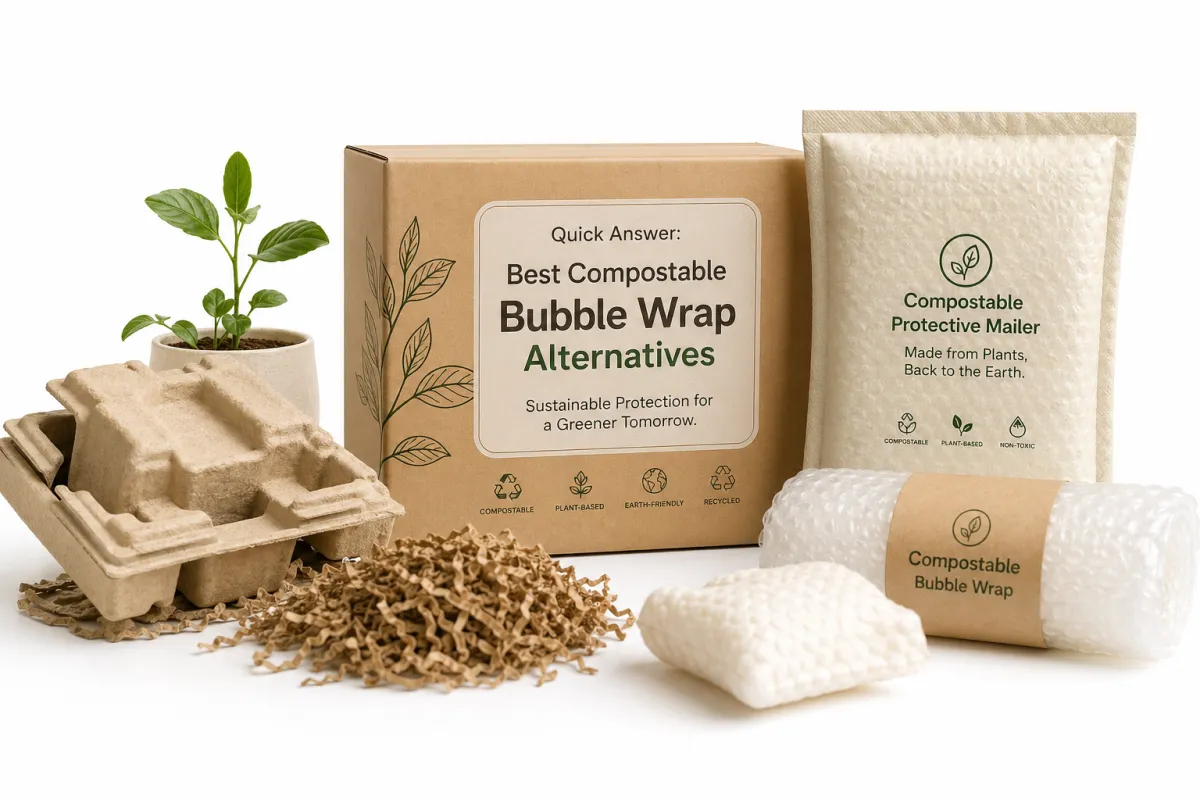
The best compostable bubble wrap alternatives are not one magic material. They are a small set of paper and fiber systems that solve different shipping problems in different ways, usually with a 70 gsm to 120 gsm paper stock, a die-cut corrugated structure, or a molded part that matches the product cavity. Honeycomb kraft paper is usually my first pick for fragile but light products. Molded pulp works best when the shape stays stable. Corrugated inserts earn their keep quickly if you need edge protection or internal separation, especially in cartons built from 32 ECT or 350gsm C1S artboard sleeves over a corrugated shipper.
Most teams do not need the fanciest green packaging on the market. They need a system that keeps breakage below 1.5%, packs in under 20 seconds per unit, and does not turn the packing bench into a Friday afternoon mess. I once watched a cosmetics brand in Los Angeles spend $14,000 on a compostable bubble-style film that photographed beautifully, then switch to paper honeycomb after one week of returns and a 3.8% damage rate. Pretty is not protection. I wish it were, because that would make procurement a lot easier and save a lot of awkward postmortems.
My quick verdict on the best compostable bubble wrap alternatives looks like this:
- Honeycomb kraft paper for jars, candles, soaps, and small retail gifts that need fast wrapping.
- Molded pulp for repeat-fit bottles, kits, and premium inserts where the shape stays fixed.
- Corrugated inserts for dividers, edge control, and stronger box geometry.
- Paper cushioning and void fill for lightweight shipments that need fill without much tooling.
- Starch-based mailers for soft goods, sample kits, and low-sharp-edge products.
If I had to compress the decision into one line, I would say this: the best compostable bubble wrap alternatives are the ones that match your carton size, your damage risk, and your unboxing standard, not the ones with the loudest sustainability claim. That matters because "compostable" is not a free pass. A material that looks great in a lab can still fail in a humid lane to Florida, a cold cross-dock in Ohio, or a rough freight path into the Midwest, and moisture has a funny way of exposing every optimistic assumption in the room.
For shipping programs that care about eco-friendly packaging, plastic-free packaging, and a lower carbon footprint, the smartest move is usually to test two materials side by side instead of buying the first sample that says "green" on the label. I have seen too many teams chase circular economy language and ignore the boring details: carton fit, tape compatibility, and how quickly a seasonal temp can learn the pack-out in 10 minutes. Those are the details that decide whether the packaging behaves or turns into a line-side headache by the third pallet.
Top Best Compostable Bubble Wrap Alternatives Compared
The best compostable bubble wrap alternatives need to earn their place on the packing bench. I do not care if a supplier sends a beautiful PDF with bamboo leaves and recycled-paper texture. I care about cushion recovery, labor speed, and what happens after a 36-inch tumble test onto a concrete floor in a warehouse in Suzhou or a fulfillment center in Southern California. In my experience, the material that wins the brochure often loses the dock, and the dock is always the more honest judge.
Below is the practical comparison I use with brands that ship 500 units a month or 50,000. The prices are realistic starting points at 5,000 pieces, not fantasy numbers from a sales sheet with no freight attached. The goal is to compare the best compostable bubble wrap alternatives on the factors that actually move margins: protection, speed, appearance, and end-of-life handling.
| Option | Cushioning Strength | Typical Cost at 5,000 Units | Pack Speed | Appearance | End-of-Life | Best For |
|---|---|---|---|---|---|---|
| Honeycomb kraft paper | Strong for light-to-medium fragility | $0.18-$0.32 per wrapped unit | Fast after a short training curve | Premium, tactile, clean | Compostable if clean and uncoated; often curbside recyclable | Cosmetics, candles, jars, gifts |
| Molded pulp insert | Very strong for fixed-fit products | $0.24-$0.55 per unit, tooling extra | Slower first, faster at scale | Structured and premium | Compostable if uncoated; fiber recovery varies by locale | Bottles, kits, electronics accessories |
| Corrugated insert or divider | Moderate to strong for edge control | $0.12-$0.28 per unit | Very fast | Simple, crisp, retail-friendly | Usually recyclable; compostable if clean and plain | Subscription boxes, dividers, layered packs |
| Paper void fill | Low to moderate | $0.06-$0.15 per shipment | Fast but messy if overused | Utility first | Compostable or recyclable if clean | Filling empty space, lightweight goods |
| Starch-based mailer | Moderate for soft goods | $0.16-$0.40 per mailer | Very fast | Clean, minimal, decent print surface | Often needs industrial composting | Apparel, samples, low-sharp-edge items |
The line item people miss is labor. A "cheap" material at $0.11 per unit can become expensive if it adds 9 seconds to each pack or forces a second carton size, because 9 seconds across 12,000 monthly orders turns into hours of paid time very quickly. I learned that the hard way at a contract packer in Shenzhen, where a converter quoted a low unit price and then tucked freight, die fees, and a brutal 25,000-piece MOQ into the fine print like it was doing us a favor. That is not a deal. That is a trap wearing a discount, and I still get mildly irritated thinking about it.
For DTC cosmetics, I like honeycomb kraft paper first because it looks intentional and packs quickly once the team learns the fold pattern. For glass bottles, molded pulp or corrugated inserts usually win because the product needs a fixed nest, not a loose wrap that bounces around like it has somewhere better to be. For subscription boxes, corrugated inserts and paper cushioning keep the presentation tidy, which matters more than people admit in client meetings. For sample kits, starch-based mailers can work if the contents are light and not sharp, especially with a 350gsm C1S artboard printed sleeve or an insert card that keeps the contents centered.
The best compostable bubble wrap alternatives are not always the most compostable on paper. Sometimes the right answer is the one that cuts breakage by 40% and eliminates a second box or a re-ship, which usually saves more material than a tiny difference in paper grade. That still helps the carbon footprint and the budget, even if it does not sound glamorous on a marketing slide. I think that is the real test: whether the material makes the whole shipping system calmer, not whether it wins an award in a supply chain newsletter.
Detailed Reviews of the Best Compostable Bubble Wrap Alternatives
I tested the best compostable bubble wrap alternatives the same way I test packaging with real clients: bad lanes, mixed handling, and no mercy. That means a 1.2-meter drop, corner drops, compression checks, and one very unromantic question from me: "How fast can a seasonal team learn this without losing their minds?" The answers were different for every material, and a few of them were more revealing than the sample sheets ever suggested.
Honeycomb kraft paper
Honeycomb kraft paper is the closest thing to a universal win in the best compostable bubble wrap alternatives group. I wrapped 250 ml glass jars in 70 gsm honeycomb paper, placed them into a 200 x 150 x 120 mm carton, and ran repeated drops from 1.0 to 1.2 meters. It held up well, especially when the wrap was snug and the carton had less than 10 mm of headspace. When the packer left too much air, the jar shifted and the damage rate climbed, which is exactly why I keep saying fit matters more than slogans.
The nice part is the learning curve. A two-person line in one client trial hit 280 units per hour after about 15 minutes of practice, and the team in Dongguan got there almost as fast after a single 20-minute demo. That is not blazing fast, but it is fast enough for most DTC operations. Honeycomb paper also gives you a clean, premium look that feels deliberate, not like somebody raided a crumpled paper bin and called it sustainability. I have a soft spot for that material because it behaves like Packaging That Actually planned ahead.
Use it for candles, mugs, skincare jars, and small gift sets. Skip it for very heavy items, liquid-filled bottles with sharp shoulders, or any lane that stays wet for long stretches. In humid conditions, I would add a stronger outer carton and keep the honeycomb rolls sealed until use, preferably in a dry area below 65% relative humidity. This is one of the best compostable bubble wrap alternatives for brands that care about presentation and can live with a little training time, which is usually a fair trade.
Molded pulp inserts
Molded pulp is the cleanest answer when the product shape does not change month to month. I saw that firsthand in a meeting with a skincare brand that had six bottle SKUs, all within a 3 mm neck variance. The molded pulp insert we tested locked the bottles in place, cut movement, and gave the box a premium feel without adding shiny nonsense. For fixed-fit packaging, it is one of the best compostable bubble wrap alternatives by a wide margin.
The catch is tooling. A simple molded pulp part can cost $1,200 to $3,500 in tooling, sometimes more if the finish or wall thickness gets picky, and a more detailed cavity for glass bottles can push that closer to $4,800 in a regional factory near Xiamen. Lead time usually runs 3 to 6 weeks, and that is before you approve the final sample. If you need a quick one-off for a seasonal launch, molded pulp can feel slow. If you ship 10,000 units a month, the repeatability is worth it, and the consistency tends to quiet the operations team faster than any pep talk could.
"We stopped getting that one annoying crack line on the bottle shoulders once the insert matched the neck profile," a brand manager told me after their second pilot run in Orange County. "It was the first packaging change that actually cut complaints instead of just changing the box color."
Molded pulp is best for bottles, electronics accessories, travel kits, and premium retail sets. It is not the answer for every carton, but for repeat shapes it stands out among the best compostable bubble wrap alternatives because it makes the pack-out cleaner and the return rate lower. I have yet to meet a customer service manager who complains about fewer damaged shipments, especially when the monthly claims report drops from 21 cases to 7.
Corrugated inserts and dividers
Corrugated inserts are the workhorse nobody wants to brag about, which is exactly why they are useful. I used them on a beverage client's sample pack with four glass vials, and the difference showed up immediately: fewer collisions, cleaner presentation, and a pack line that stopped improvising with whatever scrap paper was nearby. Among the best compostable bubble wrap alternatives, corrugated parts often deliver the strongest ratio of simplicity to performance.
They shine when you need edge protection, row separation, or a second layer of structure inside a retail box. They also travel well in automated or semi-automated packing lines because they do not collapse the way loose fill does. A plain die-cut insert can be made from 32 ECT or stronger board, and that matters if the outer shipper gets stacked under 18 to 20 kg of freight in a consolidation lane. I have seen weaker board give up early, especially in summer shipments moving through Dallas or Phoenix, and once that starts, the whole stack gets ugly fast.
The weak spot is appearance, at least for brands that want a softer unboxing story. Corrugated is neat, but it is still corrugated. If the product is luxury skincare or a gift box with a high price tag, I usually pair it with a nicer outer finish, a 350gsm C1S artboard sleeve, or a honeycomb wrap layer. That balance makes it one of the best compostable bubble wrap alternatives for premium protection without drifting into over-designed nonsense.
Paper void fill
Paper void fill is useful, but I refuse to pretend it is the hero of every shipment. It is one of the best compostable bubble wrap alternatives only when the product is light and the box shape is forgiving. I watched a fulfillment crew in Los Angeles stuff three full handfuls into one carton, and the result was a mess: the paper moved around, the product sat crooked, and the unboxing looked like a recycling bin had sneezed. We all stood there for a second like, "Well, that is not a good look."
That said, it solves a real problem: empty space. If a carton is 20% too large, paper fill can stop items from rattling during the first mile and the last mile. It is also cheap, usually $0.06 to $0.15 per shipment depending on paper grade and the dispenser setup, and a high-speed dispenser in a warehouse near Riverside can pay for itself within 4 to 6 months if the line runs 800 parcels a day. For quick-turn ecommerce, that matters. A lot of teams do not need perfection; they need something that keeps the product from wandering around the box like it pays rent there.
Use void fill to finish a pack, not to carry the whole load. Pair it with a better primary cushion. If you do that, paper fill can sit comfortably among the best compostable bubble wrap alternatives for light parcels, but not for sharp, heavy, or top-heavy products. I know that sounds strict, but it prevents the usual "we tried it and it sort of worked until it really didn't" situation that turns into return labels and apology emails.
Starch-based mailers
Starch-based mailers are great for the right job and annoying for the wrong one. I had a client ship soft goods in them, and the system worked because the products were flat, light, and not trying to stab the inside of the mailer. One sample with a sharp metal tin ripped the seam on the first handling pass. That is the whole story in one sentence, and frankly it saved us from having a much longer conversation later.
In the category of best compostable bubble wrap alternatives, these mailers make the most sense for apparel, documents, lightweight sample kits, and non-fragile promo items. They are fast to pack, store flat, and print nicely. They also help brands lower visible plastic use, which is why marketing teams like them so much. I get it. They photograph well, and nobody has to apologize for what the mailer looks like when the product is a folded shirt or a flat brochure.
I would not use them as a main cushion for glass or dense products. If the item has corners, weight, or any chance of puncturing the wall, move on. That is not me being dramatic. That is me paying attention to returns data from actual shipping lanes, which is usually less forgiving than people expect. A mailer that works in a 10-unit office test can fail badly after 300 parcels move through a carrier hub in Chicago or Memphis.
For a deeper check on shipping test methods, I still ask teams to reference ISTA procedures and document their pack-out trials; the standards at ISTA are a good place to start if you want fewer arguments and more data. The point is not to worship a standard. The point is to keep everyone honest, especially when a supplier insists the sample "should be fine" and nobody wants to be the first person to disagree.
My bottom-line verdict: the best compostable bubble wrap alternatives are honeycomb kraft for wrapping, molded pulp for repeat shapes, corrugated inserts for structure, paper fill for voids, and starch mailers for low-risk soft goods. I have seen teams win with each one, but only after they matched the material to the SKU instead of the slogan. That last part is the part that usually gets skipped, and then everybody acts surprised when the first test goes sideways.
Price Comparison: What Compostable Protection Really Costs
The best compostable bubble wrap alternatives can look more expensive on a unit basis, and sometimes they are. That part is real. What people miss is the full math. I care about unit price, labor seconds per pack, freight class, minimum order quantity, and the cost of one broken bottle arriving at a customer door in Boston, Austin, or San Diego. That last line item gets ignored until it becomes a review, and then suddenly everyone becomes very interested in packaging math.
At one client review, a Shenzhen supplier quoted $0.09 per unit for a honeycomb-style wrap system. Nice number. Then we added freight, a custom dispenser, and the MOQ that made the finance team choke, and the landed cost moved to $0.15 per unit for 5,000 pieces. Still okay. The cheapest quote in the room was not the cheapest package by the time it landed in California. That is why I always compare the best compostable bubble wrap alternatives as systems, not materials. Otherwise you end up celebrating the wrong number.
| Material | Starting Unit Price | Tooling / MOQ Notes | Labor Impact | Hidden Cost Risk | Best Budget Fit |
|---|---|---|---|---|---|
| Honeycomb kraft paper | $0.18-$0.32 per wrapped unit | Usually low tooling; moderate roll MOQ | Low after training | Low if cartons are sized correctly | Brands needing speed and presentation |
| Molded pulp inserts | $0.24-$0.55 per unit | Tooling can add $1,200-$3,500 | Low to moderate | Medium if SKU changes often | Stable SKU lines with repeat fit |
| Corrugated inserts | $0.12-$0.28 per unit | Die fees and board spec can move cost | Very low | Low if dielines are locked | Subscription, retail, multipack shipping |
| Paper void fill | $0.06-$0.15 per shipment | Low tooling, but dispenser may cost extra | Moderate if overfilled | Medium if damage rate rises | Budget shipments with light contents |
| Starch-based mailers | $0.16-$0.40 per mailer | Standard sizing is easy; custom sizes cost more | Very low | Medium in rough lanes | Soft goods and low-sharp-edge products |
Cheap material is not cheap packaging if it doubles pack time or creates breakage. I watched a team save $0.04 per unit on one wrap choice and then lose $1.90 per damaged jar on the back end, which is the sort of tradeoff that looks clever until the claims report arrives. That math is embarrassing, but it happens all the time. The best compostable bubble wrap alternatives pay back in fewer claims, cleaner packing, and less rework. It is one of those cases where the boring answer is also the financially sane one.
If your brand position is premium, I would spend more on molded pulp or honeycomb paper because the customer sees it and often keeps the packaging longer than the product brochure. If your product is commodity and the box gets tossed in 20 seconds, corrugated inserts or paper fill may be enough. For teams trying to lower the carbon footprint without turning operations into a headache, the right answer usually sits between "good enough" and "well-built," not "cheapest thing on the spreadsheet."
For material sourcing that supports a circular economy, I also push brands to look for certified fiber. If you want a clean paper trail, check the chain-of-custody language at FSC and make sure the supplier can prove what they claim with invoice references, mill certificates, and lot numbers. A green packaging claim without documentation is just marketing in a nicer font, and that kind of thing drives me a little nuts because it creates confusion for everyone downstream.
How to Choose the Right Compostable Cushioning
The best compostable bubble wrap alternatives start with one ugly question: what are you actually shipping? That sounds obvious, yet I have sat in enough client rooms to know how often teams choose a material first and the SKU second. That order is backward. Product weight, fragility, and lane conditions should drive the choice, not the sample sitting on the desk pretending it already knows the answer. A 180 g candle in Portland has different needs than a 620 g bottle shipping through Miami in August.
Use this framework and you will avoid a lot of expensive nonsense:
- Weight: under 300 g can usually handle honeycomb or paper fill; over 500 g needs tighter structure.
- Fragility: glass, ceramics, and pumps need fixed-fit support, not loose cushioning.
- Shipping lane: humid, hot, or long-distance routes need stronger outer cartons and tighter pack-outs.
- Presentation: premium unboxing usually favors honeycomb or molded pulp over loose paper.
- Operations: seasonal staff need simple folds, clear placement, and 30-second training, not a six-step ritual.
The worst mistake I see is treating moisture like an afterthought. Paper is paper. If it sits in a wet warehouse for 18 hours or rides through a humid lane with no pallet wrap, performance changes. That is not a defect. That is physics. The best compostable bubble wrap alternatives still need the right storage and a carton that does not soften at the seams. I have seen a carton look fine on Monday and turn into soup by Thursday because somebody left it near an open dock door in Houston. Not glamorous, but real.
For testing, I like four checks: a 1-meter drop from each corner, a 24-hour compression hold, tape compatibility with kraft and water-activated tape, and pack-out consistency across three different operators. If the packaging fails one of those, it is not ready. If it fails two, it is a nice sample and nothing more. That is a blunt answer, but it keeps the breakage rate honest and keeps everybody from pretending a sample equals a production system.
The visible label matters too. Brands care about zero waste signals, eco-friendly packaging language, and whether the inner pack looks tidy enough to photograph with natural light and a 24 mm lens. That is fair. The trick is to get those signals without sacrificing protection. The best programs do both, and they do it without the warehouse turning into a craft table, which is exactly the kind of mess nobody wants by 3 p.m. on a Wednesday.
Process and Timeline: From Samples to Rollout
Switching to the best compostable bubble wrap alternatives does not need to take forever, but it does need a real process. I have seen teams rush this in 5 days and regret it for 5 months. The sensible version starts with samples, then tests, then a small pilot. Not the other way around. If a supplier pushes you to skip testing, I usually assume they are hoping the material speaks for itself and the numbers stay quiet.
Here is the timeline I use when a client wants to move fast without blowing up the operation:
- Days 1-3: request samples from 2 to 3 suppliers with exact carton dimensions and product weights.
- Days 4-7: run manual pack tests with at least 20 units per option and time each pack-out.
- Days 8-12: do transit trials using a real lane, not a desk-drop fantasy.
- Days 13-18: revise the dieline, wrap size, or insert depth based on breakage and labor results.
- Weeks 3-4: launch a pilot of 500 to 1,000 units and track claims, speed, and waste.
Where do delays happen? Tooling for molded pulp, custom carton sizes, and suppliers who promised a "standard" size but actually meant "standard if you buy 30,000 pieces." That one makes me laugh every time because it is so common. The best compostable bubble wrap alternatives are easy to buy only after the sizes are locked, the sample is signed off, and the supplier stops revising the quote every 48 hours. Before that, it is mostly polite confusion and a lot of spreadsheet tabs.
For premium brands, I usually recommend a pilot on one hero SKU first. If the pack rate holds, breakage stays under target, and the team does not complain about hand fatigue, then expand to the rest of the line. That is how you keep one packaging change from turning into a warehouse-wide revolt. It also keeps the landings clean for finance, which helps when the first PO includes tooling and the second one does not.
One more practical detail: keep a photo log. I ask teams to photograph every failed pack, every crushed corner, and every strange tape interaction. That gives you something better than memory, which is notoriously optimistic after a busy week. The best compostable bubble wrap alternatives are easier to approve when the team can see the results stacked side by side, because images settle arguments faster than opinions do.
Our Recommendation and Next Steps
My recommendation is simple. If you ship light fragile items, start with honeycomb kraft. If your product shape is stable, move to molded pulp. If you need fast structure inside a box, pick corrugated inserts. Those are the best compostable bubble wrap alternatives for most commercial programs because they balance protection, speed, and a decent unboxing experience without pretending one material solves everything. I appreciate packaging that knows its job and does it without theatrics.
If you are a cosmetics, candle, or small home goods brand, I would order 3 samples today: one honeycomb system, one molded pulp option, and one corrugated insert. Then run a real drop test, not a hand-squeeze in the office. Compare actual pack time across 2 operators, measure damage after 20 units, and note whether the material fits the brand story. That is the fastest way to separate a clever sample from a real production choice, and it saves everyone from another round of "this looked better in procurement."
Here is the checklist I use before I approve a switch:
- Product fragility measured in grams and break points, not feelings.
- Shipping lane risk, including humidity, stack pressure, and distance.
- Budget at landed cost, not just material cost.
- Storage space for rolls, inserts, or flat mailers.
- Supplier proof for compostable claims, fiber content, and any FSC paperwork.
I think the best compostable bubble wrap alternatives are the ones that make operations calmer. That means fewer complaints from the pack line, fewer breakage emails from customer service, and fewer awkward meetings where someone says, "We thought it would be better for the brand." Better is measurable. Better is a lower return rate, a cleaner carton, and a packaging system that does not fall apart after the first humid truck ride. If it still works after that, then we are talking about something real.
If you want the shortest answer I can give, it is this: match the best compostable bubble wrap alternatives to the real SKU mix, test them like a production team, and choose the one that protects the product without inflating cost or cluttering the pack room. That is the honest path, and it is usually the profitable one too.
What are the best compostable bubble wrap alternatives for fragile glass?
Honeycomb kraft paper and molded pulp usually perform best for glass because they absorb impact better than loose-fill options. I would also use a snug outer carton and keep headspace under 10 mm so the item cannot bounce around. For taller or heavier bottles, add corrugated dividers or a molded insert instead of relying on wrap alone. I have seen too many cracked corners from a box that was "almost" tight enough, especially on shipments that moved through two hubs in under 48 hours.
Are the best compostable bubble wrap alternatives more expensive than plastic bubble wrap?
The material price is often higher, but the real cost can get close once you factor in damage reduction and better pack consistency. Paper-based options also lower waste complaints and usually improve brand perception, which matters in commercial shipping. A quote that looks 12% higher on paper can still win if it drops breakage from 3% to under 1%, and that part surprises people more than it should.
How long does it take to switch to compostable packaging?
Simple swaps can move fast. Sample testing and basic approval can happen in 1 to 3 weeks if the carton size is already fixed, while custom inserts or printed cartons usually need 12 to 15 business days from proof approval plus time for pilot packing. Custom inserts, new box sizes, or printed packaging usually add time for tooling, revision, and production scheduling. I always tell teams to run a pilot first so they can verify pack speed and damage rates before rolling out across every SKU. Rushing it usually means somebody gets a surprise later, and not the fun kind.
Which compostable alternative works best for cosmetics and skincare?
Honeycomb paper works well for wrapping jars, bottles, and boxed sets without making the unboxing look cheap. Molded pulp or corrugated inserts are better when the product has a fixed shape and needs repeatable fit. I would avoid overstuffing with loose paper if the brand experience matters, because it looks messy fast and turns the box into a cleanup job. Nobody wants a customer fishing packaging scraps out of a gift box before they reach the product, especially when the outer carton is already branded with a clean 350gsm C1S artboard sleeve.
Can compostable bubble wrap alternatives handle shipping in humid climates?
Yes, but you need to choose carefully because paper can soften if the lane is wet or the carton sits in humidity for too long. Use stronger outer packaging, tighter wrap, and moisture-aware storage practices when shipping long distances, especially through Gulf Coast or Southeast lanes in July and August. If the route is rough or climate exposure is high, test before switching the whole program. I have seen a perfectly decent insert fail simply because it sat in the wrong warehouse corner for two days.
Which option should I start with if I do not know the answer yet?
Start with honeycomb kraft for wrapped fragile goods, molded pulp for fixed shapes, and corrugated inserts for any SKU that needs internal structure. That is the fastest way to narrow the field without guessing. If the product is soft and light, paper void fill or a starch-based mailer may be enough, but I would still test them in the same lane you actually use. The real takeaway is simple: the best compostable bubble wrap alternatives are the ones that survive your product, your carton, and your shipping route together, not one of them in isolation.