Buyer Fit Snapshot
| Best fit | logistic packaging for medical devices decision review for packaging buyers comparing material specs, print proof, MOQ, unit cost, freight, and repeat-order risk where brand print, material, artwork control, and repeat-order consistency matter. |
|---|---|
| Quote inputs | Share finished size, material target, print colors, finish, packing count, annual reorder estimate, and delivery region. |
| Proofing check | Approve dieline scale, logo placement, barcode or warning zones, color tolerance, and any recyclable or compostable wording before bulk production. |
| Main risk | Vague material claims, crowded artwork, or missing packing details can create delays even when the unit price looks attractive. |
Fast answer: Logistic Packaging for Medical Devices Decision Review: Material, Print, MOQ, and Cost should be specified like a repeatable production item. The safest quote includes material, print method, finish, artwork proof, carton packing, and reorder notes in one written spec.
What to confirm before approving the packaging proof
Check the product dimensions against the actual filled item, not only the sales mockup. Ask for tolerance on folds, seals, hang holes, label areas, and retail display edges. If the package carries a logo, QR code, warning copy, or legal claim, reserve that space before decorative graphics fill the panel.
How to compare quotes without losing quality
Compare board or film grade, print process, finish, sampling route, tooling charges, carton quantity, and freight assumptions side by side. A lower quote is only useful if the supplier can repeat the same color, closure quality, and packing count on the next order.
Quick Answer: Best Logistic Packaging for Medical Devices
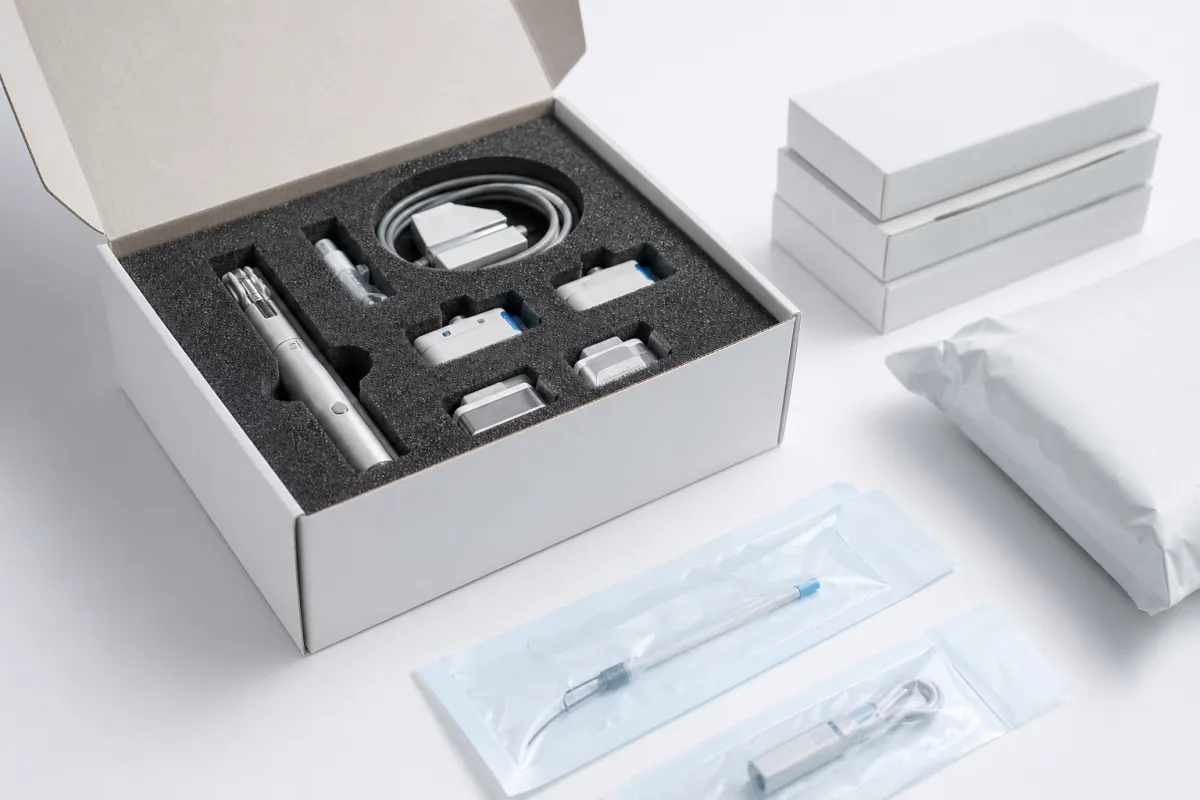
If you need the short answer, the best logistic packaging for medical devices is usually a double-wall corrugated shipper with custom foam inserts, tamper-evident sealing, and lane-specific validation. I still remember one afternoon in Shenzhen, in a plant near Longhua, when a forklift kissed a pallet just hard enough to make everybody wince, and a $12 foam insert saved a $12,000 device return. That was enough proof for me. A 2.5 mm shift in the cavity can be the difference between a clean delivery and a return authorization, and cheap protection usually beats expensive apologies once the freight bill and the claim paperwork land on your desk at the same time.
I have spent enough time on factory floors in Dongguan, Suzhou, and Penang to know that the best logistic packaging for medical devices is not the flashiest box on the shelf. It is the packout that survives drop impact, vibration, stacking, and whatever the carrier decides to do between pickup and delivery. When a team asks me for the best logistic packaging for medical devices, I start with the route, the device weight, the temperature window, and whether the product has a sterile barrier that cannot be touched. A 1.8 kg monitor on a 900-mile ground lane has different needs than a 14 kg diagnostic assembly flying through Memphis on a Thursday night. Everything else is decoration, even when the decoration is printed nicely.
Here is the blunt answer: for most shipments, the best logistic packaging for medical devices combines structural corrugate, die-cut or molded foam, and a closure that reveals tampering quickly. If the item is fragile, one-off, or high value, I lean toward a custom insert that locks the device in place with 3 to 6 mm of controlled clearance. If the lane includes air freight, I tighten the design around dimensional weight and compression strength, often targeting 200 to 275 lb burst strength on the outer carton. If the device needs cold chain protection, the best logistic packaging for medical devices shifts toward an insulated shipper with validated gel packs or phase-change materials, usually tuned to a 2 to 8 C or 15 to 25 C range. That is not flashy advice, but it keeps people from calling you at 6:45 a.m. because a shipment arrived rattling like a maraca.
"The box looked boring, which is exactly what I wanted. It arrived boring too. No crushed corners, no movement, no drama." I heard that from a service manager in Suzhou after we replaced an overpriced rigid case with a better-fit corrugated system built around 350gsm C1S artboard for the printed outer sleeve, and I still remember it because boring is what good logistics packaging is supposed to be. Boring is beautiful in this line of work, especially when the packout has already survived a 1.0-meter drop test and 24 hours of vibration on the lane profile.
Most people get this wrong because they chase buzzwords instead of failure modes. Shock protection matters. Vibration control matters. Sterile barrier safety matters. Dimensional weight matters. Temperature exposure matters. The best logistic packaging for medical devices is not one material or one supplier; it is the shipping system that protects the device and still makes commercial sense after freight, labor, and returns are counted. If you also need Custom Packaging Products for service kits, spare parts, or branded outer cartons, keep the outer layer simple and let the insert do the hard work. A lot of beautiful packaging fails because it tried to be a billboard first and a shipper second, especially on lanes where the carton gets handled three times before it leaves a regional hub.
Top Options Compared for Medical Device Shipping
When I compare the best logistic packaging for medical devices, I do not start with a glossy catalog. I start with the practical formats that actually show up on dock bays, in clean rooms, and in service centers: molded pulp, die-cut EPE or EVA foam, corrugated inserts, insulated shippers, and returnable hard cases. Each one has a place. Each one fails in a different way. A molded pulp tray that works for a 600 g accessory can collapse under a 3.2 kg assembly, and a hard case that survives ten cycles in Rotterdam may be a bad fit for one-way distribution to Phoenix. If anyone tells you otherwise, they probably have not watched a pallet get handled by three different carriers and one very determined warehouse temp.
Molded pulp is the budget-friendly choice for lighter, lower-risk parts. It works well when compression loads are modest and the device already has some internal protection, especially when the outer carton is a 200 lb test single-wall shipper. Die-cut EPE or EVA foam is my preferred answer for shock-sensitive products because it can be tuned to the geometry, density, and retention force, with common densities ranging from 28 kg/m3 to 45 kg/m3 depending on the device finish. Corrugated inserts perform well when you want lower cost, better recyclability, and less freight weight. Insulated shippers are mandatory when temperature control is real, not imaginary, and returnable hard cases make sense when the lane is controlled, the customer returns the case, and the device is expensive enough to justify the reverse logistics headache. That is why the best logistic packaging for medical devices is always a lane decision first and a material decision second.
| Packaging Format | Best Use Case | Protection Level | Typical Unit Cost | Reusability | Notes |
|---|---|---|---|---|---|
| Molded pulp | Light devices, low-to-moderate risk | Moderate shock, low moisture resistance | $0.25-$0.65 at 10,000+ | Single-use | Good for simple parts, often made in Xiamen or Dongguan, weaker on long lanes |
| Die-cut EPE / EVA foam | Fragile devices, custom fit, service kits | High shock and vibration control | $0.80-$3.50 at 5,000+ | Single-use | Often the core of the best logistic packaging for medical devices, especially for 1.0 m drop criteria |
| Corrugated inserts | Cost-sensitive shipments, lighter devices | Moderate shock, strong compression | $0.20-$0.90 at 10,000+ | Single-use | Lightweight, recyclable, easy to scale, commonly spec'd with 350gsm C1S artboard labels |
| Insulated shippers | Cold chain, temperature-sensitive components | High thermal control, moderate structural protection | $2.50-$9.00 per shipper | Usually single-use | Needs validation with the full payload and lane profile, often tested at 2 to 8 C for 48 hours |
| Returnable hard cases | High-value devices, closed-loop distribution | Very high impact resistance | $35-$120+ per case | Reusable | Best when returns are predictable and cleaning is manageable in regional hubs like Chicago or Eindhoven |
Procurement teams usually flinch at this part: the best logistic packaging for medical devices is not always the cheapest unit price. A corrugated insert at $0.55 can beat a $4.25 hard case if the device ships one way to twenty different distributors and half the cases never come back. I have seen teams spend $18,000 on reusable cases to save $0.90 per shipper, then lose the savings to reverse freight, cleaning labor, and missing inventory. That spreadsheet looked tidy right up until reality rolled in with a pallet jack and a bad attitude, and the service team in Dallas had to spend two hours hunting for one missing insert.
For brands that care about package branding, the outer carton still matters. Not because it needs to look like retail packaging, but because good branded packaging reduces mis-sorts, speeds receiving, and gives the service team a clear identity cue. A clean print spec on 350gsm C1S artboard for the carton wrap, or a simple one-color flexo mark on a brown shipper, can make receiving faster by 20 to 30 seconds per unit. If you need a more polished structure for kits or spare-parts bundles, some of the best logistic packaging for medical devices can borrow ideas from custom printed boxes without turning the shipper into a vanity project. Function first. Always. Nobody in shipping has ever said, "I wish this carton had more decorative tension."
Detailed Reviews: What I’d Buy for Each Device Type
If you asked me what the best logistic packaging for medical devices is for diagnostic equipment, I would start with a rigid corrugated outer, a fitted EPE or EVA cradle, and a retention test that proves the device does not shift more than 2 to 3 mm. I once stood next to a very expensive analyzer on a production line in Johor Bahru while the team argued over 30 grams of foam. Thirty grams. That debate ended after a 1.0-meter drop cracked the corner of the display housing. The corrected packout used Pregis Ethafoam with a tighter cavity and a 275 lb double-wall outer, and the complaint rate dropped to zero on the next pilot batch of 250 units. Everyone became an expert in foam density after that, which is how these things usually go.
For surgical tools and sterile kits, the best logistic packaging for medical devices is usually not a showy case. It is a clean, sealed, easy-to-inspect system that protects sterility and makes handling obvious. I like double-wall corrugate with die-cut partitions, a tamper-evident closure, and a clear label zone for lot codes and traceability, with room for a 50 x 80 mm serial label on the top panel. If the kit contains a sterile barrier, the logistics packaging must protect that barrier, not replace it. That distinction matters. I have had clients try to solve bad packout design by adding more tape. That is not a strategy; that is a cry for help, and usually a sign that the line supervisor in Monterrey or Pune has been ignored for too long.
For monitors, sensors, and handheld devices, I lean toward custom foam, especially if the device has fragile corners or a glossy housing that scuffs easily. Sealed Air Instapak is useful for irregular forms when you need speed and a decent mold around a device, but it is not the answer for every job, especially if the target packout only allows 4 to 6 mm of tolerance at the bezel. Ranpak and Sonoco both do a solid job in paper-based protective systems, yet I still treat paper inserts as a fit-for-purpose choice rather than the automatic winner. The best logistic packaging for medical devices for this category usually balances protection, unpacking speed, and storage footprint at the warehouse. A design that saves five seconds at pack-out and ten seconds at unpacking tends to win hearts pretty quickly, particularly when the picking team is loading 80 cartons before lunch.
Cold-chain components are a different animal. The best logistic packaging for medical devices in that lane is an insulated shipper with a validated thermal profile, not a box with "keep cool" printed on it. I have seen teams lose $7,000 in temperature-sensitive components because they guessed at gel pack weight instead of testing the full packout for 48 hours at 30 C ambient and 65 percent relative humidity. If the lane changes by three hours, the insulation spec may need a new validation. That is not fun, but neither is throwing away a shipment because the payload drifted out of range while everybody assumed the shipper was probably fine. I have a very low tolerance for probably fine in cold chain work because it usually turns into a 6 a.m. quality call.
For reusable service equipment and high-value capital devices, Pelican-style hard cases can be the right move. Models like the 0450 or 0550 are durable, stackable, and friendly to repeated handling. They also bring storage, cleaning, and return management costs that many teams underestimate by at least 20%. I had one client quote a hard-case program at $41 per round trip and forget to add replacement foam, missing return fees, and the labor to inspect every case before restocking in the Atlanta depot. The best logistic packaging for medical devices here is the one that holds up after the third, fifth, and tenth cycle, not just the first showroom demo. A case that looks indestructible in a conference room can still become a budget problem once it starts living in the real world.
Honestly, I think most people overbuy packaging. They specify the heaviest board, the thickest foam, and the biggest case because nobody wants to be the one who underprotected a device worth five figures. The best logistic packaging for medical devices comes from testing the actual risk profile. If a monitor only needs 18 mm of foam on the corners and 12 mm of clearance at the face, adding another 10 mm everywhere just raises freight and material cost. Good packaging design is restraint, not stuffing the box like a Thanksgiving turkey and hoping the tape holds. I have watched people spend real money on overkill because it felt safer emotionally, which is understandable, but still not a business plan.
Price Comparison: What the Packaging Really Costs
The best logistic packaging for medical devices can look expensive on paper until you compare it against damage, returns, and freight. I have negotiated enough with converters and foam shops in Shenzhen, Ningbo, and Guadalajara to know that a quote under $1.00 per unit is often a trap if it ignores tooling, labor, and yield loss. For custom packaging, the real number is landed cost. That includes the insert, the outer shipper, the label, the tape, the packing labor, the scrap rate, and the freight class. If you only look at the insert price, you are buying a fantasy with a SKU attached. And honestly, the fantasy usually falls apart the first time the warehouse gets busy and the team has to pack 800 units before a truck cutoff.
Here is a realistic range I would use for planning. These are not fantasy numbers from a glossy sales deck; they are the kind of numbers that survive a procurement meeting when somebody asks three times where the other cost went. The best logistic packaging for medical devices often lands in the middle of this range once volume stabilizes, though the first sample round almost always causes a little sticker shock, especially if the pilot build only runs 50 pieces and the vendor still has to charge for the die set.
| Packaging Choice | Prototype Run | Pilot Order | Scale Order | Tooling / Setup | Annual Landed Cost Risk |
|---|---|---|---|---|---|
| Corrugate + basic inserts | $3.50-$6.00 per set | $1.80-$3.20 per set | $0.95-$1.75 per set | $300-$1,200 | Low if the lane is stable |
| Custom foam + double-wall corrugate | $7.50-$14.00 per set | $3.20-$6.50 per set | $1.60-$3.90 per set | $1,200-$4,500 | Moderate, but usually worth it for fragile devices |
| Insulated shipper | $12.00-$22.00 per shipper | $6.50-$12.00 per shipper | $3.50-$8.50 per shipper | $0-$2,000 | High if the thermal profile is not validated |
| Returnable hard case | $45-$140 per case | $35-$110 per case | $28-$95 per case | $1,500-$8,000 | Low only when reverse logistics are controlled |
Now the hidden costs, because that is where the budget gets eaten. Dimensional freight can add $2.40 to $8.60 per shipment if the outer carton is oversized by 15 mm on each side. Packing labor can add $0.60 to $2.10 per unit if the insert takes too long to load. Scrap rate can quietly burn 3% to 7% of a run if the foam tears or the corrugate scores poorly. Testing fees can land at $1,800 to $6,500 for drop, vibration, compression, and thermal validation, and that is before you pay for a second sample build in case the first one misses the spec. That is why the best logistic packaging for medical devices is usually the one that keeps all those hidden costs from exploding later. The ugly truth is that packaging costs are never just packaging costs.
I had a client in a supplier negotiation who wanted to save $0.24 per shipper by dropping from a custom die-cut insert to a generic folded board. I told them that was a bad trade unless they were prepared to accept a higher claim rate. We ran the numbers with a $9,800 serviceable device and a 1.5% damage delta. The "cheaper" solution cost them about $14,700 more per year. Funny how that works. The best logistic packaging for medical devices is often the one that costs a little more up front and saves a lot more in the field, which is exactly the kind of math nobody loves and everybody eventually respects.
For teams that also need branded packaging or secondary product packaging for accessories, service parts, or distributor kits, the economics change a bit. A clean, right-sized carton can reduce freight class and improve unboxing without turning the design into retail packaging theater. I would rather spend $0.18 more on a well-drawn carton than lose $4.00 in freight and another $3.00 in repack labor. The math is not glamorous. It is just correct. The warehouse never applauds a clever cost savings idea that makes the shipment harder to handle, especially when the outer sleeve is printed in 350gsm C1S artboard and still has to survive a five-stop distribution route.
Process, Timeline, and Validation for Medical Device Packaging
The best logistic packaging for medical devices should never be designed in a vacuum. I want the process to start with spec gathering: device dimensions, weight, center of gravity, surface finish, sterility concerns, and the actual shipping lane. Then I want CAD mockups, a sample build, and a real fit check with the product in hand. On a good project, that first loop takes 5 to 7 business days for concept drawings, 12 to 15 business days from proof approval for a production-ready sample run, and another 3 to 5 business days to revise the insert geometry if the first round shows a pinch point. If somebody promises perfection in one afternoon, they are selling wishful thinking, not packaging. I have yet to see a great insert appear through optimism alone.
The sign-off chain matters too. Engineering needs to confirm fit and protection. Quality needs to confirm the test plan and acceptance criteria. Procurement needs the cost model and MOQ. Shipping operations needs to know whether the packout adds 40 seconds or 4 minutes to the line. If the device has regulated labeling or traceability requirements, regulatory review should look at the outer carton and any serialized components, including a lot-code area sized for a 12 mm high font and a scanner-friendly contrast ratio. The best logistic packaging for medical devices only works when those four groups stop talking past each other and agree on the same packout drawing. That sounds obvious until you are in the meeting and everyone suddenly has a different version of good enough.
Validation should be boring and documented. I like to use ISTA-style methods, route-specific vibration, corner and edge drop tests, and compression checks based on pallet stack height. For teams that want the source material, the standards library at ISTA is worth a proper read, not a half-scrolled glance from someone on their phone between meetings. ASTM D4169 shows up often too, especially when the product will see repeated handling or mixed transport. If the payload is temperature sensitive, run the full shipper through thermal exposure before you approve production, ideally with data loggers recording at 5-minute intervals. The best logistic packaging for medical devices is only as good as the validation behind it, and there is no substitute for actual test data when the claims start rolling in.
Here is what kills timelines. Custom tooling. Material lead times. Spec creep. Lane changes. The worst one is lane changes, because a packout that worked for a 900-mile ground lane may fail the minute the customer switches to air freight, a different DC, or a hotter warehouse. I have seen a team approve the best logistic packaging for medical devices for Chicago-to-Dallas, then call me three weeks later because the same product was now going to Munich in winter and the insulation had to be recalculated. Packaging does not care about your launch meeting. It cares about physics. It also does not care that someone thought the old spec should be fine. That phrase has caused more rework than any formal defect ever did.
One more thing: if you want recycled content, FSC-certified paperboard can support the sustainability story without making false promises. The right source materials matter, but they do not excuse a weak design. That is why I check the board grade, the flute profile, the compression target, and the tape spec before I talk about sustainability. A 32 ECT carton with recycled kraft liners can still fail if the compression requirement is 45 lb and the pallet stack is six high. If the box collapses, the eco pitch becomes expensive confetti. A better path is to combine the best logistic packaging for medical devices with responsible sourcing and honest testing. That is a better story for the planet and for the finance team, which tends to appreciate things that do not explode the claim rate.
How Do You Choose the Best Logistic Packaging for Medical Devices?
If you want a practical decision framework for the best logistic packaging for medical devices, start with five questions: How heavy is the device? How fragile is the surface or mechanism? Does it need a sterile barrier? What shipping lane will it take? Is it disposable or reusable? Those five answers will eliminate half the bad options before you waste time on drawings. A 1.2 kg sensor in a single-country ground lane has very different needs from a 14 kg diagnostic assembly flying with cold packs and documentation through Frankfurt. I wish there were a prettier formula, but most of the time it really is just those five questions and a little stubborn honesty.
For lighter, lower-risk items, corrugated boxes with simple inserts can be enough. For fragile equipment, custom foam usually wins because it absorbs energy in the exact places the device needs it. For cold chain, insulated systems with validated gel packs or PCM are the right answer, often sized at 400 g to 800 g per pack depending on the payload mass. For high-value repeat shipments, returnable containers can be smart if reverse logistics are tight and case loss is low. That is why the best logistic packaging for medical devices should be chosen by lane, value, and failure cost, not by whoever happened to like a sample the most. I have seen more bad decisions made because somebody liked the feel of a box than I care to admit.
I also want a procurement checklist on the table before anyone signs off. MOQ. Lead time. Print requirements. Serialization. Traceability. Storage space for secondary packaging. Damage claims history. Recyclability goals. Cleaning process for reusable packaging. Those details decide whether the program scales cleanly or becomes a warehouse headache with a purchase order attached. The best logistic packaging for medical devices is the one your team can actually receive, pack, ship, and audit without inventing new work every Monday morning. If the solution needs a full-time babysitter, it is not really a solution.
Do not confuse packaging with compliance. Packaging supports safety, traceability, and handling, but it does not replace device design, labeling, or quality controls. I have had more than one client try to treat the carton like a regulatory shield. It is not. It is a transport system. It helps the device survive real-world abuse, and that is plenty important, but the best logistic packaging for medical devices still sits inside a larger quality system that may also include ISO 11607, ISO 13485, or internal traceability rules. If the product design fails under load, no amount of tape, foam, or branded packaging is going to save it. I say that with love, but also with the slight exhaustion of someone who has had to say it three times in one meeting.
Package branding matters a little, even here. I am not talking about turning a clinical shipment into retail packaging with shiny graphics and no purpose. I am talking about clear labels, consistent carton art, clean lot-code zones, and a box that matches the company’s product packaging standards. A black-on-white mark that scans in one pass, a 25 x 50 mm handling icon, and a simple serial panel can reduce confusion in receiving and make it easier for distributors and service teams to spot the right shipment in a stack of fifty. A smart outer shipper can still feel like part of the brand without pretending it lives on a shelf. Good branding in logistics is mostly about clarity, not flair.
If you need a stronger visual system for service kits or spare-part bundles, align the insert architecture with your branded packaging rules. Good package branding is not just a logo; it is a legible structure, a repeatable carton spec, and a layout that tells people how to handle the box. That is where the best logistic packaging for medical devices overlaps with good packaging design: less confusion, fewer errors, and fewer annoyed phone calls from the receiving dock. And honestly, fewer annoyed phone calls is a worthy business objective all by itself.
My Recommendation and Next Steps
If I were setting up a default spec for most teams, I would choose the best logistic packaging for medical devices as a stack: double-wall corrugate, custom foam inserts, tamper-evident seals, clear lot labeling, and one proper validation run before scale-up. That stack is not glamorous. It is practical. It protects against the most common failures I see: corner crush, insert shift, carton blowout, and tampering ambiguity. I have seen expensive devices survive rough lanes because the packout was tuned within 2 mm. I have also seen cheap boxes fail because somebody saved $0.17 on board grade. The math is always there. People just ignore it until the claim appears.
Here is a 7-day action plan I would actually use. Day 1, request two material samples and one CAD layout. Day 2, compare freight impact and outer carton dimensions. Day 3, get one tooling quote and one sample cost. Day 4, run a drop test on the most fragile corner. Day 5, inspect the retention points and the tamper-evident closure. Day 6, review the landed cost across at least two lanes. Day 7, lock the packout drawing or revise it before anyone orders volume. That is how you find the best logistic packaging for medical devices without getting trapped in endless revisions. It also keeps the conversation grounded in data instead of everybody pointing at a sample and saying, "I have a feeling."
If you are still deciding between corrugate, foam, insulated systems, or reusable cases, my advice is simple: choose the option that protects the product, fits the shipping lane, and keeps costs honest. The best logistic packaging for medical devices is the one that survives a real shipment, not the one that wins a conference room vote. Pilot 25 to 50 shipments, inspect every failure mode, and fix the weak point Before You Buy in volume. That is the last boring step, and it is the one that saves the most money. Boring wins more often than people admit, especially when the pilot moves through a warehouse in Cleveland and the cartons are stacked six high on a hot Friday afternoon.
For teams that want help building the right custom structure, the right Custom Packaging Products can turn a good concept into something the warehouse can actually use without cursing under its breath. And if your program needs Custom Printed Boxes, accessories, or a cleaner packaging design for service kits, make sure the outer layer supports the lane instead of fighting it. A 5000-piece run can often move from proof approval to shipment in 12 to 15 business days when the spec is clean and the art file is ready. The best logistic packaging for medical devices is never just one box; it is the complete shipping system working as intended. That is the part people remember after the pallet leaves the dock.
What is the best logistic packaging for medical devices shipped by air?
Choose a lightweight but rigid setup so you do not pay extra dimensional weight on every lane. In practice, the best logistic packaging for medical devices shipped by air is often a strong corrugated outer with foam or formed inserts, plus tamper-evident closure. If temperature matters, validate the insulated packout under air-transport conditions before production, ideally with a 48-hour hold at 30 C and a full payload. Air lanes punish sloppy dimensions fast, and the freight bill does not care about good intentions.
Is foam always the best choice for medical device logistics packaging?
No, and anybody who says yes is selling foam. Foam is excellent for shock absorption and custom fit, but corrugated structures can be better for cost, recyclability, and compression strength. The best logistic packaging for medical devices is usually a hybrid: foam where protection is needed, corrugate where the carton needs strength and lower freight weight. I like foam a lot, but I like not overpaying even more, especially on a 10,000-unit run.
How much does the best logistic packaging for medical devices cost per unit?
Low-volume custom packaging can cost several dollars per unit once tooling, labor, and scrap are included. High-volume runs can drop sharply, especially when the geometry is simple and the lane is stable, and a quote like $0.15 per unit for 5000 pieces is possible only on straightforward corrugated components with clean print and no complicated inserts. The real number is landed cost, not just unit cost, because freight, damage, and packing time can change the math fast for the best logistic packaging for medical devices. The quote on the page is rarely the whole story, which is inconvenient but true.
Do reusable cases make sense for medical device shipping?
Yes, if the device moves through a controlled network and the case returns reliably without cleaning headaches or loss. They make less sense on one-way international lanes or low-value products where reverse logistics eats the savings, especially when return freight from Europe to the U.S. adds $28 to $65 per cycle. The best logistic packaging for medical devices in reusable form works best for expensive, fragile equipment shipped often to the same customers or service centers. If the return process feels shaky, the economics usually fall apart pretty quickly.
How do I test whether my medical device packaging is good enough?
Run drop, vibration, and compression tests that match the actual route, not a generic lab pass that looks impressive on paper. Then pilot a small shipment batch, inspect every failure pattern, and fix the weak point before scaling. If the packaging survives testing but fails in the field, the validation was too gentle. That is not bad luck. It means the best logistic packaging for medical devices was not validated hard enough. I have had to learn that lesson the hard way more than once, and it is not my favorite lesson.


