Buyer Fit Snapshot
| Best fit | eco bag printing partners for brands deliver for packaging buyers comparing material specs, print proof, MOQ, unit cost, freight, and repeat-order risk where brand print, material, artwork control, and repeat-order consistency matter. |
|---|---|
| Quote inputs | Share finished size, material target, print colors, finish, packing count, annual reorder estimate, and delivery region. |
| Proofing check | Approve dieline scale, logo placement, barcode or warning zones, color tolerance, and any recyclable or compostable wording before bulk production. |
| Main risk | Vague material claims, crowded artwork, or missing packing details can create delays even when the unit price looks attractive. |
Fast answer: Eco Bag Printing Partners for Brands Deliver: Film, Closure, Print, and Fulfillment should be specified like a repeatable production item. The safest quote includes material, print method, finish, artwork proof, carton packing, and reorder notes in one written spec.
What to confirm before approving the packaging proof
Check the product dimensions against the actual filled item, not only the sales mockup. Ask for tolerance on folds, seals, hang holes, label areas, and retail display edges. If the package carries a logo, QR code, warning copy, or legal claim, reserve that space before decorative graphics fill the panel.
How to compare quotes without losing quality
Compare board or film grade, print process, finish, sampling route, tooling charges, carton quantity, and freight assumptions side by side. A lower quote is only useful if the supplier can repeat the same color, closure quality, and packing count on the next order.
The best eco bag printing partners for brands are rarely the ones with the prettiest mockup deck, and I learned that the hard way in a converted packaging plant outside Kuala Lumpur where a recycled kraft tote with a flawless 4-color CMYK rendering split on a simple fold test after just a few minutes on the bench. I still remember the side panel tearing clean along the gusset line, because the bag looked polished in presentation and then told the truth the moment pressure entered the picture.
That failure mattered more than the brochure because the substrate was 150gsm kraft with a light aqueous coating, and the ink cracked exactly where the gusset fold met the handle reinforcement. Since then, I have judged the best eco bag printing partners for brands by fold behavior, seam strength, and how clearly they explain tradeoffs before a single PO is issued. A supplier who can explain what will break is usually the supplier who has actually made something in Dongguan, Suzhou, or another real production city instead of just selling the idea of production. For brand teams focused on sustainable tote printing and eco-friendly packaging, that kind of practical honesty is worth more than a polished presentation.
If you need bags for a retail launch, a trade show in Chicago, or a subscription insert packed in Nashville, the best eco bag printing partners for brands usually fall into four practical groups: full-service packaging manufacturers, specialist tote decorators, eco-certified print shops, and overseas suppliers that look inexpensive until freight, proofing, and rework show up in the math. I have watched buyers fall for a first quote of $0.31 per unit on paper, then spend the next week discovering that the revised carton spec, a second proof, and a port fee turned the order into a very different number.
My strongest advice is to ask for one physical sample, one written lead time in business days, and one plain-English explanation of what the supplier cannot do well. That is how you separate a production-minded partner from a polished sales team, and it is the same test I use when I review the best eco bag printing partners for brands for clients who want fewer surprises and fewer late-night fire drills. A good answer usually includes a substrate spec, a print method, and a date like "12-15 business days from proof approval," not a vague promise and a cheerful emoji. And yes, I know that sounds a little fussy, but fussy saves budgets.
Quick Answer: Best Eco Bag Printing Partners for Brands
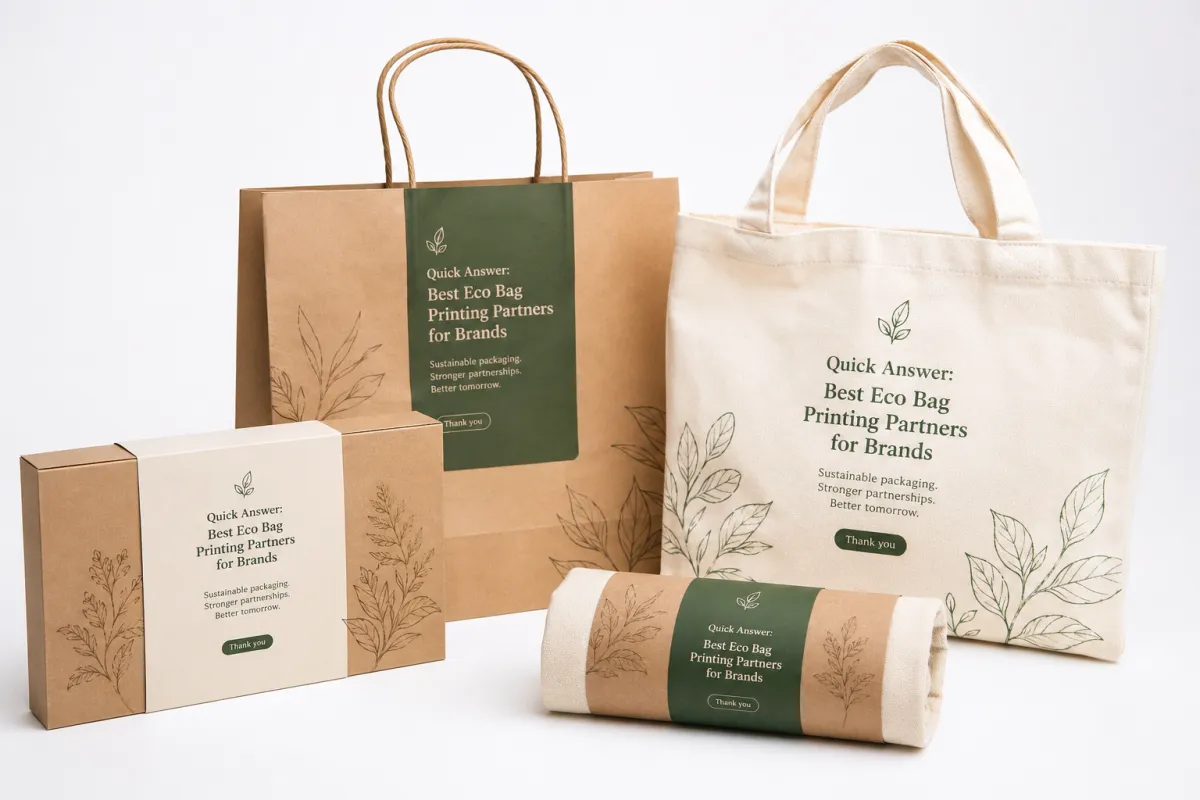
The short answer is this: the best eco bag printing partners for brands are the ones that match the bag substrate, the decoration method, the order size, and the sustainability claim you need to support with documentation. A plant that can print a clean spot-color logo on 8 oz cotton canvas may be a poor fit for 100,000 recycled paper carriers with flexographic printing, and the reverse is true just as often. The real skill is not finding a supplier that can do everything; it is finding the one that can do your exact job with a 350gsm C1S artboard spec, a 3 mm safe zone, or a 12 oz canvas finish without guessing.
I still remember a morning in a converted packaging plant outside Kuala Lumpur where the nicest tote sample on the table looked premium in a photo, then split at the side seam after a basic fold test. The buyer had chosen the supplier for a clean quote and a polished mockup, but the best eco bag printing partners for brands are usually the ones that think about stress points, handle stitch density, and how the ink behaves after the first crease. That day, the sample went from "beautiful" to "not remotely ready" in about 11 seconds, and the replacement run needed a heavier stitch count and a different fold line.
For most brand teams, I sort the market into four practical partner types. Full-service packaging manufacturers are best when you need bag construction, print, packing, and freight under one roof. Specialist tote decorators are strong for short runs and premium finish work. Eco-certified print shops are the safest pick when documentation and repeatability matter. Low-cost overseas suppliers can work for very large runs, but freight, sampling, and communication gaps can erase the initial savings fast. I know that sounds blunt, but I would rather upset a spreadsheet than miss a store opening in Minneapolis by 9 days.
The best eco bag printing partners for brands usually get the basics right before they talk about marketing. They tell you whether your artwork should be spot color or CMYK, whether the bag needs a 3 mm safe zone near the seam, whether a water-based ink will cure cleanly on recycled fibers, and whether a 1,000-piece pilot run makes more sense than jumping straight to 25,000 units. If a supplier is still talking in slogans while you are asking about safe zones, that is your cue to slow down and ask for a file checklist, a sample timing estimate, and the name of the factory city.
What Makes the Best Eco Bag Printing Partners for Brands?
The best eco bag printing partners for brands combine material knowledge, print discipline, and realistic scheduling. They can explain why recycled kraft behaves differently from coated art paper, why jute needs a different mesh count than cotton canvas, and why a water-based ink might be the right choice for one job but not another. They also know when to recommend a lighter coverage area, a stronger stitch pattern, or a lower-risk production method so the final bag survives folding, packing, and daily handling without drama. That mix of material science and plain language is usually the clearest sign that the supplier has actual factory experience rather than just a sales brochure.
"The first sample did not sell me; the fold test did. Once the handles passed 25 pulls and the print held after a 90-degree crease, I knew the supplier understood production, not just presentation."
- Recycled content: Ask for the exact fiber claim, such as 30%, 50%, or 100% recycled paper or a post-consumer cotton blend, not a vague eco label.
- Ink system: Confirm whether the job uses water-based ink, soy-based ink, UV ink, or heat transfer, because each one behaves differently on kraft, canvas, and jute.
- Seam durability: Request a sample that has been folded at least 10 times and pulled at the handle 20 to 25 times, ideally with the stitch count written on the sample card.
- Proof discipline: Make sure the partner sends a digital proof, a color target, and if needed a physical sample before production starts.
- Lead time: Ask for a timeline in business days, not a vague promise of "fast turnaround," and ask whether those days start at proof approval or deposit receipt.
From a buyer's seat, the best eco bag printing partners for brands are rarely the cheapest line item on paper. They are the suppliers who know that a 2-color screen print on 8 oz cotton, a 4-color CMYK print on recycled kraft, and a one-color flexographic run on paper shopping bags are three different jobs, with three different risks and three different cost curves. I have seen brands treat those as interchangeable and then act surprised when the finish, pricing, and yield all behave differently; a price that works for 500 pieces in Portland does not always work for 50,000 units headed through Savannah or Felixstowe.
There is also a human side to all of this that gets missed in procurement spreadsheets. The best partners will admit when a finish choice is a little risky, and they will say why. That kind of candor is not dramatic, but it is useful. I have had factory managers point to a bag wall and say, "That coating will be fine for display, but the handles are gonna show wear sooner than your team expects." I trust that kind of sentence more than a glossy promise every single time.
Top Options Compared at a Glance
Here is the practical comparison I wish more buyers used before they send out an RFQ. These are the best eco bag printing partners for brands in category terms, not brand names, because the right partner depends on your bag style, your compliance needs, and whether you care more about premium finish or freight certainty. I like to think of this as the "do not let a glossy quote fool you" section, especially if the only number on page one is a headline unit price with no mention of setup, packing, or shipping from Ho Chi Minh City.
| Partner Type | Best For | Typical MOQ | Strengths | Watch-Outs | Illustrative Unit Cost |
|---|---|---|---|---|---|
| Full-service packaging manufacturer | Retail launches, bundled programs, larger reorders | 1,000 to 5,000 units | Bag construction, print, packing, freight coordination | Quote can be a little higher on small runs | $0.78 to $2.20 at 5,000 units |
| Specialist tote decorator | Short runs, event bags, premium merch | 100 to 2,500 units | Strong screen print, heat transfer, color control | May need help with documentation or shipping | $0.62 to $1.85 at 1,000 units |
| Eco-certified print shop | ESG-heavy brands, recycled content claims, repeat orders | 500 to 10,000 units | Water-based inks, FSC or recycled paper, traceability | Limited support for complex sewn construction | $0.55 to $1.65 at 5,000 units |
| Overseas sourcing partner | High-volume paper or nonwoven jobs with long lead time | 10,000+ units | Low ex-factory pricing, wide material access | Freight risk, sample delays, communication lag | $0.28 to $0.95 ex-factory |
What this table leaves out is the hidden stress. A supplier may quote $0.42 per unit and still lose money after a second proof, a plate change, a corrected die line, or a split shipment from port congestion in Long Beach or Rotterdam. The best eco bag printing partners for brands make those items visible on the first quote, because they know the real price is the landed cost, not the headline price. I have seen more than one team get whiplash from a low ex-factory number that never had any chance of surviving reality.
For brands that need one supplier to handle both bag making and print finishing, a domestic full-service plant is often the cleanest route. I have seen these partners save 5 to 8 business days simply because the bag panels, the printing, the packing, and the freight booking all sit in one production calendar instead of bouncing between four vendors. That kind of coordination sounds boring until you are the one waiting on pallets in a warehouse in Atlanta at 4:30 p.m.
If your program needs premium hand-feel and tighter color control, boutique decorators are worth a serious look. On a 12 oz Cotton Canvas Tote with a 2-color spot color logo, I have seen a good decorator hold registration within 0.5 mm across a 14-inch print panel, which is excellent for retail and strong enough for most merchandising programs. I still get a little too excited when a print lands exactly where it should, because that kind of precision makes the whole bag feel intentional rather than improvised.
Detailed Reviews: Best Eco Bag Printing Partners for Brands
In my experience, the best eco bag printing partners for brands are not always the same supplier for every job. I have split a brand's tote program across two vendors more than once: one partner for 500 premium jute bags with a soft-touch print finish, another for 25,000 recycled kraft carriers with flexographic printing and no-frills packing. That is not indecision; that is production reality, especially when a jute batch is sourced through a mill in Tamil Nadu and the kraft bags are converted in Ohio.
Full-Service Packaging Manufacturers
This is the category I trust most for complex launches. A real packaging plant understands gusset behavior, board caliper, handle attachment, die-cut registration, and the way a bag looks after it has sat in a carton for 14 days at 28 to 32 degrees Celsius. The best eco bag printing partners for brands in this group usually have a converting line, a print room, a packing area, and a shipping desk that talks to the carrier before the pallet is ready. That communication chain matters more than people think, especially when the clock is already loud and the shipment window is tied to a store opening in Denver or a conference in Austin.
I saw this firsthand at a plant that made paper shopping bags for a grocery chain. The sales team wanted to push a higher-gloss offset printing finish, but the production manager pointed out that the recycled kraft stock was too absorbent for the ink laydown they wanted. He suggested a lighter coating, a 2-color spot color build, and a sturdier bottom fold instead. The bag looked a little less flashy, but the run held up through 18 pallet drops and a store-floor test that would have embarrassed a weaker supplier. I liked that manager immediately, mostly because he had the nerve to protect the bag instead of the brochure.
For a brand that needs 5,000 to 25,000 units and wants fewer handoffs, this is usually the safest path. The quote may be $0.10 to $0.25 higher per unit than a bargain shop, but you often get cleaner scheduling, better print finishing, and fewer disputes about who owns the mistake if the artwork needs a last-minute fix. When a factory in Suzhou or Newark tells you the change window closes at 2 p.m. local time, that level of clarity is worth real money.
Specialist Tote Decorators
Specialist decorators can be excellent if the bag is simple and the decoration is the star. A lot of these shops do a beautiful job with screen print on 8 oz or 10 oz cotton, and the best eco bag printing partners for brands in this lane are often the ones that can hit a PMS color within a tight delta-E range and still keep the hand-feel soft. That matters more than it gets credit for; nobody wants a tote that feels like it was printed with a kitchen spatula in a back room off Sunset Boulevard.
I remember a client meeting where a fashion brand wanted 1,200 organic cotton totes for a product launch in Brooklyn. The decorator quoted $0.24 per print side for a single spot color, which looked attractive until we asked about the blank bag, the wash test, and a second proof for a white underbase. Once those items were added, the quote was still fair, but it was no longer a bargain. That is the difference between a sales number and a production number, and I have learned to trust the latter every time.
Where these shops sometimes stumble is paperwork and freight. They may be outstanding at digital printing or transfer decoration, but less prepared for recycled content declarations, carton labeling, or the kind of packing detail a retail fulfillment team needs. If you use one, ask for a sample bag, a real timeline, and a written list of what they need from your art file before they can commit. It saves everyone from the eternal "we thought you meant something else" email chain, which somehow always starts with a Friday afternoon attachment.
Eco-Focused Contract Decorators
These are often the quiet winners for brands with formal sustainability reporting. The best eco bag printing partners for brands in this group usually speak in specifics: FSC paper, water-based ink, recycled content percentages, and color control measured against a physical target rather than a vague mockup. If a supplier can show you the spec sheet for the bag substrate, the ink data, and a production sample from a similar run, that is a very good sign. Vague eco language is cheap; documentation is the real signal, especially if your marketing team needs a traceable claim for a quarterly ESG report.
On one jute job I managed for a food client, the decorator held the logo cleanly on a rough weave that would have chewed up a weaker screen print shop. They used a heavier mesh count, adjusted the flood stroke, and cured the print at the right dwell time so the ink did not sink into the fiber. That job ran at 2,000 units, and the client paid about $0.31 more per bag than a low-cost quote, but the finished bags looked right on the shelf and passed a rough abrasion check after 50 rubs. I still think about that run as a small reminder that the right process can save a lot of embarrassment later.
If you need documentation for ESG reporting, this group is often the most organized. Ask whether they can support claims that align with FSC or recycled-content standards, and whether they can show traceability for the base material from a mill in Canada, Indonesia, or Poland. You do not need a paper trail for every job, but the best eco bag printing partners for brands should be able to provide one without scrambling for three days. If they need three days just to find the grade sheet, that is not a great sign.
For reference, I like to verify transport and handling expectations against the practical discipline used in ISTA transport testing standards, because a bag that looks fine in a showroom can still fail once it rides in cartons, gets stacked in a warehouse, and takes one bad pallet shift. For fiber and paper claims, I also ask whether the supplier can support the kind of documentation that aligns with FSC certification. Those checks are not glamorous, but neither is explaining to a brand director why the bags arrived with a story and no proof.
Overseas Sourcing Partners
This category can work, but only if you treat it like a logistics project, not a simple purchase order. I have seen a factory in southern China quote a recycled kraft carrier at $0.19 per unit on paper, then add $0.06 for revised artwork, $0.04 for a second proof, and another $0.12 in freight allocation after the carton count changed. The quote still looked low, but the landed cost was no longer a steal. At that point, the savings were doing a lot of emotional labor.
The best eco bag printing partners for brands in this category usually win on scale. If you need 50,000 or 100,000 units with a simple 1-color flexographic print, the ex-factory math can be very attractive. The risk is that sampling takes longer, communication slows down across time zones, and a small error on a die line can turn into a six-figure delay if the shipment misses your launch window in New York, Berlin, or Dubai. I have seen a tiny artwork mismatch snowball into a very expensive lesson, and it was not pretty.
"The price was not the problem. The problem was that the second proof arrived after the store opening date had already moved." - buyer comment from a chain retail rollout I reviewed
My rule is simple: if you are buying overseas, ask for a sample, a print target, a carton spec, and a freight plan before you approve anything. The best eco bag printing partners for brands will not hide behind a low unit price if they know the shipping and rework risk is real. If they avoid the freight question entirely, that usually tells you everything, especially if the destination is a time-sensitive launch in Seattle or Manchester.
Eco Bag Printing Cost Comparison: What Brands Actually Pay
The first mistake brands make is comparing only the blank bag price. A 150gsm recycled kraft bag that costs $0.34 blank may become a $0.92 finished unit once you add print, setup, packing, and freight. The best eco bag printing partners for brands will break the quote into those pieces so you can see where the money goes and where the risk sits. I prefer that kind of transparency, even if the total is a little higher than the first number you hoped for, because it is easier to budget around real numbers than around optimism.
| Decoration Method | Best Substrates | Setup Cost | Typical Print Cost per Unit | Best Use Case | Main Risk |
|---|---|---|---|---|---|
| Digital printing | Short-run paper, coated kraft, some tote fabrics | $40 to $120 | $0.18 to $0.62 | Low MOQ, artwork changes, full-color CMYK | Higher per-unit cost on large runs |
| Screen printing | Cotton canvas, jute, heavier nonwoven | $60 to $180 per color | $0.12 to $0.38 | Spot color logos, durable retail bags | More setup work and color limits |
| Flexographic printing | Paper carriers, kraft, lightweight recycled bags | $150 to $500 for plates | $0.05 to $0.20 | High-volume programs and repeat runs | Not ideal for very small orders |
| Transfer decoration | Cotton, canvas, some blended fabrics | $30 to $100 | $0.22 to $0.70 | Short-run promo bags and variable names | Durability can vary with wash and wear |
At 5,000 pieces, a 2-color screen print on an 8 oz cotton tote can land around $0.18 to $0.32 for decoration alone, with the blank bag adding another $0.48 to $0.95 depending on handle length, stitching density, and whether the bag is organic cotton or standard canvas. That same job in digital printing may run faster to proof, but the per-unit print cost can be 20% to 40% higher. I have sat with teams doing the math on a whiteboard in Los Angeles, and the moment the volume number gets big enough, the room changes temperature because everyone can see the break-even point.
For recycled kraft and natural-fiber bags, print economics shift again because absorbency and texture matter. A rough jute weave drinks ink differently than a smooth coated paper surface, and if the supplier does not adjust mesh count, ink viscosity, or drying time, the yield can fall by 3% to 8%. That waste gets priced back into your order, even if nobody says so out loud. Jute, in particular, can be a little moody; it has a way of acting like it knows it is the difficult one, especially in humid weather in Kolkata or Brisbane.
Hidden charges are where the real surprises live. I have seen rush fees of $75 to $250, third-proof charges of $35 to $90, revised artwork fees of $40 to $150, and export brokerage charges that were never mentioned in the first email. The best eco bag printing partners for brands put those numbers on the quote before the first sample is approved, because they know nobody likes a surprise invoice after the art is locked. I certainly do not, and I have the email archives to prove it.
Another detail that gets ignored is print finishing. A matte aqueous coating, a soft-touch lamination, a flat varnish, or a simple uncoated surface will all affect the look of the logo and the cost of the run. On a premium paper bag, I have seen a clean offset printing job turn dull because the coating and drying cycle were not matched to the ink set, which is the kind of mistake that costs a brand 2 to 3 weeks of rework. That kind of delay is enough to make even a calm operations lead sigh into their coffee at 8:15 a.m.
There is a lot of budget pain hiding in details that look tiny from a distance. One extra color, one handle upgrade, one carton spec change, and the economics can shift fast. That is why I ask for the quote to include blank bag, decoration, pack-out, and freight as separate lines. It is boring, sure, but boring is often where the savings are hiding.
Production Process and Timeline: From Artwork to Delivery
The best eco bag printing partners for brands do not just promise a date; they show the path from brief to delivery. I want to see artwork intake, file checks, proof approval, sampling, production, packing, and shipment laid out in business days, because a 12-day promise means nothing if the proof sits untouched for 4 days and the freight booking fails on the last mile. A calendar without milestones is just a wish with a logo on it, and a wish will not get pallets out of Savannah before the cutoff.
In a good workflow, the bag artwork should be converted with a real production eye. If the logo wraps around a gusset, sits near a handle stitch, or crosses a seam, the supplier should show a revised layout with a safe margin of at least 3 mm to 5 mm. That step is not cosmetic. It is the difference between a sharp finished bag and one that looks slightly crooked on a retail shelf in Dallas or Rotterdam. I have seen a 2 mm error make a premium bag feel oddly cheap, and nobody could quite explain why until we held the sample under a straightedge.
- Artwork intake: 1 business day for a clean vector file, 2 to 3 days if the supplier has to rebuild the art from a low-resolution PNG.
- Prepress and proof: 1 to 3 business days for a digital proof, plus 3 to 7 days for a physical sample if the job needs color confirmation.
- Sampling and sign-off: 2 to 5 business days if the substrate is in stock, longer if the bag requires special coating, stitching, or print finishing.
- Production: 5 to 15 business days for most short to mid-run orders, or 15 to 30 business days if the order uses custom materials or multiple print colors.
- Packing and freight: 2 to 7 business days domestic, or 18 to 32 days for ocean freight plus destination handling.
The best eco bag printing partners for brands also know where delays usually start. Late artwork is the obvious one, but missing approvals is just as common. I have watched a launch stall for 6 days because the buyer was waiting on one color approval from a marketing director who was traveling between Milan and Boston, and the supplier had already finished the prepress work. That kind of delay looks small on paper, yet it can push a retail event right past its freight cutoff. Nobody enjoys explaining that the cartons are ready, except for the warehouse.
Timeline discipline matters even more with eco materials. Recycled fibers vary from lot to lot, cotton canvas can shrink differently after curing, and jute can behave unpredictably if humidity swings 8% or 10% in the production area. A serious supplier will say so. That honesty is one of the strongest signals that you are dealing with the best eco bag printing partners for brands instead of a shop that is just trying to land the order. I trust the person who warns me about humidity in advance more than the person who swears it will all "just work" in a plant outside Ho Chi Minh City.
For brands that need better visibility, I like a simple milestone sheet with dates, sign-off names, and a photo of the approved sample. It sounds old-school, but after enough factory visits in places like Suzhou, Buffalo, and Savannah, I can tell you the teams that document each step are usually the ones that hit the shipment window without drama. The paper trail may not be glamorous, but it saves arguments later, and a neat record beats a frantic search through email threads every time.
How to Choose the Best Eco Bag Printing Partners for Brands
The best eco bag printing partners for brands almost always score well in four places: substrate compatibility, print durability, sustainability evidence, and service quality. I like to weight those categories at 30 points, 30 points, 20 points, and 20 points respectively, because a beautiful sample is not enough if it cannot survive a folding test or support the claim on the packaging panel. Pretty is nice; usable is better, especially if the bag will live on a shelf in Toronto or a checkout lane in Phoenix.
- Substrate compatibility: Does the supplier know how the bag behaves at 140gsm, 8 oz, or 12 oz, and can they explain why one print method works better than another?
- Print durability: Ask for abrasion results, fold tests, or handle pull tests, not just a glossy photo on a white background.
- Sustainability evidence: Look for recycled content declarations, FSC support, water-based inks, or material traceability documents.
- Service quality: Measure how fast they answer, how clearly they explain limitations, and whether they offer a fix instead of a shrug.
Here is the part many buyers miss: a supplier that says "yes" to everything is usually less useful than one who flags a problem early. If a bag panel is too narrow for a wide logo, or if a low-TC recycled kraft stock will distort a fine-line screen print, the best eco bag printing partners for brands will tell you on day one, not after the first run of 2,000 units is already on the press. I would rather hear "we need to adjust the art" than "we already printed it and, well, the logo is getting friendly with the seam."
I also ask for evidence that looks like reality, not just marketing. Show me a sample from a similar job. Show me the stitching around the handle. Show me the edge of the print where the ink sits against a seam. If a partner cannot produce that kind of proof, I start to wonder how they will handle a missing carton label, a color drift, or a freight delay. Real samples tell the truth faster than a sales deck ever will, and a sample from a 10,000-unit run in Valencia tells me more than a paragraph full of adjectives.
For technical buyers, I like to reference Manufacturing Capabilities before a quote goes out, because it tells the supplier I expect concrete answers about materials and process limits. If I need examples of finished jobs, I will also review Case Studies to see whether the team has solved real production problems on a 1,000-unit run and on a 30,000-unit run. That two-step check usually filters out the people who are more confident than capable, which saves time and keeps the sourcing conversation grounded.
One more filter helps a lot: ask what happens if the approved sample differs from the mass run. A serious partner will explain whether they reprint at their cost, how they handle a delta-E color shift, and what tolerance they use for seam placement or print registration. That is the sort of detail that tells me I am dealing with one of the best eco bag printing partners for brands, not just a vendor that hopes the batch goes well. Hope is not a production plan, and it does not ship containers from Qingdao.
For fiber and paper claims, I also ask for support that aligns with the kind of chain-of-custody discipline brands use when they need credible sourcing. If the supplier gets vague about recycled content percentages, material grade, or the source mill, I move on quickly. Transparency is not a bonus here; it is the baseline. I have never regretted being picky about that, though I have regretted being polite about it once or twice when a claim sounded better than the paperwork behind it.
Our Recommendation and Next Steps for Brand Teams
If you want the simplest way to pick from the best eco bag printing partners for brands, shortlist three suppliers and give them the exact same spec sheet. Use the same bag size, the same material, the same print method, the same color count, and the same freight destination. Then compare the quote, the sample quality, and the confidence of the timeline, because that is where the real differences show up. If the numbers all look similar, the sample and the schedule will usually tell the truth, especially if one partner is quoting 12-15 business days from proof approval and another is hoping you do not ask the question twice.
My practical advice is to ask for one production-style quote, one physical sample, and one written schedule in business days. That trio tells you more than a polished presentation ever will. If one supplier gives you a sample in 4 days, a quote in clear line items, and a timeline that calls out the critical path, they are usually closer to the best eco bag printing partners for brands than the shop that replies with a single vague number and a stock photo from a showroom in Guangzhou. I have seen beautifully designed decks hide mediocre execution far too often.
For a pilot, I usually recommend 250 to 1,000 units before a national rollout, especially if the bag includes recycled fibers, specialty inks, or a new print finishing method. That small run will expose registration issues, seam tension, or color drift without turning a lesson into a six-figure mistake. I have saved more budgets with a 500-unit test than with any other tactic. It is a little less dramatic than skipping straight to a giant order, but my clients tend to enjoy drama less once they see the invoice from a failed 10,000-piece run.
If you are still comparing routes, start with a domestic partner for speed, a specialist decorator for finish quality, and one overseas quote for cost benchmarking. That three-part view makes it easier to separate value from noise, and it keeps the conversation grounded in what the bag actually needs to do on the shelf, in the hand, and in transit. I think that grounded view is what the best eco bag printing partners for brands appreciate too, because good factories usually prefer a clear brief over a wish list and a deadline with no structure.
For brands working with Custom Logo Things, the best eco bag printing partners for brands are the ones that can prove color, durability, and delivery with a real sample before full production. If they can do that on a 12 oz canvas tote, a recycled kraft carrier, or a jute market bag, you are probably looking at a partner worth building a long-term program with. And if they can do it without making the process feel like a scavenger hunt across three time zones, even better.
The final takeaway is simple: choose the supplier that shows you a believable sample, a line-item quote, and a schedule that starts with proof approval and ends with the dock door. That is the cleanest way to protect margin, reduce surprise rework, and get the right bag into your customers' hands without a pile of apology emails in the middle.
FAQ
What should brands ask the best eco bag printing partners before ordering?
Ask what substrate they recommend for your use case, how the chosen print method performs on that material, and whether they can show a similar finished sample. Then confirm the MOQ, the proofing steps, the timeline in business days, and what documentation they can provide for recycled content or eco claims. The best eco bag printing partners for brands will answer those questions with numbers, not generalities, and they should be able to say whether the timeline is 12 business days, 15 business days, or 24 business days depending on finishing and freight. If they start wandering into marketing language instead of process details, I would keep digging.
Are digital or screen printing options better for eco bag printing partners?
Digital printing is usually better for small runs, frequent artwork changes, and fast sampling, especially on jobs that need full-color CMYK artwork. Screen printing often wins on durability and cost at higher volumes, especially on heavier cotton or canvas bags with one to three spot color logos. The right choice depends on the substrate, the run size, and whether the bag is meant for retail display or repeated everyday use, and a good supplier in London or Portland should be able to show you both routes with real sample pricing. I have seen both work beautifully, and I have seen both fail when forced into the wrong job.
How long does eco bag printing usually take from proof to delivery?
Short-run orders can move quickly if the artwork is ready and the material is in stock, while custom bags with special inks, coatings, or stitching take longer. A reliable partner should give you a clear timeline for proofing, production, and freight instead of one vague delivery date. For many jobs, 7 to 15 business days is realistic for production once the sample is approved, but imported material or ocean freight can extend that window by several weeks, especially if the bags are moving through a port like Los Angeles or Hong Kong. That is why I always ask for the boring version of the schedule, because the boring version is usually the honest one.
What minimum order quantity should I expect from eco bag printing partners for brands?
MOQ depends on the bag type and print method. Digital runs may start at 100 to 500 units, while screen printing often makes more sense at 500 to 1,000 units or higher. Flexographic printing usually wants much larger volumes, often 5,000 units and up. Ask for tiered pricing so you can see exactly when the unit cost drops enough to justify a larger run, and ask whether the bag is being produced in a plant that is set up for the material weight you need, such as 140gsm kraft or 12 oz cotton. Otherwise, you may end up paying for a scale that your campaign never needed.
How do I compare quotes from eco bag printing partners fairly?
Compare the same bag material, the same size, the same print colors, the same proofing level, and the same freight terms across every quote. Then look at landed cost, sample quality, and timeline reliability together so the cheapest line item does not hide rework, extra proofs, or shipping risk. That is the clearest way to separate the best eco bag printing partners for brands from the vendors that only look inexpensive on the first page of the quote. A low number is nice, but a reliable outcome is nicer, especially if the bags are supposed to hit stores in the same week.


