Buyer Fit Snapshot
| Best fit | to sustainable retail packaging for packaging buyers comparing material specs, print proof, MOQ, unit cost, freight, and repeat-order risk where brand print, material, artwork control, and repeat-order consistency matter. |
|---|---|
| Quote inputs | Share finished size, material target, print colors, finish, packing count, annual reorder estimate, and delivery region. |
| Proofing check | Approve dieline scale, logo placement, barcode or warning zones, color tolerance, and any recyclable or compostable wording before bulk production. |
| Main risk | Vague material claims, crowded artwork, or missing packing details can create delays even when the unit price looks attractive. |
Fast answer: To Sustainable Retail Packaging: Claims, Protection, MOQ, and Cost should be specified like a repeatable production item. The safest quote includes material, print method, finish, artwork proof, carton packing, and reorder notes in one written spec.
What to confirm before approving the packaging proof
Check the product dimensions against the actual filled item, not only the sales mockup. Ask for tolerance on folds, seals, hang holes, label areas, and retail display edges. If the package carries a logo, QR code, warning copy, or legal claim, reserve that space before decorative graphics fill the panel.
How to compare quotes without losing quality
Compare board or film grade, print process, finish, sampling route, tooling charges, carton quantity, and freight assumptions side by side. A lower quote is only useful if the supplier can repeat the same color, closure quality, and packing count on the next order.
I still remember standing beside a carton line in Shenzhen, Guangdong, with a three-layer spec on the table, a steel rule die on one side, and an ISTA 3A drop-test report on the other. We cut the box from three layers to two, saved 18 grams per unit on a 350gsm C1S artboard sleeve, and the pack still passed five drops from 30 inches after proof approval and a 14-day sample cycle. I was tired, a little sticky from factory dust, and relieved enough to laugh when the first pallet came through without a single crushed corner. That is the kind of result a guide to sustainable retail packaging should promise in plain language: less material, lower freight, and no panic when the pallet reaches the warehouse floor.
The guide to sustainable retail packaging is not a purity contest, and honestly, that is a relief, because purity contests are how people end up spending far too much money on a carton that looks morally superior and performs like wet cardboard. It is a practical way to use fewer resources, protect the product, and make disposal easier for the customer without turning your margin into confetti. I have watched brands spend $12,000 on a beautiful sleeve with blind emboss and soft-touch lamination in Dongguan, only to see zero reduction in damage rates, and I have watched a simple die-cut structure cut returns by 9% because the package fit the product instead of pretending to be a sculpture.
What should a guide to sustainable retail packaging include?
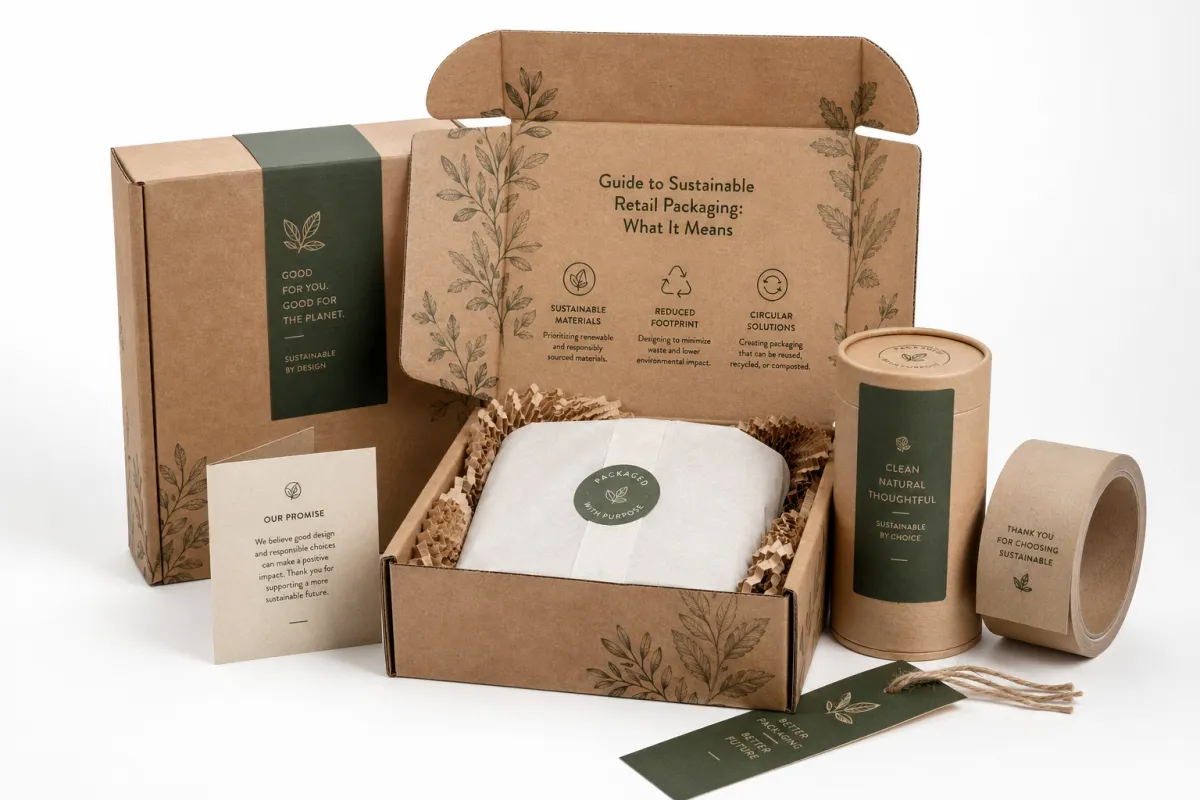
A useful guide to sustainable retail packaging should cover three things: material efficiency, product protection, and end-of-life handling. If the package uses less board, survives the route, and can be recycled or reused where customers actually live, it is doing the job. Add the real-world pieces too, like right-sizing, recycled content, FSC-certified paperboard, and route testing, because that is where the spec either holds together or falls apart.
The guide to sustainable retail packaging also needs to show the trade-offs clearly. A lighter carton can cut freight and cube, but only if it still passes the drop test. A mono-material pouch may simplify recycling, but only if the barrier properties suit the product. A molded fiber insert can reduce plastic, but it may raise the footprint and the drying time. Those are not contradictions; they are the practical decisions that make sustainable retail packaging useful instead of decorative.
It also helps to define the scope before anybody starts arguing over the wrong thing. Is the project for shelf packaging, ecommerce transit, or both? Will the package be opened by a shopper in a store, packed by a fulfillment team, or shipped by a third-party warehouse with a conveyor line that hates flimsy corners? Those details matter more than most brands want to admit, and they shape the final structure long before the first proof hits the table.
Guide to Sustainable Retail Packaging: What It Means
A guide to sustainable retail packaging starts with a plain definition: use the least material that still protects the item, choose formats that fit the recycling or reuse system, and avoid extra work that adds weight without adding value. If a carton carries a 180-gram watch set and survives a 36-inch drop, that is useful. If a carton needs a foam cradle, a PET window, and a glossy sleeve just to look premium, the structure needs a rethink. I have had buyers in New York and Singapore tell me the carton "needs more presence," which is often code for "we have not measured anything yet." I would rather have a box that disappears into the waste stream than one that announces itself loudly and then fails at the first bump.
The guide to sustainable retail packaging also needs a vocabulary lesson, because brands love to blur the words until everyone in the room nods along and nobody knows what is actually being bought. Recyclable means the local collection system accepts it; recycled content means the board or resin already had a previous life; compostable only matters if industrial composting exists and the item is certified for it; reusable means it can survive multiple cycles, often 20, 30, or 50 uses; and source-reduced means the same function with less material. No magic, just definitions, paperwork, and a supplier in Jiaxing or Ho Chi Minh City who can show the numbers without reaching for a marketing deck. That is usually where the nonsense starts to show itself.
For most teams, the guide to sustainable retail packaging is also a cost story. Oversized mailers can increase freight by 12% because cube matters more than people admit, and I have sat through enough freight reviews in Los Angeles and Rotterdam to know that nobody likes saying the word "cube" until the bill lands. A neat, right-sized retail box can look better on shelf than a loud one with three coatings and a plastic insert. Customers notice the opening feel, the weight, and whether they can flatten the package in 10 seconds without hunting for a knife. That is branded packaging doing real work, not decoration dressed up as strategy.
Brands get into trouble when sustainability becomes a badge instead of a spec. One cosmetics buyer in Chicago told me, with a very expensive pen and a very vague brief, that the carton had to "feel green." I asked how many grams per unit she wanted to save, whether the board needed FSC certification, and whether her store staff had 45 seconds to assemble it. Once the numbers came out, the answer changed fast. The guide to sustainable retail packaging works best when the facts are ugly enough to be useful, because ugly facts usually save money and protect the launch schedule.
"A package that looks green but collapses on a shipping test is just a refund with branding."
Guide to Sustainable Retail Packaging in Practice
The guide to sustainable retail packaging starts at the mill or resin plant and keeps going until the box hits a bin, a composter, or a desk drawer full of random cables and old receipts. I look at sourcing, conversion, printing, packing, freight, store handling, consumer use, and end-of-life. If one step relies on a 200gsm overwrap to hide a weak structure, the whole file gets worse. Material choice is not a side note; it is the backbone of product packaging, and if someone says otherwise, I usually assume they have never had to explain a crushed launch to a retail buyer in Dallas or Munich.
- Sourcing: FSC board, 30% PCR resin, or virgin fiber from a named mill in Canada, Oregon, or Vietnam with chain-of-custody paperwork.
- Conversion: Die-cutting, flexo, digital, or offset in Shenzhen, Dongguan, or Monterrey, each with different waste rates and setup costs.
- Packing: A 12-piece master carton, a 6-piece shipper, or a 1-piece mailer changes labor, cube, and carton erector speed.
- Shipping: ISTA 3A or ASTM D4169 testing for the route your freight actually takes, whether that is air to Dubai or ocean to Long Beach.
- Use: Retail display, ecommerce transit, or subscription unboxing all ask for different structures and print finishes.
- Disposal: Curbside recycling, store take-back, industrial composting, or landfill, which is where the real story ends.
The guide to sustainable retail packaging gets practical fast inside the substrate list. A 350gsm FSC paperboard carton with aqueous coating is lighter than a rigid setup, and an E-flute corrugated mailer can protect a 1.2 kg candle without foam. Molded fiber works well for trays and end caps, but it needs drying energy and more cube, which people often underestimate until the quotes arrive from facilities in Huzhou or Xiamen. Mono-material polyethylene or polypropylene can be smart for refill pouches, although recycling access is still uneven in a lot of zip codes. There is no universal winner. There is only the right fit for the job, the channel, and the route your cartons actually travel.
The guide to sustainable retail packaging usually saves more through design than through a heroic material swap. Right-sizing can cut void fill by 30%, and removing one insert can shave $0.06 to $0.14 per unit. Two-color artwork, tighter copy placement, and a water-based finish often beat heavy soft-touch lamination if the product sits on shelf for 14 days and ships only once. Better packaging design comes from proportion, fit, and structural honesty, not from drowning a carton in ink. I know that sounds almost annoyingly simple, but the simple answer is often the one that survives the pallet jack in a warehouse in Atlanta or Tilburg.
The guide to sustainable retail packaging falls apart if the disposal path is ignored. A paper carton with a PE window may be recyclable in one city and rejected in another; a fiber tray with a waxy coating can confuse a materials recovery facility; and a compostable label on a plain carton is still just a label. I keep teams honest by checking local hauler rules first, then asking whether the material has any chance of being handled the way the claim suggests. Half the fight is making sure the promise on the carton matches what the bin can actually do in Seattle, Sydney, or Toronto.
For reference, I send people to the EPA's Sustainable Materials Management pages and to a hauler's local rules before we lock the spec. That does not solve everything, but it stops the worst mistakes before they get printed in 10,000 units. I have seen one tiny wording change save a client from a very awkward customer service week in Austin, and nobody ever celebrates that kind of win enough.
Key Factors in Sustainable Retail Packaging Decisions
The guide to sustainable retail packaging forces trade-offs into the open, which is useful even if it makes everybody slightly uncomfortable for an afternoon. A carton with a thin 250gsm board may look elegant, but if the product dents in transit, the returns line gets ugly. A molded pulp insert protects better than shredded paper in many cases, yet it can raise the cubic size by 15%. Brands get tripped up by shelf appeal because they treat it as a finish problem instead of a structural one. The box either works or it does not, and the warehouse has no patience for a pretty failure, especially when 2,400 units are waiting on a dock in New Jersey.
The guide to sustainable retail packaging can be derailed by a 3-cent adhesive. Hot-melt can contaminate some paper recovery streams if the line is over-glued; pressure-sensitive labels can wreck a clean recycling story; UV spot coating can look premium, but it may complicate repulping; and a metalized tear strip can turn a simple carton into mixed-material trouble. If you want easier end-of-life, ask for water-based varnish, paper tape, soy or algae inks, and closures that pop off in one motion. I once watched a perfectly decent carton in Shenzhen become a recycling headache because somebody insisted on a shiny strip that served no purpose besides looking "finished." Finished for whom, exactly?
The guide to sustainable retail packaging also needs claims that can survive a procurement call. If a supplier says FSC Mix, ask for the certificate number and chain-of-custody paperwork. If they claim 40% PCR, get the resin declaration, not a marketing slide deck. Compostability needs ASTM D6400 or EN 13432 data, and I only trust it if industrial composting is available in the market where the product will actually be used, whether that is Portland, Amsterdam, or Seoul. For the basics, I keep the FSC standards pages handy and I do not let vague eco language near the final proof. A vague claim is like a loose hinge: it feels small until the whole thing wobbles.
The guide to sustainable retail packaging also has a supply-chain side that buyers miss. If a converter in Dongguan quotes 5,000 units with a $210 die charge, a $160 plate set, and a 12- to 18-business-day lead time, that is normal. If they demand 20,000 units just to price molded fiber, you are buying their MOQ, not your project. Freight can add $0.04 to $0.19 per unit depending on cube, pallet count, and whether the shipment goes by air through Hong Kong or ocean through Ningbo. That matters more than a 2% print discount that looks good in an email and disappears in the freight bill. I have seen teams celebrate the wrong number so hard they forgot to ask how the cartons were actually getting to the dock in the first place.
"We saved $8,000 a year only after we removed a plastic window nobody wanted anyway," a cosmetics buyer told me after three sample rounds and one very honest freight invoice.
Cost and Pricing in the Guide to Sustainable Retail Packaging
The guide to sustainable retail packaging should show the whole invoice, not just the pretty part, because the pretty part is usually where the trouble hides. Substrate is usually 35% to 55% of landed cost, print and finishing 15% to 25%, structural engineering and samples another $150 to $600 per SKU, and freight can swing hard on a 1,000-piece order. A simple folding carton might quote at $0.18 per unit for 5,000 pieces, while a molded fiber insert and box combo can land closer to $0.41 per unit before warehouse handling. I have seen those numbers from WestRock in North Carolina, Smurfit Kappa in the UK, and a small converter in Dongguan in the same month, which is a good reminder that the market can be oddly consistent when it wants to be.
| Build | Typical Unit Cost | MOQ | Strength | Watch-Out |
|---|---|---|---|---|
| FSC paperboard carton, 350gsm | $0.11-$0.24 | 5,000 | Crisp branding, low cube | Less crush resistance for heavier SKUs |
| E-flute corrugated mailer | $0.16-$0.38 | 2,500 | Strong shipping protection | Bulkier than a flat carton |
| Molded fiber insert | $0.12-$0.35 | 10,000 | Good shock absorption | Longer drying time and more cube |
| Mono-material PP or PE pouch | $0.08-$0.19 | 20,000 | Lightweight, low freight | Barrier and recycling trade-offs |
| Rigid reusable box | $0.65-$1.80 | 1,000 | Premium presentation | Higher storage and assembly cost |
Notes: The table assumes 1-color print, standard finishes, and no foil stamping. Add $0.03 to $0.12 per unit for special coatings, add $85 to $300 for extra tooling, and add more if you need air freight because a launch date moved from March 18 to March 11. The guide to sustainable retail packaging is cheaper when the spec is simple, the run length is honest, and the art file does not ask for six things at once. I wish that last part was rare in Minneapolis, Tokyo, or Milan. It is not.
The guide to sustainable retail packaging is not a guarantee of higher spend. A smaller carton can save $0.07 on freight, $0.03 on void fill, and 9% on warehouse cube, which beats a fancy recycled sleeve every time. A specialty molded insert at 8,000 units might cost $0.09 more than a foam alternative because tooling and drying are real costs. I learned that in a buyer meeting where the request was "sustainable" and the budget ceiling was exactly $0.22. Cute, but not math. The room went quiet for a second, which is usually how you know somebody has just discovered gravity.
The guide to sustainable retail packaging should be priced three ways: per unit, per shipment, and per damaged order. I once watched a $0.05 cheaper mailer create 2.8% more damage, which turned into $14,000 in monthly replacements across two fulfillment centers in Ohio and Texas. If a supplier will hold a 90-day price on 15,000 units, ask for a second quote at 25,000 and a third at 50,000; the jump from $0.31 to $0.24 often comes from spreading die and plate costs, not from magic. If you need starting points, our Custom Packaging Products and custom printed boxes and retail packaging options show the structures most teams can actually source.
Step-by-Step Guide to Launching Sustainable Retail Packaging
The guide to sustainable retail packaging starts with a blunt audit. List every SKU, every current board spec, every failure point, and every claim you already print on the carton. I want numbers: 12 SKUs, 3 return reasons, 2 ink systems, 1 landfill-heavy insert. If you do not know your damage rate, start there before you touch artwork. Most packaging disasters begin with a guess and end with a pallet of regrets. I have been in that room, and the smell of optimism mixed with corrugate dust is not a good scent.
The guide to sustainable retail packaging is easier to build when the sequence is fixed: protection first, then shelf impact, then budget, then disposal. I use a simple grid with four columns: product weight, shipping stress, retail environment, and end-of-life. If a perfume bottle weighs 180 grams and ships 900 miles, that is a different structure than a 45-gram lip balm sold at checkout in a cardboard display in Seattle. The best packaging design answers those numbers before it starts dressing them up. A lot of teams get tangled because they begin with the finish and hope the structure behaves later, which it usually does not.
A realistic timeline
The guide to sustainable retail packaging usually takes 6 to 8 weeks for a clean rollout if the team moves fast and the product is already close to the right structure. Week 1 is the audit and supplier shortlist. Week 2 is structural design. Weeks 3 and 4 are samples and revisions. Weeks 5 and 6 are approval, printing, and testing. If you need custom tooling, add another 7 to 10 business days because dies, plates, and mockups do not care about your launch calendar, no matter how politely you ask. In a typical run from proof approval, sample delivery lands in 12 to 15 business days from a converter in Shenzhen or Ho Chi Minh City if the art file is clean and the dieline is final.
- Days 1-3: Audit the current SKU, material weight, damage rate, and claim language.
- Days 4-7: Request 2 to 3 structural options and quote 5,000, 10,000, and 25,000 units.
- Days 8-15: Review samples, adjust folds, and ask for a second pass on fit.
- Days 16-25: Approve artwork, confirm coatings, and lock the spec sheet.
- Days 26-40: Run production, QC, and freight booking.
- Days 41-50: Launch one SKU, not the entire catalog.
Testing before you greenlight
The guide to sustainable retail packaging gets expensive when brands skip testing and hope for the best, which is apparently still a strategy in some boardrooms. Run ISTA 3A or ASTM D4169 on the worst route, not the ideal one. A sample pack that survives a 24-inch drop on the design table means little if the box gets thrown 36 inches onto a pallet in Texas. I ask for three prototypes, not one, because the second round usually catches glue squeeze-out, liner crush, or a lid that opens at the corners. That is cheaper than paying for 600 damaged orders later. It is also less embarrassing, which matters more than people like to admit.
The guide to sustainable retail packaging also benefits from a pilot launch. Put the new carton on one hero SKU, one region, or one fulfillment center, then watch the return data for 30 days. If damage drops from 3.1% to 1.8% and packing speed stays under 45 seconds per unit, you have something real. If not, fix the structure before you print 15,000 more. The goal is not to be clever. The goal is to ship product safely and still look good on the shelf in Denver, Dublin, or Melbourne. I would rather be mildly boring and accurate than wildly creative and wrong.
Common Mistakes Brands Make With Sustainable Retail Packaging
The guide to sustainable retail packaging fails fast when a brand chases the greenest-sounding substrate instead of the right one. I have seen teams choose a compostable pouch for a humid product, then discover the seal opens at 28 degrees Celsius in a warehouse outside Miami. I have also seen oversized cartons with 40% void space because nobody wanted to pay for a new die in the first round of sourcing. That kind of overpacking adds freight, paper, and embarrassment in equal measure, which is a terrible combination. The box looks responsible on a slide and absurd on a conveyor belt.
The guide to sustainable retail packaging also gets wrecked by vague claims and skipped testing. If the sleeve says "eco-friendly" but hides a metallized window, customers notice. If the project skips an ISTA drop test and 20% of orders arrive crushed, the recycling story is dead on arrival. My blunt rule is simple: no claim without a spec sheet, no spec sheet without a sample, no sample without a route test. That sounds strict, and it is, but I have never had a retailer thank me for being relaxed about a structural flaw in a store opening in Boston or Bristol.
- Mixed materials: A paper carton plus a PET window plus a foil label turns one simple item into three disposal problems.
- Oversized boxes: A 12-inch cube for a 6-inch product can add 24% to shipping cost and 18% to dunnage.
- Weak adhesives: A low-grade glue line can fail after 48 hours in humidity, which is brutal for store shelves in Singapore or Bangkok.
- Unverified claims: "100% recyclable" without regional proof is how brands earn customer complaints in the first 50 orders.
One more mistake shows up all the time: teams treat internal approvals like a formality and rush past the people who actually touch the carton. A picker, a packer, and a store associate can tell you in 90 seconds whether a carton opens badly, stacks badly, or tears badly. I have learned more from a warehouse supervisor at 6:30 a.m. in Phoenix than from a 40-slide deck. The guide to sustainable retail packaging is supposed to reduce waste, not create a prettier version of the same mess. If your frontline people roll their eyes at the sample, believe them. They have usually seen what happens next.
Expert Tips and Next Steps for a Smarter Rollout
The guide to sustainable retail packaging gets cheaper when you negotiate like a buyer, not a dreamer. Ask for quotes at 5,000, 10,000, and 25,000 units; ask for a second substrate option; and ask whether a 1-color flood can replace a 4-color process. At one Smurfit Kappa meeting in the UK, I cut a carton from $0.27 to $0.19 by removing a separate sleeve and moving the logo to the top flap. That is the kind of savings nobody sees until somebody asks the annoying questions, which I am perfectly happy to do if the numbers need rescuing.
The guide to sustainable retail packaging should not roll out across 36 SKUs at once. Start with one hero product, one region, or one box size, then use the data to justify the next move. Build a 30-day checklist: audit in week 1, supplier shortlist in week 2, sample review in week 3, ship test in week 4. That is how the plan turns into action instead of living in a deck that gets opened twice and ignored forever. If you need a starter path, this is it. And if someone on the team says the launch can "just happen," I would suggest a strong coffee and a test report.
My best advice is boring, which is usually why it works. The guide to sustainable retail packaging succeeds when the structure is right, the claim is honest, and the unit economics are visible from day one. If you can save 14 grams per unit, keep freight under control, and pass a real route test, you have done the hard part. Everything else is just the finish. Nice to have, not the point. A clean structure with a plain finish is often more persuasive than a loud carton trying too hard to look ethical.
If you need one move this week, pick a single SKU, request two material quotes, and run one ISTA 3A test before you approve artwork. A guide to sustainable retail packaging only works when it saves material, holds its shape, and gives the customer a box they can actually recycle without a cheat sheet. That is the bar I use after years of factory visits in Shenzhen, Dongguan, and Ningbo, supplier negotiations in Rotterdam and Los Angeles, and enough damaged cartons to know the difference between marketing and reality. I would rather see a pack do its job quietly than make a dramatic speech and fail on the truck.
What is sustainable retail packaging and how do I know if mine qualifies?
It should reduce material waste, protect the product, and make disposal easier for the customer or the recycling stream. Look for right-sized structures, recycled content, recyclable formats, or reusable designs backed by supplier data. If it only sounds green but uses mixed materials, heavy coatings, or vague claims, it probably does not qualify. I would ask for the exact board weight, coating type, and end-of-life note before I call it sustainable. If the answer gets fuzzy, that is usually the answer.
Is sustainable retail packaging always more expensive?
No. Smaller boxes, lighter materials, and simpler structures can lower freight and damage costs. A $0.18 carton that saves $0.07 in shipping can beat a $0.12 carton that arrives crushed and triggers a return. Some specialty materials cost more upfront, especially at low volume or with custom tooling. The real number is total cost, not just the unit price on the quote, and I wish more teams would stop pretending otherwise.
How long does it take to switch to sustainable retail packaging?
A simple switch can take a few weeks if the design is already close and the supplier has stock materials. Custom structures, new printing setups, or compliance reviews usually take longer because samples and revisions are part of the process. A realistic plan often runs 6 to 8 weeks from audit to launch, and sample approval alone can take 12 to 15 business days from proof approval if the converter is busy in Shenzhen, Dongguan, or Ho Chi Minh City. If somebody promises faster without seeing the spec, I would keep one eyebrow raised.
Which materials are best for sustainable retail packaging?
Paperboard, corrugate, molded fiber, and recycled-content options are common starting points. The best choice depends on product weight, moisture sensitivity, shipping stress, and end-of-life handling. There is no universal winner; the right material is the one that performs well and is easy to dispose of responsibly. If the product needs crush protection, I usually look at E-flute or molded fiber before I reach for plastic, though the final call always depends on the route and the product, not a slogan.
How do I avoid greenwashing in sustainable retail packaging?
Use specific claims backed by supplier specs, certifications, and measurable data. Avoid broad statements like "eco-friendly" unless you can explain exactly what makes the package better. Be honest about trade-offs, because customers usually trust clear facts more than marketing fluff. If a carton is recyclable only in some regions, say that. If the package uses 30% PCR, say 30%, not "made with recycled materials" and hope nobody asks follow-up questions. That kind of shortcut always comes back around.
One final practical move: before you approve the next print run, write down the board weight, coating, insert material, test standard, and disposal claim on a single spec sheet and send it to procurement, the converter, and the fulfillment lead at the same time. If all three people agree on what the pack is supposed to do, you are already ahead of most launches. That single sheet is often the cleanest guide to sustainable retail packaging a team will ever use, and it keeps the project grounded when everybody starts chasing pretty things again.