Buyer Fit Snapshot
| Best fit | minimalist packaging ideas for startups work for packaging buyers comparing material specs, print proof, MOQ, unit cost, freight, and repeat-order risk where brand print, material, artwork control, and repeat-order consistency matter. |
|---|---|
| Quote inputs | Share finished size, material target, print colors, finish, packing count, annual reorder estimate, and delivery region. |
| Proofing check | Approve dieline scale, logo placement, barcode or warning zones, color tolerance, and any recyclable or compostable wording before bulk production. |
| Main risk | Vague material claims, crowded artwork, or missing packing details can create delays even when the unit price looks attractive. |
Fast answer: Minimalist Packaging Ideas for Startups Work: Material, Print, MOQ, and Cost should be specified like a repeatable production item. The safest quote includes material, print method, finish, artwork proof, carton packing, and reorder notes in one written spec.
What to confirm before approving the packaging proof
Check the product dimensions against the actual filled item, not only the sales mockup. Ask for tolerance on folds, seals, hang holes, label areas, and retail display edges. If the package carries a logo, QR code, warning copy, or legal claim, reserve that space before decorative graphics fill the panel.
How to compare quotes without losing quality
Compare board or film grade, print process, finish, sampling route, tooling charges, carton quantity, and freight assumptions side by side. A lower quote is only useful if the supplier can repeat the same color, closure quality, and packing count on the next order.
Top Minimalist Packaging Ideas for Startups That Actually Work
Top Minimalist Packaging ideas for startups work best when the package does two jobs at once: protect the product and make the brand feel deliberate instead of thrown together at 11:30 p.m. I still remember standing beside a packing line in Shenzhen's Longhua district and watching a founder spend $1,200 on a decorative insert that nobody noticed, while the plain kraft mailer sitting next to it, marked with a single clean logo, looked sharper and held up better in transit over a 2,200-mile route to Los Angeles. That moment stayed with me because the result was obvious the second the cartons came off the pallet.
That is the part many teams miss. Minimal does not mean cheap, and it definitely does not mean careless. The strongest versions of top minimalist packaging ideas for startups use fewer colors, fewer parts, and fewer chances for the factory in Dongguan or Ningbo to wander off script. In practice, that usually means kraft mailers, white folding cartons, rigid boxes with one-color print, or a simple sleeve and tray system built around a disciplined packaging design approach. In my experience, the best packaging looks almost plain on paper and quietly expensive in the hand. When a brand gets that balance right, the unboxing experience feels calm, precise, and far more premium than the render suggested.
I have watched startups burn cash on foil stamping, spot UV, magnets, and oversized inserts that made the unboxing heavier without making it better. I have also seen a $0.18 label and a carefully cut carton do more for package branding than a full-page illustration with six competing fonts. If you want top minimalist packaging ideas for startups that survive real production, I focus on four things every single time: shipping durability, brand feel, reorder cost, and how easy the format is to source without forcing a 10,000-unit MOQ. Those are the numbers that matter, not the glossy render that never leaves Figma. A clean dieline, sensible paperboard, and a realistic production plan usually do more for a launch than a stack of decorative finishes ever will.
What Are the Top Minimalist Packaging Ideas for Startups?
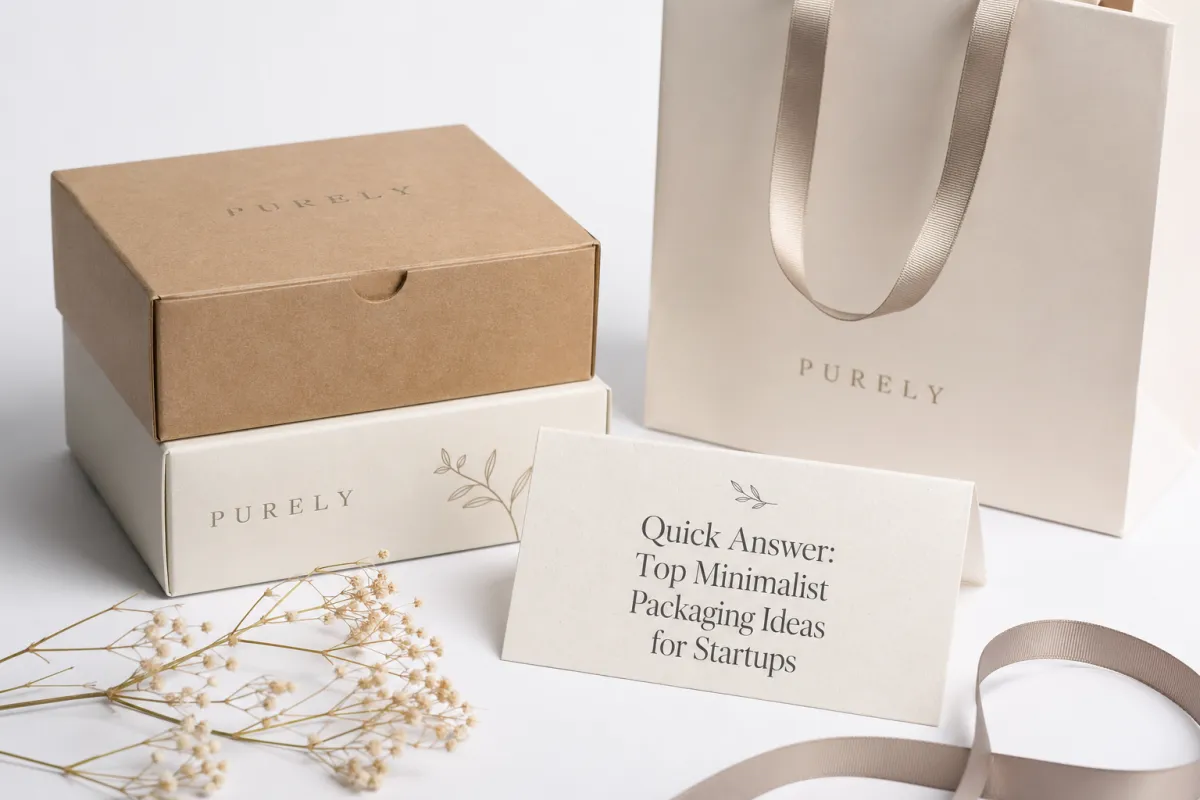
Top minimalist packaging ideas for startups are not mysterious. If I were telling a founder what to test first, I would start with kraft mailers, white folding cartons, rigid boxes with one-color print, and sleeve plus tray setups. Those four cover most DTC apparel, beauty, supplements, and small electronics without pushing custom box packaging into a ditch. I have had clients come in convinced they needed a complex custom structure, only to discover that a clean carton solved the brief better and saved them $0.27 to $0.61 per unit at 5,000 pieces.
Here is the blunt version. Top minimalist packaging ideas for startups work because they lower setup costs, keep proofing simple, and cut the number of variables that can ruin a launch. One logo, one accent color, and a clean type system usually beat a crowded box full of finishes that look expensive on screen and awkward on the shelf. I have sat in client meetings where the "premium" version added three effects and a $0.42 unit cost bump, then the customer chose the plain sample because it felt more honest. Customers often read honesty faster than decoration, especially when the carton ships from Shenzhen or Ho Chi Minh City in a plain corrugated master case.
My review standard stays simple: if the package cannot survive an ISTA-style transit test, looks clumsy on a retail shelf, or needs an enormous budget to reorder, it does not make the cut. I still lean on public testing references like ISTA for drop and vibration expectations, and I check material sourcing against FSC when a brand wants paperboard with a cleaner sustainability story. Standards do not make a box beautiful, but they do keep the packaging from pretending. I have seen too many expensive cartons fail after a 42-inch drop because the insert was a decorative afterthought, and too many promising launches lose momentum because the package could not handle ordinary shipping abuse.
- Kraft mailers are best for apparel, accessories, and light e-commerce orders that need low-cost protection.
- White folding cartons fit cosmetics, supplements, tech accessories, and other product packaging that needs a cleaner shelf presence.
- Rigid boxes are worth it for premium launches where the box is part of the perceived value.
- Sleeve and tray setups are smart for brands that want restrained branding with a bit of structure.
If you want to move quickly, start by requesting samples from Custom Packaging Products and ask for two structural options, not ten. Top minimalist packaging ideas for startups are easier to judge when the sample set is small enough to compare side by side instead of turning your desk into a cardboard warehouse. I have made that mistake before, and my office looked like a recycler had exploded in it for three days while I waited on a courier from Dongguan.
Top Minimalist Packaging Ideas for Startups Compared
Top minimalist packaging ideas for startups compare best when you look at the same four metrics every time: cost, protection, assembly, and brand feel. A pretty box that tears in transit is not branding. It is inventory loss with a nice face, and the warehouse in Phoenix or Rotterdam still has to process the return.
| Packaging option | Best use case | Typical cost at 5,000 units | Strengths | Main tradeoff |
|---|---|---|---|---|
| Kraft mailer | DTC apparel, small accessories, light kits | $0.38 to $0.72 each | Low setup, ships flat, easy to print | Less shelf presence |
| White folding carton | Cosmetics, supplements, retail packaging | $0.29 to $0.55 each | Crisp branding, good print quality, flexible sizes | Needs smart inserts for fragile products |
| Rigid box | Premium gifts, higher-ticket launches | $1.20 to $2.80 each | Strong presentation, high perceived value | Higher freight and storage cost |
| Sleeve and tray | Subscription boxes, cosmetics sets, bundled kits | $0.45 to $0.95 each | Flexible, refined, good package branding | More assembly labor |
| Tissue wrap plus sticker | Very light products, inserts, sampling kits | $0.08 to $0.22 each | Cheap, tidy, easy to scale | Weak protection on its own |
For top minimalist packaging ideas for startups, the winner is usually the format that looks intentional without pushing the budget too far. A single-color logo on kraft often feels more premium than full-bleed graphics because the stock itself does part of the talking. I have seen this in the hand again and again. At a Chicago client review near Fulton Market, we swapped a glossy coated box for a white folding carton with a blind deboss and saved about $0.31 per unit while making the box feel quieter and more expensive. That was one of those rare moments where the spreadsheet and the sample both smiled back at me.
The fastest way to spot a weak option is to ask whether the box has too much empty space, too many finishes, or a structure that asks for an extra minute of fiddling on every order. Those little problems do not show up in renders. They show up in warehouse labor bills, customer complaints, and damage claims that arrive 17 days after launch. That is why top minimalist packaging ideas for startups work best when the structure stays simple and the visual language stays disciplined. I have never once heard a warehouse manager in Ontario, California say, "Thank you for the fifth version of the insert."
One startup I advised wanted a black soft-touch box with silver foil, a ribbon pull, and a molded insert. The sample was handsome. The production quote was $2.14 per unit, and the shipping carton barely fit the freight budget leaving Guangzhou. We cut it down to a white folding carton, one spot color, and a paperboard insert. The result looked cleaner, cost less, and landed better with customers. Fancy is not a business model, and in that case the glossy version was basically wearing a tuxedo to a warehouse shift in August.
Detailed Reviews: What Actually Works and What Fails
Top minimalist packaging ideas for startups become useful only when you look at production details. Pretty mockups are cheap. Die lines, board caliper, glue points, and fold memory are where the real story lives. I have had sample cartons look gorgeous on a desk, then collapse into weak corners once the line started moving at 1,200 units per hour. The factory in Shenzhen does not care that the render looked expensive.
Kraft mailers for lean e-commerce
Top minimalist packaging ideas for startups often begin here because kraft mailers are easy to source, easy to brand, and hard to mess up if you keep the print simple. I like E-flute for light protection and a natural kraft exterior when the product can carry a muted, earthy look. A one-color logo, one return address line, and a restrained interior print are usually enough. I personally prefer this approach for founders who want to feel polished without creating a design circus around a $24.00 apparel order.
The upside is clear: flat shipping, lower freight volume, and a faster proof cycle. The downside is clear too. If the product inside is fragile, or the box is too large for the item, the mailer starts looking like a compromise instead of a choice. I have seen founders try to stuff glass bottles into mailers with no insert. That is not minimalism. That is damage with branding, and it makes me wince every time the carrier hands over a crushed corner in Chicago or Dallas.
White folding cartons for cleaner shelf presence
Top minimalist packaging ideas for startups and folding cartons go together because cartons give you structure without forcing a heavy-duty box. I prefer 350gsm C1S artboard for cosmetic and supplement cartons, with a matte aqueous coating if the brand wants a softer finish and less glare under retail LED lighting. When the artwork stays restrained, a carton can carry package branding better than a louder box because the face feels crisp from edge to edge. The whole thing reads more confident, and confidence sells better than clutter.
In one factory visit in Dongguan, a supplier tried to upsell me on 157gsm art paper wraps, soft-touch film, and a metallic board upgrade. I told him the customer was buying the serum, not the carton. He laughed, probably because he knew I was right. We stayed on a cleaner board spec, and the factory line ran faster because the finishing stack was thinner. That saved about 11 minutes per 1,000 units and reduced reprint risk. Top minimalist packaging ideas for startups should cut friction, not create a trophy cabinet.
"The sample looked pretty; the shipping claims didn't." A founder said that to me after three rounds of revisions and a revised freight quote from Ningbo, and he was right. The box should support product packaging, not audition for a museum wall.
Rigid boxes for products that need ceremony
Top minimalist packaging ideas for startups sometimes need a rigid box, but only when the product price or category can justify it. I am talking about a 1200gsm chipboard structure wrapped in 157gsm art paper or similar, with one-color printing, blind deboss, or a small foil mark. The presentation is excellent. The real question is whether the customer will pay for that extra ceremony. If the margin cannot support it, the box becomes a very expensive flex that sits in a warehouse in Los Angeles for 90 days.
Rigid boxes feel premium because they hold shape and slow the opening down in a good way. That matters for gift sets, luxury skincare, jewelry, and small electronics. The trap is overdesign. Once you stack magnets, ribbons, and specialty lamination, the box starts eating the margin. I have watched a brand lose a wholesale account because their package looked premium but pushed landed cost up by $1.60 per unit. Pretty does not excuse bad math, and the finance team will never be charmed by a ribbon.
Sleeve and tray setups for restrained branding
Top minimalist packaging ideas for startups can use a sleeve and tray when the product needs a little architecture without a full rigid box. This format works especially well for subscription kits and multi-piece bundles. The sleeve gives you package branding space, while the tray keeps the interior tidy and makes the product feel organized rather than stuffed in. I like this option when a brand wants the box to feel considered but not overbuilt, especially at 1,000 to 3,000 units.
If you want this option to look good, keep the sleeve typography simple and let the tray do the invisible work. A pale sleeve, a single accent color, and a sturdy tray made from paperboard or corrugated board can create a premium feel without turning the order into a hand-finishing nightmare. In my experience, sleeve and tray packaging is one of the best top minimalist packaging ideas for startups that want controlled presentation and decent protection. It gives a little ceremony without asking the factory in Vietnam to perform magic.
Tissue wrap and sticker systems for light-touch presentation
Top minimalist packaging ideas for startups also include a very stripped-down layer: tissue wrap plus a branded sticker. This is not for everything. It works best for apparel, lightweight accessories, and sampling kits that already have a nice primary container. Use it as a presentation layer, not as the whole protection strategy. I like it because it can make a package feel intentional without making the budget cry, especially when a 500-sheet tissue order costs under $0.04 per fold.
Where it fails is obvious. If the product can shift, crush, or rub in transit, tissue wrap alone is not enough. But if the item is soft, light, or already boxed, a textured tissue and a simple seal sticker can make the unboxing feel thoughtful for pennies. The trick is keeping the visual system calm. Too many patterns and it stops feeling minimalist. I have seen a tissue system go from elegant to noisy in one extra print color, which was deeply annoying in the most avoidable way.
One supplier in Dongguan once pushed me to add a printed insert, a metallic sticker, and a second wrap layer because "customers like more surprise." I said no. We tested the lighter option anyway, and the cleaner version won because the product itself was strong. That is the rule I keep repeating: top minimalist packaging ideas for startups should frame the product, not fight it. If the box is louder than the brand, something has gone wrong.
Price Comparison for Top Minimalist Packaging Ideas for Startups
Top minimalist packaging ideas for startups save money because they avoid the hidden costs that pile up fast: extra colors, special finishes, custom inserts, oversized cartons, and proof revisions that drag the schedule. The sticker price is only one part of the bill. Freight, storage, assembly labor, spoilage, and reprints all matter. I wish more founders were shown the full landed cost early, because the cheap quote is often the sneakiest one in the room, especially if it ships from Shenzhen to New York via a rushed air booking.
For a practical example, I usually quote landed package costs like this for a mid-size startup order: kraft mailers at about $0.42 to $0.68 each, white folding cartons at about $0.33 to $0.60, sleeve and tray setups around $0.55 to $1.05, and rigid boxes anywhere from $1.35 to $3.10 depending on the wrap and insert. Add $0.06 to $0.25 for assembly labor if the structure is not ship-flat. That is where budgets drift if nobody watches the details. The boxes themselves are rarely the only problem; the handling is where the hidden pain shows up.
| Cost driver | Typical impact | What to do |
|---|---|---|
| One-color printing | Often keeps setup in the $180 to $350 range | Use a single logo or type lockup |
| Full CMYK or multi-pass decoration | Can add $200 to $900 in setup and proofing | Only use it if the art really needs it |
| Special finishes like foil or soft-touch | Usually adds $0.08 to $0.45 per unit | Choose one finish, not three |
| Custom inserts | Can add $0.10 to $1.20 per unit | Use paperboard or molded pulp only if needed |
| Higher MOQ | Lowers unit cost but raises cash tied in inventory | Balance unit savings against storage and cash flow |
Top minimalist packaging ideas for startups also change price when MOQ changes. A digital short run of 100 to 250 units may cost more per box, but it lets a founder validate the market before committing to 5,000 or 10,000 pieces. Offset gets cheaper as volume climbs, but only if the artwork is locked and the structure is stable. I have seen a team save $0.14 per carton by moving from a 300-unit test to a 3,000-unit run, then waste twice that because the product dimensions changed and they had to reprint the second batch. That kind of savings is fake, and it always comes back to bite someone in month two.
There is also the fake savings trap. A cheaper quote that arrives with poor freight terms, weak board, or a bad dieline is not really cheaper. I once compared a Mondi board quote with a local converter in Shenzhen. The local price was only $0.04 higher on paper, but the better caliper and cleaner shipping plan made the total landed cost lower by $0.11 per unit after rework and transit damage were counted. Top minimalist packaging ideas for startups should be judged on total cost, not quote theater. The quote sheet is a nice starting point; it is not the full story.
How Do You Choose the Top Minimalist Packaging Ideas for Startups?
Top minimalist packaging ideas for startups should start with the product, not the mood board. Weight, fragility, and dimensions decide the structure before branding enters the conversation. If the item is light and durable, a mailer or carton may be enough. If it is fragile or premium, you may need an insert, a sleeve, or a rigid box. I have had clients fall in love with a structural concept first, then discover the product simply did not fit because the bottle was 2.5 mm taller than the inner cavity. That kind of miss is kinda painful, and it is also completely avoidable.
Start with product fit
Top minimalist packaging ideas for startups fail fastest when the box is too large or too loose. Empty space is not sophistication. It is movement. Movement creates scuffs, cracked corners, and that annoying half-open look that makes the whole package feel cheap. I always ask for exact product measurements first, then I match the dieline to the object, not the other way around. That habit alone has saved more launches than any fancy finish ever did, especially on cartons made in Zhejiang and shipped into a fulfillment center in Nashville.
Match the sales channel
Top minimalist packaging ideas for startups should also reflect where the product gets sold. DTC shipments need real protection because parcels go through more hands and more corners. Retail packaging needs shelf visibility, barcode space, and a clean face that reads at arm's length from 4 to 6 feet. That is why branded packaging for a web store can be different from retail packaging for a boutique shelf, even when the logo stays the same. The same brand can wear two different coats and still feel like itself.
Use brand stage as a filter
Top minimalist packaging ideas for startups at the pre-scale stage should favor flexibility. I would rather see a founder choose a simple folding carton and spend the saved money on better product photos than lock into an elaborate custom structure too early. Once the brand is stable and reorder patterns are known, then a rigid box or a custom printed box can make sense. Until then, keep the structure honest. There is enough to worry about without designing a monument to uncertainty that costs $2.80 a unit.
Sustainability needs to be practical
Top minimalist packaging ideas for startups also need to survive the sustainability conversation without turning into green theater. Recyclable paperboard, FSC-certified stock, fewer mixed materials, and fewer glued-in parts usually make more sense than a box covered in claims and difficult-to-dispose finishes. I like designs that make it easy for the customer to separate materials without thinking hard. Simple beats performative. If a package needs a brochure to explain how to recycle it, the package is already doing too much.
If you are checking whether a supplier can actually do the job, ask for board specs, glue type, and sample photos from the factory floor. Also ask for transit testing language that matches the product. For lightweight kits, I still refer to ISTA 3A and ASTM D4169 style expectations because those references keep the conversation grounded in reality instead of marketing language. Top minimalist packaging ideas for startups are better when the testing is plain and the paperwork is boring. Boring paperwork has saved me more than once on a Friday afternoon in Shanghai.
My practical rule is simple: protect the product first, then add just enough visual polish to make the unboxing feel intentional. Anything beyond that should earn its place. If it does not make the package safer, clearer, or more distinctive, I cut it. I have no patience left for decorative extras that only make the receiving team groan while they open 600 cartons at 7:00 a.m.
Process and Timeline: From Dieline to Delivery
Top minimalist packaging ideas for startups usually move faster than ornate projects, but only if the dimensions are locked and the artwork stays disciplined. The full path is usually product measurements, dieline selection, artwork setup, proofing, sampling, bulk production, and freight. Skip one step and the factory will remind you in the least charming way possible. Usually right when your calendar is already full and your launch deck is already circulating.
A realistic timeline looks like this for a simple carton or mailer: 1 to 2 days for dimensions and dieline selection, 2 to 4 days for artwork, 5 to 7 business days for a digital sample, and 12 to 15 business days for bulk production after proof approval. Rigid boxes and specialty inserts take longer because the structural work and assembly are heavier. Ocean freight can add 18 to 30 days, so nobody should pretend this is instant. I have seen founders act surprised by freight timing as if boats were supposed to ignore the South China Sea and arrive in 48 hours.
"We do not lose three days to production. We lose them to missing barcode files." That came from a supplier manager during a late-night proof review in Shenzhen, and he was not wrong.
Where delays usually happen is embarrassingly consistent. The founder changes the logo size after proof approval. The barcode is missing or wrong. The pantone callout is not supplied. The insert dimensions are based on the product sample from six weeks ago instead of the updated unit. Top minimalist packaging ideas for startups reduce some of this risk, but they do not erase it if the team keeps moving the goalposts. The factory can build a clean box, but it cannot rescue a moving target that changed from 120 mm wide to 123 mm wide after approval.
My checklist for startup launches is brutally simple:
- Confirm exact product dimensions and weight.
- Choose the structure and keep it locked.
- Request a dieline before designing artwork.
- Approve one sample only after checking the real product inside.
- Ask for landed costs, not just unit price.
- Set a reorder point before stock gets tight.
Top minimalist packaging ideas for startups can shorten approvals because there are fewer graphics and fewer finish decisions. That said, minimal designs only move quickly when the design system stays disciplined. One logo, one type family, one accent color, and a fixed size set are easier to approve than a box with three metallic inks and a different message on every panel. The factory likes clarity. So do your margins. And so does the person trying to get the launch out the door without a caffeine headache and a missed freight cutoff.
Our Recommendation and Next Steps
Top minimalist packaging ideas for startups should not be chosen because they are trendy. They should be chosen because they are the simplest formats that protect the product and make the brand look sharper, not louder. My default recommendation is to shortlist two options, request samples, and compare them under actual shipping and shelf conditions instead of trusting renders and sales talk. I trust a dented sample carton more than a beautiful mockup every single time, especially if the sample came from a factory in Guangzhou and the render came from a freelancer who never touched board stock.
If you are stuck, begin with a kraft mailer for light e-commerce, a folding carton for tighter product presentation, and a rigid box only if the price point can support it. That three-option set covers most early-stage brands without making the purchasing team miserable. You can also browse Custom Packaging Products to see how top minimalist packaging ideas for startups can be built into real formats instead of mood-board fantasies. I have spent too many meetings trying to explain why a dream box and a production box are not the same thing, especially once the quotes land at $1.87 versus $0.48.
Here is the next-step checklist I would use if I were launching another product line tomorrow:
- Lock product dimensions and weight.
- Ask for two dielines and one backup structure.
- Get quotes for 500, 1,000, and 5,000 units so MOQ pressure is visible.
- Compare sample packages by damage resistance, print quality, and assembly speed.
- Measure reorder time, customer feedback, and breakage after the first batch.
One of the smartest things a founder can do is watch what happens after launch. Did customers mention the unboxing? Did damage claims drop from 3.2 percent to 1.1 percent? Did the warehouse hate the assembly step? Those numbers tell you more than a pretty mockup ever will. I have walked enough factory floors in Suzhou, Dongguan, and Los Angeles to know that the best package is the one the customer barely notices because it simply works. That sounds unglamorous, but it is exactly why it wins.
Top minimalist packaging ideas for startups are most powerful when they stay boring in production and thoughtful in the hand. Choose the cleanest format that protects the product, supports the brand, and fits the cash flow. Then test it, ship it, and improve it with real data instead of guesswork. If the box does its job quietly, you have probably made the right call.
FAQ
What are the cheapest top minimalist packaging ideas for startups?
Plain kraft mailers and simple folding cartons are usually the cheapest top minimalist packaging ideas for startups because they use less material and fewer print steps. One-color printing keeps setup in a lower band, often around $180 to $350 for smaller production runs, and it avoids the pricing jump that comes with foil, lamination, or layered decoration. If cash is tight, pick a format that ships flat and assembles quickly so you do not pay extra labor just to get the package into use, especially on orders under 1,000 units.
How do minimalist packaging ideas for startups still look premium?
They look premium when the sizing is precise, the typography is clean, and the stock has real substance. A 350gsm carton with one accent color can feel richer than a crowded box with five effects fighting each other. I have seen blind deboss, a matte board, and a single strong logo outperform glossy graphics every time, especially when the carton is printed in Shenzhen or Taipei and the finish is restrained. The package feels deliberate, and deliberate is what customers read as premium.
What MOQ should I expect for custom minimalist packaging?
Small digital runs can start low, sometimes at 100 to 250 units, but custom structural packaging and offset printing usually ask for higher minimums. The MOQ depends on the material, print method, insert requirements, and whether the dieline needs special cutting. Ask suppliers for a test run if you are still validating product-market fit, because a smaller order can save you from sitting on the wrong box for six months in a warehouse in Dallas or Tilburg.
How long does minimalist packaging production usually take?
Sampling can take about 5 to 7 business days for a simple structure, but changes to size or print can add time fast. Bulk production often takes 12 to 15 business days after sample approval, and freight can add another 18 to 30 days if you are importing. Build buffer time for proof revisions, material delays, and the usual last-minute artwork changes that somehow always show up at the worst moment, usually right before a Friday cutoff.
Which minimalist packaging ideas work best for fragile products?
Rigid boxes, reinforced mailers, and folding cartons with inserts offer the best balance of protection and clean presentation. Avoid oversized empty space because product movement causes damage and makes the package feel cheap. Test the package with real shipping conditions before you order in bulk. A pretty box that fails in transit is not a win, no matter how nice it looks on a desk in your studio or in a client deck.