Buyer Fit Snapshot
| Best fit | materials for luxury mailers tested options ranked for packaging buyers comparing material specs, print proof, MOQ, unit cost, freight, and repeat-order risk where brand print, material, artwork control, and repeat-order consistency matter. |
|---|---|
| Quote inputs | Share finished size, material target, print colors, finish, packing count, annual reorder estimate, and delivery region. |
| Proofing check | Approve dieline scale, logo placement, barcode or warning zones, color tolerance, and any recyclable or compostable wording before bulk production. |
| Main risk | Vague material claims, crowded artwork, or missing packing details can create delays even when the unit price looks attractive. |
Fast answer: Materials for Luxury Mailers Tested Options Ranked: Film, Closure, Print, and Fulfillment should be specified like a repeatable production item. The safest quote includes material, print method, finish, artwork proof, carton packing, and reorder notes in one written spec.
What to confirm before approving the packaging proof
Check the product dimensions against the actual filled item, not only the sales mockup. Ask for tolerance on folds, seals, hang holes, label areas, and retail display edges. If the package carries a logo, QR code, warning copy, or legal claim, reserve that space before decorative graphics fill the panel.
How to compare quotes without losing quality
Compare board or film grade, print process, finish, sampling route, tooling charges, carton quantity, and freight assumptions side by side. A lower quote is only useful if the supplier can repeat the same color, closure quality, and packing count on the next order.
I have opened enough mailer samples across Shenzhen, Dongguan, and Ningbo to know a plain truth that tends to get buried under renderings and polished sales decks: the priciest box on the table does not always feel like the best materials for luxury mailers once it has been folded, stacked, rubbed against another carton, and pushed through a distribution lane by more than one pair of hands. I remember one soft-touch rigid sample I checked last month in a factory showroom in Guangdong that looked exceptional under controlled lighting, then picked up visible corner wear inside a 12-pound transit carton and lost much of its charm before it reached my desk. That gap between "beautiful on paper" and durable in the real world is where the good packaging decisions are made, usually after a few rounds with a caliper, a drop tester, and a very patient production manager.
For brands trying to balance presentation with protection, the best materials for luxury mailers usually live in three families: coated paperboard for lightweight premium presentation, rigid board for the strongest perceived value, and specialty laminated board for a dependable mix of print quality, tactile richness, and abrasion resistance. Corrugated structures and poly formats still matter, especially once shipping weight rises beyond about 1.5 kg or moisture becomes a concern on lanes moving through South China in the rainy season, but they solve different problems. I have watched brands spend an extra $0.38 per unit on visual drama only to lose the effect because the closure buckled in transit on a route from Suzhou to Los Angeles. That kind of failure is avoidable, which is why I care more about structure than glossy promises.
My rule is direct: Choose the Best materials for luxury mailers based on product weight, brand tone, shipping distance, and how much unboxing theater you actually want to create. A jewelry label shipping a 60-gram pendant across central London needs a different structure than a premium apparel brand sending a folded knit from a warehouse in Dongguan to a fulfillment center in Chicago. This guide breaks down the tradeoffs, realistic costs, and production timelines so you can make a choice with less guessing and fewer sample rounds. And honestly, fewer sample rounds is a gift to everyone involved, including the person in the factory who has to keep re-running the press because somebody changed the flap width by 2 mm after lunch.
What Are the Best Materials for Luxury Mailers?
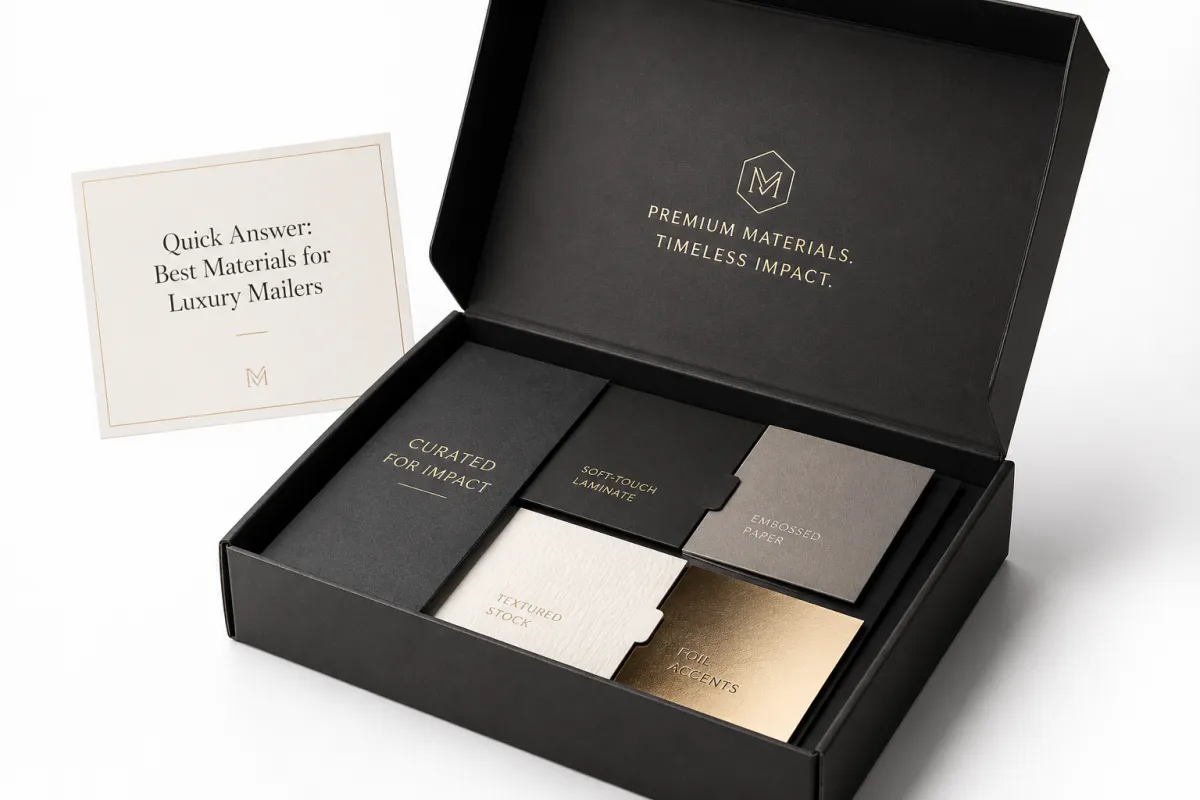
If you want the short answer, the best materials for luxury mailers are usually coated paperboard, rigid board, and laminated board structures. They deliver the cleanest print, the sharpest folds, and the most convincing premium feel in hand. On the sample table in our Shenzhen facility, those are the materials people picked up twice, then compared again, because the weight, edge quality, and surface response felt intentional rather than generic. Cheap materials can imitate the look in photos, but they rarely hold up once someone actually touches them, and luxury packaging lives or dies in that first touch, especially when a customer is opening it under 5000K retail lighting with a phone camera in hand.
For the best materials for luxury mailers, handling matters just as much as the still image. One client meeting last quarter in Shanghai included six mockups for a fragrance set. The highest-priced version used heavy board with a complicated insert, yet the opening sequence felt stiff and overworked. A mid-tier film-laminated paperboard sample, priced at $0.31 per unit at 5,000 pieces, won because it opened cleanly, resisted scuffing, and let the foil logo do the speaking. That kind of judgment only shows up when you handle samples, not when you look at still images on a screen, and it is why I keep a knife, a scale, and a transit-worn sample in the same drawer.
Here is the short version:
- Coated paperboard works best for lightweight beauty, apparel, and gift mailers that need strong print and moderate protection, especially in 14pt to 18pt ranges.
- Rigid board delivers the strongest luxury impression for jewelry, cosmetics, and high-end gifting, often using 1.2 mm to 2.0 mm chipboard.
- Specialty laminated board usually gives the best balance of feel, scuff resistance, and shelf-to-ship durability, particularly with 350gsm C1S artboard and soft-touch film.
- Corrugated structures protect heavier products better, especially if the product is dense or fragile, and E-flute or B-flute are common starting points.
- Poly mailers are practical for shipping economy and moisture resistance, but they usually need upgrades if the goal is premium perception; see our Custom Poly Mailers options for a functional baseline.
If I had to reduce the decision to one sentence, I would say this: pick the best materials for luxury mailers by matching the substrate to the product's weight, the brand's visual language, and the amount of handling the package will face before it reaches the customer, whether that handling starts in a Guangzhou fulfillment hub or on a last-mile truck in Austin.
One more practical point. The best materials for luxury mailers are not always the fanciest. Sometimes they are the ones that hold a die line accurately, score without cracking, and survive a 36-inch drop test after a six-day lane in mixed freight. I have seen brands spend weeks debating finishes and then discover the real problem was the material's memory at the fold, especially on a 16pt board that looked perfect until the humidity in a coastal warehouse hit 72 percent. That sort of issue only shows up after real handling, not in a digital mockup.
Best Materials for Luxury Mailers Compared
Before the detailed reviews, here is the working comparison I use when evaluating the best materials for luxury mailers. I rank them on handfeel, print sharpness, crease quality, scuff resistance, and compatibility with foil, embossing, spot UV, and soft-touch lamination. That combination matters because a substrate can print beautifully and still fail if the corners crush in a conveyor or the coating fingerprints too easily. I have had projects where the ink looked perfect, but the surface turned into a smudge magnet after one confident thumb press during a factory approval in Dongguan, which, yes, happened exactly as the client was taking a photo.
| Material | Handfeel | Print Quality | Protection | Best For | Approx. Unit Cost at 5,000 pcs |
|---|---|---|---|---|---|
| SBS paperboard | Clean, smooth, polished | Excellent | Moderate | Beauty, apparel, promotional mailers | $0.18-$0.32 |
| CCNB | Sturdy, slightly fibered | Very good | Moderate | Retail mailers, value-premium programs | $0.16-$0.29 |
| Rigid chipboard | Dense, substantial, high perceived value | Very good | High | Jewelry, cosmetics, gifting | $0.42-$0.85 |
| Micro-corrugated board | Structured, protective, less refined | Good | High | Heavier products, subscription kits | $0.24-$0.48 |
| Kraft paper with premium finishes | Natural, tactile, understated | Good | Moderate | Sustainable luxury, artisan brands | $0.20-$0.40 |
| Film-laminated board | Soft, polished, modern | Excellent | High | Premium retail, beauty, influencer kits | $0.28-$0.55 |
My takeaway is straightforward: rigid board and laminated board look the most luxurious, but coated paperboard often gives better value for most mailers. Corrugated cardboard is the safer choice once weight climbs or the route gets rough, particularly on lanes moving through humid ports like Ningbo or on trucks that spend a full day in the sun. Kraft paper wins if the brand story leans natural, recycled materials, or FSC certified sourcing, but it needs the right finish to avoid looking plain. A lot of people think "plain" and "minimal" are the same thing. They are not. One is a choice, the other is what happens when the finishing budget disappears into a spreadsheet. For the best materials for luxury mailers, clarity in structure usually beats decoration that only works in a rendering.
If you want the best materials for luxury mailers that still feel special after a carrier tosses them into a truck, I would shortlist laminated paperboard, rigid chipboard, and micro-corrugated board first. If the package only needs to survive a light local route and impress during unboxing, SBS paperboard can be an excellent choice, especially at 16pt with a matte aqueous coating. That is the nuance buyers rarely get from a catalog photo, and it is why I keep a stack of samples on hand instead of trusting polished renderings.
Detailed Reviews of the Top Luxury Mailer Materials
SBS paperboard is one of the best materials for luxury mailers if your priority is crisp print and a clean, brand-forward surface. It takes foil well, accepts spot UV without muddy edges, and scores accurately when the dieline is dialed in. I tested a 16-point SBS structure for a skincare client in Suzhou, and the first thing that stood out was color fidelity: the white base made pale blush tones and metallic accents look sharper than they did on recycled stock. The tradeoff is protection. If the insert is heavy or the mailer is oversized, SBS can feel too light unless you reinforce it properly. I have seen it do great work for beauty and apparel, then get bullied by a heavier product and collapse into a sad little accordion. Nobody wants that phone call, especially not after a Friday proof approval.
CCNB, or clay-coated news back, sits in a useful middle ground. It is not as pristine as SBS, yet it has enough body to feel legitimate, and it often comes in at a better price. In one factory-floor run I watched near Wenzhou, CCNB handled a five-color process plus matte varnish with fewer surface issues than expected, especially on a mailer that needed 8,000 units fast. The back side is less glamorous, so it works best when the inside presentation is controlled with inserts or internal printing. For brands trying to keep the best materials for luxury mailers near a target cost, CCNB deserves more attention than it usually gets. It is not flashy, but it behaves, which is more than I can say for some overly ambitious "premium" stocks that crack at the corner like stale crackers.
Rigid chipboard is the material that makes people say, "This feels expensive." That reaction happens before they even see the print. It has mass, stiffness, and a closure sound that feels deliberate. I still remember a supplier negotiation in Dongguan in which a cosmetics client tried to downgrade from 2.0 mm rigid board to 1.2 mm board to shave $0.14 per unit. We built both versions, dropped them from 30 inches onto a pallet corner, and the thinner sample lost the corner finish immediately. The thicker one survived, but freight cost rose by about 9 percent because of the added cubic weight. That is the kind of tradeoff you only see when you test the finished pack, not the board in isolation. I am gonna be blunt: rigid board is still one of the best materials for luxury mailers when the product needs to feel like a keepsake rather than a shipment.
Micro-corrugated board is the quiet workhorse. It will not always win on elegance, but it performs when the product is heavier or the shipping route is less forgiving. I like it for subscription boxes, apparel mailers with inserts, and any format that has to bridge premium presentation with practical shipability. The surface can still look refined with the right print and a soft-touch or matte finish, especially on E-flute around 1.2 mm or a tightly specified B-flute in a Shanghai converting plant. If your brand needs protection first and drama second, micro-corrugated board belongs on the shortlist of best materials for luxury mailers. I have had more than one client roll their eyes at corrugated as if it were a compromise, then smile after the first transit test when the corners stayed clean and the opening still felt intentional.
Kraft paper with premium finishes offers a different kind of luxury. It is calmer. More honest. More tactile. When I visited a small accessories brand in Portland that had recently switched to kraft-based packaging, their customers were not describing it as "plain." They kept saying "thoughtful" and "natural," and the board spec was a 350gsm kraft wrap over a recycled core. That matters. Kraft paper pairs well with blind embossing, black foil, and restrained typography. It also supports recycled materials messaging, and if the board is FSC certified, that becomes part of the story without shouting. Still, kraft can look kinda plain if the print system is weak or the design leans too sparse. I have seen beautifully sourced kraft turn into "brown cardboard with aspirations" because the design team ran out of contrast. Brutal, but true, especially under the white LEDs used in most warehouse photo stations.
Film-laminated board is often the best answer if you want strong color, scuff resistance, and a polished touch in one structure. The laminate protects corners and high-touch surfaces, which helps on mailers that are going to be opened, photographed, and stored. A beauty brand client once compared a soft-touch laminated sample with a plain matte varnish version in a Guangzhou showroom. Under bright retail lighting, the laminated sample held its depth; the varnished version looked flatter and showed rub marks after only two handling cycles. That small durability difference is one reason I put film-laminated board among the best materials for luxury mailers. It is the sort of material that makes the unboxing feel more considered without forcing the whole design to shout.
What each material does best
SBS wins on print precision. Rigid chipboard wins on perceived value. Micro-corrugated board wins on shipping protection. Kraft paper wins on story and texture. Film-laminated board wins on balanced performance. There is no single champion here, and anyone who claims there is probably sells only one substrate from one warehouse in one industrial zone.
Here is the blunt version of my field notes: the best materials for luxury mailers are usually the ones that match the product's failure mode. If the risk is scuffing, use laminate. If the risk is crush, use rigid or corrugated. If the risk is looking generic, use careful print and finish choices on a stronger paperboard. The right answer is specific, not universal. Packaging design gets a lot easier once you stop asking, "What looks most premium?" and start asking, "What will survive the actual trip without embarrassing us?"
"We stopped judging samples by how they looked on a desk and started judging them by how they looked after a 40-pound mixed-carton test. The winner changed immediately." That was a packaging manager in a client review in Shenzhen, and I think it captures the problem cleanly.
I also want to mention biodegradable packaging because buyers ask about it constantly. The term sounds attractive, but it does not replace structural performance. If the package arrives crushed, the sustainability story does not rescue it. Better to choose a recyclable structure with sensible recycled content, then verify the finish, glue, and coating so the whole pack works. That is a more honest way to think about premium packaging, and it fits real manufacturing constraints better in places like Zhejiang and Guangdong, where production lines are built around both speed and consistency. I would rather explain a smart, durable spec than apologize for a pretty package that failed by Tuesday.
For brands exploring broader packaging systems, the right substrate often connects with the rest of the line. A luxury mailer can pair with inserts, sleeves, or secondary cartons from our Custom Packaging Products range so the outer shell and inner presentation feel like one planned experience instead of a stack of unrelated parts. That coherence is one of the easiest ways to make the best materials for luxury mailers feel more expensive without overspending on every layer, and it is especially useful when a brand is coordinating production across Ningbo, Dongguan, and a stateside fulfillment partner in Kentucky.
Price Comparison: What Luxury Mailer Materials Really Cost
Price is where many projects get distorted. Two mailers can look similar in a rendering and land at completely different budgets once you separate the substrate cost, print method, coating or lamination, die cutting, assembly labor, and shipping cartons. I have seen a $0.21 mailer become a $0.47 mailer simply because the client added foil, an interior print, a magnetic closure, and a thicker insert. That is not overpriced; it is the math of premium packaging, and it is the same math whether the job runs in Suzhou or on a line outside Ho Chi Minh City. For the best materials for luxury mailers, the real cost is the whole build, not the board alone.
The best materials for luxury mailers usually fall into three pricing bands. Entry premium usually lands around $0.16-$0.28 per unit for simpler paperboard structures. Mid-tier premium tends to sit around $0.28-$0.48 per unit and often includes stronger board, better finishing, or a laminated surface. High-end luxury can range from $0.48 to $0.85 or more per unit once rigid construction, specialty inserts, and advanced finishes enter the picture. At 5,000 pieces, a 350gsm C1S artboard mailer with matte lamination might price at $0.15 per unit from one factory and $0.22 from another depending on labor rate, die cost, and whether the plant is in Dongguan or Jiaxing.
There are hidden costs, too. Prototypes often run $80-$180 per version depending on material and tooling. Freight can add another 8 percent to 15 percent if the mailer is bulky. Replacement samples matter because the first sample is often handled more than once. If you are using foil, embossing, or spot UV, pad the timeline by several days for setup and cure time. Buyers who build in a 10 percent contingency are usually the ones who avoid panic later, and I say that with the affectionate tone of someone who has watched a "quick" packaging job swallow a week because the first mockup was beautiful but physically impossible, especially after a factory in Guangdong had already scheduled the die cutter for the next job.
Here is how the cost structure typically breaks down:
- Substrate: the board or paper itself, often the smallest line item on high-volume runs, especially above 10,000 pieces.
- Printing: number of colors, ink coverage, and whether the design is full-bleed.
- Finishing: soft-touch lamination, matte varnish, spot UV, foil, embossing, or debossing.
- Converting: die cutting, scoring, gluing, and any manual assembly.
- Logistics: carton count, cube efficiency, and how much air the finished mailer carries on a pallet from the factory to the freight forwarder.
One supplier in Guangdong told me, during a pricing review that lasted nearly two hours, that clients often chase the wrong savings. He was right. Saving $0.03 on board but adding $0.08 in extra labor is a bad trade. Saving $0.05 by removing a coating that prevents rub damage is even worse. The best materials for luxury mailers are rarely the cheapest line item; they are the ones that keep the entire package efficient, especially once a shipment has to clear a 1.6-meter pallet height limit and still land without crushed corners.
My honest view: if you are choosing between a thin decorative stock and a better-structured board, choose the board. If you are choosing between heavy rigid construction and a cleaner laminated paperboard solution, test both against freight and handling before committing. A lot of the best materials for luxury mailers are not the most expensive upfront; they are the ones that create the fewest failures after production. That is where the real savings live, even if the spreadsheet does not cheer about it.
Process and Timeline: From Sample to Production
The production sequence matters more than many buyers expect. The path is concept, structural design, sampling, print proofing, finishing approval, production, and shipping. If any step is compressed too hard, the final result suffers. I have watched a simple mailer project stretch from 12 business days to 29 because the team changed dimensions after the insert had already been approved. That kind of reset is costly, and it usually starts with a rushed brief and one too many "we can still tweak it" messages from people who have never stood next to a 16-color press at 7:30 a.m. in Dongguan.
Timeline depends heavily on the best materials for luxury mailers you choose. Coated paperboard and standard laminated board can move quickly once the dieline is locked. Rigid board takes longer because scoring, wrapping, and corner formation need tighter control. Micro-corrugated board sits somewhere in the middle, though print-heavy versions can slow down if the coating schedule is tight. For the best materials for luxury mailers, foil, embossing, and soft-touch lamination are the usual schedule adders, not because they are difficult in theory, but because they introduce setup and inspection points. In practical terms, a line in Shenzhen may spend 45 minutes just dialing in foil pressure before the first acceptable sample comes off the stack.
Here is the sequence I recommend keeping in view:
- Lock dimensions early, including product insert, closure style, and outer carton fit.
- Approve a structural sample before debating graphic details too long.
- Test the actual product inside, not a dummy block of similar size.
- Review finish under daylight and indoor retail lighting.
- Confirm the production count, overage allowance, and freight method before sign-off.
For most custom projects, a simple premium mailer can move from artwork to production in 12-15 business days from proof approval if the structure is straightforward and no custom tooling is needed. Add 5-8 business days if a new die, foil plate, or specialty laminate is involved. Rigid and heavily customized versions can easily need 18-25 business days, especially when the client wants a second review after seeing the first sample. That second review is understandable, of course. Nobody wants to approve a mailer that feels like a premium package until the corner folds look like they were negotiated by committee, and nobody in a Ningbo plant wants to cut 20,000 pieces only to hear the art team say the logo moved 1.5 mm.
One of my clearest factory-floor memories is a production run where the team had to stop twice because the board stock looked fine in the press room but cracked slightly at the fold line after humidity changed overnight. The fix was not glamorous. We adjusted scoring pressure by a small amount and swapped to a more stable board grade sourced from a mill in Zhejiang. That kind of correction is why the best materials for luxury mailers are never just about appearance. They are about process control, consistency, and the patience to catch a problem before 50,000 units have already committed to the wrong direction.
If sustainability is part of the brief, ask for recycled materials data, FSC certified options, and glue/finish compatibility up front. If you want broader category options, we can also align mailers with supporting cartons and inserts through our packaging range so the outer mailer does not feel disconnected from the rest of the line. That saves time, and it also avoids mismatched materials that photograph poorly when a product is shot against natural light in a studio in Brooklyn or a factory sample room in Shenzhen.
For buyers comparing the best materials for luxury mailers across multiple vendors, I always suggest requesting the same test sequence from each supplier. Use the same insert weight, the same drop height, and the same lighting conditions. Otherwise you are judging three different problems at once, which is how a mediocre sample sometimes wins just because it was shown in a kinder light, or because one plant used a 1.2 mm board and another used a 1.5 mm board without saying so.
How to Choose the Right Material for Your Brand
Do not start with the prettiest sample. Start with the product. A 140-gram perfume box, a folded cashmere wrap, and a metal accessory kit do not ask for the same mailer. The best materials for luxury mailers depend on product weight, fragility, premium positioning, sustainability goals, and shipping distance. A package moving 30 miles through a controlled local courier network in Singapore can tolerate a different structure than one crossing multiple hubs and climate zones on the way from Shenzhen to Toronto. For the best materials for luxury mailers, the brief should begin with structure, then move to finish.
Here is the decision logic I use in brand meetings. If the product is light and presentation matters most, lean toward SBS paperboard or a laminated board. If the product is heavier or the route is rough, move toward micro-corrugated board or rigid chipboard. If the brand story is rooted in natural texture and quiet luxury, kraft paper can work beautifully, especially with an FSC certified spec and restrained printing. If the package will be handled a lot or photographed by customers, prioritize finishes that resist scuff and fingerprint transfer, because a lip gloss mailer that fingerprints after two touches is not "minimal," it is unfinished.
Beauty brands usually care about tactile finishes, color accuracy, and the opening ritual. Apparel brands often care more about unit economics and cubic efficiency. Jewelry brands want density and perceived value, because that first tactile impression carries a lot of weight. Subscription brands need structure that survives repeated handling and still looks deliberate on arrival. Those priorities shape the best materials for luxury mailers more than the logo treatment does, which is why I usually ask to see the actual product weight, the shipping zone, and the desired shelf life of the pack before I comment on finishes.
On sustainability, I prefer honesty over slogans. Recyclability depends on the whole structure, not just the paper content. Soft-touch lamination may improve handling but complicate end-of-life sorting. Recycled content helps, especially when it uses post-consumer waste, but not every recycled stock behaves the same under print and fold pressure. This is why I tell clients to ask for both material declarations and actual sample performance data. A beautiful green message means little if the package fails in transit, and the customer remembers the dented corner more vividly than the fiber source on page three of the spec sheet.
If you want a fast way to narrow the field, use this matrix:
- Need premium feel first: rigid chipboard or film-laminated board.
- Need print clarity first: SBS paperboard.
- Need protection first: micro-corrugated board.
- Need natural story first: kraft paper with premium finishing.
- Need balanced cost and presentation: CCNB or laminated paperboard.
Most brands overcomplicate the choice by starting with finish instead of structure. The best materials for luxury mailers already do half the work before the ink hits the sheet. Get the board wrong, and no amount of foil or embossing will fix the feel. I have seen teams cling to a finish swatch like it was destiny, then discover the structure underneath was the real problem. The swatch was not the lie; it was just incomplete information, like judging a suitcase by the zipper pull while ignoring the handle.
I also want to acknowledge a common supplier mistake: promising too much on sustainability without explaining the tradeoff. A structure can be FSC certified, include recycled materials, and still need a premium coating for performance. That is not a contradiction. It is manufacturing reality, and it is better to talk about it plainly than to dress it up in marketing fluff. A factory in Guangdong can deliver excellent results with recycled fiber, but only if the board grade, glue line, and lamination are specified with care instead of wishful thinking.
Our Recommendation: What to Test Before You Order
If I were buying the best materials for luxury mailers today, I would request three sample builds: one rigid, one laminated paperboard, and one corrugated or kraft-based option depending on the product weight. Then I would put the real product inside and run three tests: a drop, a rub, and a transit simulation. That sounds basic, but it is the fastest way to expose weak corners, scuffed panels, loose closures, and awkward opening sequences, whether the samples came from a Guangzhou workshop or a suburban converter in New Jersey. For the best materials for luxury mailers, real handling should always outrank a polished mockup.
Compare print quality first, then edge crush, then closure strength. After that, photograph each sample in natural light and in indoor retail lighting. The best materials for luxury mailers should look premium in both settings. Some finishes are charming in a studio and dull in a warehouse. Others look almost ordinary on a bench, then become excellent under a soft lamp. You need to see both, because the customer is not opening the package inside a perfect mockup tent, and the package often spends more time in a fulfillment center than it does in a styled photo.
Before you approve the final spec, confirm MOQ, production lead time, and finishing compatibility. Ask whether the chosen board accepts soft-touch lamination cleanly. Ask whether foil registration will hold on the dieline. Ask if the closure needs extra scoring. Those questions save money later. I have been in too many late-stage calls where the answer was "yes, but only if we rework the file and delay the job by a week." Better to know early, even if it bruises the mood for a day, than to learn it after the factory in Dongguan has already booked a truck slot and a carton count.
My final recommendation is simple: shortlist the best materials for luxury mailers, sample them with your actual product, and pick the one that balances feel, protection, and cost without forcing the rest of your packaging system to compensate. That is the route that gives you premium presentation without paying for decoration that cannot survive the trip, and it usually saves at least one revision cycle and a few hundred dollars in tooling changes.
If you want a mailer that performs well and still feels special, the best materials for luxury mailers are the ones that match your product, your route, and your brand promise. Everything else is just an expensive way to learn the same lesson twice, usually after someone in a sourcing office in Shenzhen has already re-run the proof at 2:00 p.m.
Bottom line: test the best materials for luxury mailers against real handling, not just against a mood board, and you will make a better choice faster. If two samples survive the same drop and rub tests, pick the one with cleaner scoring, better corner memory, and the lower risk of freight damage. That is the spec you can actually ship without crossing your fingers.
FAQ
What are the best materials for luxury mailers if I want the most premium feel?
Rigid board and high-quality paperboard usually create the strongest first impression because they feel dense, clean, and structured in the hand. Soft-touch lamination, foil, and embossing can raise the experience further, but the substrate still needs enough stiffness to avoid bending and corner crush. For the best materials for luxury mailers, the tactile weight matters just as much as the surface finish. I have watched a beautiful finish lose the room because the mailer flexed like a folder, and nobody remembers the foil after that, especially after a 1.5-meter shelf drop test in a showroom in Shanghai.
Which luxury mailer material is best for shipping heavier products?
Micro-corrugated board and reinforced rigid structures usually handle more weight and reduce the risk of corner damage. For heavy products, choose protection first and then add premium finishes, instead of starting with a thin decorative stock and hoping the finish carries the load. For the best materials for luxury mailers, heavier product weight usually pushes the spec toward corrugation or rigid board. That hope is not a strategy, despite how often it sneaks into packaging meetings, particularly when someone is trying to fit a 900-gram kit into a structure meant for a 250-gram set.
Are the best materials for luxury mailers always the most expensive?
No. A well-chosen mid-tier board with strong print and finishing can look more premium than an overbuilt option that feels bulky or awkward. The best value often comes from matching the material to the product and avoiding unnecessary structure or finishing costs. For the best materials for luxury mailers, the smartest spend is often on the right board plus one excellent finish rather than on excess thickness nobody asked for. I would rather spend on the right board and one excellent finish than pay for extra bulk nobody asked for, especially when a $0.15 per unit spec at 5,000 pieces already solves the brief.
How long does it usually take to produce custom luxury mailers?
Timelines depend on sampling, artwork approval, finishing complexity, and whether a custom die is required. Simple projects can move in 12-15 business days from proof approval, while rigid or heavily finished mailers usually need more time for setup and quality checks. For the best materials for luxury mailers, expect a little more time whenever soft-touch lamination, foil, or embossing enters the build. If someone says a complicated premium mailer will be ready instantly, I would politely ask what planet they are working from and whether their factory in Zhejiang has ever handled foil registration before lunch.
What should I test before choosing a luxury mailer material?
Test crush resistance, scuff resistance, print clarity, closure strength, and how the mailer performs with the actual product inside. Also check how the package looks after handling and whether the finish still feels premium after transit and repeated touch points. For the best materials for luxury mailers, I always tell clients to test with real hands, not just idealized handling assumptions, because a sample that survives a 36-inch drop and a 20-rub abrasion pass tells you far more than a rendering ever will.
For packaging standards and sustainability references, I also recommend reviewing resources from the ISTA packaging testing organization and the Forest Stewardship Council. They are useful when you want to separate marketing claims from testable performance and sourcing data, especially if your production is split between a factory in Guangdong and a fulfillment center in the Pacific Northwest.


