Buyer Fit Snapshot
| Best fit | ways to benchmark supplier quotes for packaging buyers comparing material specs, print proof, MOQ, unit cost, freight, and repeat-order risk where brand print, material, artwork control, and repeat-order consistency matter. |
|---|---|
| Quote inputs | Share finished size, material target, print colors, finish, packing count, annual reorder estimate, and delivery region. |
| Proofing check | Approve dieline scale, logo placement, barcode or warning zones, color tolerance, and any recyclable or compostable wording before bulk production. |
| Main risk | Vague material claims, crowded artwork, or missing packing details can create delays even when the unit price looks attractive. |
Fast answer: Ways To Benchmark Supplier Quotes: MOQ, Samples, Lead Time, and Quote Checks should be specified like a repeatable production item. The safest quote includes material, print method, finish, artwork proof, carton packing, and reorder notes in one written spec.
What to confirm before approving the packaging proof
Check the product dimensions against the actual filled item, not only the sales mockup. Ask for tolerance on folds, seals, hang holes, label areas, and retail display edges. If the package carries a logo, QR code, warning copy, or legal claim, reserve that space before decorative graphics fill the panel.
How to compare quotes without losing quality
Compare board or film grade, print process, finish, sampling route, tooling charges, carton quantity, and freight assumptions side by side. A lower quote is only useful if the supplier can repeat the same color, closure quality, and packing count on the next order.
The best ways to benchmark supplier quotes without getting fooled
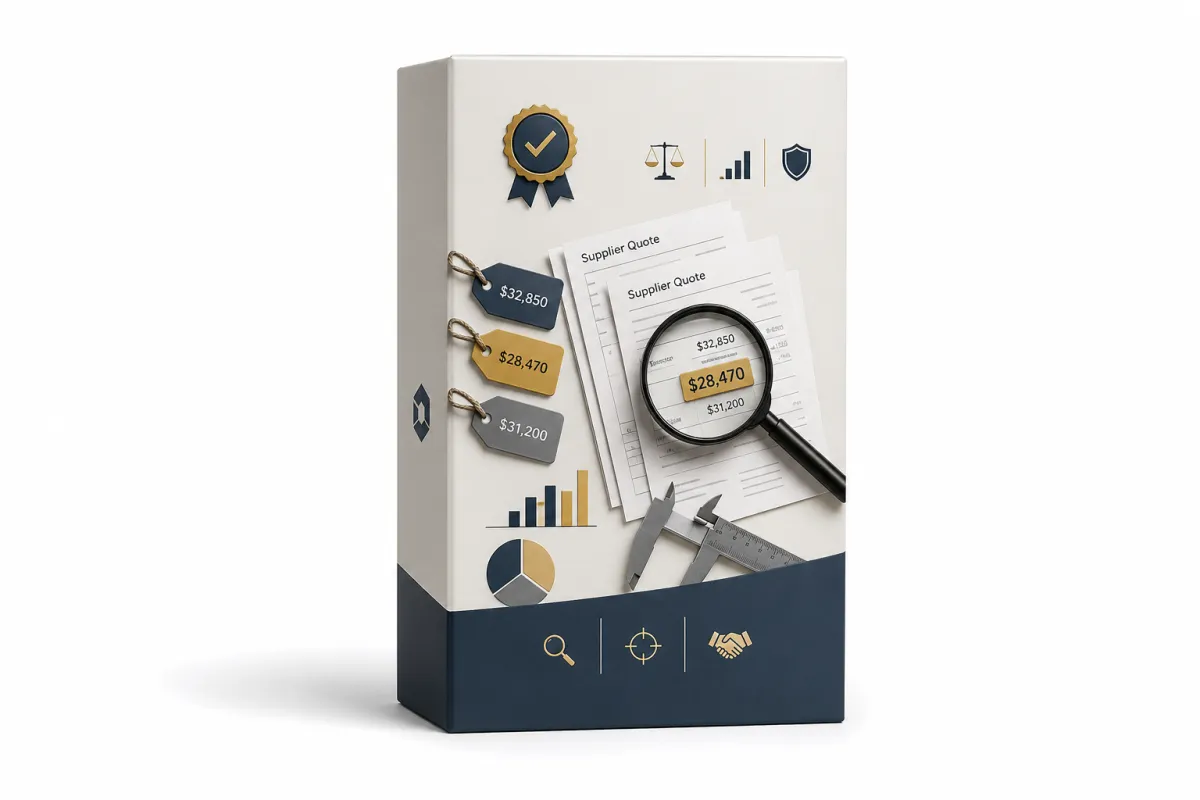
I learned the best ways to benchmark supplier quotes the hard way, standing on a Shenzhen packing line with two quote sheets that looked almost identical until one vendor had quietly excluded insert tooling. I still remember staring at those sheets like they were trying to prank me. The price gap was only $0.08 per unit on paper, yet once I added the missing die charge, the extra proof round, and the insert labor for 5,000 pieces, the "cheaper" quote turned into a real margin problem of more than $400.
That is the trap. Suppliers know how to make numbers look comparable while hiding different assumptions under the hood. One quote might include 500 sample units, another might exclude export cartons, and a third might bury freight in a vague line that says "to be confirmed" for a shipment leaving Ningbo or Yantian. Honestly, I think half the pain in purchasing comes from reading between the lines when the lines were never written clearly in the first place. The best ways to benchmark supplier quotes start with one boring but necessary step: normalize the scope before you compare the price.
I have seen buyers get pulled into a false race to the bottom because they focused on unit cost first and asked questions later. Then the corrections started. One more proof. One more carton spec. A revised insert size from 68 mm to 72 mm. Suddenly the quote that looked $0.05 cheaper was $300 more expensive on a 5,000-piece run. I have a soft spot for clean math, and this kind of messy math makes my eye twitch a little. The best ways to benchmark supplier quotes are not glamorous, but they save money where it actually matters.
Most quote comparisons fail because people compare sales language instead of manufacturing reality. A rep writes "all-in pricing," but that often means "all-in except for the things you care about," like foil plates, pallet wrap, or inland trucking from Dongguan to Shenzhen port. Hidden setup fees, vague MOQs, inconsistent spec sheets, and fake all-in pricing are the usual suspects. The best ways to benchmark supplier quotes keep all of that in the open, where it belongs. If a supplier has to explain the quote three different ways, the quote probably was not ready to send in the first place.
"The cheapest quote was the most expensive mistake I made."
I heard that from a buyer in Chicago after we rebuilt his carton order from scratch. He had 8,000 units of a folding box, 350gsm C1S artboard, and a soft-touch lamination finish, but the first supplier had quoted the inserts separately, while the second had not. The buyer thought he was saving $520. He was not. That is why the best ways to benchmark supplier quotes start with scope, not pride. Pride is a terrible budgeting tool, and I say that as someone who has watched more than one project get kneecapped by it.
And if you are wondering whether the difference is ever really that big, yes, it absolutely can be. I have seen a quote that looked tidy on a PDF turn into a mess once the client added a custom foam insert, a revised sleeve length, and carton dividers for shipping. The whole thing went from "fine" to "why is finance calling me?" in a matter of hours. That is the kind of mistake that makes a grown buyer mutter under their breath, and I have done a little of that myself.
What are the best ways to benchmark supplier quotes?
The best ways to benchmark supplier quotes start with one simple move: compare identical scope, not similar-sounding sales language. If two suppliers are quoting the same rigid box, mailer, or display carton, the materials, dimensions, finish, packaging format, and delivery terms need to match line by line. Otherwise the comparison is a mirage, and the lowest number may only be the quote with the fewest inclusions.
I like to think of it as building a clean comparison grid before the spreadsheets start arguing back. A quote comparison sheet that captures unit price, tooling, sampling, freight, MOQ, lead time, payment terms, and exclusions gives you a fair baseline. The best ways to benchmark supplier quotes are not about squeezing every vendor into the same answer; they are about making sure each answer was built on the same question.
That is where landed cost enters the picture. A factory price can look fine until freight, duties, domestic trucking, and packaging add-ons are folded in. On a small packaging run, those extras can shift the real cost by hundreds of dollars. The best ways to benchmark supplier quotes keep the full order economics visible from the start, because a low factory price is not very useful if the shipment lands late, damaged, or too expensive to store.
If you want the cleanest comparison, ask every supplier to respond to the same spec sheet in the same format. One source of truth removes a lot of noise. It also forces the vendor to state what is included, what is excluded, and where the assumptions sit. That kind of discipline is one of the best ways to benchmark supplier quotes because it turns a sales pitch into a manufacturing conversation.
I have also found that a supplier’s response style tells you a lot about their process. If they answer with clean itemization, clear assumptions, and realistic timing, they usually run a tighter shop. If they answer with five vague bullets and a smiley face, I know I am gonna spend extra time pulling the truth out of the details. That is not a perfect science, but it is a useful read on the room.
What to compare in supplier quotes before you look at price
One of the best ways to benchmark supplier quotes is to rebuild every line into the same structure. I use the same categories every time: product type, materials, dimensions, printing method, packaging format, testing, and service level. If those pieces do not match, the price is just a number with no context. A quote without context is basically a cocktail napkin with ambition, even if it comes from a polished sales team in Guangdong.
For a rigid box, a mailer, and a display carton, the sales sheet may all say "custom packaging," but that phrase covers wildly different assumptions. A mailer can be printed on E-flute board with one-color flexo, while a premium setup box can use 1200gsm grayboard wrapped in 157gsm art paper with foil stamping and an EVA insert. The best ways to benchmark supplier quotes depend on comparing the same scope, not the same product name. I remember one buyer insisting two boxes were "basically the same" because they were both square. They were as similar as a bicycle and a pickup truck.
I keep a quote comparison sheet with columns for unit price, tooling, sampling, freight, MOQ, lead time, payment terms, and exclusions. That sheet sounds simple because it is. The hard part is forcing every supplier to answer the same questions in the same order, whether they are in Foshan, Wenzhou, or a small shop outside Suzhou. One of the best ways to benchmark supplier quotes is to make the vendors do the organizing for you, because memory is a terrible spreadsheet. And yes, I have learned that one more than once, usually at 10:30 p.m. with too much coffee.
The most common missing items are always the same: artwork prep, plates, dies, sampling, packaging inserts, export cartons, and domestic trucking to the port. On one order for a cosmetic rigid box, a supplier quoted $0.62 per unit and forgot to mention the $140 die charge plus $210 for a pre-production sample. The best ways to benchmark supplier quotes catch those misses before they become excuses. If a line item appears only after you ask about it, it was never really "included."
During a visit to a factory in Dongguan, a sales manager tried to compare a folding carton quote against a rigid box quote as if both were interchangeable. They were not. Different machine, different waste rate, different packing method, different freight cube, and a very different labor path on the assembly table. The best ways to benchmark supplier quotes demand that you ask one blunt question: "What exactly is included, and what is excluded?" That question saves me more time than any polished procurement template ever has.
If you want cleaner comparisons, use a short checklist before you ever ask for pricing:
- Exact product type: mailer, folding carton, rigid setup box, sleeve, or display tray.
- Exact materials: 350gsm C1S, 1200gsm grayboard, E-flute, or FSC-certified board.
- Exact finish: matte lamination, gloss varnish, soft-touch, foil, embossing, or spot UV.
- Exact quantity: 2,000, 5,000, 10,000, or a test run of 500.
- Exact delivery terms: EXW, FOB, or DDP, plus who pays the freight from Shenzhen or Ningbo.
That checklist is one of the best ways to benchmark supplier quotes because it strips away sales spin and leaves you with facts. If a vendor cannot quote from a line-item spec sheet, the quote is not ready to trust. I would rather get a slow, accurate quote than a fast, fuzzy one that needs a cleanup crew afterward.
For packaging performance, I also ask whether the supplier has tested similar structures against ISTA protocols, especially ISTA 3A for parcel distribution. If the box has to survive a courier network from Guangzhou to Chicago, a pretty render does not matter much. The best ways to benchmark supplier quotes always include the question nobody wants to answer: how will this hold up after transit, stacking, and a rough drop from 30 inches? I have seen beautiful boxes arrive looking like they lost a fight with a forklift. Nobody needs that kind of surprise.
There is also a practical reason to compare the physical build before the price: once production starts, changes get expensive fast. A different board grade can alter the crease line, a heavier paper wrap can change machine setup, and a deeper insert pocket can slow the assembly team down by a surprising amount. That is not drama; that is just how paperboard behaves on a real line with real people and real tolerances.
Specifications that make supplier quotes comparable
The best ways to benchmark supplier quotes depend on one annoying truth: small spec changes can swing cost, durability, and lead time at the same time. A 1 mm shift in board thickness can alter crease performance. A different laminate can change scuff resistance. A tighter print tolerance can add make-ready waste on a press run in Dongguan or Kunshan. The supplier is not always being difficult; sometimes the spec really does require a different production path. I wish that were less true, but packaging has a way of making tiny choices expensive.
I have watched two samples that looked nearly identical on a white table behave very differently under load. One used 1.5 mm grayboard, the other 1.8 mm. The thicker board raised cost by $0.06 per unit and increased assembly time by several minutes per dozen because the wraps pulled tighter at the corners. The best ways to benchmark supplier quotes include those physical realities, not just the carton drawing. I still remember the client saying, "They look the same to me," while the corner panels were clearly not doing the same job.
To make quotes comparable, I insist on written confirmation for dielines, artwork file requirements, sample format, and approval stage. If the supplier wants a PDF proof, an Adobe Illustrator file, or a printed hard sample before production, I want that in writing. The best ways to benchmark supplier quotes are the ones that remove interpretation. Translation is where a lot of money disappears. A little ambiguity can turn into a very expensive game of telephone.
I also like to define the closure style and fit method in plain language. Magnetic flap, tuck-top, lift-off lid, drawer slide, or auto-lock bottom all behave differently in production. A box with a hidden magnet can cost $0.18 more per unit than a straight tuck design on a 5,000-piece order, especially if the magnet is 10 mm x 2 mm and needs a hand-set process. That is not a small detail. That is the whole margin story for some brands. Honestly, I think closure style is one of those specs people underestimate until the sample arrives and everyone goes quiet for a minute.
One of my ugliest quote disputes came from a supplier who swapped the outer wrap paper without saying a word. The replacement looked close enough in a screenshot, but the texture and stiffness were off, and the client noticed as soon as the first carton sample came out. I now write material substitution language into every quote review. The best ways to benchmark supplier quotes protect against surprise changes with approved samples and explicit sign-off. I would rather sound picky than re-explain a failed order to a frustrated brand manager.
For brands that care about sustainability, ask for FSC certification details and chain-of-custody proof, not just a logo slapped onto the email. The FSC standard is useful only if the supply chain can actually support it. I have seen more than one supplier claim "FSC available" and then stall for a week while they hunted for the certificate number, usually because the paper mill was in Zhejiang and the paperwork sat in a different folder. The best ways to benchmark supplier quotes ask for proof, not promises. Otherwise you are basically buying a logo-shaped hope.
Here is the short version of what needs to match exactly before you compare prices:
- Substrate: board grade, paper weight, or flute type.
- Thickness: 350gsm, 400gsm, 1.5 mm, 1.8 mm, or whatever the structure needs.
- Coating and finish: gloss, matte, soft-touch, AQ, UV, foil, or embossing.
- Color count: 1C, 2C, 4C, or PMS spot colors.
- Tolerances: fold accuracy, print registration, and insert fit.
- Closure style: tuck, magnet, sleeve, drawer, or tab lock.
The best ways to benchmark supplier quotes get much easier when these details are locked. Without them, one quote might price a standard dieline while another prices a custom engineered rebuild. That is not a comparison. That is a guessing contest with invoices, and I have no interest in paying for a guessing contest.
There is a second layer here too: the production line itself. A tight tolerance on a drawer box can force slower assembly. A foil-stamped panel may require a separate pass. A coated paper stock may need extra drying time before folding. Those are not little footnotes. They are the stuff quotes are made of, whether the salesperson mentions them or not.
Best ways to benchmark supplier quotes on price, MOQ, and freight
The best ways to benchmark supplier quotes on price are useless if you ignore MOQ, tooling, and freight. I once reviewed a set of box quotes where Supplier A looked unbeatable at $0.42 per unit, but the MOQ was 10,000 and the die charge was $250. Supplier B was $0.48 per unit with a 2,000-piece MOQ, no die charge, and a smaller carton pack-out. On a 3,000-piece buy, Supplier B was the better deal by a wide margin. I remember the client blinking at the spreadsheet like it had betrayed him personally.
Landed cost matters here. Add production price, freight, duties, packaging, warehousing, and any rush charges before the product is usable. If you are paying $380 for ocean freight, $120 for domestic delivery, and $90 for import handling, then the quote is not really a unit quote anymore. It is a landed-cost question. The best ways to benchmark supplier quotes treat the shipment as a full system, not a factory-only number. If the cartons cannot reach your warehouse affordably, the factory price is just a decoration.
Here is a simple comparison I use with clients who are evaluating two or three packaging vendors:
| Supplier | Unit Price | MOQ | Setup / Tooling | Freight | Lead Time | What It Really Means |
|---|---|---|---|---|---|---|
| Supplier A | $0.42 | 10,000 | $250 die charge | Separate quote, usually $480 to $620 | 18 business days | Best only if you need a full run and can carry inventory |
| Supplier B | $0.48 | 2,000 | Included | $520 estimated to your port | 14 business days | Better for tighter cash flow and lower storage risk |
| Supplier C | $0.51 | 5,000 | $120 sampling fee credited on order | $390 with consolidated shipping | 12 business days | Best if speed matters more than the lowest sticker price |
The table looks dry, but it is one of the best ways to benchmark supplier quotes because it exposes what the headline price hides. I have seen a $0.03 unit difference become a $1,200 swing once freight, sample fees, and storage got counted. Nobody likes that surprise. The best ways to benchmark supplier quotes should always start with landed cost, not wishful thinking. Wishful thinking is useful for birthdays, not purchase orders.
MOQ changes the real comparison more than buyers expect. A supplier at $0.42 with a 10,000-piece minimum may be worse than a supplier at $0.48 with a 2,000-piece minimum if you only need 3,000 units. I have watched brands overbuy packaging just to "earn" a lower unit rate, then sit on cartons for nine months while their product line changed twice. The best ways to benchmark supplier quotes protect cash, not just vanity metrics. Storage fees have a sneaky way of becoming the forgotten villain in the story.
Payment terms matter too. If one supplier wants a 50% deposit and the balance before shipment, while another offers 30% down and 70% after inspection, that changes the economics. Net 30 can help if you have cash discipline, but it can also create hidden risk if the supplier inflates the quote to cover carrying costs. The best ways to benchmark supplier quotes include asking how the price changes with staged shipments or better terms. A decent supplier will answer that without making it sound like a hostage negotiation.
I had a freight negotiation with a supplier in Ningbo where the quoted ocean rate jumped by $180 after the booking window slipped three days. Nothing was wrong with the box. The delay came from an unapproved artwork revision, and the freight desk simply repriced the space. That is why the best ways to benchmark supplier quotes include a blunt check on who owns the schedule, who books the space, and who eats the rush fee if the timing moves. I am not especially fond of surprises with dollar signs attached, and I suspect you are not either.
My rule is simple: if a quote is much lower than the others, look for what was left out before you celebrate. Missing sampling, missing export cartons, missing palletizing, missing domestic delivery, or a tiny "TBD" on freight can all turn a low quote into an expensive one. The best ways to benchmark supplier quotes are rarely the cheapest-looking ones. They are the cleanest ones, the ones that make you nod instead of squint.
Another thing I check is whether the supplier is quoting from actual carrier behavior or just guessing off a chart. A carton that ships fine by ocean freight can still get punished by local drayage, warehouse receiving rules, or a last-minute transload. Those little charges do not sound dramatic, but they stack up fast, and then everybody acts surprised. I would rather see a quote that admits uncertainty than one that pretends freight is a fixed object in space.
Process and timeline: benchmark supplier quotes against real deadlines
The best ways to benchmark supplier quotes go beyond dollars. Timeline is part of the deal. Map the full path from quote to delivery: sampling, revisions, production slot, inspection, packing, export booking, and transit time. If one supplier says 12 to 15 business days from proof approval and another says 18 to 20, that matters more than a $0.02 price gap when a launch date is already fixed. I have seen projects get rescued by a faster factory and sunk by a cheaper one that moved like molasses.
I learned that lesson during a client meeting for a subscription box launch. One supplier quoted lower, but the production slot was three weeks out because their line was loaded with a 50,000-piece cosmetics order. The higher quote had space immediately and could ship two weeks earlier. The launch sold out in the first weekend. The best ways to benchmark supplier quotes sometimes favor the vendor with the calendar advantage, not the lower number. Timing has a funny way of becoming the real price.
Ask what happens if approvals slip by three days. That question usually separates the organized suppliers from the optimistic ones. A serious factory will tell you whether the press can hold, whether the finishing line can absorb a delay, and whether the shipping booking can be moved without a penalty. The best ways to benchmark supplier quotes are the ones that ask for contingencies, not fairy tales. I trust factories that can talk through setbacks more than the ones that promise perfection with a grin.
I also score vendors on responsiveness because a slow quote usually becomes a slow production cycle. If a supplier takes 48 hours to answer a basic question about board thickness, I assume the same delay will show up when I need a revised dieline or a corrected invoice. That is not always the case, but it is common enough to matter. The best ways to benchmark supplier quotes track response time, because communication is part of production quality. A quote is only as good as the speed at which people can fix it.
For shipping-sensitive projects, I ask whether the packaging has been tested against parcel abuse or stack pressure. A box that survives a pretty photo shoot can still fail in transit. If you want a stronger benchmark, pair the quote review with a quick check against standards like ASTM D4169, then confirm the supplier knows the test profile, not just the acronym. The best ways to benchmark supplier quotes treat performance as real, measurable risk. I have no patience for a supplier who can say "tested" but cannot say what happened during the test.
Deadlines deserve a checklist, and I keep it short:
- Weekends and holidays: factory shutdowns can add 2 to 7 days without warning.
- Customs hold times: a held carton shipment can sit 24 to 72 hours before release.
- Inspection windows: third-party checks need 1 to 2 business days of lead time.
- Air-freight backup: useful, but often adds $1.20 to $3.50 per unit on smaller packaging jobs.
The best ways to benchmark supplier quotes become sharper when you price time like money, because that is what it is. If a missed delivery costs you a launch slot, retail placement, or ad spend, then the "cheap" supplier was never cheap. They were just late with confidence. I have met more than a few of those, and confidence does not pay freight bills.
One more practical point: ask for the critical path in writing. I want to know when the art proof is due, when the first sample is due, when production starts, and who is on the hook if the schedule slips. That does not make the supplier nervous; it makes the job easier. Clear timing is boring right up until it saves a launch.
Why choose us when you benchmark supplier quotes
At Custom Logo Things, we send quotes the way buyers actually need them: clear inclusions, clear exclusions, and no mystery math. That is one of the best ways to benchmark supplier quotes from our side of the table, because I have sat through enough supplier negotiations to know that vague numbers waste everybody's time. If the quote says 350gsm C1S artboard, matte lamination, and a 1,000-piece MOQ, that is exactly what the factory is pricing. No smoke, no mirror tricks, no surprise little asterisks hiding in the corner.
Real supplier relationships help tighten pricing and reduce waste. I have negotiated enough carton runs to know that a factory will often sharpen a price by $0.02 to $0.04 per unit when the spec is stable, the art files are clean, and the shipping plan is clear. It is not magic. It is less rework. The best ways to benchmark supplier quotes usually favor the vendor who asks smart questions early instead of apologizing late. I like a supplier who spots a missing bleed before it turns into a production headache.
One client came to us with three quotes for a rigid box set. The lowest was $0.39 per unit, but the insert was missing, the lamination was not specified, and the freight line was blank. We rebuilt the scope, added the insert, standardized the proof stage, and the real comparison landed at $0.44, $0.47, and $0.50. The best ways to benchmark supplier quotes are the ones that make the real numbers impossible to hide. That kind of clarity can feel a little brutal, but it beats getting surprised later.
Our process is straightforward: confirm specs first, then quote, then sample, then lock production. That sequence sounds basic because it is. It is also how you stop a cheap-looking sheet from becoming a bad purchase order. If you want a second set of eyes on a confusing quote, use our Contact Us page and send the spec sheet, quantity, and delivery target. The best ways to benchmark supplier quotes are easier when somebody who lives in packaging can read the details with you. I have always preferred plain language over fancy assumptions.
I also prefer to discuss the risk points before money changes hands. If the job needs foil, embossing, a tight fit, or a retail shelf look that cannot tolerate a crooked crease, I will say so. That honesty can save a client from reprints that cost $800 or more on a small run. The best ways to benchmark supplier quotes are not about pushing the prettiest number. They are about buying the least expensive path to a usable result. That is a much less glamorous pitch, but it is the one that keeps projects sane.
If you want to compare us fairly against another supplier, send the same spec sheet to all of us and keep the format identical. That is the cleanest test. The best ways to benchmark supplier quotes only work when every vendor is answering the same question. If you want help writing that question, I would start with our Contact Us page and ask for a quote review before you commit to a PO. I cannot promise the spreadsheet will become exciting, but I can promise it will become clearer.
I have also found that buyers appreciate it when we say "we do not know yet" instead of pretending every detail is settled. If a paper mill has a stock issue, if a magnet size needs a sample check, or if freight is moving around because of port congestion, I would rather say that directly than dress it up. Trust is built in those tiny moments, not in the polished language on a quote sheet.
Next steps after you benchmark supplier quotes
After you gather three quotes, strip out the noise and rebuild them into one comparison sheet with unit cost, setup, MOQ, freight, and lead time. That single sheet is one of the best ways to benchmark supplier quotes because it gives you a clean view of the tradeoffs in front of you. If the numbers still do not line up, the scope is not settled yet. I would rather slow down for one more round of clarity than charge ahead and regret it later.
Then send every supplier the same revised spec sheet. I cannot stress that enough. If Supplier A got the old dieline, Supplier B got the new board thickness, and Supplier C never saw the updated insert drawing, the comparison is already broken. The best ways to benchmark supplier quotes are repeatable, and repeatability starts with one source of truth. I have seen teams accidentally compare three different versions of the same project and then wonder why the answers were nonsense.
If the product has any print, finish, or fit risk, request one pre-production sample or an approved reference sample before you place the order. On a 5,000-piece packaging run, a sample that costs $45 can save you from a $900 reprint. That is not a theory. That is a Tuesday I have seen more than once, usually with a box coming from a factory in Guangdong and a deadline on Friday. The best ways to benchmark supplier quotes include one small investment in proofing before the larger spend locks in. A tiny bit of caution up front is much cheaper than a pallet of regrets.
My closing advice is plain: pick the winner based on landed cost, timeline, and execution risk, not on the lowest headline line item. If one supplier is $0.03 higher but ships five days earlier, includes the die, and answers in under 12 hours, that often wins. The best ways to benchmark supplier quotes point you toward the supplier who will deliver the product you can actually use, not just the number you wanted to see. Honestly, that is the kind of decision that keeps a project calm.
Before you approve the PO, do one final pass with the same three questions: what is included, what is excluded, and what happens if the schedule shifts. If those answers are clean, you are probably making the right call. If they are fuzzy, the quote is not ready yet. That simple check is still the best safeguard I know, and it has saved me from more than a few expensive headaches.
If you want a quote review that does not waste your afternoon, send us the spec sheet and the target quantity. I will tell you where the gaps are, what is missing, and which line items are bending the comparison. That is one of the best ways to benchmark supplier quotes before you sign off on an order, and it is usually the step buyers wish they had taken sooner. I have yet to meet the person who regretted catching the problem before the PO was issued.
What are the best ways to benchmark supplier quotes if every vendor formats them differently?
Rebuild every quote into the same line items: unit price, setup, sampling, freight, duties, and payment terms. I do this on a single sheet because the best ways to benchmark supplier quotes are about judging the same scope, not three different sales formats. If a line is vague, ask the supplier to restate it in writing before you compare final numbers. That little bit of discipline saves a lot of back-and-forth later.
How do I compare supplier quotes that have different MOQs?
Calculate the total order cost, not just the unit price, because MOQ changes the real spend. A quote at $0.42 with a 10,000-piece minimum is often worse than a quote at $0.48 with a 2,000-piece minimum if you only need 3,000 units. The best ways to benchmark supplier quotes always compare the quantity you actually plan to buy, not the supplier's ideal run size. I have watched people talk themselves into buying more than they need just to chase a prettier unit price, and it never feels as clever later.
What hidden costs should I check when benchmarking supplier quotes?
Look for tooling, plates, dies, sampling, artwork prep, packaging inserts, freight, duties, and rush fees. I also check whether the quote includes export cartons, palletizing, and domestic delivery to the warehouse. The best ways to benchmark supplier quotes include a written list of exclusions, because "not included" is where most budgets get surprised. If you have ever had a quote turn into a scavenger hunt, you already know why this matters.
Is the lowest quote usually the best supplier choice?
No, not if it leaves out critical items or creates delays that cost more than the savings. Compare reliability, lead time, and quality risk alongside price. A quote that is $0.05 higher can still win if it avoids rework, missed launches, or freight surprises. The best ways to benchmark supplier quotes are built around total value, not the cheapest headline number. I would take a boring, accurate quote over a flashy one that falls apart under scrutiny.
How many quotes should I get before I decide?
Three solid quotes are usually enough to spot outliers and identify a fair market range. More than three can slow the decision without adding much clarity unless the project is unusually complex. The best ways to benchmark supplier quotes depend on consistency: one clean spec sheet, sent to all suppliers, with no drifting requirements and no hidden add-ons. If the scope keeps moving, the comparison keeps lying to you.
Should I compare supplier quotes before or after sample approval?
Do the first comparison before samples, then confirm the winner after you have a physical sample or approved reference piece in hand. That gives you the best of both worlds: early pricing visibility and a real check on fit, finish, and build quality. The best ways to benchmark supplier quotes treat sampling as part of the decision, not as an afterthought. A nice-looking quote can still hide a shaky build, and a sample is where that gets exposed.
If you want a final pass before ordering, send the files, the quantity, and the delivery target through our Contact Us page. The best ways to benchmark supplier quotes are simple once the scope is clean, the exclusions are clear, and the landed cost is in front of you. That is how I would run the comparison, and frankly, that is how I still run it when the money is real. I have no interest in guessing with someone else's budget.


