Buyer Fit Snapshot
| Best fit | Biodegradable Mailer Boxes for Small Business projects where brand print, material claims, artwork control, MOQ, and repeat-order consistency need to be specified before quoting. |
|---|---|
| Quote inputs | Share finished size, material target, print colors, finish, packing count, annual reorder estimate, ship-to region, and any compliance wording. |
| Proofing check | Approve dieline scale, logo placement, barcode or warning zones, color tolerance, closure strength, and carton packing before bulk production. |
| Main risk | Vague material claims, crowded artwork, missing packing details, or unclear freight terms can make a low unit price expensive after revisions. |
Fast answer: Biodegradable Mailer Boxes for Small Business: Board, Finish, Dieline, and Unit Cost should be specified like a repeatable production item. The safest quote records material, print method, finish, artwork proof, packing count, and reorder notes in one written spec.
Production checks before approval
Compare the actual filled-product size with the drawing, then confirm tolerance on folds, seals, hang holes, label areas, and retail display edges. Reserve space for logos, QR codes, warning copy, and material claims before decorative graphics fill the panel.
Quote comparison points
Review material grade, print process, finish, sampling route, tooling charges, carton quantity, and freight assumptions side by side. A quote is only useful when the supplier can repeat the same color, closure quality, and packing count on the next order.
Biodegradable Mailer Boxes for Small Business: Branding Tips That Hold Up in Transit
A single box carries more weight than most founders expect. It has to survive courier handling, photograph well on a phone, open cleanly, and tell a customer something real about the brand before the product even appears. That is a tall order for cardboard, and it is exactly why biodegradable Mailer Boxes for Small business deserve a closer look than a generic green badge in the corner. A box can raise perceived value, reduce damage, and make the whole unboxing feel deliberate instead of improvised.
Packaging buyers often make the same early mistake: they chase the eco label and skip the operational details. The better question is whether the box fits the product, the route, and the budget without stretching the truth past what the supplier can prove. Biodegradable mailer Boxes for Small business sit in that narrow middle ground. They are more brand-forward than a plain poly mailer, usually less fussy than a rigid gift box, and often better suited to e-commerce than a folding carton alone. The appeal is obvious. The details decide whether the purchase actually works.
That is why compostable packaging, corrugated mailers, and Kraft Mailer Boxes should be treated less like marketing phrases and more like operational decisions. A business does not need packaging theory. It needs something that ships, looks good, and does not make the invoice sting for the wrong reasons.
And yes, the wrong box can absolutely cost more than the right one. I have seen a founder save a few cents per unit on packaging, only to burn through that savings in replacements, customer complaints, and the second shipment that should never have been necessary.
What Biodegradable Mailer Boxes for Small Business Really Mean
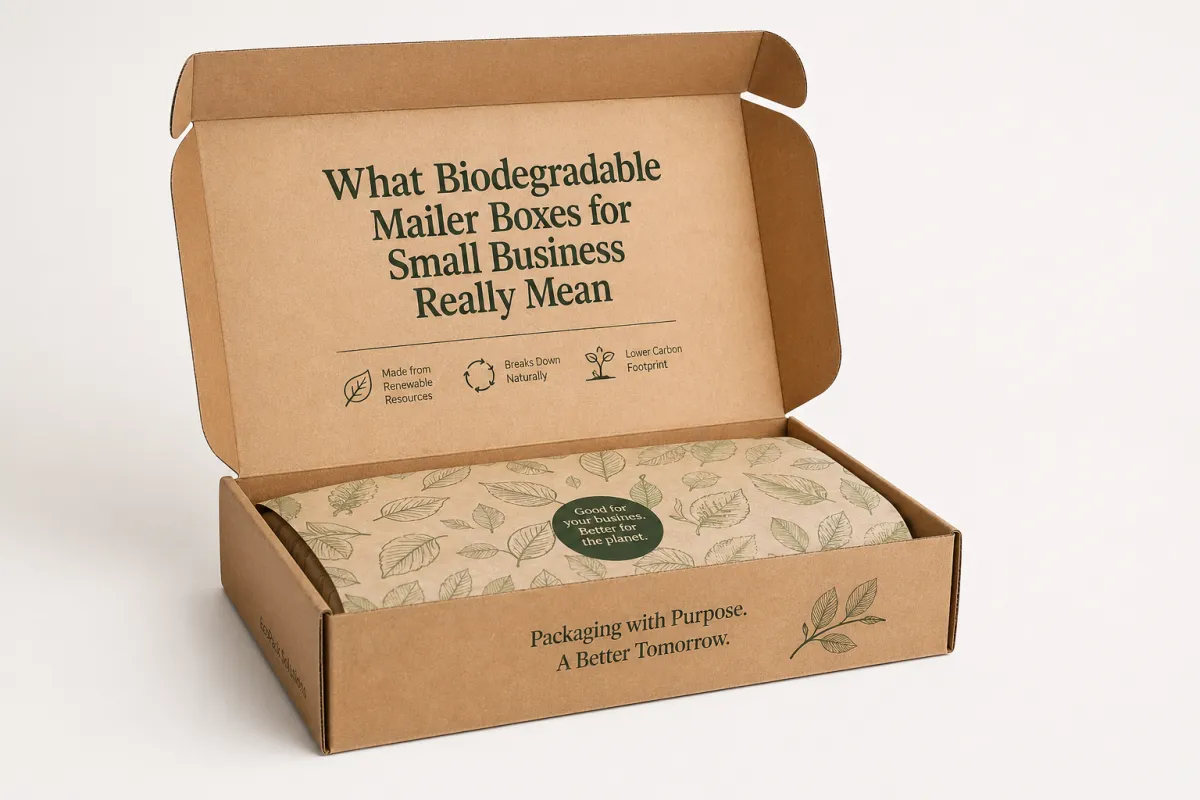
Biodegradable mailer boxes for small business sound straightforward until someone asks what, exactly, is biodegradable. The answer depends on the board, ink, coating, adhesive, label stock, and the conditions at disposal. A corrugated box made from fiber-based material may break down over time, but that does not mean every component behaves the same way or disappears on the same schedule.
That distinction matters because packaging language often runs ahead of reality. A box described as biodegradable may still be better recycled in many regions. Add plastic tape, a glossy film, or a moisture barrier that clashes with the claim, and the story changes fast. A good supplier should be able to explain whether the structure is biodegradable, recyclable, home compostable, or intended for industrial composting. Those are not close cousins. They are different disposal paths with different rules and different levels of proof.
There is also a design problem hiding under the sustainability message. Biodegradable mailer boxes for small business are often chosen because they must do more than carry a product. They need to protect a candle tin, a skincare set, an apparel bundle, or a subscription kit while shaping how the customer experiences the brand. That separates them from a poly mailer. A poly mailer can be lighter and cheaper, but it rarely delivers the same shelf-like, giftable feel. A folding carton can print beautifully, yet it often needs outer packaging for e-commerce. A rigid box sends a luxury signal, though it can be too much for a business shipping hundreds or thousands of orders each month.
From a branding point of view, biodegradable mailer boxes for small business work because they are practical and memorable at the same time. The structure is visible before the product appears. The closure flap, the print treatment, and even the natural texture of kraft board shape the first impression. Brands notice this in repeat orders and on social media. People share Packaging That Feels deliberate. They rarely share packaging that feels like a last-minute fix.
If the package feels flimsy in hand, the brand promise starts leaking at the doorstep.
That is the part many founders miss. The environmental story is only one layer. The bigger question is whether biodegradable mailer boxes for small business support the product, the brand, and the fulfillment operation at once. When they do, the box becomes an asset instead of a line item that looks good only in a pitch deck.
How Biodegradable Mailer Boxes for Small Business Break Down
Biodegradable mailer boxes for small business are made from a stack of materials and decisions, not one magical ingredient. The base is usually corrugated fiberboard, often with recycled content. That is the structural layer. On top of it, you may see water-based inks, aqueous coatings, paper-based labels, and a closure system that stays inside the same environmental story. Each choice changes the end-of-life outcome.
Corrugated board deserves special attention because it offers strength relative to weight. In packaging terms, that is efficiency. A business does not want to pay freight on dead weight. Many mailer styles use E-flute or B-flute corrugation depending on product size and fragility. E-flute gives a smoother print surface and a lower profile. B-flute adds more cushioning and often handles heavier contents better. Neither is automatically better. The right option depends on compression risk, stacking, and the distance the box has to travel.
Biodegradable mailer boxes for small business also live inside a vocabulary problem. Biodegradable means material can break down through biological activity over time. Compostable means it breaks down under defined composting conditions and leaves a specific residue profile. Home compostable is a stronger claim than industrial compostable, because the conditions are less controlled and usually less intense. Recyclable is different again; it refers to a material stream that can be collected, sorted, and turned into new fiber or product. A box can be one of these, several of these, or none of them depending on its full construction.
If a supplier cannot explain the difference in plain language, that is a warning sign. The claim has to cover the whole packaging system, not just the outer shell. Printed surfaces, adhesives, interior inserts, stickers, and tape all count. Some brands choose simple fiber-based construction and avoid heavy coatings because the story stays cleaner. Others add a moisture-resistant barrier because the shipping route demands it. Both choices can be valid. Neither should happen by accident.
Performance tradeoffs are real. A more moisture-resistant coating can help a box survive humid warehouses or summer transit, but it may slow breakdown or reduce recyclability. A thicker board improves crush resistance, but it raises material cost and can add weight. A paper-based insert can look cleaner than foam, yet it may not hold delicate products securely unless the dieline is tuned properly. The best biodegradable mailer boxes for small business are the ones where those tradeoffs are understood before production begins.
I learned that lesson watching a skincare brand move from a thin, heavily printed carton to a simpler corrugated mailer with a paper insert. The first version looked prettier in a mockup, sure. But the second version cut down on scuffed jars and saved the packing team from babysitting every order. Pretty matters. So does the part where the box actually gets across town without a fight.
Testing turns the conversation from theory into reality. A supplier should be able to discuss:
- Crush resistance for stack pressure in transit or storage.
- Drop testing for corner and edge impacts during carrier handling.
- Humidity exposure if the route includes wet climates or unconditioned warehouses.
- Stackability for palletized storage, retail backstock, or fulfillment carts.
For transit performance, it helps to look at packaging guidance from groups such as ISTA transit-testing standards. For disposal and recycling language, the EPA's recycling guidance at EPA recycling resources is a useful baseline. Neither source replaces supplier documentation, but both keep the discussion anchored in something firmer than marketing adjectives.
One more nuance: FSC certification speaks to responsible fiber sourcing, not compostability. So if a supplier mentions FSC, that is a sourcing signal, not a disposal guarantee. Good brands keep those ideas separate and use them carefully. Biodegradable mailer boxes for small business work best when fiber source, print system, and handling performance all point in the same direction.
Biodegradable Mailer Boxes for Small Business Cost and Pricing
Price is where enthusiasm gets tested. Biodegradable mailer boxes for small business often cost more per unit than off-the-shelf mailers, but that comparison misses the larger picture if it ignores brand effect, damage rates, and freight behavior. The real question is landed cost, not just quote cost. A box that protects better may save money in returns. A tighter size may reduce void fill. A more compact structure may lower dimensional weight charges.
The biggest pricing drivers are predictable: box size, board thickness, print coverage, number of colors, finish, inserts, and die-cut complexity. A simple kraft mailer with one-color print is usually the cheapest branded option. Full-coverage print, special coatings, or intricate inserts push cost up quickly. In small orders, setup fees and proofing can make the first run look expensive because those fixed costs are spread across fewer units.
In many programs, a 500-unit order can carry a noticeably higher unit price than a 5,000-unit order. A common pattern is a 15% to 30% reduction in unit cost when volume rises, though the exact gap depends on the supplier and the print specification. That is why biodegradable mailer boxes for small business should be priced as a system. If the box removes the need for an outer shipper, lowers product damage, or lets a brand skip a separate gift insert, the net cost picture can improve.
| Option | Typical Unit Cost | Best For | Main Tradeoff |
|---|---|---|---|
| Blank stock mailer | $0.45-$0.85 | Fast launch, low branding needs | Least distinctive unboxing |
| One-color custom print | $0.65-$1.20 | Most small brands | Moderate setup and artwork prep |
| Full custom branded run | $0.95-$2.40+ | Premium presentation, subscription kits | Higher setup, more scrutiny on proofs |
| Custom box with insert | $1.20-$3.20+ | Fragile or bundled products | More material and longer approval cycle |
Those ranges are not universal, and they should not be treated like a quote. A 4 x 4 x 2 inch mailer and a 10 x 8 x 4 inch mailer live in different cost worlds. Print coverage matters too. A box that uses a single brand mark on kraft board will almost always price differently from one that uses a full bleed design with tight registration. Board grade shifts the math as well. A heavier flute or higher recycled-content sheet can move the price in either direction depending on market conditions.
Hidden costs deserve equal attention. Freight is the obvious one, especially when the box volume is large relative to order value. There are also sample rounds, storage space, spoilage from over-ordering, and the cost of a launch delay when packaging is not ready. A business that runs out of boxes mid-campaign can lose more money in missed sales than it saved by ordering too cautiously. That is why biodegradable mailer boxes for small business should be evaluated against cash flow and launch risk together.
It also helps to compare the box decision with other packaging options. If the product is light and not fragile, a Custom Poly Mailer can still be a practical benchmark. For heavier or more giftable products, a corrugated mailer can save enough on void fill and damage to justify the higher unit price. The right answer is often not "cheapest box," but "lowest total packaging burden." A small business can explore those tradeoffs through Custom Packaging Products and compare them against simpler formats such as Custom Poly Mailers.
Biodegradable mailer boxes for small business are easiest to judge after four questions: how much do they cost, how much do they protect, how long do they take, and what do they replace in the shipping stack? If the answer to the last question is "nothing," the price is harder to defend.
Ordering Timeline: From Dieline to Delivery
Biodegradable mailer boxes for small business do not appear overnight, even when the order looks simple. The process usually starts with a brief, then sizing, then dieline development, then artwork prep, then prototyping, then proof approval, then production, then quality check, then shipment. Every step seems small until one step slips. Then the whole schedule moves.
For a stock-based or lightly customized run, the timeline can be relatively fast. A business that chooses an existing size, modest print coverage, and standard board may see turnaround in roughly 10 to 15 business days after proof approval, depending on the supplier's workload. Fully custom structures or more complex print jobs often need 20 to 35 business days, sometimes longer if the board spec or coating is unusual. That is normal. It does not automatically signal trouble.
What usually slows a job is not the press run. It is the back-and-forth. Late artwork changes, slow approvals, missing dieline dimensions, unavailable board stock, and seasonal congestion all add days. In some cases, a brand loses more time waiting for internal sign-off than the manufacturer spends making the boxes. Biodegradable mailer boxes for small business reward decisive paperwork.
There is also a planning issue many small brands underestimate. Packaging should arrive before the product launch buffer gets tight. If the first shipment is tied to an influencer drop, holiday promo, or retail reset, the boxes need extra lead time. A good rule is to build one safety margin: enough boxes for the launch order, plus enough to cover a late proof or a delayed freight booking. For some brands, that means ordering four to six weeks before the first need date, not two.
The cleanest way to control the timeline is to request the right inputs at the start. That prevents the usual round-trip of "please confirm size," "please confirm print area," and "please confirm closure style." Once those details are clear, biodegradable mailer boxes for small business move faster through production.
- Start with measurements for product, insert, and shipping clearance.
- Approve the structure before final artwork is locked.
- Request a physical sample if the product is fragile, premium, or irregularly shaped.
- Check the proof for logo size, barcode placement, and sustainability language.
- Confirm the freight plan before production ends, not after.
If a supplier offers a prototype, use it. A photo on a screen cannot show how a flap closes, how an insert sits, or how the box holds up under pressure. Real samples also reveal whether the print reads correctly on kraft or recycled surfaces. The goal is not perfection. The goal is avoiding surprises in the first production run. That is where biodegradable mailer boxes for small business earn their keep.
Step-by-Step Setup for Biodegradable Mailer Boxes
The strongest packaging decisions begin with an audit, not a catalog. For biodegradable mailer boxes for small business, that means measuring the product, weighing it, listing every accessory, and checking the shipping distance before choosing a structure. A candle in a glass vessel behaves differently from a clothing bundle or a skincare kit. A box that looks generous in a mockup may be too loose in practice. A box that seems snug on paper may crush the contents once padding is added.
Start by deciding what the box must do first. Is the top priority protection, presentation, or a balance of the two? If protection comes first, board grade and internal fit matter more than a fancy printed interior. If presentation comes first, the surface texture, closure style, and print hierarchy matter more. Most brands land in the middle, and that is usually the healthiest place for biodegradable mailer boxes for small business.
Then request structural samples. Not just one sample, either. Test the mailer with real product, real padding, and the actual packing staff who will build it every day. One person can make a prototype look perfect. Ten people on a shift can reveal whether the closure is fussy or the fold sequence is slow. If the packaging takes too long to assemble, labor cost quietly eats the margin benefit.
The artwork stage is where many small brands overdesign. A mailer does not need every inch of its surface covered in copy. Usually, a clear logo, a concise brand line, and a sensible color system do more than a crowded collage. On kraft or recycled board, strong contrast matters. Dark text on a dark substrate can look muddy. Fine lines can disappear. Heavy ink coverage can also make the box feel less natural, which works against the sustainability message. With biodegradable mailer boxes for small business, restraint often looks more premium than excess.
There is a practical compliance layer too. If the box will carry composting or recycling instructions, those instructions should be accurate and easy to follow. The last thing a brand wants is to tell customers to compost a component that local systems cannot accept. A straightforward disposal note is better than a vague claim. A box can be both honest and appealing.
A useful setup sequence looks like this:
- Measure the product, insert, and finished packed height.
- Choose the main job of the box: protection, presentation, or both.
- Order structural samples and printed proofs.
- Test real product placement and carrier handling.
- Finalize the art with readable copy and restrained branding.
- Set reorder points before the first run is consumed.
That last step matters more than it sounds. Small brands often order once, then forget to create a reordering trigger. A good rule is to keep at least one replenishment window ahead of usage. If the supplier needs two to four weeks after approval, the business should not wait until the last pallet is empty. That is especially true for biodegradable mailer boxes for small business tied to seasonal sales or subscription cycles.
Design restraint is not a compromise; it is often the cleanest way to make recycled or kraft packaging feel intentional.
Set the pilot launch to teach you something useful. Track assembly time, damage rate, customer reaction, and how many boxes survive a realistic shipping route without scuffing or crush marks. A pilot of 100 to 300 units is often enough to expose weak sizing or awkward print placement. After that, scale with confidence instead of assumption. That is the practical value of biodegradable mailer boxes for small business: they are not just a purchase, they are a testable system.
Common Mistakes With Biodegradable Mailer Boxes
The first mistake is treating the word biodegradable as proof by itself. It is not. Biodegradable mailer boxes for small business need verification for board, ink, coating, tape, and inserts. If even one component contradicts the claim, the packaging statement becomes shaky. Claim language should be specific and documented, not hopeful.
The second mistake is poor sizing. Oversized boxes waste material and create a loose pack that invites movement, scuffing, and damage. Undersized boxes can crush product or make fulfillment slower because the operator has to fight the fit every time. Both problems cost money. A packaging audit usually shows that a box can be trimmed by a few millimeters in one direction and still perform, or adjusted with an insert to stop movement without increasing the entire footprint. For biodegradable mailer boxes for small business, small dimensional changes often produce outsized results.
Third, many brands overprint kraft or recycled surfaces. Heavy coverage can flatten the natural texture that makes the box appealing in the first place. High-gloss finishes can also work against the eco story unless they are chosen carefully and explained well. Dark colors can be beautiful, but they need strong contrast and careful registration. Otherwise the print looks dull instead of premium. A box that tries too hard often feels less thoughtful.
Fourth, transit testing gets skipped. A box can survive sitting on a table and still fail after humidity, vibration, and stacking. That is why a supplier should be able to speak about real handling conditions, not only a mockup photo. For products headed across regions or through hot warehouses, test the box with the actual route in mind. Biodegradable mailer boxes for small business are supposed to reduce problems, not create a new round of claims and returns.
Fifth, some brands make sustainability the only message. That approach sounds noble, but customers still need clarity, hierarchy, and a strong unboxing moment. A box can mention recycled content or responsible sourcing without turning into a lecture. The customer should understand what the product is, why the brand exists, and how the packaging fits the experience. The green story should support the brand, not replace it.
There is one more mistake that shows up often in early-stage companies: ordering the same box for every SKU. A lip balm, a candle, and a hoodie do not need the same geometry. The box that works for one category can waste material or leave another product underprotected. Biodegradable mailer boxes for small business work best when the packaging matches the product family instead of forcing one spec across everything.
If the claim matters, keep records. Ask for the material spec, certification documents, print system details, and the recommended disposal wording. Good suppliers can explain whether the board is FSC-certified, how the coating behaves, and whether the structure is better suited to recycling or composting. That paper trail matters if a customer asks a direct question later. So does honesty. Brands that overpromise on sustainability tend to lose trust faster than they gain attention.
The most expensive mistake is not paying too much for a box. It is buying biodegradable mailer boxes for small business that look right in theory but fail in real use.
What Should Small Brands Ask Before Ordering Biodegradable Mailer Boxes for Small Business?
The best questions are direct. What exactly is the board made from? Which components are compostable, recyclable, or neither? Does the coating help with moisture, and what does it do to end-of-life behavior? Can the supplier show a sample that matches the final print and board spec? Those answers matter more than polished sales language.
Small brands should also ask how the box behaves in the real world. Will it hold up in a humid warehouse? Does it resist corner crush during parcel handling? Is the closure fast enough for a small fulfillment team? Biodegradable mailer boxes for small business can look similar on a screen and perform very differently in a packing room.
A second cluster of questions is about the economics. What is the minimum order quantity? How do freight, insert choices, and proof rounds affect landed cost? What happens if artwork changes after the first proof? A cheap quote can become expensive once revisions, storage, and rush freight are added. A careful buyer asks for the total story, not just the front-page price.
Finally, ask about proof. Can the supplier document FSC status, material composition, and any compostability or recycling claims? If not, the brand is being asked to carry risk without evidence. That is a poor trade. Biodegradable mailer boxes for small business should make the brand look credible, not hopeful.
There is a practical branding angle here too. Ask what the box says in a customer’s hands, not just in a render. Does it feel clean and intentional? Does the print read instantly, or does it ask the buyer to work too hard? Good packaging communicates in a second or two. Anything longer and the box is kinda missing the point.
Practical Next Steps for Small Brands
The easiest way to start is with one top-selling SKU or a tight product family. That gives the team a narrow target and keeps the first order manageable. A single best-seller can tell you a lot about sizing, assembly time, and customer response. Once that run proves itself, expand into adjacent products. This staged approach usually beats a big all-at-once rollout for biodegradable mailer boxes for small business.
Keep the design disciplined. A strong logo, one secondary mark, and a restrained color palette often outperform a cluttered surface with too many messages. The box should feel like a packaging system, not a billboard. Texture can do a lot of the work here. Kraft stock, recycled board, and a clean print layout can feel premium precisely because they are not trying to imitate luxury with excess.
Then measure the results after launch. Track damage rates, customer comments, repeat purchase signals, and how often the package shows up in social posts. A small business does not need a giant analytics stack to learn something useful. Even basic order notes can reveal whether the unboxing feels memorable or merely functional. That feedback is especially useful if the brand is comparing biodegradable mailer boxes for small business against poly mailers, folding cartons, or a mixed packaging system.
The next step is simple: request samples, compare landed cost, and test a pilot run before scaling. This is where many brands save themselves a headache. A catalog can show structure. A sample shows reality. The difference between the two is often where the budget gets protected. If a box feels right in hand and ships well in the real world, it earns its place.
It also helps to think about replenishment from day one. Set minimum stock levels, reorder triggers, and a realistic review point after the first production run. If a brand waits until the last carton is used, it usually loses control of timing and freight. That risk is easy to avoid with a little planning. For biodegradable mailer boxes for small business, timing is part of the package.
The strongest packaging choices are rarely the flashiest. They are the ones that calm operations, lower returns, and make the brand easier to trust. That is why biodegradable mailer boxes for small business should be treated as an operating decision, not just a packaging purchase.
Clear takeaway: choose one product, one box spec, and one disposal claim you can document. Test it in real shipping conditions, check the total landed cost, and only then scale the order. That sequence keeps the brand honest and the packaging useful.
FAQs
Are biodegradable mailer boxes for small business actually home compostable?
Only if the supplier clearly states home-compostable materials and every relevant component qualifies too. Many products are only suitable for industrial composting, while some are better recycled instead of composted. Check the board, inks, tapes, labels, and inserts before putting the claim on-pack. A single plastic-coated label can change the answer.
How much do biodegradable mailer boxes for small business cost per unit?
Blank stock is usually the lowest-cost option, while custom print, special coatings, and inserts raise the price. Small runs carry higher setup and freight costs per box, so the landed unit cost matters more than the quoted unit price. Volume breaks can reduce cost sharply, but only if storage space and cash flow can support the larger order. If the order is too large, the savings disappear into inventory risk.
What products work best in biodegradable mailer boxes for small business?
Apparel, beauty products, candles, books, accessories, and curated kits are usually strong fits. Heavy, fragile, or moisture-sensitive products may need stronger board, inserts, or an added barrier layer. The best fit is the one that matches product weight, transit distance, and unboxing expectations. A box that is too elegant for a rugged product can actually create more damage than value.
Do biodegradable mailer boxes for small business protect products as well as regular mailers?
Yes, when the board grade, size, and internal fit are matched to the product and shipping route. Protection depends on structure and cushioning, not just on whether the box is biodegradable. Testing with real shipments is the fastest way to confirm performance before scaling up. If the route includes humidity or rough handling, the sample should be tested under those conditions, not just on a clean desk.
How do I choose a supplier for biodegradable mailer boxes for small business?
Ask for material specs, proof of compostability or recyclability, sample availability, and print guidance. Compare total landed cost, lead time, minimum order quantity, and revision policy, not just the catalog price. Choose the supplier that can document claims and support a repeatable ordering process. Used well, biodegradable mailer boxes for small business become a durable part of the brand system, not a one-time experiment.