Buyer Fit Snapshot
| Best fit | Biodegradable Mailers Design for Better Shipping projects where brand print, material claims, artwork control, MOQ, and repeat-order consistency need to be specified before quoting. |
|---|---|
| Quote inputs | Share finished size, material target, print colors, finish, packing count, annual reorder estimate, ship-to region, and any compliance wording. |
| Proofing check | Approve dieline scale, logo placement, barcode or warning zones, color tolerance, closure strength, and carton packing before bulk production. |
| Main risk | Vague material claims, crowded artwork, missing packing details, or unclear freight terms can make a low unit price expensive after revisions. |
Fast answer: Biodegradable Mailers Design for Better Shipping: Film, Print, MOQ, and Carton Packing should be specified like a repeatable production item. The safest quote records material, print method, finish, artwork proof, packing count, and reorder notes in one written spec.
Production checks before approval
Compare the actual filled-product size with the drawing, then confirm tolerance on folds, seals, hang holes, label areas, and retail display edges. Reserve space for logos, QR codes, warning copy, and material claims before decorative graphics fill the panel.
Quote comparison points
Review material grade, print process, finish, sampling route, tooling charges, carton quantity, and freight assumptions side by side. A quote is only useful when the supplier can repeat the same color, closure quality, and packing count on the next order.
Biodegradable Mailers Design Tips: What Should They Prioritize in the Real World?
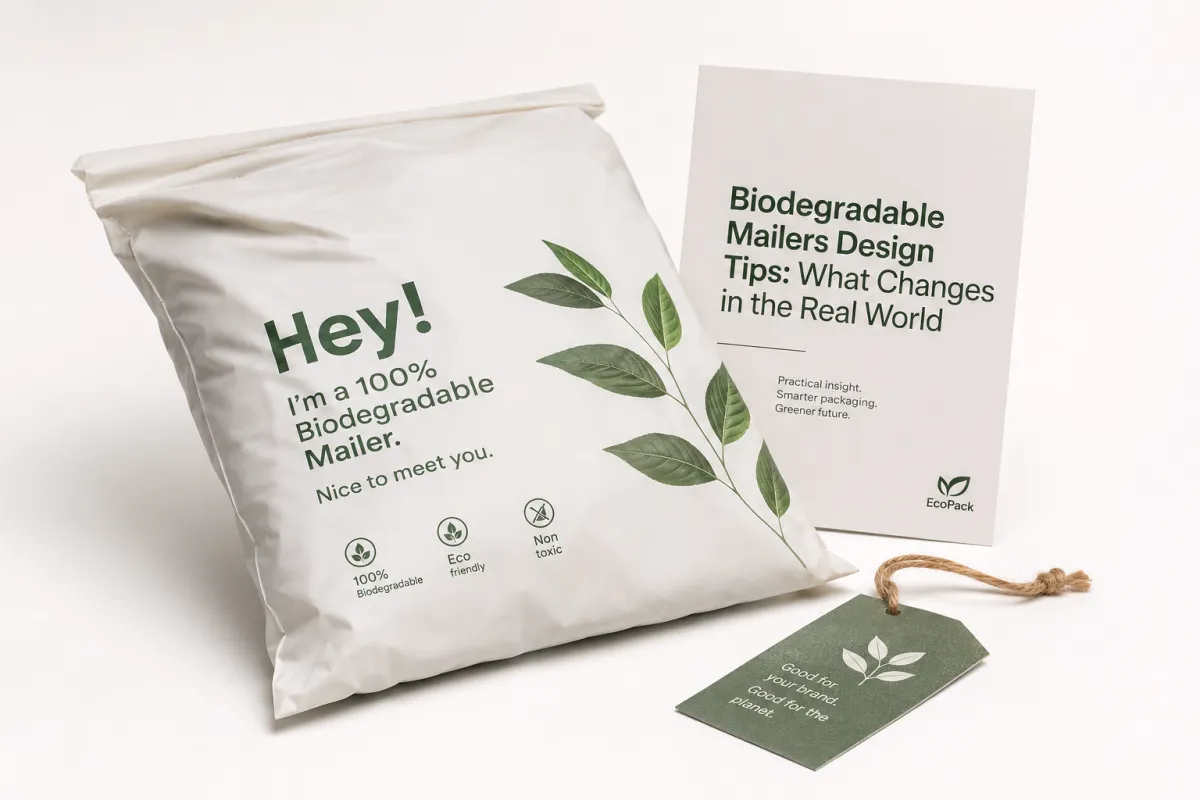
A biodegradable mailer can look polished in a render and still fail the second it hits a conveyor belt. Shipping systems are not sentimental. They crush, scrape, bend, stack, and occasionally seem to enjoy being difficult. So the first rule of biodegradable Mailers Design Tips is simple: design for abuse before you design for applause. If the seal is weak or the fit is sloppy, the package gets punished fast. Decoration comes after survival.
People toss around biodegradable, compostable, recyclable, and recycled-content like they are interchangeable. They are not. Biodegradable packaging is intended to break down under specific conditions. Compostable packaging usually has stricter standards and a narrower end-of-life path. Recyclable means the material can enter a recovery stream if that stream exists and accepts it. Recycled-content means the package includes recovered material, which is a completely different claim. Clear language makes biodegradable mailers design tips useful, and it keeps the compliance side from getting twitchy.
Design is not just about the print file. The way a mailer is built affects shelf life, seal integrity, puncture resistance, handling, and the customer’s first impression. A sharp-looking bag with a split seam is still a broken bag. I have seen teams spend hours arguing about artwork while ignoring the seal zone, and then act surprised when the mailers fail in packing. That never gets old. Good biodegradable mailers design tips treat the mailer like shipping gear first and a branding surface second.
"A mailer does not get credit for looking pretty in the mockup. It has to survive folding, sealing, sorting, and the kind of porch weather that ruins everyone’s day."
That practical view is the difference between packaging that flatters a presentation deck and packaging that survives the route. The best biodegradable mailers design tips keep material behavior, print quality, and shipping stress in the same conversation. Start with the abuse the parcel will take. The rest follows.
How Biodegradable Mailers Work Inside the Supply Chain
Good biodegradable mailers design tips make more sense once you look at the layers doing the work. In a typical custom run, one layer provides structure, another creates the seal, and the print surface has to accept ink without cracking every time the mailer flexes. If those layers do not play nicely together, the package starts failing in small, annoying ways. A film that seals beautifully but scratches easily still creates a bad customer experience. A film that prints well but tears near the fold is not much of a win either.
The supply chain changes how the material behaves long before the customer sees it. A mailer meant to biodegrade under controlled conditions can still spend weeks in a warehouse, then travel through loading docks, trailers, and final-mile handling before anyone opens it. That means biodegradable mailers design tips need to respect storage reality, not just the end-of-life story. Biodegradation depends on moisture, heat, oxygen, and microbial activity. It does not happen because the carton sat near a sunny window and someone got creative with a pallet jack.
Moisture and sunlight deserve more attention than most teams give them. High humidity can affect print adhesion. Heat can soften certain seal layers or make stacked mailers cling together. UV exposure can dull ink and age the surface before the shipment even moves. If you are turning biodegradable mailers design tips into a spec sheet, add storage guidance too: keep cartons dry, keep them out of direct sun, and keep them away from hot zones near heaters or dock doors. Small habits prevent ugly surprises.
Transit testing is where a lot of projects get lazy. Brands do not need a giant lab for every order, but they do need a basic routine that reflects how parcels actually move. Organizations such as ISTA publish shipment simulation methods, and the idea is straightforward: if the package survives drop, vibration, compression, and abrasion in a test setting, it has a better shot in the real network. That is why strong biodegradable mailers design tips include testing, not just style direction. For broader waste and material guidance, the EPA’s recycling and composting resources help teams separate marketing language from disposal reality.
In practice, the best supply-chain decisions cut down on surprises. The material should survive fulfillment, parcel handling, and customer receipt first. A mailer that starts falling apart before delivery just creates returns and more waste. Good biodegradable mailers design tips make sure the package reaches the customer in one piece before anyone starts talking about its afterlife.
Key Factors That Shape Biodegradable Mailers Design
Thickness, seal strength, and puncture resistance sit at the center of most biodegradable mailers design tips. A light apparel shipment might do fine in a 30-40 micron structure. A heavier accessory with corners may need a 45-60 micron build and a more careful seal layout. The point is not to bulk up the mailer for show. The point is to choose enough structure that the parcel survives the route without wasting material or making freight costs ridiculous. Nobody wants a fancy green bag that tears because somebody packed a boxy candle insert into a film meant for socks.
Sizing matters just as much. An oversized mailer lets the product shift around, which can scuff print, stress seams, and make the package look careless. An undersized mailer loads stress onto the closure or side seams and can make automated packing awkward. The best biodegradable mailers design tips usually begin with product dimensions plus a realistic allowance for folding, insert cards, or tissue. Flat apparel can tolerate a little extra room. Dense items with sharper edges usually need a tighter fit and a stronger seal.
Print coverage and ink compatibility shape the design too. Heavy flood coats, very dark solids, and aggressive graphics can make a thin film feel stiffer or show scuffing sooner in handling. Good biodegradable mailers design tips leave safe margins around folds, seal zones, and tear strips because artwork placed too close to a weld line often distorts after converting. A practical rule: leave 3-5 mm of breathing room near folds and keep critical text farther away from edges that see repeated abrasion.
Closure style and tear features deserve attention. A standard peel-and-seal strip is common, but a second adhesive strip for returns can save time if the brand expects exchanges. Tear notches or easy-open lines help the customer open the mailer cleanly, which improves perceived quality without adding much cost. That is the part people forget. Biodegradable mailers design tips should cover the whole user journey, from packing table to first opening. If the mailer makes the customer fight it, the packaging already lost some of its value.
Claim language is another design element, even if it is not visual in the usual sense. If you use the words biodegradable, compostable, or recycled-content, the wording needs to match the material and any certification documents. Vague green claims create confusion quickly. Strong biodegradable mailers design tips keep the copy accurate, specific, and defensible if a retailer, distributor, or compliance team asks for proof. If you are building a wider packaging system, it helps to align those rules across your Custom Packaging Products so the language stays consistent everywhere.
- Structure: Match film thickness to product weight, edge profile, and roughness of transit.
- Seal: Test closure strength and weld consistency before approving the run.
- Artwork: Keep critical copy away from folds, seams, and tear areas.
- Claims: Use exact disposal language and certification references only when they apply.
- Fit: Size the mailer for the packed product, not for the empty dieline alone.
Those points sound basic because they are. They are also the difference between Packaging That Feels considered and packaging that creates cleanup work for everybody else. Strong biodegradable mailers design tips keep structure, print, and claims pointed in the same direction.
Biodegradable Mailers Design Tips for Cost and Pricing
Price is shaped by more than the visible artwork, and that is where a lot of biodegradable mailers design tips turn into useful buying advice. The main cost drivers are material formulation, thickness, print complexity, order quantity, and whether the project needs a custom size. Add special finishes, double-sided printing, or certification-heavy claim language, and the price moves fast. For a 10 x 13 inch custom mailer at 5,000 pieces, a realistic working range might land somewhere around $0.18-$0.35 per unit depending on resin blend, print coverage, and converting setup. Not a fixed quote. Just a sane range so nobody compares two totally different products and pretends it is a fair fight.
Minimum order quantity changes the math too. Setup costs for plates, film runs, and press adjustment get spread across the order, so a 1,000-piece run usually carries a higher unit price than a 10,000-piece run. The same pattern shows up with color count. One or two carefully chosen colors keep costs controlled. Full-bleed graphics, multiple spot colors, or repeated proof revisions push the project up. Good biodegradable mailers design tips always ask whether the visual payoff is worth the extra setup spend. Pretty is nice. Budget discipline is nicer.
There is hidden economics here that buyers miss all the time. A stronger mailer with a better fit can reduce damage claims, returns, and replacement shipments. That does not show up on the packaging invoice, but it absolutely changes the real cost of the program. If a slightly higher unit price prevents one damaged order out of a few hundred, the design often pays for itself. That is one of the least flashy but most honest biodegradable mailers design tips: judge the package by the cost of failure, not only by the cost of purchase.
Comparing biodegradable film to conventional poly also needs a full-package view. A standard poly mailer may come in cheaper on the front end, but the right biodegradable material can support a stronger sustainability story and a better brand presentation if the fit and print quality are handled well. If you need a baseline for strength and artwork placement, Custom Poly Mailers can be a useful reference point before you shift to a biodegradable structure. The point is not to declare one material universally better. The point is to match the material to the item, the route, and the budget.
| Option | Typical Structure | Indicative Unit Cost at 5,000 pcs | Best Use |
|---|---|---|---|
| Lightweight biodegradable film | 30-40 micron blend, 1-color print | $0.18-$0.26 | Flat apparel, accessories, low-abrasion routes |
| Reinforced biodegradable mailer | 45-60 micron blend, stronger seal zone | $0.24-$0.38 | Denser soft goods, better puncture resistance |
| High-coverage custom run | 40-50 micron, full-bleed graphics, more setup | $0.30-$0.52 | Premium branding and more demanding presentation |
| Custom size with return strip | Tailored dimensions, dual adhesive strip | $0.28-$0.45 | E-commerce programs with frequent exchanges |
Those numbers are illustrative, but they show why biodegradable mailers design tips need to cover more than ink and color. A cleaner artwork layout, a simpler closure, and a right-sized format can all reduce cost without wrecking performance. Lead time matters too. Standard proof-to-production schedules often run 12-15 business days after artwork approval, while custom sizing, special claims, or revised tooling can push that to 18-25 business days. Freight adds its own timing, so early planning usually costs less than a rush order and a headache.
Step-by-Step Process for Designing Biodegradable Mailers
The cleanest way to apply biodegradable mailers design tips is to treat the project like a production sequence instead of a one-off creative sprint. Start with the product profile. Measure the item’s finished dimensions, weight, surface texture, and any corners or edges that could challenge the film. A soft folded tee behaves very differently from a boxy skincare bundle. If the product needs tissue, inserts, or a small air cushion inside the mailer, account for that before you lock the size.
Pick the structure next. Select the material family, thickness, closure method, and any return feature. This is where a simple spec sheet saves time later: resin type, micron count, seal style, print method, safe zones, and approved claim language. Good biodegradable mailers design tips keep that sheet simple enough to use and detailed enough to kill guesswork at reorder time. If a supplier can repeat the same look and feel on the next run, the spec is doing its job.
Artwork comes after the structure, not before it. Build the file around the dieline, confirm the fold lines, mark the seal zones, and keep critical copy away from high-stress areas. Use vector files when possible, keep raster art at 300 dpi at final size, and remember that biodegradable substrates can shift slightly from screen to press. Strong biodegradable mailers design tips also call for a real proof, not just a PDF on a monitor, because print density and scuff resistance often look different in the hand.
After proofing, sample the mailer with the actual product inside it. Run it through a short transit test, even if the order is not huge. Drop it, shake it, stack it, and check the closure after handling. If possible, mimic the rough spots that matter in your own shipping flow, whether that is a conveyor, tote bin, or parcel sort. That is one of the simplest biodegradable mailers design tips to follow, and one of the easiest to skip when the launch date is breathing down your neck. I have watched more than one team learn this the expensive way. No need to repeat that tradition.
- Measure the product: Capture length, width, thickness, and any packaging inserts before choosing the mailer size.
- Select the material: Decide on thickness, seal behavior, and whether the structure needs a return strip.
- Build the artwork: Place graphics with safe margins and use accurate claim language from the start.
- Request a proof: Confirm folds, seals, and panel placement on a physical sample or production-like mockup.
- Test the shipment: Check the filled mailer under handling, stacking, and short transit conditions.
- Approve the run: Lock the spec, timeline, and reorder details only after the sample performs as expected.
That sequence keeps the work organized and protects the launch schedule. If the team follows these biodegradable mailers design tips in order, there is far less chance of discovering a fit issue after production has already started.
Common Mistakes in Biodegradable Mailers Design
The first mistake is loose claim language. A package labeled vaguely as eco-friendly or biodegradable without the right support can confuse buyers and create compliance trouble. If the material is compostable only under industrial conditions, say that clearly. If the mailer is biodegradable but not certified for a specific standard, do not hint that it is. Strong biodegradable mailers design tips keep the claims honest because trust is part of the package. A pretty lie is still a lie.
The second mistake is underbuilding the structure. Too-thin film, weak side seams, or a closure that opens under pressure will do more damage to the brand than a slightly higher material cost ever would. This is one of the most common failures in custom shipping work: the render looks beautiful, but the package cannot stand up to abrasion or corner stress. The best biodegradable mailers design tips start with a durable seal and only then move to the graphics.
A third problem is heavy ink coverage or poor adhesive choice. Too much ink on a flexible film can stiffen the surface, and the wrong adhesive can reduce flexibility or lift during packing. Automated equipment makes those flaws louder because the mailer gets bent, compressed, and handled faster than a person would handle it by hand. That is why careful biodegradable mailers design tips include print area planning, not just artwork approval. If your design needs a giant black flood coat to feel premium, make sure the substrate can actually carry it without getting weird.
The fourth mistake is skipping real-world testing. A design that looks excellent on screen can still scuff, split, or misalign in production. A simple filled-sample test often catches the problem in time, and that is much cheaper than replacing a damaged shipment program later. For the same reason, it is smart to compare the printed mailer against other packaging options in your line, including your broader Custom Packaging Products, so the standards stay consistent across the whole brand.
The fifth mistake is assuming one mailer size can handle every order. It cannot. Product mix changes, returns happen, and SKUs tend to grow corners at the worst possible moment. A size that works for tees might be a disaster for a boxed accessory or a multi-item kit. Good biodegradable mailers design tips account for real catalog behavior, not just the hero product someone used for the mockup.
- Overstated eco claims: Match the wording to the actual material and certification.
- Weak seals: Check weld consistency and adhesion before approving the full run.
- Poor sizing: Prevent product movement and seam stress with the right fit.
- Too much ink: Keep flexibility and scuff resistance in mind during artwork layout.
- No testing: Validate the filled mailer under real handling conditions.
Those mistakes are easy to avoid once the team is focused. Good biodegradable mailers design tips are less about perfect theory and more about stopping the common failures before they hit the customer.
Biodegradable Mailers Design Tips: Final Checks and Next Steps
Before you release production, run a short but disciplined checklist. Confirm the finished dimensions, review the material spec, validate the seal area, and read every line of claim language again. Then approve the sample only after the filled mailer passes transit testing. Those final steps are the practical side of biodegradable mailers design tips, and they matter because they keep the launch from turning into a reprint.
It also helps to compare suppliers on more than price. Review substrate data, print quality, seal performance, lead time, and reorder consistency. Ask for a clear answer on minimum order quantity, sampling time, and whether the production line can repeat the same size and artwork on the next run. Strong biodegradable mailers design tips always look at repeatability, because a one-time prototype is not the same thing as a dependable supply program.
A simple spec sheet is worth its weight in avoided mistakes. Include the product dimensions, mailer size, resin or material description, thickness, print colors, artwork placement, closure type, and approved environmental claims. If a team can hand that sheet to a buyer six months later and get the same result, the program is working. That is the quiet payoff of good biodegradable mailers design tips: fewer surprises, better shipments, and a cleaner customer opening experience.
Most packaging problems show up when design, sourcing, and fulfillment live in separate silos. Pull those decisions together early, and the mailer becomes a dependable part of the shipping system instead of a last-minute accessory. If you keep biodegradable mailers design tips grounded in the product, the seal, and the shipment, you end up with packaging that looks credible, performs under pressure, and still supports the sustainability story you want to tell. The same approach also works for compostable packaging and other eco-friendly mailers, which is probably why the basics keep winning.
The takeaway is boring, but it works: choose the material for the route, size the mailer for the packed product, prove the claims with documentation, and test the filled sample before you order in volume. Do those four things well, and the rest of the design stops being guesswork.
What should I check before approving biodegradable mailers design?
Verify the finished size, seam area, and print placement so the design matches the actual filled product rather than a flat artwork template. Confirm the material spec, thickness, and closure method, because those details determine whether the mailer survives handling and shipment. Review the exact claim language and any certification references so the packaging stays accurate and consistent with the product documentation. If you want to keep the process organized, use the same review logic that guides your broader biodegradable mailers design tips checklist.
Are biodegradable mailers more expensive than regular poly mailers?
Usually yes, because the raw material, conversion process, and lower-volume sourcing often carry a premium over standard poly film. The price gap can shrink when you order larger quantities, simplify artwork, and avoid special finishes or multiple print passes. A stronger, better-sized mailer may reduce damage and replacement shipments, which can improve the overall package economics. That is one reason biodegradable mailers design tips should always include a total-cost view, not only a unit-price view.
Can I print full-color graphics on biodegradable mailers?
Yes, full-color printing is possible when the ink system is matched to the film and the press setup is tuned for adhesion and flexibility. Keep critical graphics away from fold lines, seals, and high-abrasion zones if the mailer design will be handled by automation or rough transit. Always request a physical proof or sample, since color density and scuff resistance can look different on the real substrate than on a screen. That is one of the most reliable biodegradable mailers design tips for branded e-commerce packaging.
How do I choose the right thickness for biodegradable mailers?
Start with the product weight, shape, and edge profile, since sharper or denser items usually need a more durable structure. Test for puncture resistance and seal performance, not just feel, because a mailer that seems sturdy can still fail at stress points. Use sample shipments to confirm the thickness protects the product without making the mailer unnecessarily bulky or expensive. The most useful biodegradable mailers design tips are the ones that tie thickness to real shipping conditions.
What timeline should I expect for biodegradable mailers production?
Allow time for artwork setup, proofing, and any needed revisions before production is released. Add sample testing and approval time if you want to verify seal strength, print quality, and package fit before the full run starts. Production and freight timing will depend on order quantity, print complexity, and whether the supplier needs custom materials or sizing. Solid biodegradable mailers design tips include timeline planning, because rushing the approval stage usually creates more cost than it saves.
Do biodegradable mailers break down in a warehouse?
Not under normal storage conditions. Biodegradation usually needs the right combination of moisture, heat, oxygen, and microbial activity, so a dry warehouse is not enough on its own. That is why storage guidance matters so much in biodegradable mailers design tips. Keep stock dry, shaded, and away from heat, and the material should remain stable through the normal supply chain window.
What proof should I ask for on environmental claims?
Ask for the specific standard, certification, or test method tied to the claim, along with the exact material composition if needed. If a supplier says a mailer is compostable or biodegradable, make sure they can show what condition, region, or standard the statement refers to. Vague marketing copy is not documentation. The most practical biodegradable mailers design tips always include a paper trail that can survive a compliance review.


