Buyer Fit Snapshot
| Best fit | Branded Corrugated Shipping Boxes Order projects where brand print, material claims, artwork control, MOQ, and repeat-order consistency need to be specified before quoting. |
|---|---|
| Quote inputs | Share finished size, material target, print colors, finish, packing count, annual reorder estimate, ship-to region, and any compliance wording. |
| Proofing check | Approve dieline scale, logo placement, barcode or warning zones, color tolerance, closure strength, and carton packing before bulk production. |
| Main risk | Vague material claims, crowded artwork, missing packing details, or unclear freight terms can make a low unit price expensive after revisions. |
Fast answer: Branded Corrugated Shipping Boxes Order: Pricing & Specs should be specified like a repeatable production item. The safest quote records material, print method, finish, artwork proof, packing count, and reorder notes in one written spec.
Production checks before approval
Compare the actual filled-product size with the drawing, then confirm tolerance on folds, seals, hang holes, label areas, and retail display edges. Reserve space for logos, QR codes, warning copy, and material claims before decorative graphics fill the panel.
Quote comparison points
Review material grade, print process, finish, sampling route, tooling charges, carton quantity, and freight assumptions side by side. A quote is only useful when the supplier can repeat the same color, closure quality, and packing count on the next order.
Branded Corrugated Shipping Boxes Order: Pricing & Specs
A branded Corrugated Shipping Boxes order can look simple on a spreadsheet, but once those cartons start moving through parcel hubs, warehouse conveyors, and delivery trucks, the real story shows up pretty fast. A box that saves a few cents upfront can end up costing more if the corners crush, the ink scuffs, or the product has to go back out a second time.
For order fulfillment, the carton has three jobs at once: it protects the product, carries the brand, and keeps freight costs from running away. If the spec is off, ecommerce shipping gets more expensive, package protection drops, and the customer’s first physical touchpoint with the brand feels a little off. That part matters more than people admit.
That is why a branded Corrugated Shipping Boxes order should be judged by total landed cost, not unit price alone. The cheapest quote is not always the best value once damage, void fill, labor, dimensional weight, and rework from a messy production run are all counted. I have seen small packaging decisions snowball into real money lost, and it is usually the boring stuff that does it.
Branded Corrugated Shipping Boxes Order: Why Damage Costs More Than Box Price
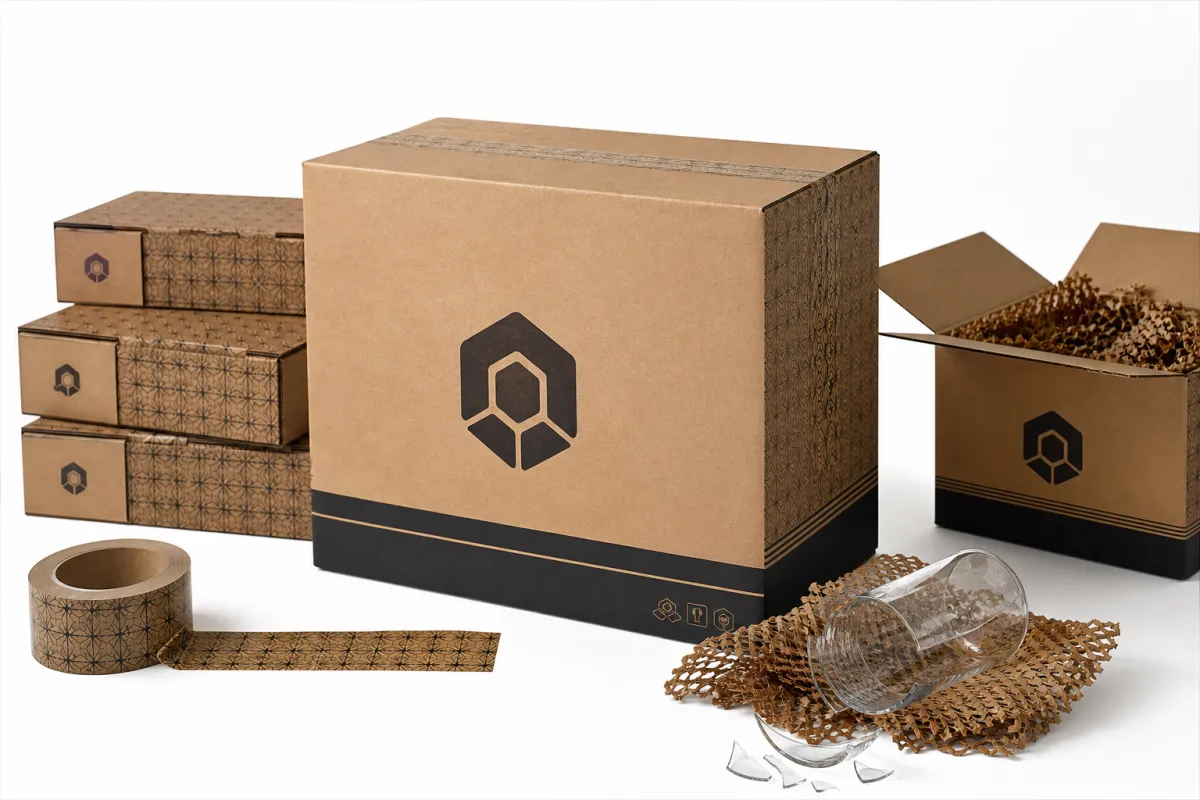
Most branded corrugated shipping boxes order conversations start with price, which is fair enough, but carton cost only tells part of the story. A box that is 8% cheaper can still create a much higher failure rate if the board is too light, the fit is sloppy, or the print surface does not hold up once the package starts getting tossed around.
Think through the full chain. A damaged carton can trigger a replacement shipment, a customer service message, a refund, and another unit pulled from inventory. Thin margins leave very little room for that kind of leak. One bad shipment can wipe out the profit from several clean ones, which is why transit packaging belongs in the same conversation as freight planning and warehouse labor.
Brand presentation matters just as much. The doorstep is a retail shelf for ecommerce shipping. A square, clean, well-printed carton signals care and consistency. A soft, crushed, over-taped box sends a different message. Buyers may not say it out loud, but they notice, and they remember.
A branded corrugated shipping boxes order is one of the least expensive places to buy trust. Corrugated board is still a relatively low-cost packaging material compared with the product value it protects, especially for apparel, supplements, electronics accessories, home goods, and subscription kits. With the right spec, the carton works as both a shield and a small billboard.
"The cheapest carton is not the lowest-cost carton if it arrives crushed, forces a reship, or makes the brand look careless."
Damage prevention is a financial decision, not a packaging preference. For many buyers, the real cost sits around the carton rather than inside it. Repacking, relabeling, customer support, and returns processing can add up faster than the difference between a light-duty box and a properly specified branded corrugated shipping boxes order.
Another comparison matters here. A product may ship fine in a plain brown carton, but that does not mean the same structure will perform once branding, print coverage, inserts, or a tighter product fit are introduced. Print changes the load on the board. Route type changes it too. Parcel networks, regional carriers, and palletized freight all stress a carton in different ways. The right branded corrugated shipping boxes order reflects the actual lane, not a hoped-for one.
For buyers comparing packaging formats before they commit, the broader selection at Custom Packaging Products and the box-specific options on Custom Shipping Boxes can narrow the field quickly. A look through Case Studies also helps show how different specs influence damage rates and presentation.
Dimensional weight can quietly reshape the budget. If the branded corrugated shipping boxes order adds even a small amount of outer size, freight math can shift. A box that is half an inch too tall or too wide can move a shipment into a higher billable tier. Carton dimensions are not a cosmetic choice; they are part of cost control.
Product Details: What Your Branded Corrugated Shipping Boxes Order Includes
A branded corrugated shipping boxes order can be produced in several structural formats, and the structure matters just as much as the logo. Common options include regular slotted cartons, mailer-style corrugated boxes, roll-end tuck top styles, and fully custom die-cut formats. Each one balances protection, presentation, and production cost in a different way.
Regular slotted cartons are the workhorse. They are efficient to produce, easy to stack, and often the most economical option for standard shipping. Mailer-style boxes deliver a stronger unboxing moment and a cleaner top closure, which is why they show up so often in ecommerce shipping and subscription packaging. Roll-end tuck tops sit in the middle, giving a sturdier shape and a more polished look than a plain RSC. Fully custom die-cut boxes are built around the product instead of forcing the product to adapt to the box.
Print choices inside a branded corrugated shipping boxes order matter just as much. A one-color flexographic print is usually the most cost-conscious way to add a logo, a web address, or a handling message. Two-color print broadens the visual language without turning the run into a headache. Interior print creates a moment at opening that can carry brand copy, instructions, or a thank-you note that strengthens the unboxing experience.
Some orders need more than ink. Fragile products, premium products, and bundled kits often need inserts, partitions, or custom-fit interiors to hold items in place during transit packaging. A single cavity for a bottle is not the same challenge as a multi-item electronics kit or a ceramic bundle. The carton has to control movement, not just look good in a rendering.
Sometimes the simplest choice is the right one. A branded corrugated shipping boxes order does not always call for a structural redesign. If the product is light, the shipping lane is short, and the current carton already fits well, print-only changes may be enough. If the current box is tall, floppy, or prone to crush, a score adjustment or reinforced panel can deliver more value than adding more ink. That can feel less exciting, but it is usually the smart move.
- Regular slotted cartons work well for standard parcel shipping and higher-volume replenishment.
- Mailer-style corrugated boxes support a cleaner opening experience and better presentation.
- Roll-end tuck tops give structure and a premium feel without jumping straight to a fully custom assembly.
- Custom die-cut formats are best when the product shape demands tighter control and stronger package protection.
If the brand is still deciding between cartons, mailers, and other formats, the difference between a branded corrugated shipping boxes order and other packaging styles may become clearer by comparing the lineup on Custom Shipping Boxes with lighter-weight alternatives such as Custom Poly Mailers. Not every item belongs in corrugated board, but every item does need a shipping method that matches its risk profile.
For teams focused on sustainability claims, sourced fiber deserves attention too. If recycled content, responsible forestry, or chain-of-custody proof is part of the spec, the FSC standard is worth reviewing before final approval. Claims should be specific and supportable, not fuzzy marketing copy.
A branded corrugated shipping boxes order also needs to be discussed with the final destination in mind. Retail replenishment, direct-to-consumer parcels, and wholesale shipments all treat a carton differently. A structure that feels oversized in one lane may be the right fit in another. That is why the product details section should include shipping method, product weight, and whether the carton will ride on a pallet, move through a parcel network, or do both.
Specifications for a Branded Corrugated Shipping Boxes Order
The fastest way to slow down a branded corrugated shipping boxes order is vague specifications. A box is not defined by logo alone. Buyers need inside dimensions, board grade, flute profile, print coverage, seam placement, finish, and the shipping environment the carton must survive. Leave out one of those pieces and the quote may look tidy while the production result turns messy.
Start with inside dimensions, not outside dimensions. Product fit drives the rest. A box that is too tight can crush the contents during packing, while a box that is too loose increases movement and wasteful void fill. From there, define the board grade. For light apparel or small accessories, a single-wall board around 32 ECT may be enough. Heavier SKUs or routes with more compression may call for 44 ECT or a stronger double-wall structure. The point is not to build the heaviest carton possible, only to match the load to the lane.
Flute profile matters more than many buyers expect. E flute gives a smoother print surface and a slimmer profile, while B and C flutes provide different strength and cushioning characteristics. If the carton needs a sharp logo and a compact footprint, E flute can be a strong fit. If the box needs more crush resistance, another flute combination may be better. That kind of decision can change both pricing and performance in a branded corrugated shipping boxes order.
Print quality depends on both artwork and substrate. A crisp logo can still look uneven if the board surface is rough or the print method is poorly matched to the carton. Flexographic print is usually practical for simple graphics and larger quantities, while more detailed work may require another approach. The logo, type size, and amount of ink coverage should be considered together rather than as separate choices. Heavy coverage can raise cost and sometimes complicate drying or rub resistance.
Independent standards help take guesswork out of testing. ISTA test methods are often used to simulate parcel handling, vibration, drop, and compression conditions. ASTM methods can also help evaluate compression and material performance. A branded corrugated shipping boxes order does not need to be over-tested for every product, but it should be tested enough to confirm the carton survives the real lane rather than only the mockup table.
One useful way to read the spec sheet is to treat each line as a risk control:
- Dimensions control fit, void fill, and dimensional weight.
- Board grade controls crush resistance and stacking strength.
- Flute profile affects print appearance, cushioning, and thickness.
- Print coverage affects brand impact, ink usage, and price.
- Finish and seam placement affect assembly speed and how the box rides through fulfillment.
In a branded corrugated shipping boxes order, seam placement is not a small note. If the seam lands where a label, tape strip, or graphic needs to sit, the result can create a visual or functional problem. Finish matters too. A plain kraft surface may fit some brands best, while a brighter white liner or coated surface can support more premium branding. The right answer depends on the product, the route, and the level of package protection required.
Compression and stackability deserve attention as well. If cartons will be stacked before shipping or palletized for order fulfillment, the structure has to hold shape under load. A box that survives a single drop can still fail in a warehouse stack. That is why even basic compression testing is worth discussing before production starts.
Good spec discipline saves time later. A branded corrugated shipping boxes order with clear dimensions, board grade, and artwork notes is easier to quote, faster to proof, and less likely to need expensive revisions after the die is cut. Buyers who want a stronger internal reference point can compare box styles, board types, and print options across Custom Packaging Products before the quote is finalized.
Branded Corrugated Shipping Boxes Order: Pricing, MOQ, and Cost Drivers
Pricing for a branded corrugated shipping boxes order comes down to five factors more than any others: quantity, board grade, print complexity, box style, and whether tooling or plates are required. That sounds basic, but buyers often compare quotes that are not truly comparable. One supplier may quote a simple carton with one-color print. Another may include stronger board, inside print, and a more refined closure style. Same general category, very different value.
As a working range, a simple printed regular slotted carton at higher volume might land around $0.35-$0.70 per unit, depending on size and print coverage. A mailer-style corrugated box with a more polished print often sits closer to $0.65-$1.25. Custom die-cut formats or cartons with inserts can move into the $1.25-$3.00 range, especially when the run is smaller or the design requires more setup. These are not hard rules, but they are practical enough for budgeting.
The MOQ question matters just as much. A lower MOQ can help a launch move quickly, yet it usually carries a higher unit cost. A larger run usually lowers the carton price, but it also adds storage demand and ties up cash in inventory. For a branded corrugated shipping boxes order, the best quantity is rarely the largest one. It is the quantity that fits sales velocity, warehouse space, and the product life cycle.
Ask directly about hidden costs. Plates, dies, sampling, freight, art corrections, and rush charges can all move the final total. Flexographic plates often add a setup fee per color. A custom die may add tooling cost if the format is unique. Some suppliers also charge for pre-production samples or for revisions after proof approval. None of those fees are unusual. The problem is surprise, not the fee itself.
The production economics are simple enough to state plainly: a branded corrugated shipping boxes order becomes cheaper per unit as volume rises, while total exposure rises too. That is why buyers should compare landed cost per shipped order, not only carton price on paper. If a box saves two cents but pushes the return rate higher, the math falls apart fast.
| Box Type | Best Use | Typical MOQ | Typical Unit Cost at 5,000 Units | Notes |
|---|---|---|---|---|
| Regular Slotted Carton | Standard ecommerce shipping and replenishment | 500-1,000 | $0.35-$0.70 | Efficient, stackable, and usually the most economical branded corrugated shipping boxes order option. |
| Mailer-Style Corrugated Box | Premium unboxing and subscription programs | 1,000-3,000 | $0.65-$1.25 | Stronger presentation, often better for brand-forward ecommerce shipping. |
| Roll-End Tuck Top | Sturdy retail-ready shipping with a cleaner closure | 1,000-2,500 | $0.90-$1.80 | Good blend of structure and appearance in a branded corrugated shipping boxes order. |
| Custom Die-Cut With Inserts | Fragile, premium, or multi-item kits | 2,500+ | $1.25-$3.00 | Higher setup cost, stronger product control, and better package protection for sensitive SKUs. |
Those numbers do not include every variable. Freight can swing widely based on weight and destination. Artwork fixes can add days. A tighter print spec can increase the plate count. Even so, the ranges offer a practical starting point for a branded corrugated shipping boxes order, especially when the decision has to be made before a launch or replenishment cycle.
One of the most common mistakes is over-specifying the board. Stronger is not always better. A heavier carton can raise material cost, increase freight cost, and add weight to the parcel without improving protection enough to justify the spend. The smarter question is whether the box is strong enough for the lane and the product, not whether it feels strongest on a sample table. That can be a hard lesson, but it saves money later.
A branded corrugated shipping boxes order should also be compared with the cost of secondary materials. If tighter dimensions reduce the need for void fill, bubble wrap, or corner protection, the carton may save money even if the unit price is a little higher. That trade-off is easy to miss on a quote sheet, but it shows up immediately in fulfillment labor and packing materials usage.
Process & Timeline: From Proof to Delivery
A branded corrugated shipping boxes order follows a predictable path, and the fastest projects are usually the ones where the buyer answers questions early. The process starts with a quote request, then moves to spec confirmation, artwork submission, digital proofing, sample approval if needed, production, and freight booking. Each step is simple on its own. Delays usually appear when one of them is incomplete.
For a standard order, quote review and spec confirmation often take 1-2 business days if the information is complete. Digital proofs can follow quickly, sometimes within another 1-3 business days. If a physical sample or pre-production sample is required, more time has to be built in. Manufacturing commonly takes around 10-15 business days after approval, though larger or more complex runs can take longer. Transit time depends on distance and carrier choice.
Clarity is the biggest timeline accelerator. When the buyer submits inside dimensions, product weight, target quantity, print colors, and artwork in clean vector format, fewer questions come back from prepress. A single decision-maker on the buyer side also helps. A branded corrugated shipping boxes order can stall when marketing, operations, and procurement all need to sign off separately. That is normal, but it should be planned for.
A few delay points show up again and again. Missing dieline details can hold up proofs. Late art approval can push the job into the next production window. Dimension changes after proof approval may require a revised plate or even a new structure. Freight booking can also become the bottleneck if the shipping window is tight and the warehouse is already full.
From an order fulfillment view, the packaging schedule should be tied to the inventory schedule. If a product launch has a fixed date, the packaging needs a cushion. A branded corrugated shipping boxes order should reach the warehouse early enough for inspection, receiving, and any pack-line tests. Waiting until the final week is a common reason a solid carton spec still fails operationally.
It helps to think in phases:
- Briefing - confirm dimensions, product weight, destination, and print requirements.
- Proofing - review artwork placement, structure, and any copy on the carton.
- Approval - lock the spec so production does not drift.
- Production - manufacture the branded corrugated shipping boxes order.
- Delivery - receive, inspect, and slot into fulfillment.
If the project needs speed, keep the file set clean. Vector logos, Pantone or CMYK references, and a simple note on logo placement can trim days from the front end. That matters for branded corrugated shipping boxes order requests tied to seasonal launches, subscription renewals, or promotional ecommerce shipping campaigns.
A practical rule holds up here: the more custom the structure, the more carefully the timeline needs to be managed. Simple print-only boxes can move relatively fast. A custom die-cut with inserts and a premium finish needs more coordination. That is manageable when the buyer knows it upfront. It becomes a problem only when packaging is treated like an afterthought.
Why Choose Us for a Branded Corrugated Shipping Boxes Order
At Custom Logo Things, the aim is simple: make the branded corrugated shipping boxes order clear, repeatable, and matched to the actual job. That means honest pricing ranges, practical MOQ guidance, and proof support that helps buyers move quickly without guessing at specs. For procurement teams, that kind of clarity is more useful than a long list of vague promises.
Consistency matters. A branded corrugated shipping boxes order should not look right on the first pallet and then drift on the second. Buyers need repeatable board quality, stable print results, and structural control that holds from run to run. If the artwork is approved and the spec is locked, the next order should match the first one closely. That sounds basic, yet not every supplier treats it that way.
Quote clarity matters too. A strong supplier should be able to explain whether a lower quote reflects a smaller run, a lighter board, less print coverage, or a simpler structure. That makes comparison easier and keeps the buyer from overbuilding the carton. Packaging spend rises quickly when the spec drifts beyond what the product actually needs.
Responsive prepress support adds value in practical ways. A minor spacing issue on a proof can be fixed fast enough to save a day or more. When carton dimensions need to shift, a good partner should flag the impact on the die line, print area, and freight footprint before production starts. In a branded corrugated shipping boxes order, that kind of input shortens approval cycles and cuts down avoidable waste.
If sustainability documentation is part of the buying decision, it should be handled carefully. Claims around recycled content, chain-of-custody, or certified fiber need to be specific and supportable. That is one reason buyers often reference standards such as FSC rather than relying on vague eco language. The more precise the claim, the easier it is to defend internally and externally.
For packaging teams comparing formats, it can help to review the broader portfolio alongside the box order. The range of Custom Packaging Products shows where a carton fits among other shipping materials, while Custom Shipping Boxes keeps the focus on carton structures built for transit packaging and package protection. If the business wants a quick refresher on common production questions, the FAQ page is also useful.
Most buyers are not looking for a prettier brochure. They need a supplier who can explain the trade-off between unit price, protection, and speed. That matters whether the job is a low-cost branded corrugated shipping boxes order for replenishment or a more premium box for a launch. Good packaging is not only about appearance. It is about making the economics work after the cartons leave the dock.
From the buyer's side, that is where the value shows up: fewer surprises, fewer revisions, and fewer compromises between brand and performance. A branded corrugated shipping boxes order should support ecommerce shipping, protect the product, and keep the brand intact when the parcel reaches the customer.
Next Steps to Place Your Branded Corrugated Shipping Boxes Order
If you are ready to request a branded corrugated shipping boxes order, gather the core details first. The quote is only as accurate as the information you send. That means inside dimensions, product weight, shipping method, print colors, quantity, and the delivery window. Leave out those six items and the estimate becomes a placeholder instead of a decision tool.
Send artwork files in vector format if possible. Include logo guidelines, Pantone references if available, and any notes about safe zones or preferred logo placement. If the brand has a package photo or a sample of the current box, include that too. A photo helps the estimator understand how the product sits inside the carton and how much room the branded corrugated shipping boxes order needs for inserts or void fill.
It also helps to decide the priority before the quote arrives. Is the goal lower unit cost, stronger protection, or faster turnaround? You can only get all three when the project is simple enough. More often, one priority has to lead. If the product is fragile, protection should win. If the launch date is tight, lead time may matter more. If the volume is large and stable, unit cost may carry the most weight. Clear priorities make the branded corrugated shipping boxes order easier to spec.
A good action list looks like this:
- Measure the product and confirm inside dimensions.
- Weigh the packed item and note the shipping lane.
- Choose the print style and color count.
- Set the initial quantity and acceptable MOQ range.
- Attach artwork, photos, and any reference packaging.
- Confirm whether inserts, partitions, or special finishes are needed.
If the team is comparing carton styles, do that before final approval rather than after. The cost difference between a basic box and a more premium structure can be modest or significant depending on the spec, but the operational impact can be large. A small change in box type can alter pack speed, pallet density, and dimensional weight. That is why it pays to think through the whole branded corrugated shipping boxes order before the proof is signed off.
Once the quote comes in, review three numbers side by side: unit cost, setup cost, and freight. Then ask what is included. Does the price cover plates or tooling? Are proof revisions included? Is there a charge for samples? Are there packaging or palletization assumptions hidden in the freight estimate? The branded corrugated shipping boxes order becomes much easier to approve once those items are visible.
For a cleaner buying cycle, keep the objective simple: approve the right spec, not the cheapest line item. A well-planned branded corrugated shipping boxes order can reduce damage, support the brand, and protect margin in the same move. That is the standard worth aiming for, and it is usually more achievable than buyers think.
How do I start a branded corrugated shipping boxes order if I only have my logo and rough dimensions?
Share the rough dimensions, the product weight, and a photo or sample of the item so the box can be sized correctly. Send the logo in vector format if possible, plus any color references or print placement notes. A quote can be started from assumptions, then refined after proof review if the branded corrugated shipping boxes order needs adjustment.
What MOQ should I expect for a branded corrugated shipping boxes order?
MOQ depends on box size, print complexity, and whether custom tooling or plates are required. Simple printed cartons often support lower minimums than highly customized die-cut formats or multi-color runs. If volume is limited, ask about phased ordering or a standard-size structure with custom branding for the branded corrugated shipping boxes order.
How long does a branded corrugated shipping boxes order usually take?
Timeline depends on artwork readiness, proof approval speed, manufacturing queue, and freight distance. Clean files and fast approvals can remove several days from the front end of the process. Rush requests may be possible in some cases, but they usually increase cost and narrow material options for the branded corrugated shipping boxes order.
Which print method is best for a branded corrugated shipping boxes order?
Flexographic print is often cost-effective for simple logos and higher-volume runs. More detailed graphics may require a different production method depending on color count and finish goals. The best choice balances visual impact, run length, and the board surface you are printing on, so the branded corrugated shipping boxes order performs well as shipping materials.
Can a branded corrugated shipping boxes order reduce shipping damage and freight cost?
Yes, if the structure is sized correctly and matched to the product weight and shipping lane. A better fit can reduce void fill, lower dimensional waste, and improve pallet stability. The goal is a box that protects the product without adding unnecessary board weight or bulk, which is why a thoughtful branded corrugated shipping boxes order can improve both package protection and freight efficiency.

